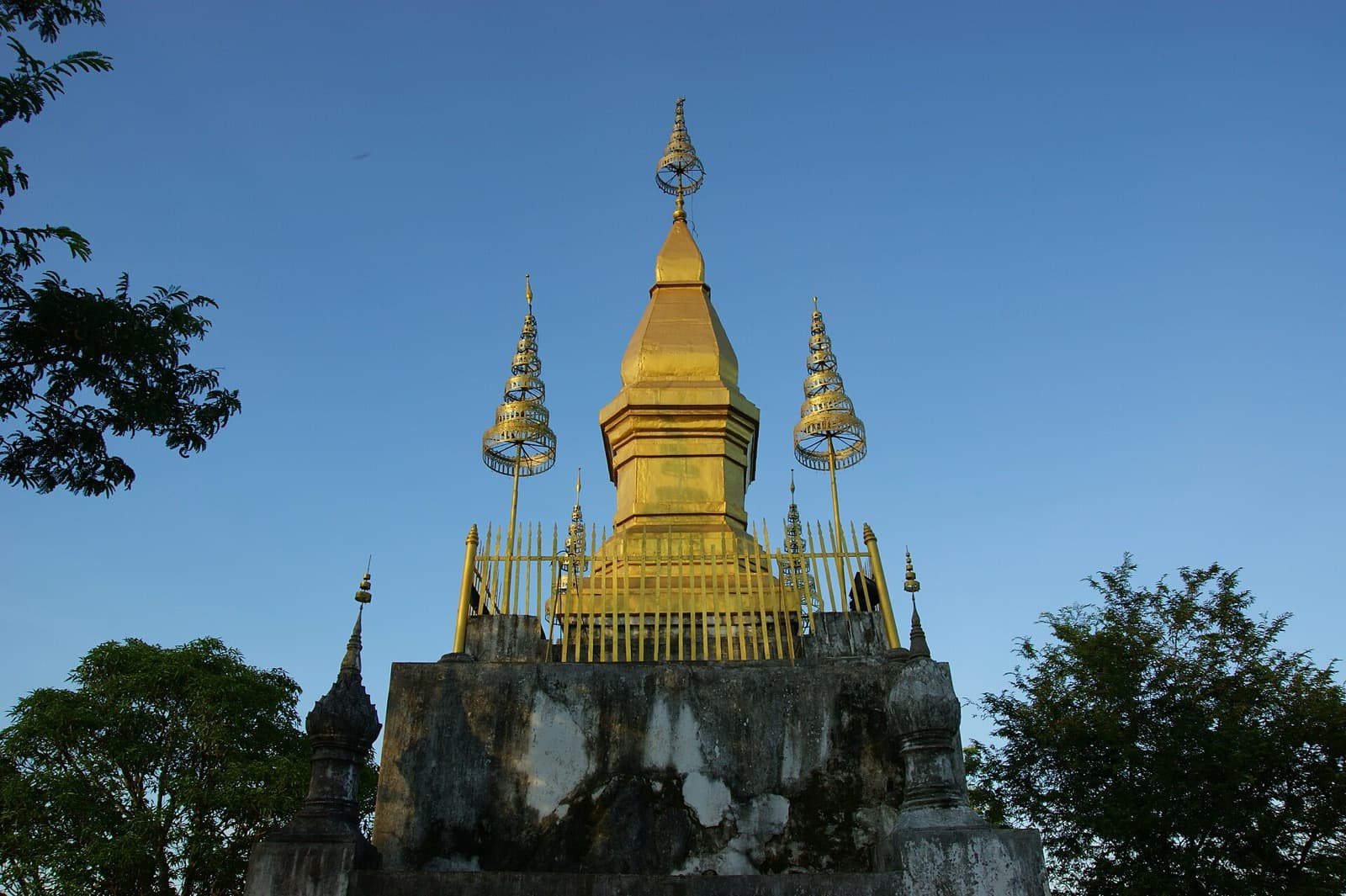
Climb the sacred hill at the heart of Luang Prabang, from a painted temple at its foot to the golden summit stupa, and read the whole royal town off the rock as it opens between the Mekong and the Nam Khan.
Start · Wat Pa Huak: The Painted Temple at the Foot of the Hill
DirectionsStops
- 1
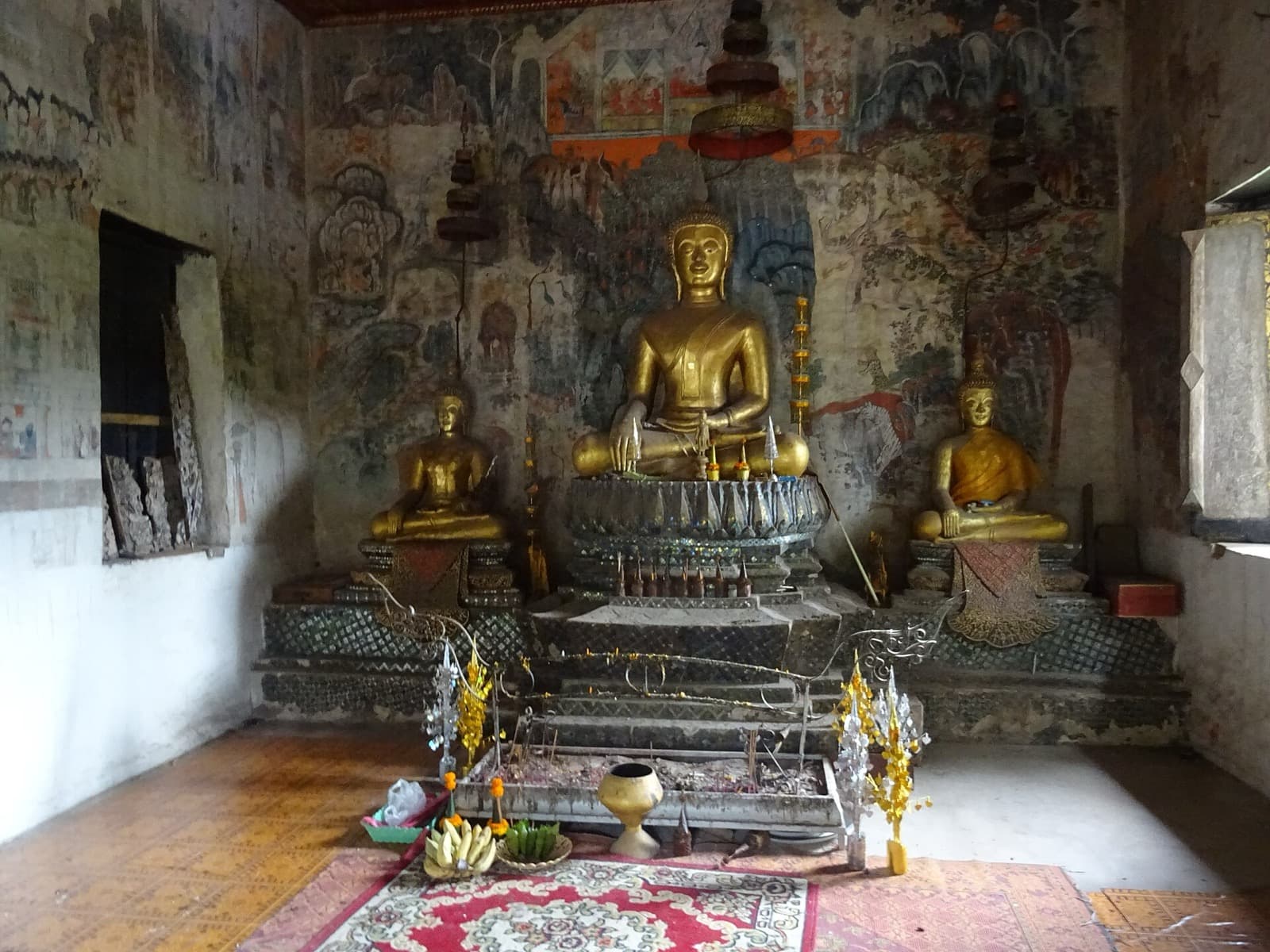
Wat Pa Huak: The Painted Temple at the Foot of the Hill
A small mid-nineteenth-century temple at the base of Mount Phousi, keeping rare unrestored murals that record caravans, river craft and foreign envoys.
- 2
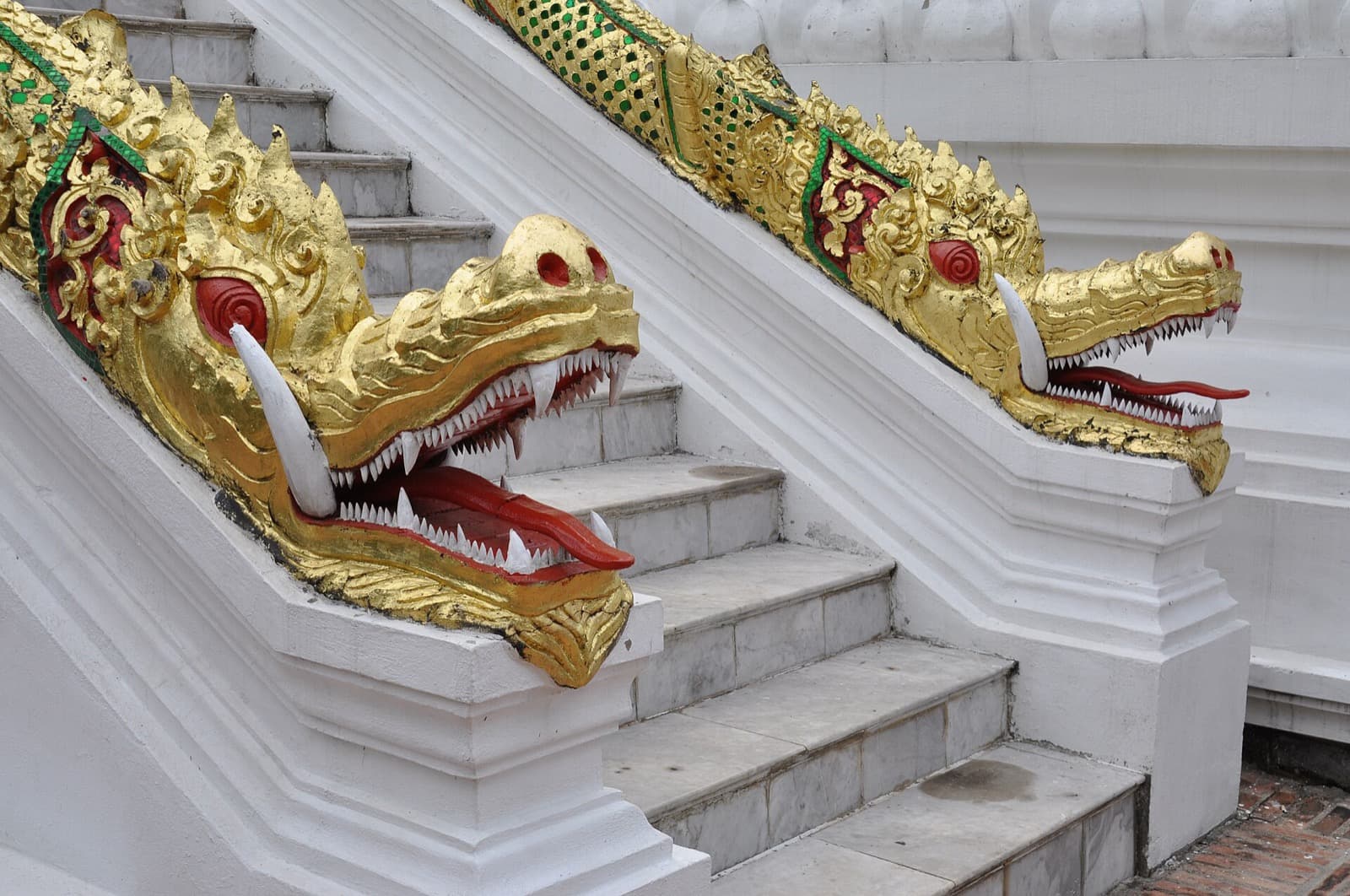
The Stairway: A Few Hundred Steps to the Sky
The front stairway of about three hundred and twenty-eight steps rising from Sisavangvong Road under frangipani trees past small shrines toward the summit.
- 3
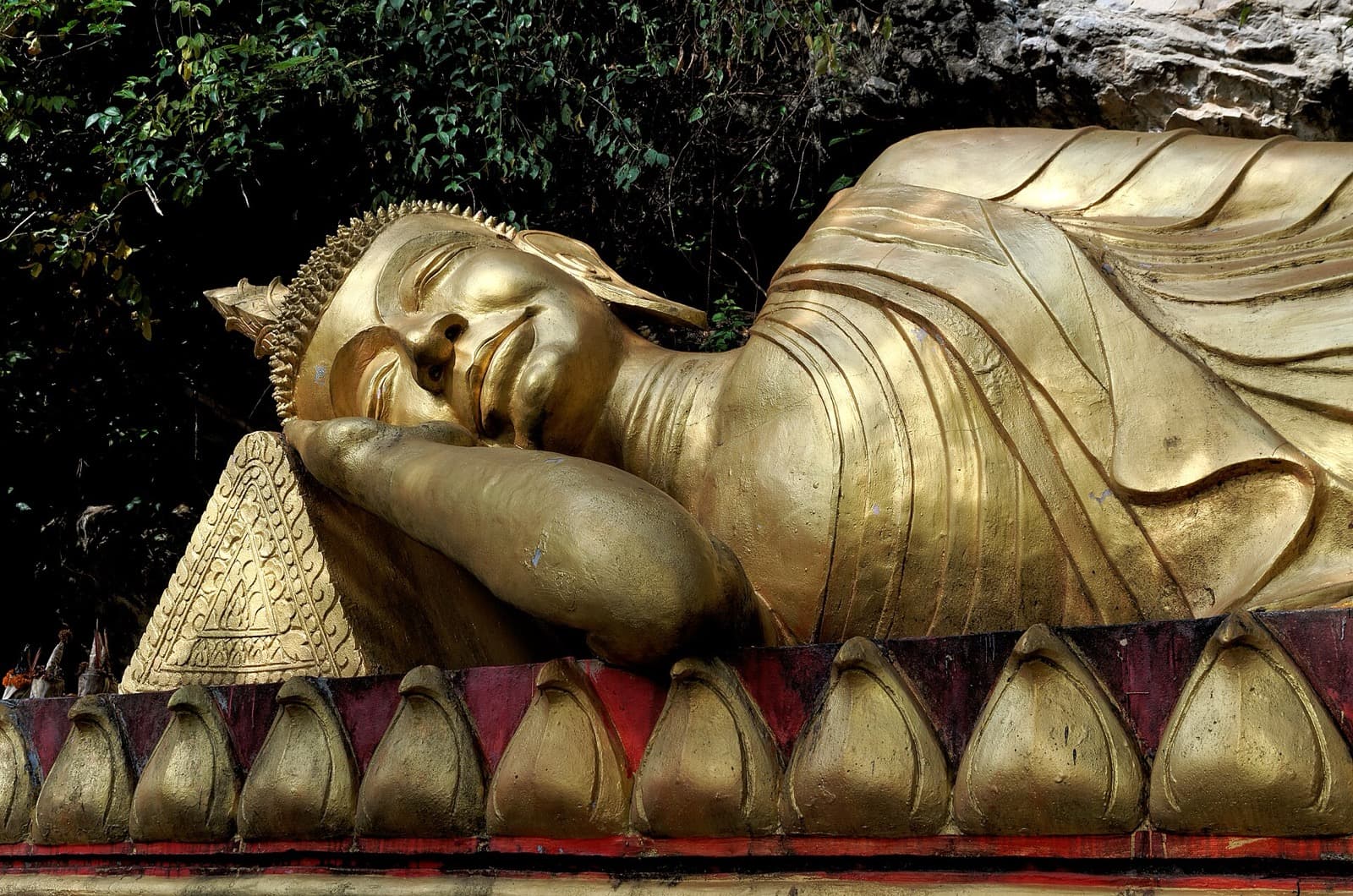
Wat Tham Phousi: Built Against the Living Rock
A small cave temple about halfway up the hill, set against the rock and overlooking the Nam Khan, housing several Buddha images including a large-bellied seated figure.
- 4
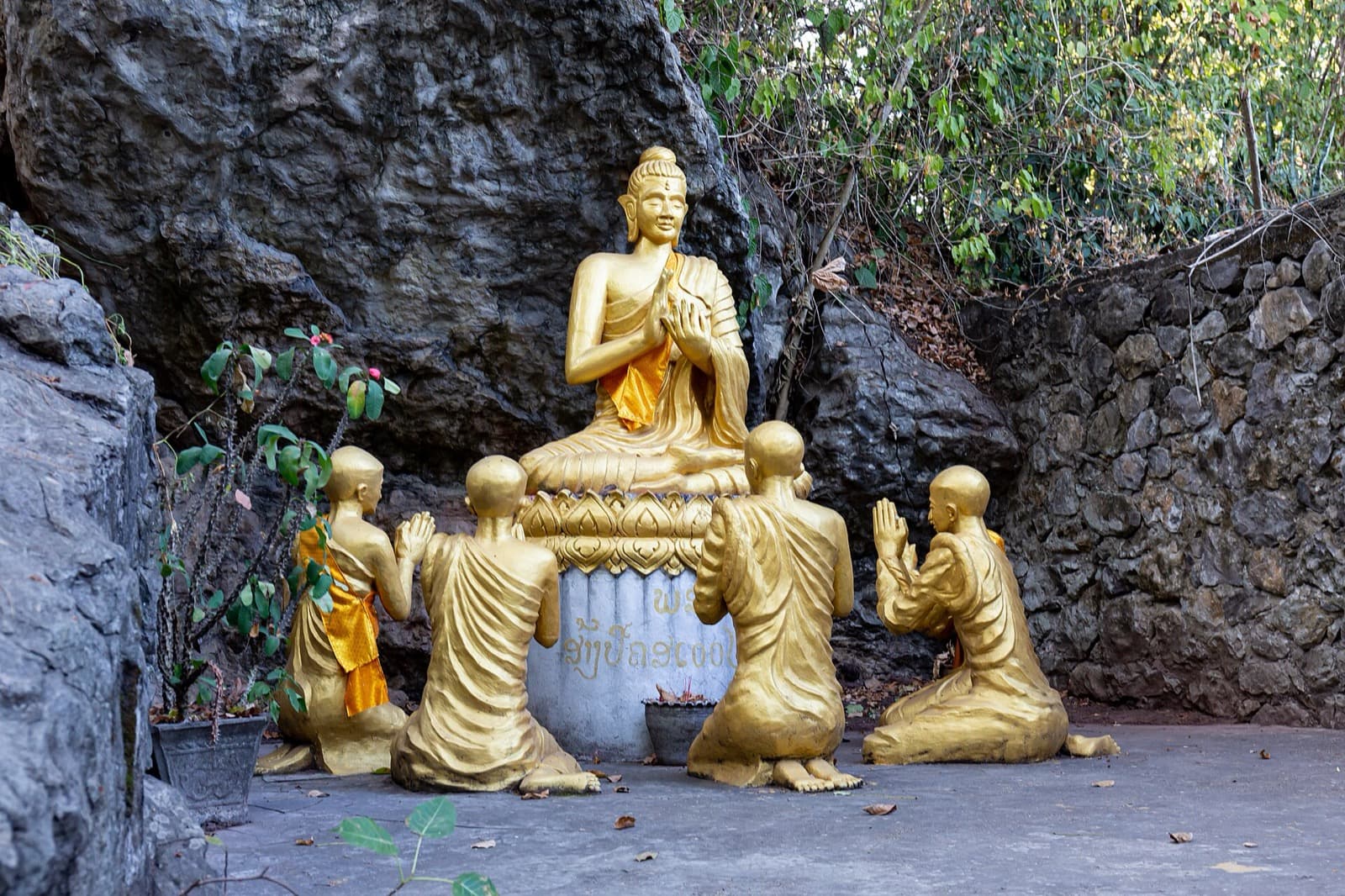
The Buddha Footprint: An Object of Pilgrimage on the Hill
A revered Buddha footprint enshrined in the rock high on the eastern flank of the hill, an object of veneration and the namesake of a temple below.
- 5
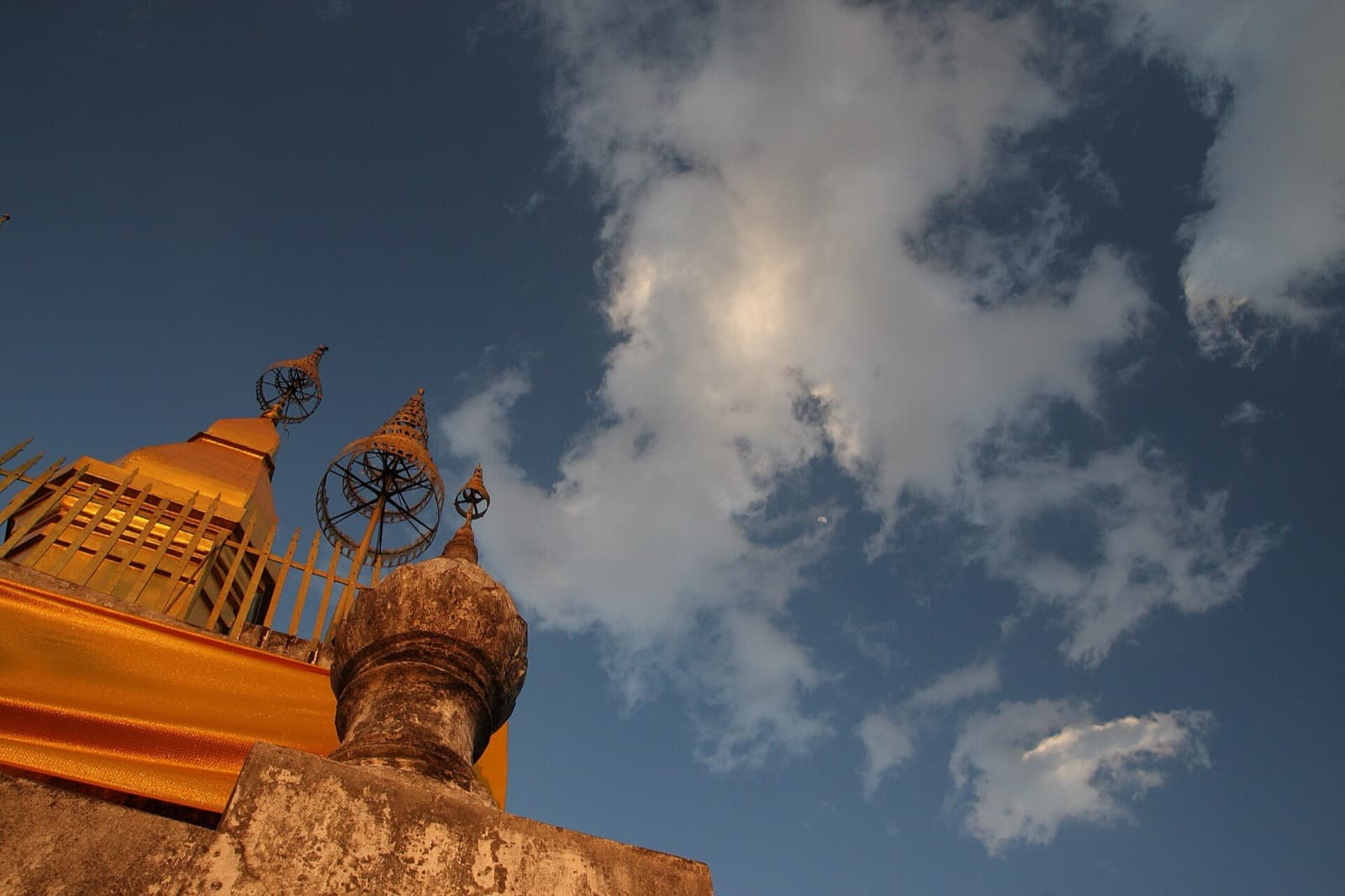
That Chomsi: The Golden Stupa of Eighteen Oh Four
The gilded summit stupa built in eighteen oh four under King Anourout, about twenty metres high, the landmark of Luang Prabang and the goal of the climb.
- 6
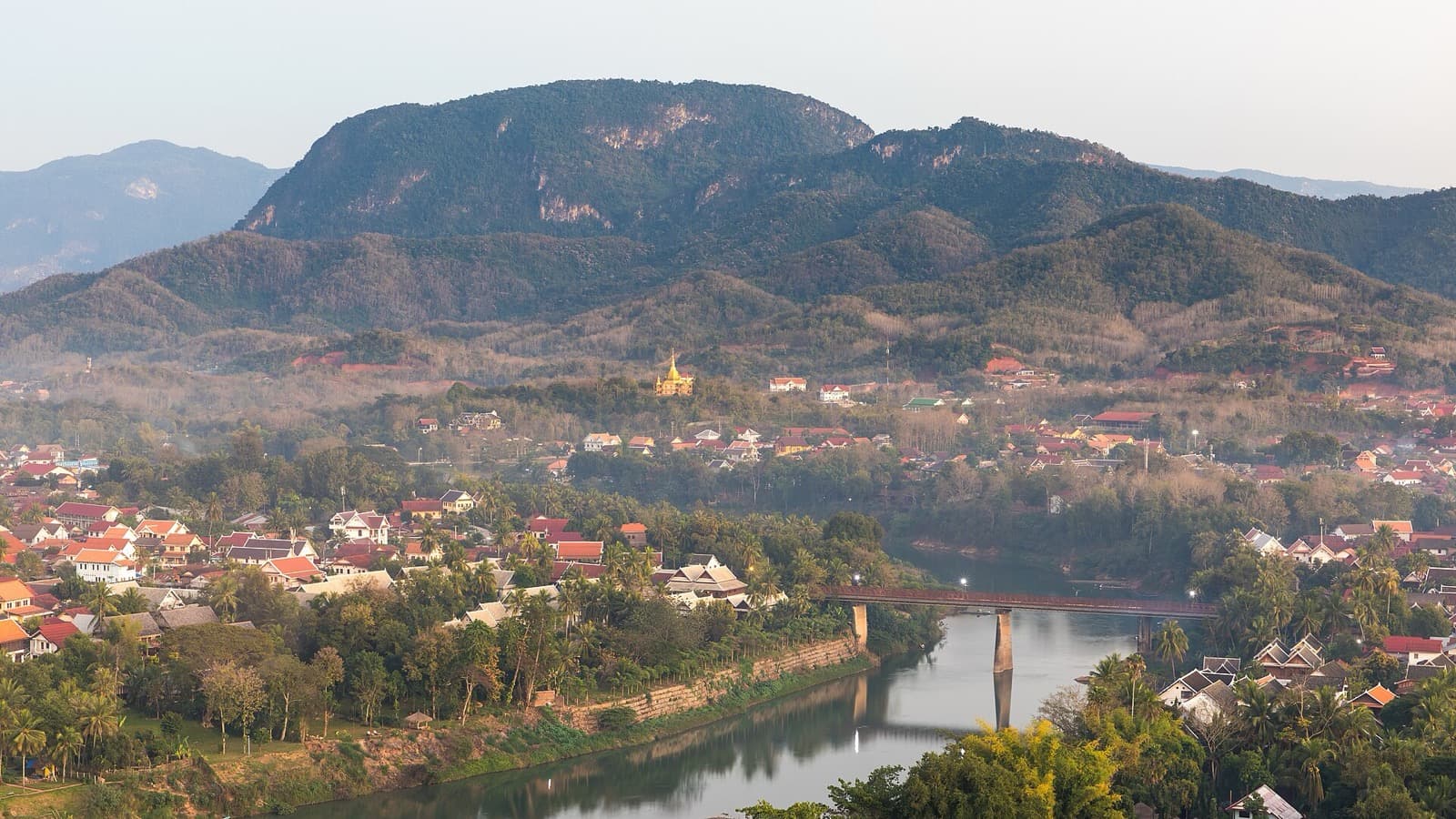
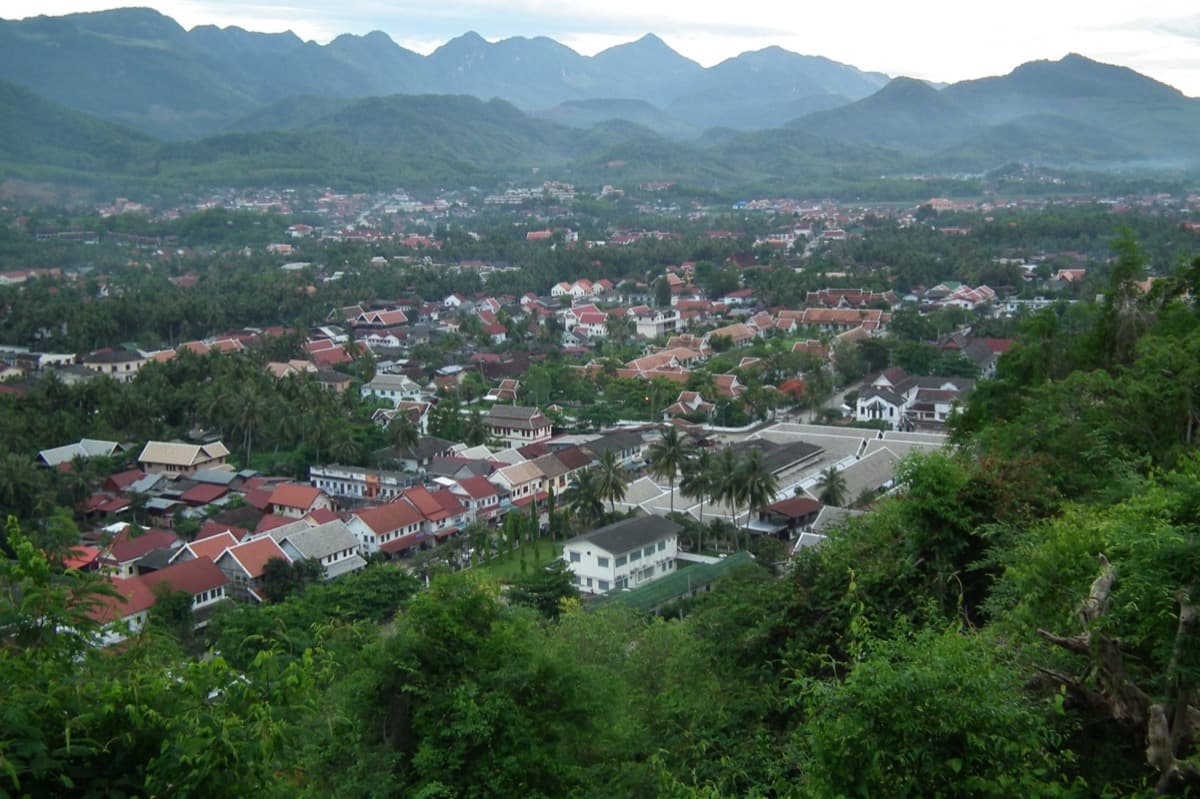
The Summit View: The Royal Town Between Two Rivers
The panoramic summit platform beside the stupa, where the whole peninsula between the Mekong and the Nam Khan lies legible at once.
- 7
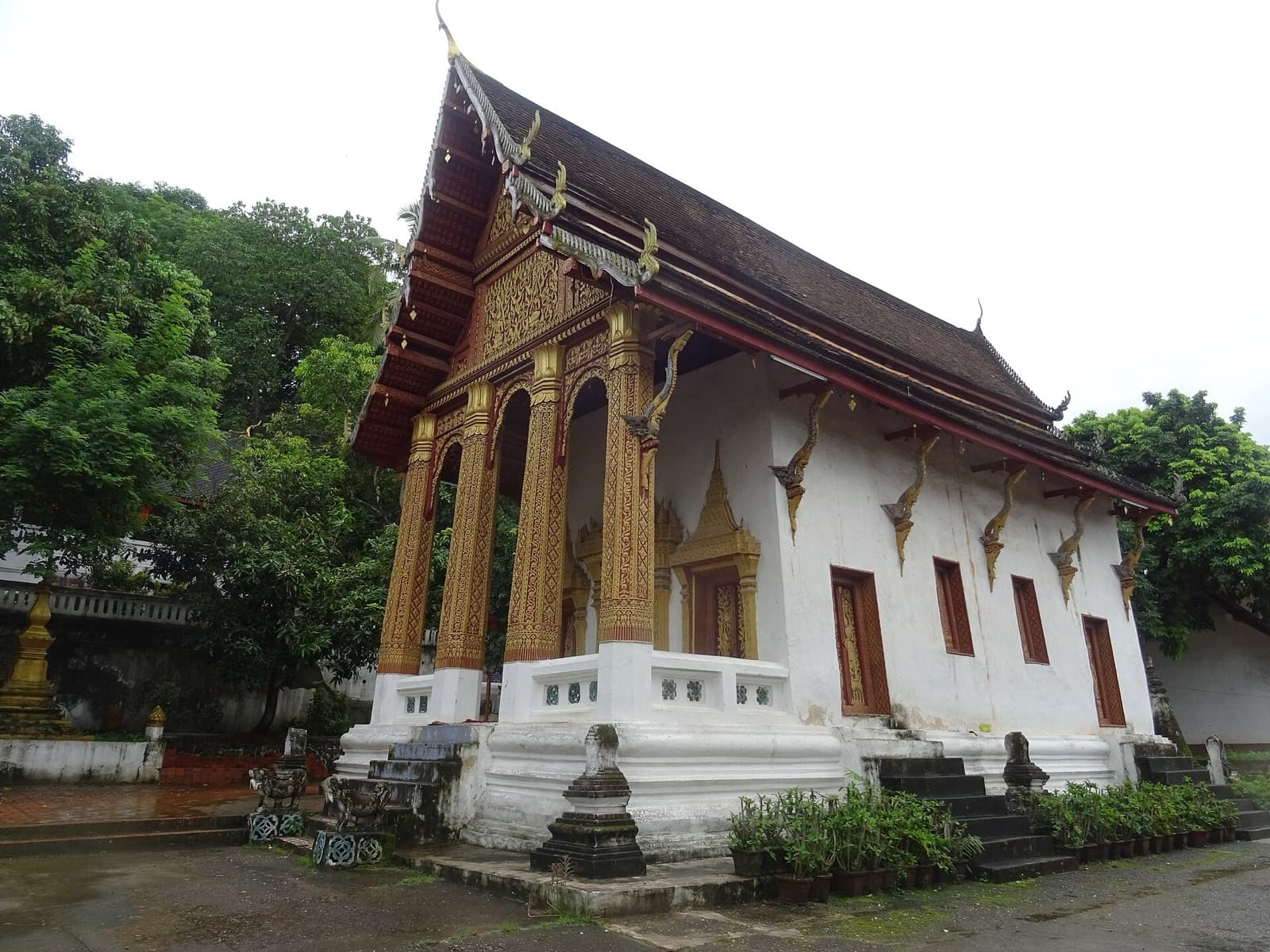
Wat Siphoutthabath and the Descent to the Nam Khan
The quiet descent of the eastern stairway past a working monastery whose name means the Buddha's footprint, coming out among the calm lanes along the smaller river.
Details
Best Time to Visit
Early morning or late afternoon. The climb is hot and exposed by midday, and the summit platform grows crowded at sunset when scheduled groups arrive at the same hour. Going soon after the summit opens around six in the morning, or an hour or more after the sunset queue has cleared, gives you the shrines and the view at your own unhurried pace. The dry, cooler season from roughly November to February is the most comfortable for climbing; in the wet months the stone steps turn slippery.
Pro Tips
- •Do the climb at your own hour rather than joining the sunset crush. Early morning light over the two rivers is soft and quiet, and the shrines are yours alone.
- •Go up the front stairway of about three hundred and twenty-eight steps from Sisavangvong Road and come down the longer eastern stairway of about three hundred and fifty-five steps to Wat Siphoutthabath, so you descend the quieter side and avoid the crowd funneling down the front.
- •Carry a small amount of Lao kip in cash for the summit ticket, about thirty thousand kip for foreign visitors, since it is collected near the top and cards are not accepted.
- •Pause at the cave temple and the footprint shrine on the way up rather than racing to the summit. These are the stops the crowd skips, and they are where the hill reveals itself as a sacred place, not just a viewpoint.
- •Dress modestly for the temples on the hill, with shoulders and knees covered, and remove your shoes where signs or a threshold indicate. These are working places of worship.
- •Bring water, a hat and sun protection. The steps are uneven and mostly exposed, and even the short climb is warm work under the tropical sun.
Safety & Precautions
- •Mount Phousi is a genuine climb of a few hundred uneven stone steps, hot by day and very crowded at sunset. Wear sturdy shoes, carry water, take rests as you need them, and consider going early or late to beat both the heat and the crowd.
- •The temples on the hill are living places of worship. Cover your shoulders and knees, remove your shoes where required, keep your voice low, and give anyone at prayer room and quiet.
- •If you encounter the dawn alms-giving, the Tak Bat, in the lanes near the Nam Khan, treat it as the sacred daily ritual it is. Watch quietly from a distance, dress modestly, and never intrude, block the monks or buy a place in the line.
- •The tropical sun and heat are strong and the riverbanks and some stairways can be steep, slippery in the wet season and often without railings. Move carefully, and note that the town keeps quiet hours at night, so carry small Lao kip in cash as many places do not take cards.
Gallery
Related Reading
Go deeper on what you'll see, hear, and walk through.
Overview
Best Self-Guided Walking Tours in Luang Prabang (2026)
4 min
Overview
Luang Prabang Travel Guide: Days, Transport, Season, Safety, Budget
7 min
Overview
One Day in Luang Prabang: A Walkable Itinerary, Dawn to Night Market
7 min
Thematic
Best Culture Walking Tours in Luang Prabang (2026)
2 min
Thematic
Luang Prabang: The Fusion Royal Town Between Two Rivers
7 min
Companion
That Chomsi Stupa: Why the Golden Point Above Luang Prabang Reads the Whole Town
7 min
Deep dive
The Summit of Mount Phousi: Reading Luang Prabang From the Sacred Hill
7 min
Read
What to Eat in Luang Prabang: A Local Food Guide
6 min
Read the walk
The full story of Mount Phousi: The Sacred Hill Between Two Rivers, in words. Prefer to listen? Play it narrated, from home or on location.
Introduction
Mount Phousi is the wooded hill at the exact centre of Luang Prabang, the old royal capital of northern Laos, a knob of rock about one hundred metres high standing inside the confluence of two rivers. On one side runs the Mekong. On the other runs the Nam Khan, the smaller river. The historic peninsula between them is only about one kilometre long and about two hundred and fifty metres wide, and this hill is its sacred core. This tour reads the whole town by climbing it. There are seven stops, and the walk takes roughly ninety minutes to two hours at an easy pace, over a distance of about two kilometres, much of it up and down a few hundred uneven stone steps. You will begin at a painted temple at the foot of the hill, rise through shaded shrines and a cave temple, pass a revered Buddha footprint, reach the gilded stupa of That Chomsi on the summit, take in the view that made the hill sacred, then descend the quieter eastern side to a working monastery near the Nam Khan. Here is the thing worth knowing before you start. This climb is the most tour-packaged experience in Luang Prabang, and at sunset the narrow summit platform fills with scheduled groups arriving at the same hour. Your freedom is the whole point. Go early, go late, linger at a hillside shrine as long as you like, set your own hour on a sacred hill. When you arrive at Wat Pa Huak, at the foot of the hill opposite the former Royal Palace, begin with stop one.
1. Wat Pa Huak: The Painted Temple at the Foot of the Hill
You start at the foot of the hill, at a modest temple that most sunset climbers walk straight past on their way to the steps. Wat Pa Huak sits at the northwest entrance to Mount Phousi, directly across Sisavangvong Road from the former Royal Palace. Its name is glossed as the monastery of the thornless bamboo forest, for a bamboo grove that once grew here. Wat means temple, or monastery. The temple was founded in eighteen sixty-one, during the reign of King Chantharath, and what makes it worth your time is inside the sim, the ordination hall. Its walls carry rare murals that were never restored, and unlike the usual scenes of the Buddha's lives, these paint the world outside the temple door. They show caravans and warriors and merchants on horseback, river craft on the Mekong, and Luang Prabang receiving visitors from China and beyond, arriving with elephants and horses. The temple's own history documents them as a record of trade, travel and diplomacy in the nineteenth century, a picture of a kingdom that sat on the trade routes between larger powers. Across the road stands the building the town knows best. The former Royal Palace, or Haw Kham, was built in nineteen oh four for King Sisavang Vong during the French colonial period. In nineteen seventy-five, after the monarchy was abolished, it became the National Museum. Take the murals slowly. This is a working temple, so keep your shoulders and knees covered and your voice low. When you have looked your fill, the front stairway waits just around the corner, and you set the pace from here.
2. The Stairway: A Few Hundred Steps to the Sky
Now the climb itself. The main stairway rises from Sisavangvong Road, near the former Royal Palace, and there are about three hundred and twenty-eight steps on this front side of the hill. There is a second stairway of about three hundred and fifty-five steps on the Nam Khan side, and you will come down that quieter one at the end. For now, the front steps. Take them at your own speed. The whole climb runs roughly fifteen to thirty minutes at an easy pace, and the hill is only about one hundred metres high, but the steps are uneven and the day can be hot, so there is no shame in resting on the way. The stair climbs under frangipani trees, their white and yellow blossoms scenting the shade, past small shrines and seated Buddha images set into the hillside. You will pass the Buddha in several poses, calling for rain, deep in meditation, cradling an alms bowl, each posture carrying its own meaning in Lao Buddhist practice. Where the balustrades take the shape of long serpents, those are naga, the serpent guardians that flank temple stairways in Lao tradition, said to protect the sacred way. This hill is the sacred centre of a very small peninsula, about one kilometre long and two hundred and fifty metres wide, wedged between the Mekong and the Nam Khan. And here is where your freedom pays off. This is the town's crowd-packed sunset climb. Scheduled groups pour up these same steps at the same golden hour. You do not have to. Climb before the crowd or long after it, stop wherever the trees open, and let the town come to you on your own clock.
3. Wat Tham Phousi: Built Against the Living Rock
About halfway up, the path reaches a small temple pressed into the hillside. Wat Tham Phousi. The word tham means cave, and that is what this is, a rock temple built against the living stone of the hill, looking out over the Nam Khan below. It is one of only five temples that remain on Mount Phousi today. The hill once held as many as thirteen, and the tourism authority records the five survivors by name, this cave temple among them. Step out of the sun and into the cool of the rock. Inside sit several Buddha images, and the one visitors remember is a seated Buddha with a broad, rounded belly, quite unlike the slender meditating figures on the stairway. Pilgrims commonly call this figure Kaccayana, a disciple of the Buddha, though you should take that identification as the tradition people attach to the image rather than as documented fact. There is a reclining Buddha here too. This is a quiet stop, and quiet is the reward. Where the sunset crowd streams past on its way to the summit, few pause at the cave. You can. Stand a moment in the shade, look out at the smaller river winding below, and feel how the hill was built into, not just climbed. That is the difference between reaching a viewpoint and reading a sacred place. Take as long as you like. No group is waiting on you, and the summit is not going anywhere. When you are ready, the path continues up toward the footprint shrine and the golden stupa above.
4. The Buddha Footprint: An Object of Pilgrimage on the Hill
Higher on the eastern flank of the hill, near where the far-side stairway begins its descent, you reach a shrine that many climbers miss entirely. A Buddha footprint, enshrined in the rock. The tourism authority records that Mount Phousi holds an enshrined Buddha footprint, and…
Full narration for this stop unlocks with the tour.
5. That Chomsi: The Golden Stupa of Eighteen Oh Four
This is the summit, and this is the goal of the whole climb. That Chomsi, the gilded stupa that crowns Mount Phousi. Its spire is the landmark of Luang Prabang, visible across the peninsula and lit at night, the golden point every eye finds from the streets below. Now you stand…
Full narration for this stop unlocks with the tour.
6. The Summit View: The Royal Town Between Two Rivers
Now the reason a kingdom chose this hill. From the platform beside the stupa, the whole town lies open below you, and the geography that made Mount Phousi sacred becomes legible at a single glance. On one side runs the Mekong, wide and brown. On the other runs the Nam Khan, the…
Full narration for this stop unlocks with the tour.
7. Wat Siphoutthabath and the Descent to the Nam Khan
Now you leave the crowd behind and take the far side down. The eastern stairway, the longer one of about three hundred and fifty-five steps, drops through the trees on the Nam Khan side, and while the sunset groups funnel back down the front, you descend into quiet. Partway down…
Full narration for this stop unlocks with the tour.