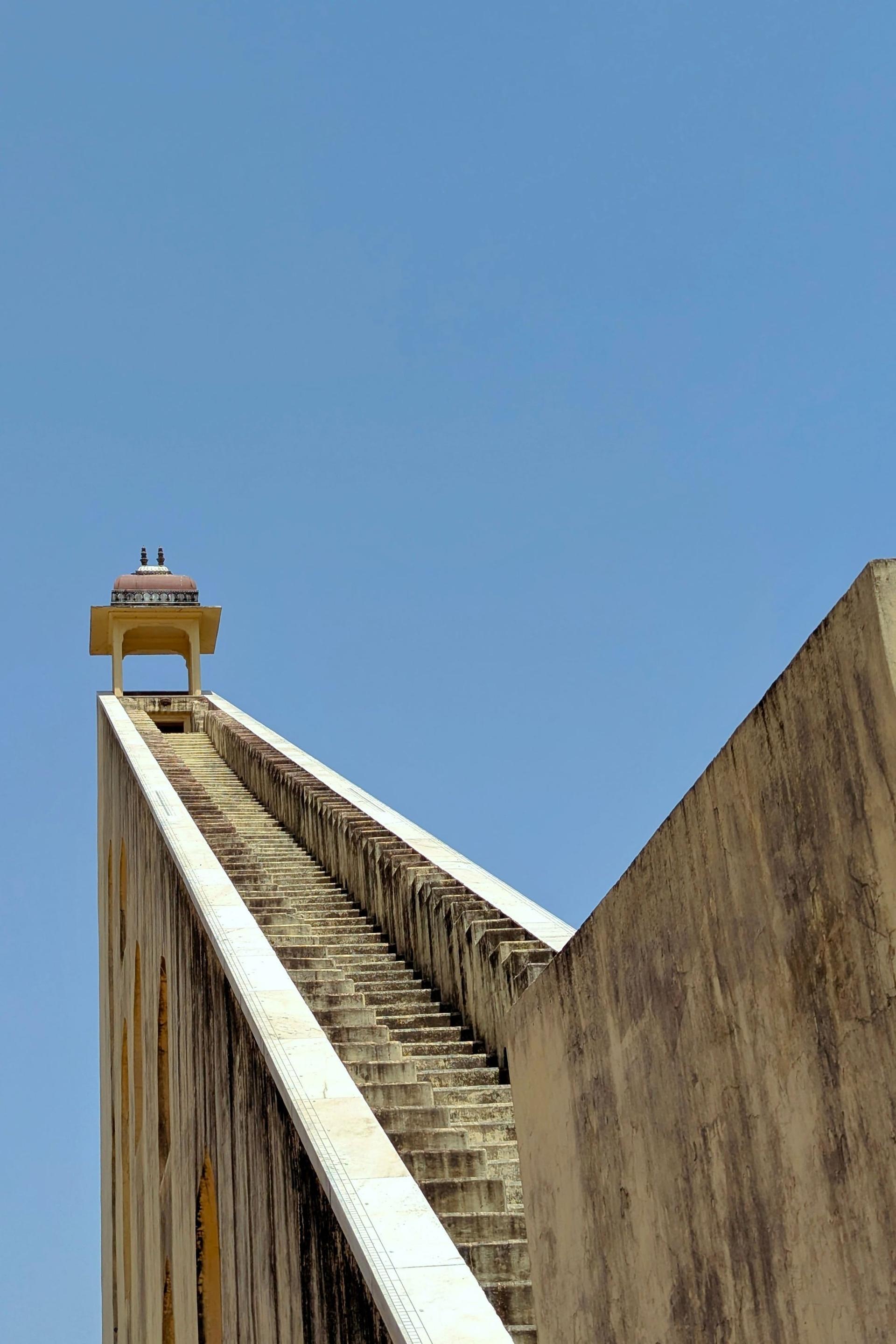
Inside Jaipur's Jantar Mantar, the UNESCO-listed observatory of Sawai Jai Singh II: the hanging ring and the great astrolabe, the giant Samrat sundial and how to read its shadow, the twelve zodiac instruments, the twin sky bowls, the drums, and the small sundial by the exit.
Start · Unnatamsa Yantra
DirectionsStops
- 1
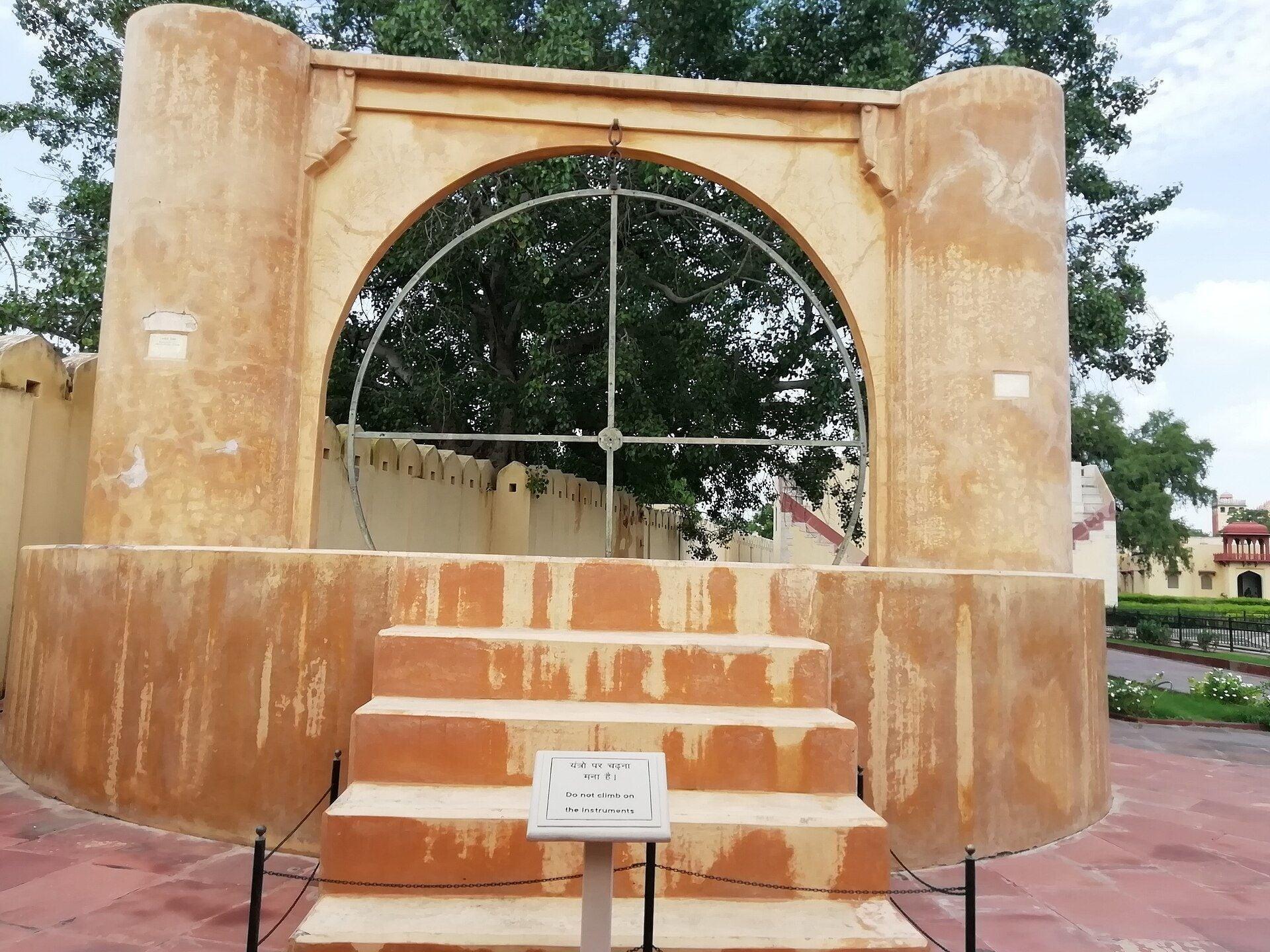
Unnatamsa Yantra
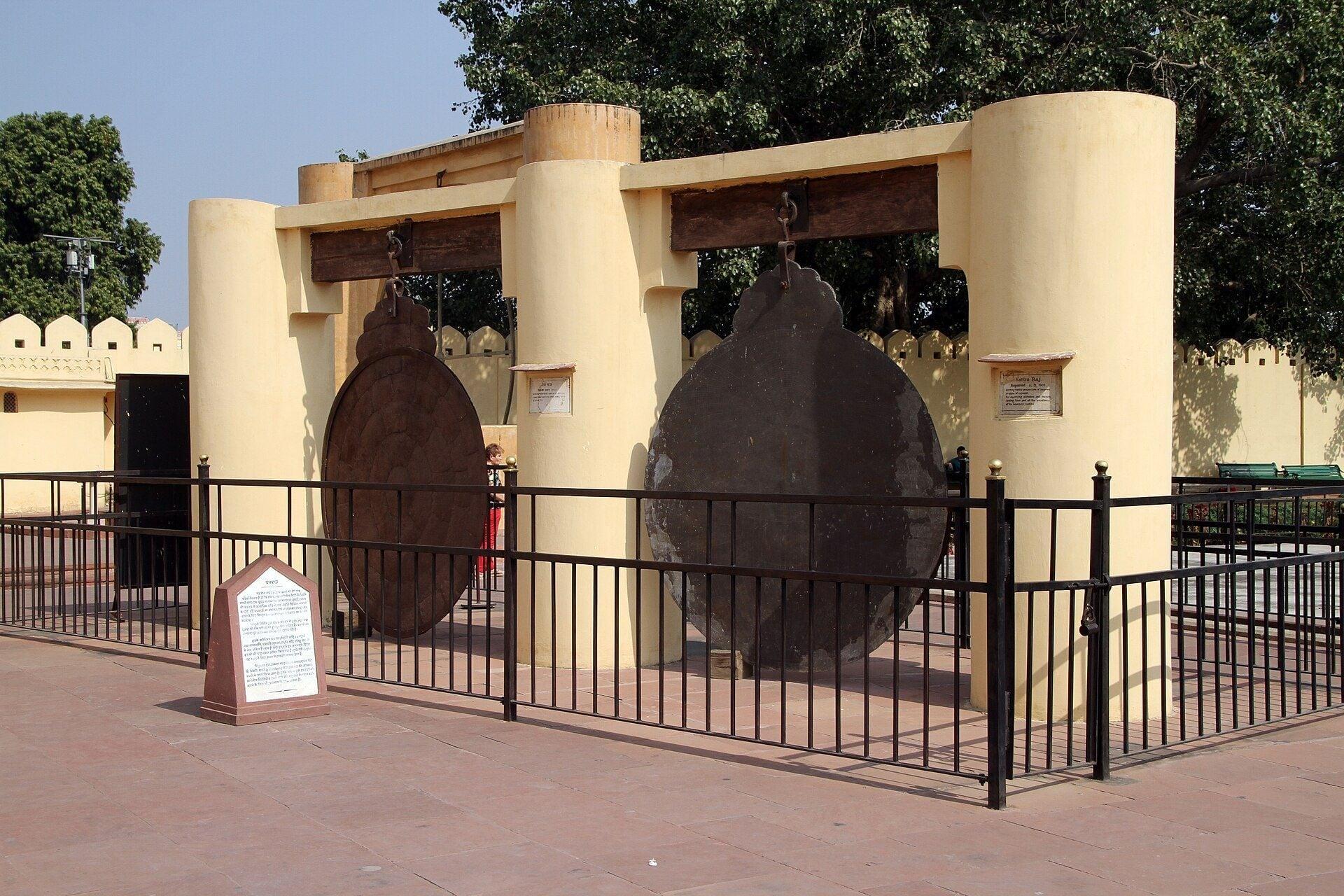
The tour opens with the metal tools. The Unnatamsa Yantra, a brass ring 5.35 m across hung between two pillars over a pit, and beside it the Yantra Raj, an astrolabe that UNESCO's evaluators called probably the largest of its type.
- 2
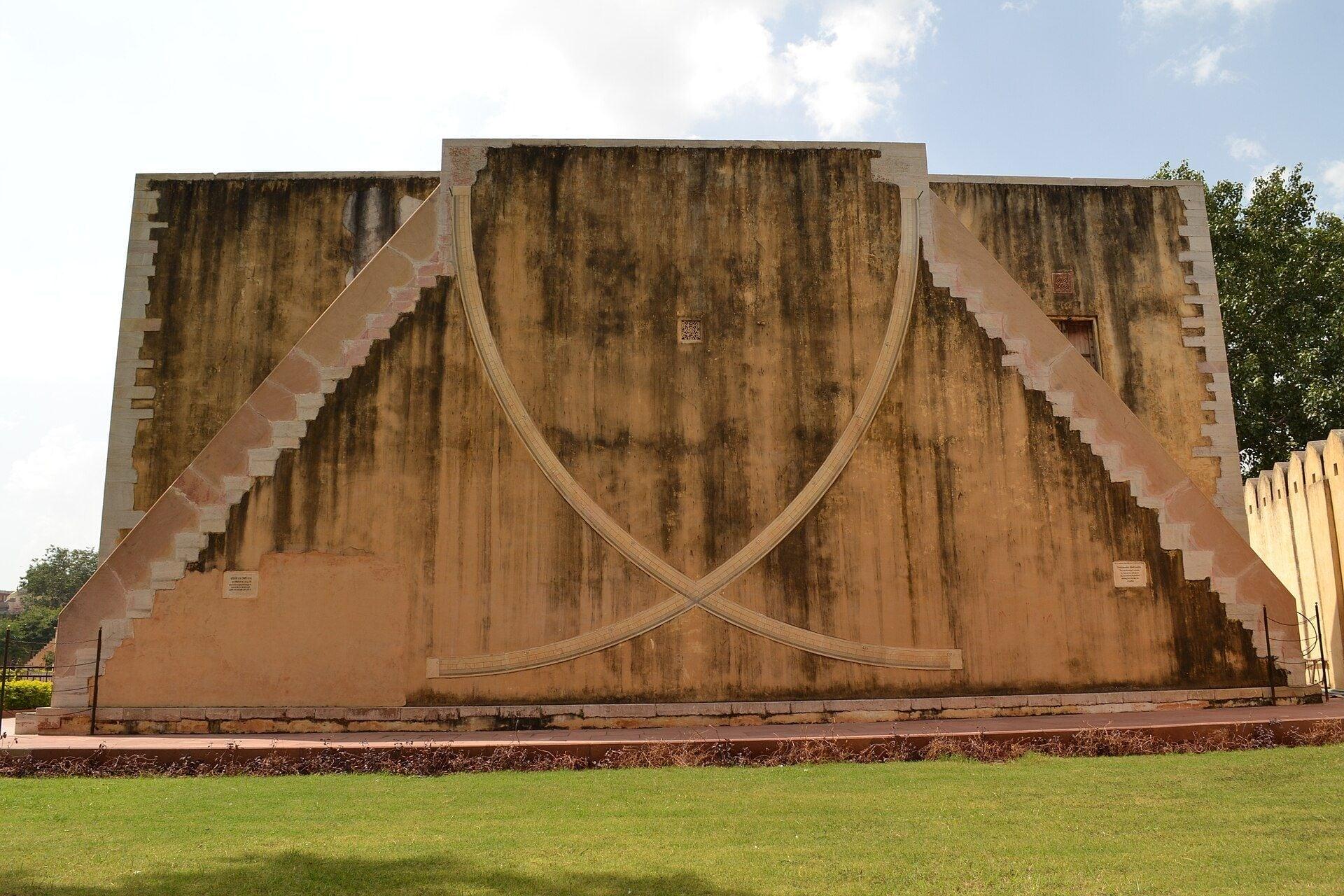
Dakshinottara Bhitti Yantra
An instrument moved stone by stone. The Dakshinottara Bhitti Yantra, a north-south wall with marble arcs for the noon sun, taken apart and rebuilt on the great sundial's axis when a road cut the site's corner in Ram Singh II's reign.
- 3
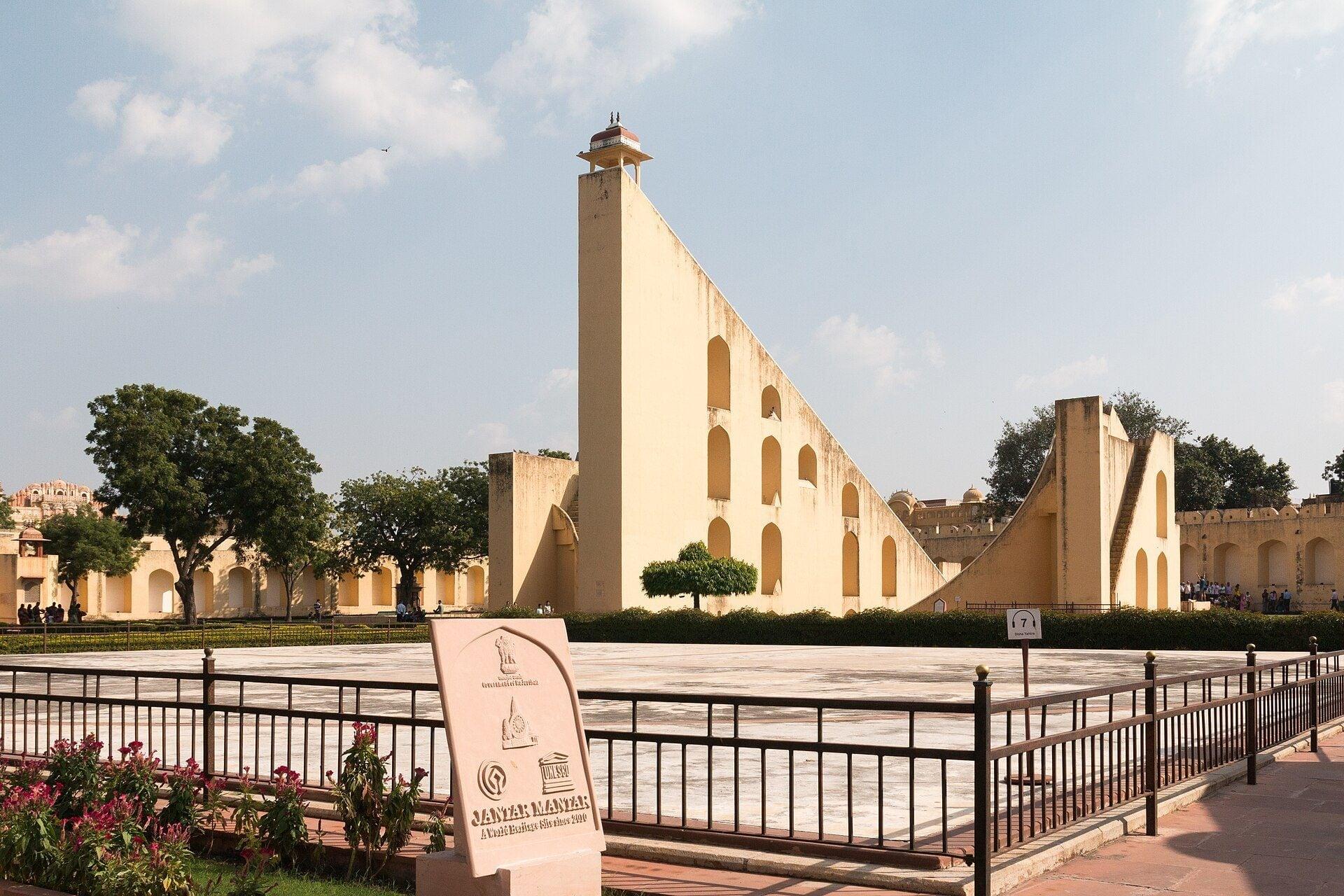
Disha Yantra
An honest mystery among exact instruments. The Disha Yantra, also called Jai Singh's Seat: a circle about 30 m across in red stone on a low platform, whose purpose the observatory's own nomination calls not clear.
- 4
Great Samrat Yantra
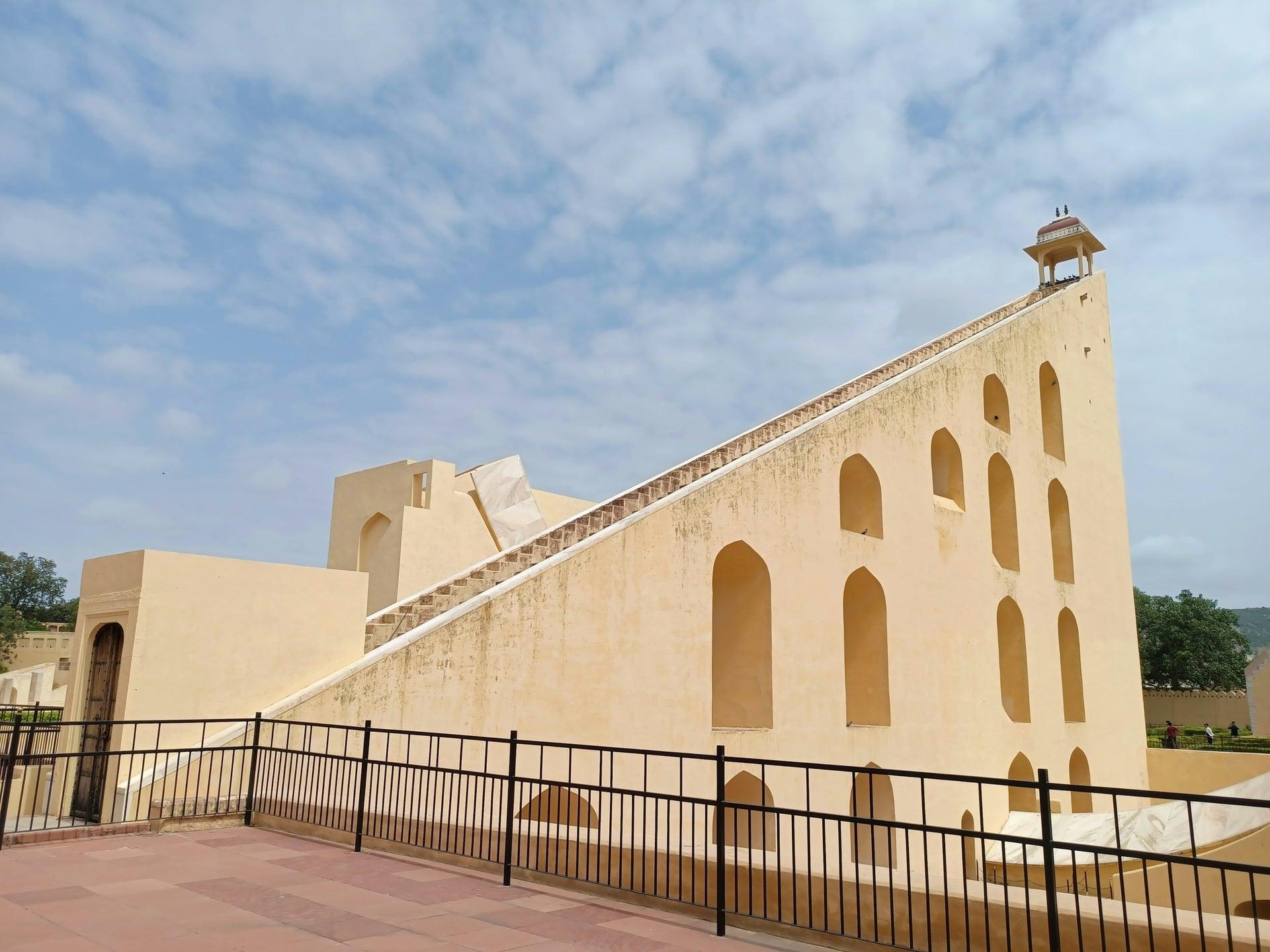
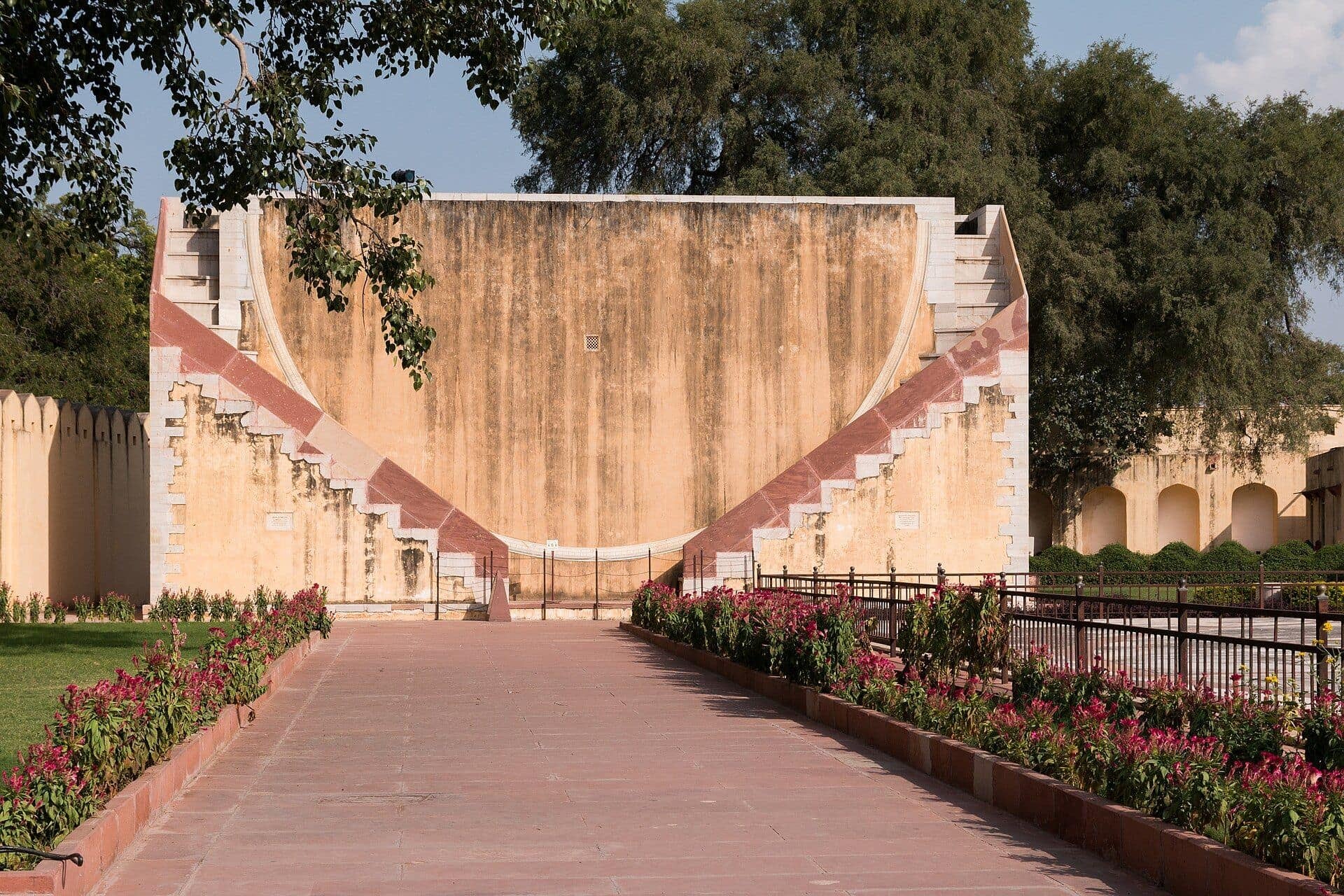
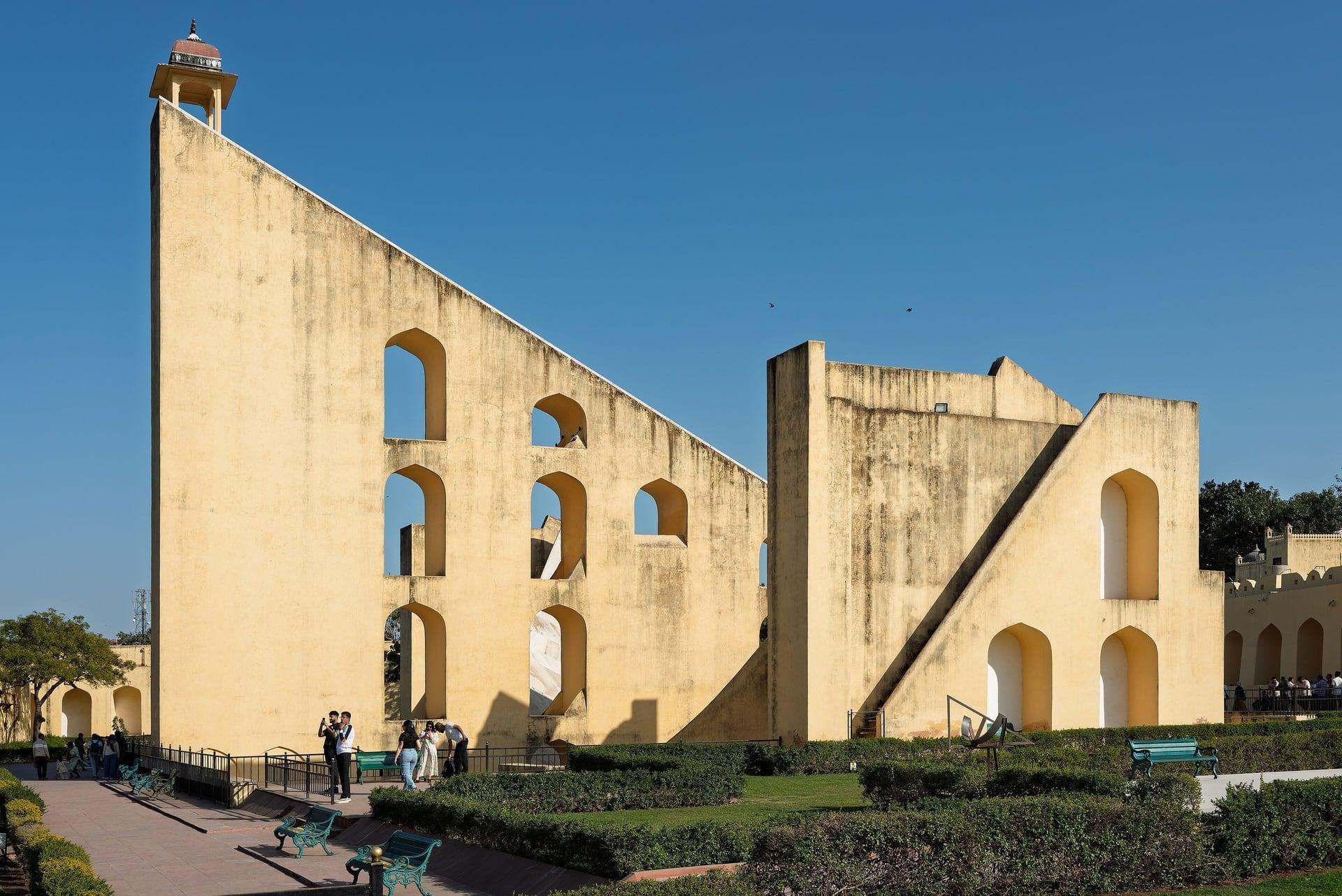
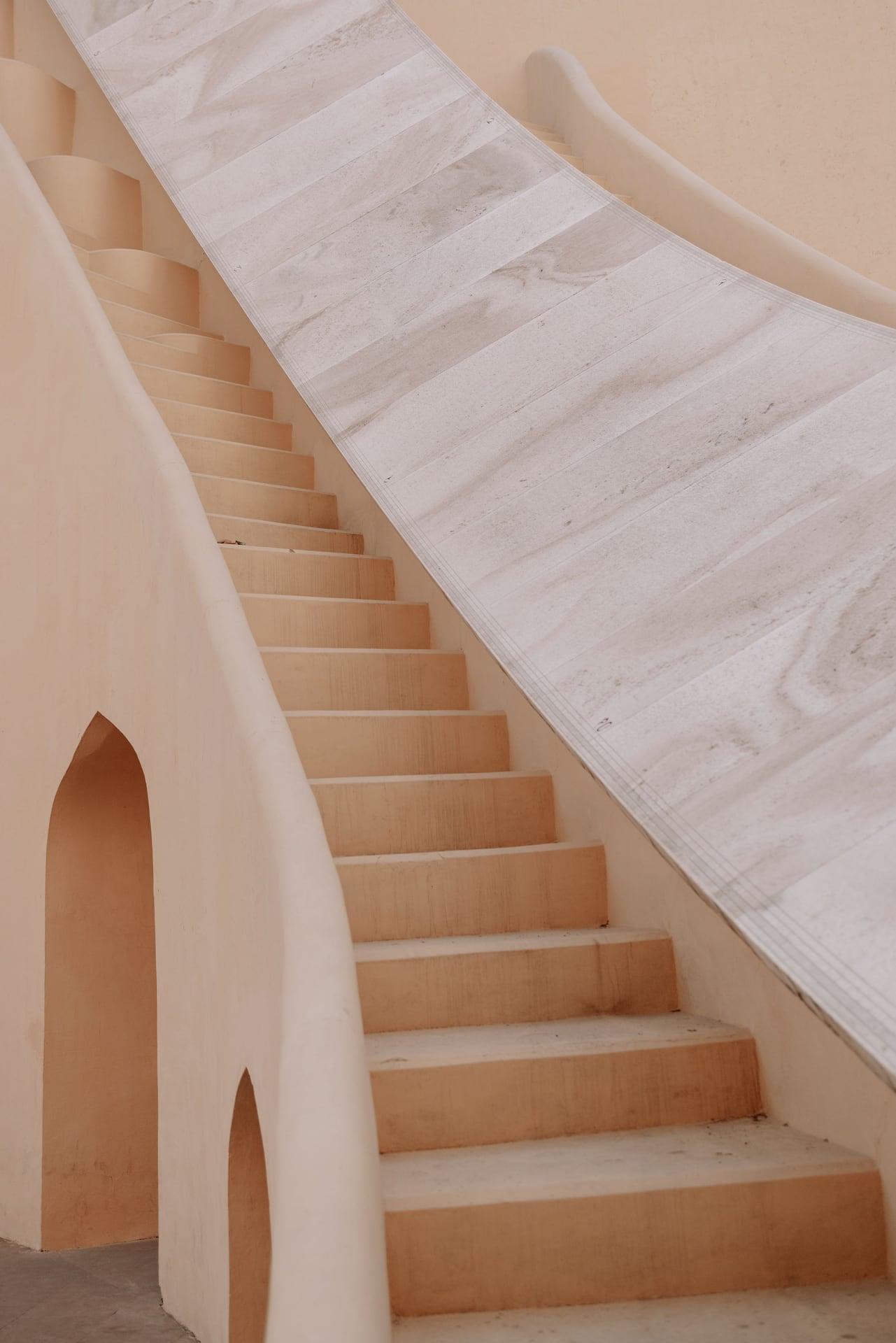
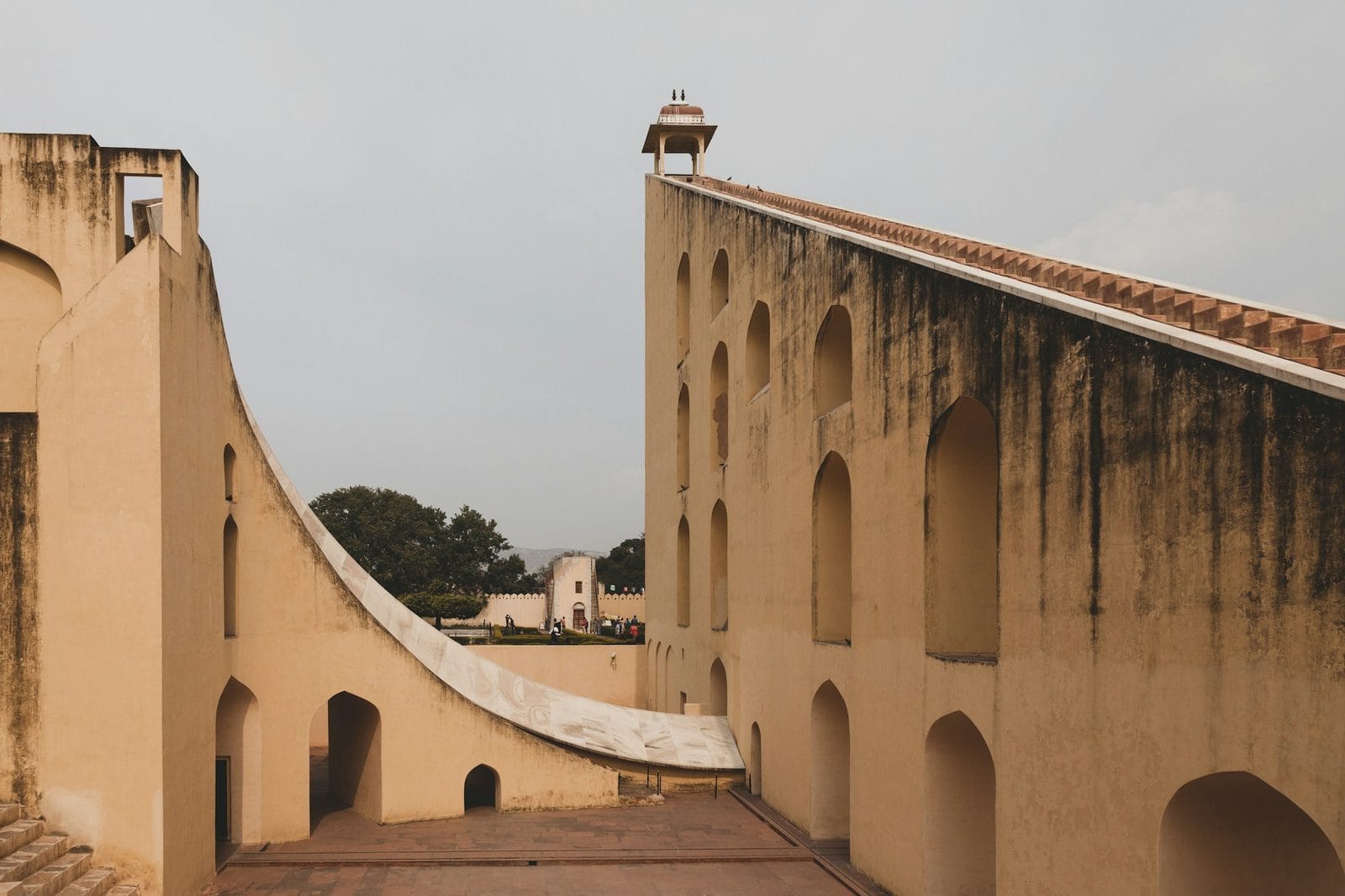
The largest sundial of its kind, by its own nomination. The Great Samrat Yantra: a triangular wall about 19 m above the ground, curved marble scales 15 m in radius, and two dark chambers where a pinhole throws the noon sun onto a scale.
- 5
Samrat Yantra: Reading the Time
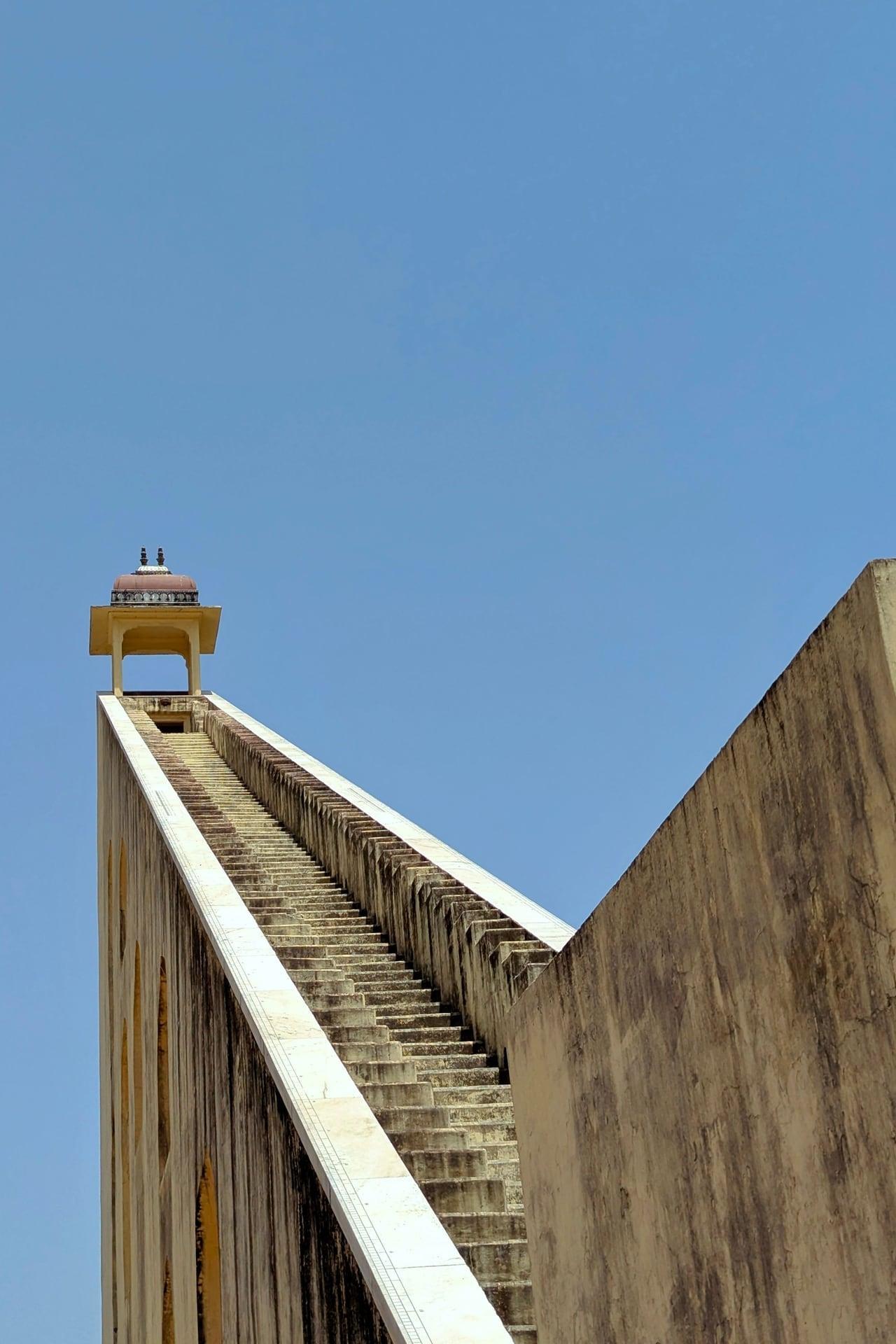
A clock the size of a building. From the south end, the Samrat Yantra's wall points along the meridian toward the pole, and its shadow on the curved scales gives Jaipur's local sun time, on a scale marked in 2-second steps.
- 6
Rashivalaya Yantra
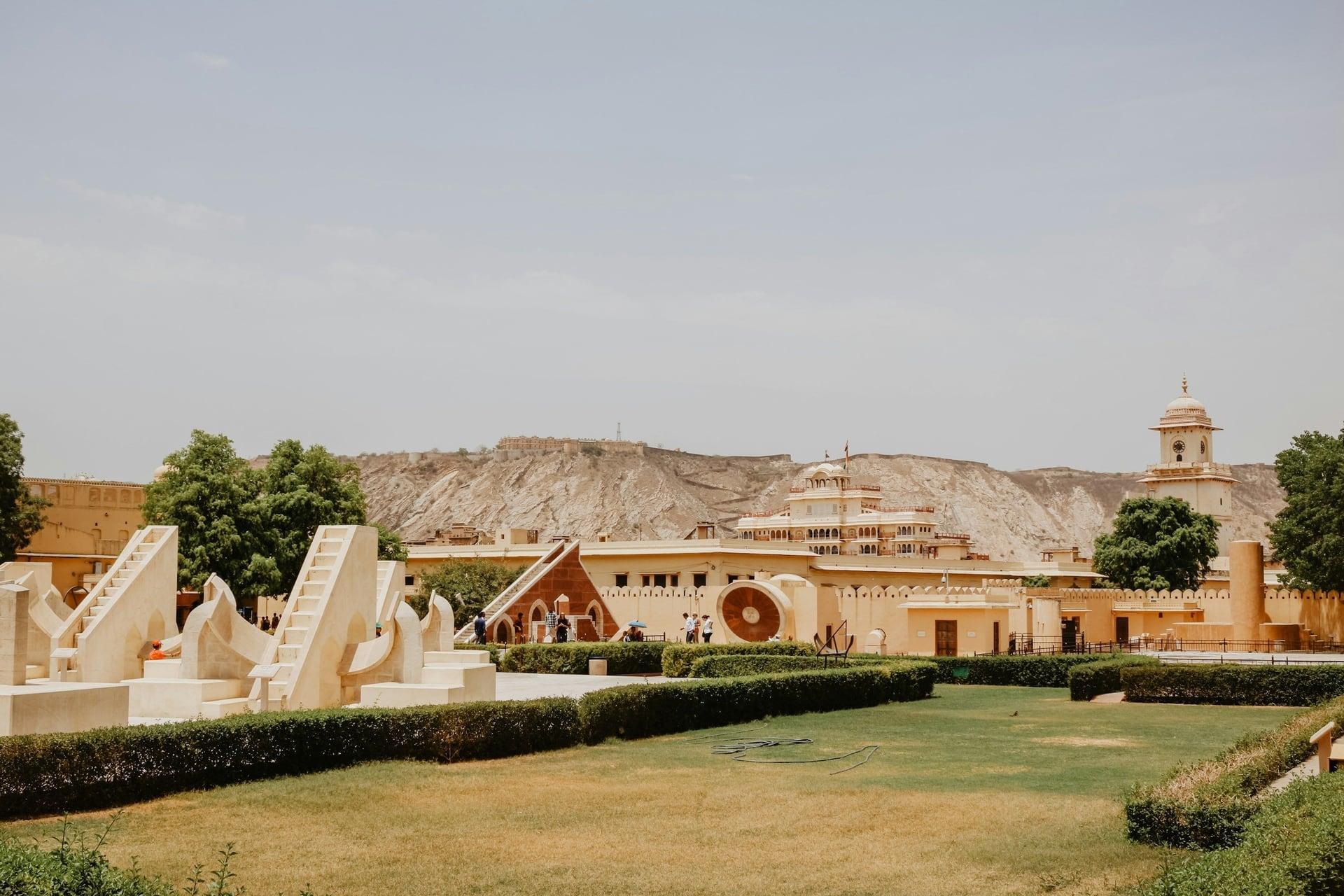
Twelve sundials for twelve signs of the zodiac. The Rashivalaya Yantra: twelve small Samrat-type instruments on one floor 41 by 39 m, each tilted differently, their angles altered slightly during the restoration of 1901 to 1902.
- 7
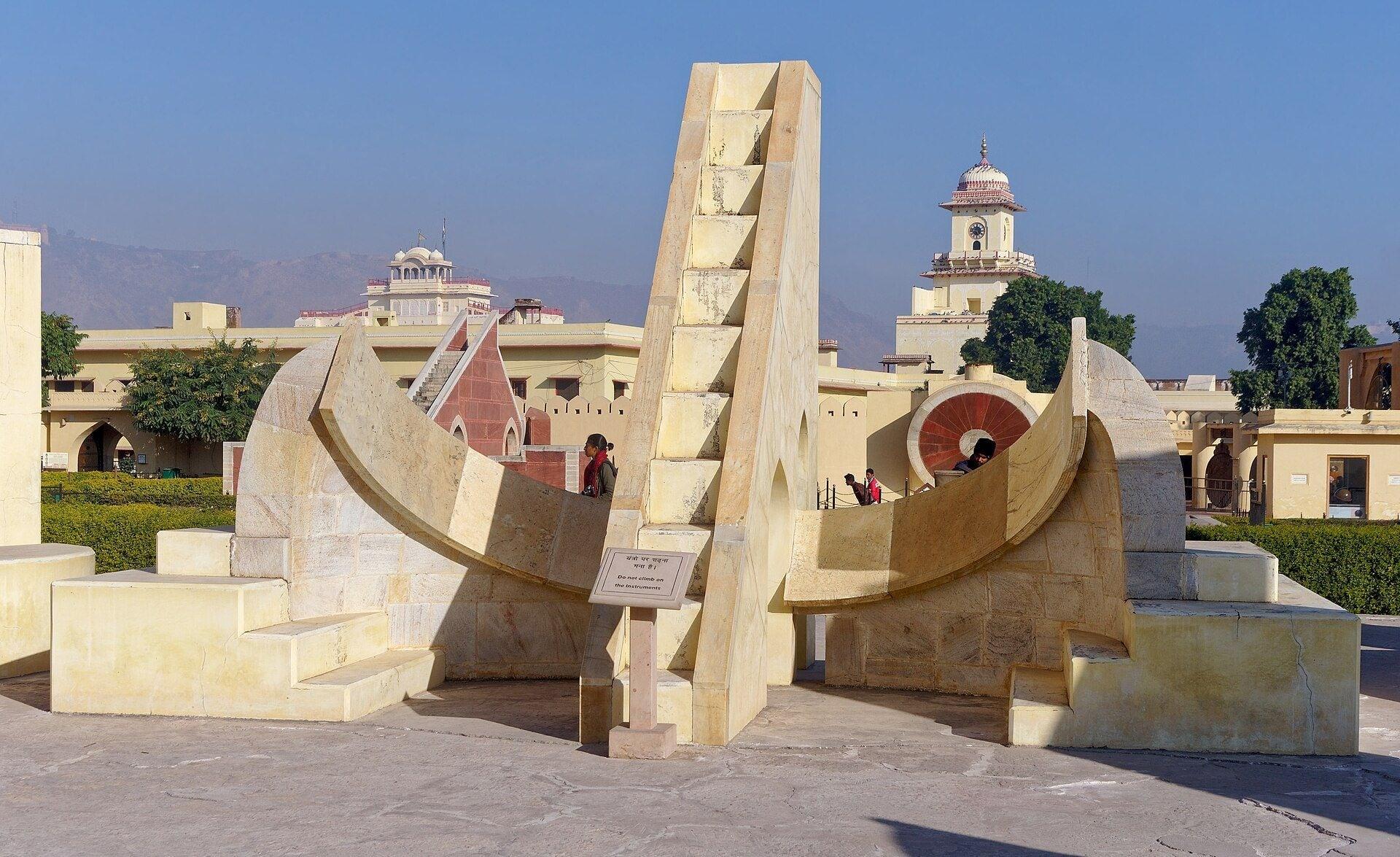
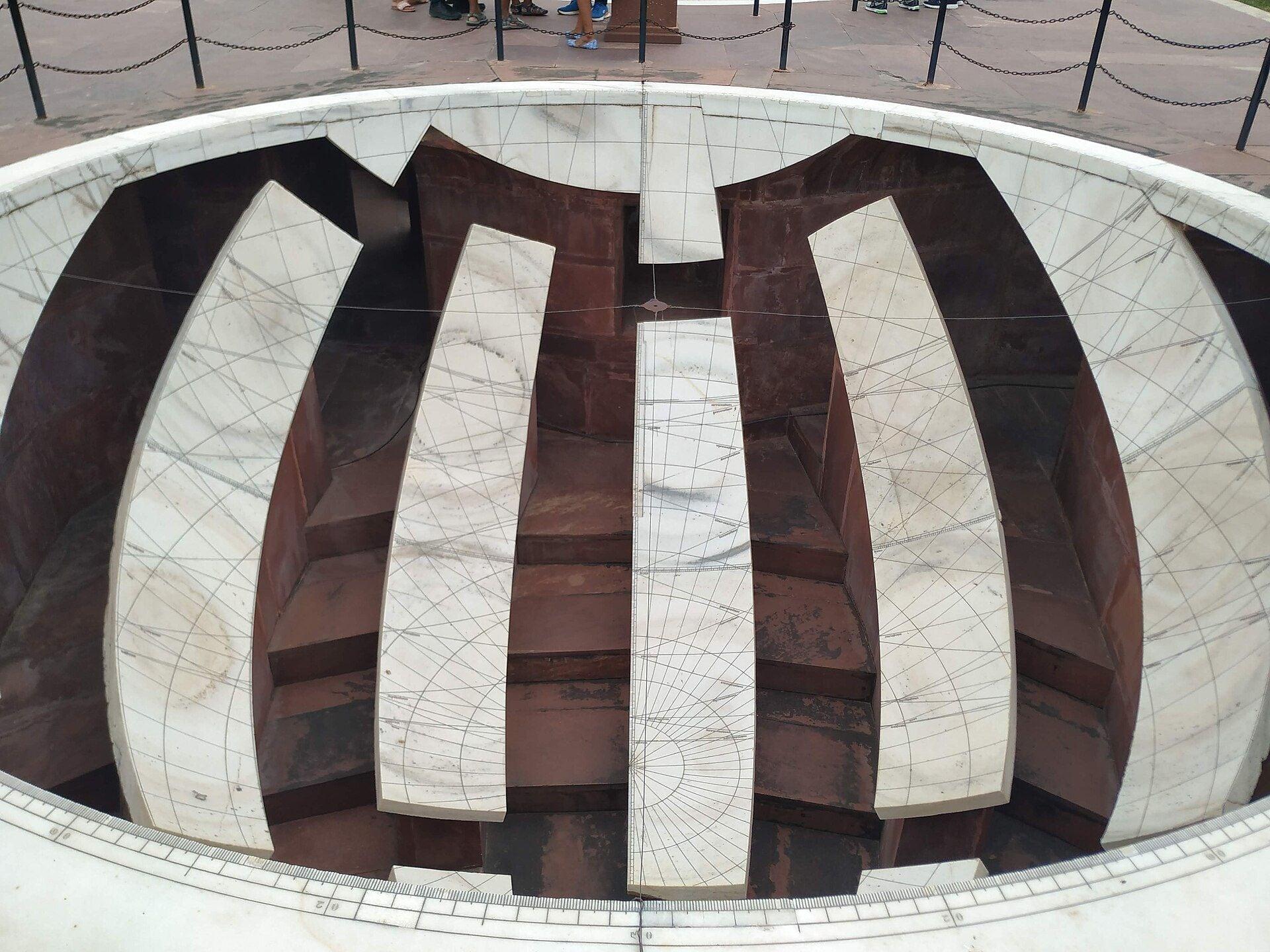
Jai Prakash Yantra
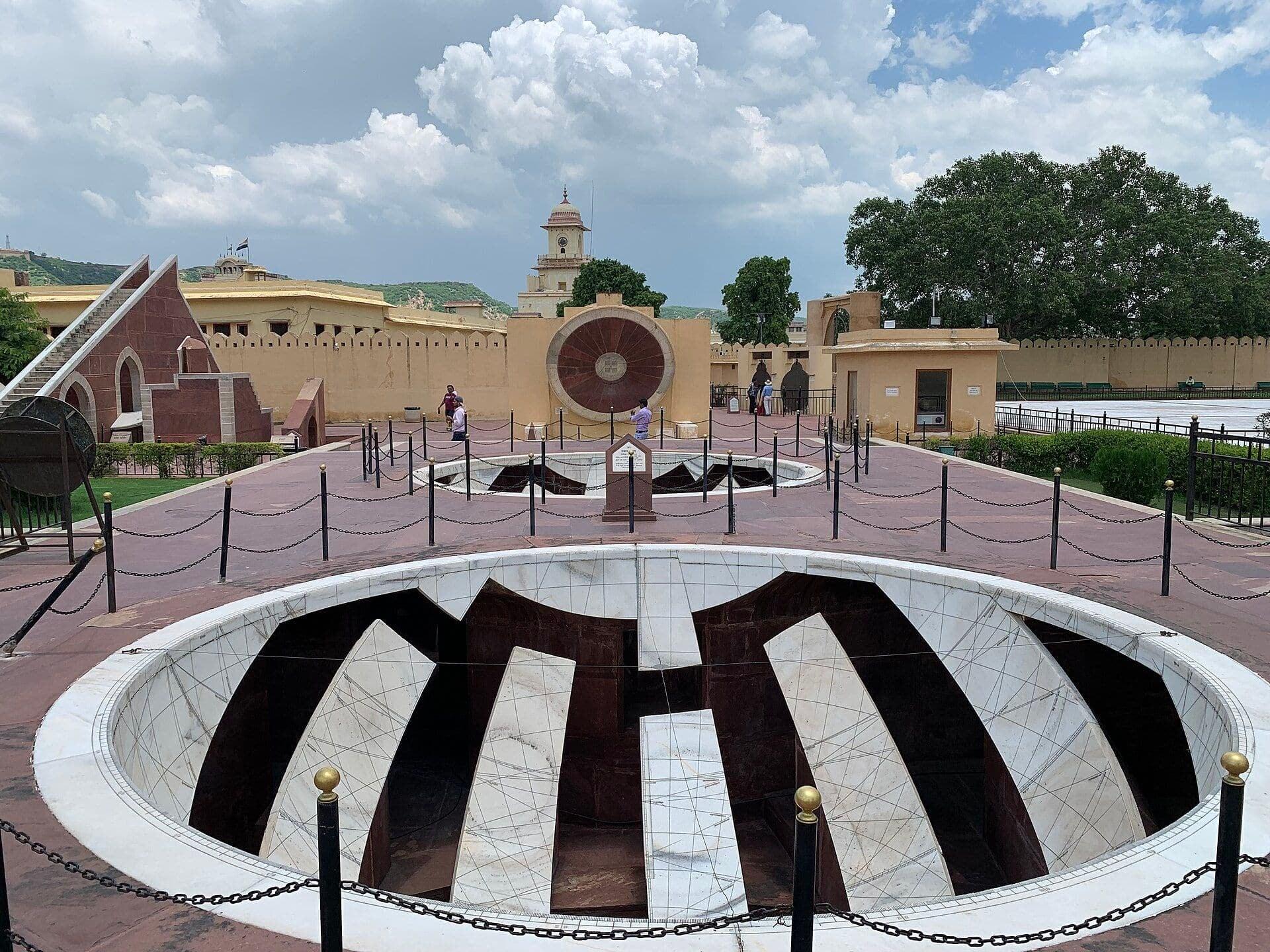
The sky turned inside out. The Jai Prakash Yantra: two sunken marble hemispheres 5.44 m across, cut with steps, whose solid and open bands are reversed so that together they make one complete sky; restored in white marble in 1901.
- 8
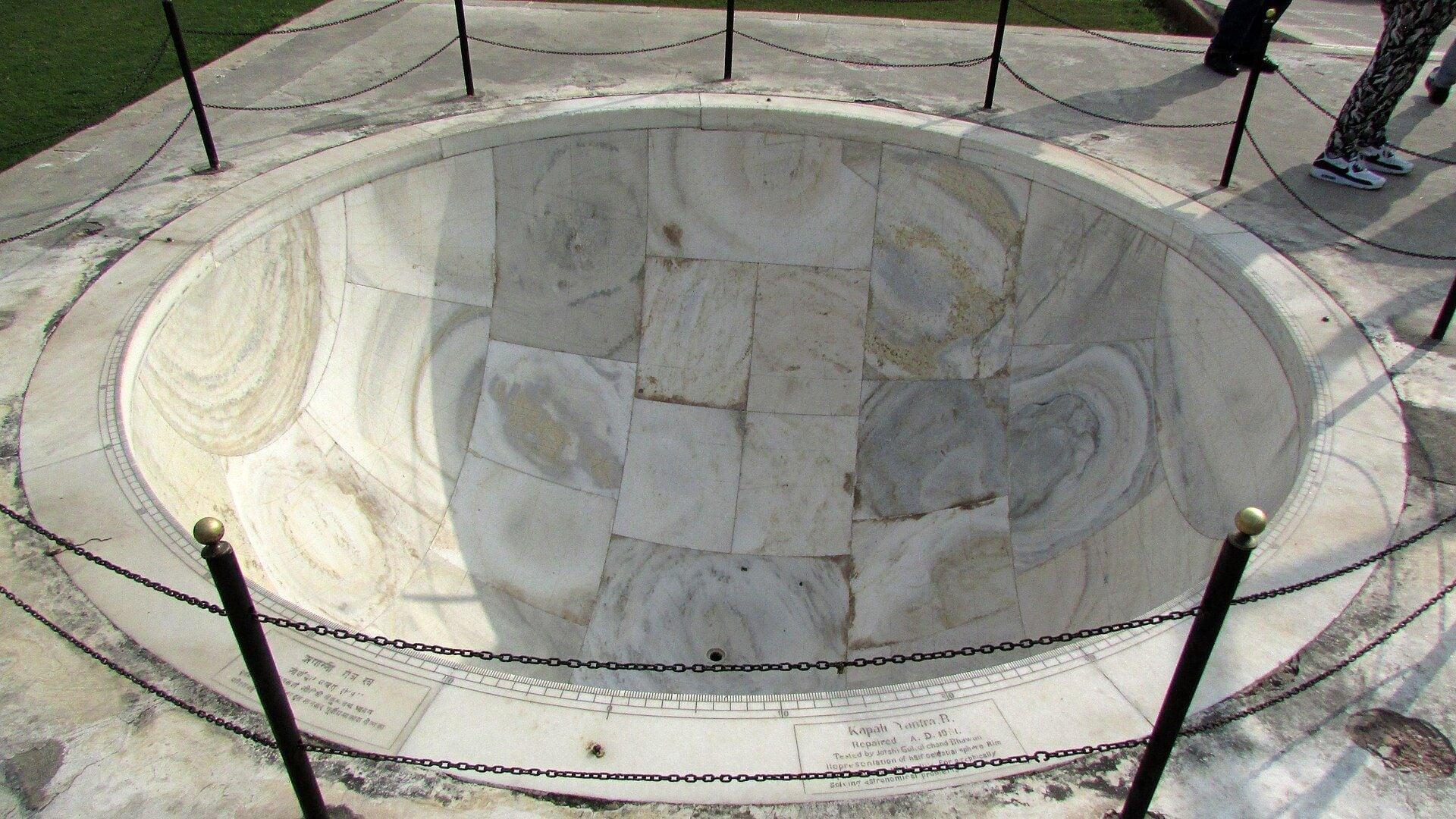
Kapala and Chakra Yantras
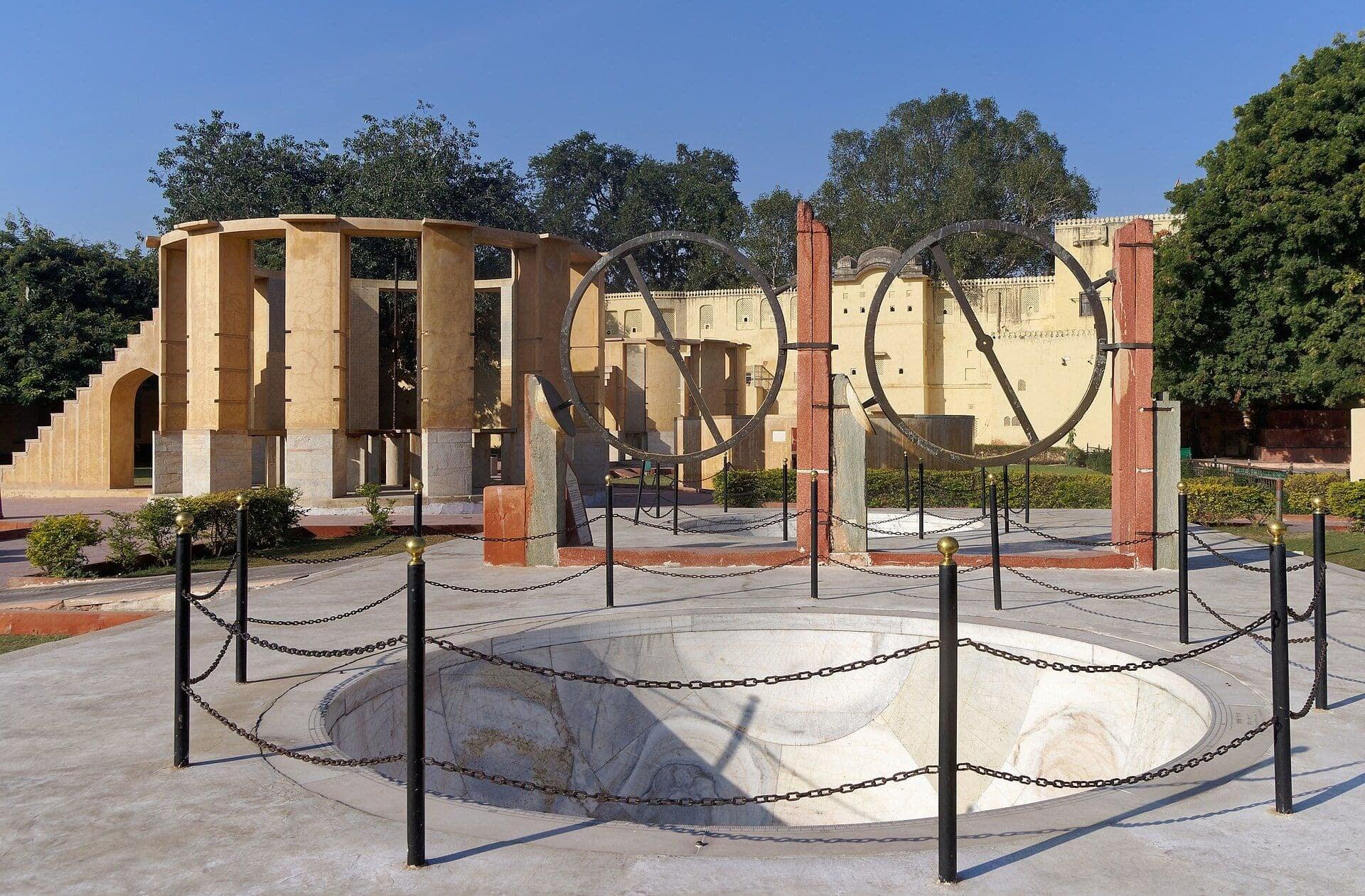
A stone bowl that does trigonometry. The Kapala Yantras, two bowls a 1918 survey called peculiar to Jaipur, one of which converts coordinates as a drawing, and between them the Chakra rings, turning on an axis parallel to the Earth's.
- 9
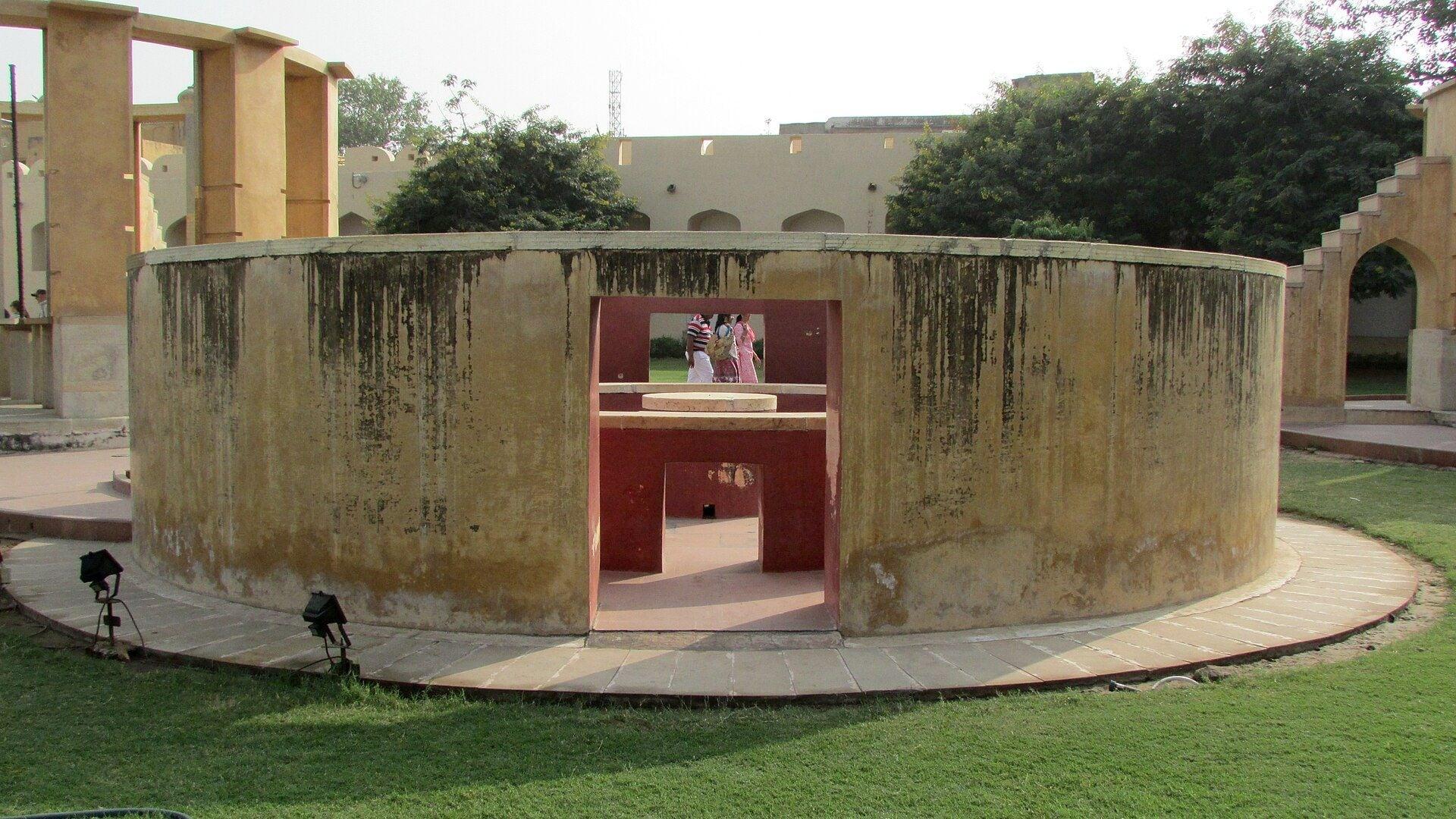
Ram Yantra and Digamsa Yantra
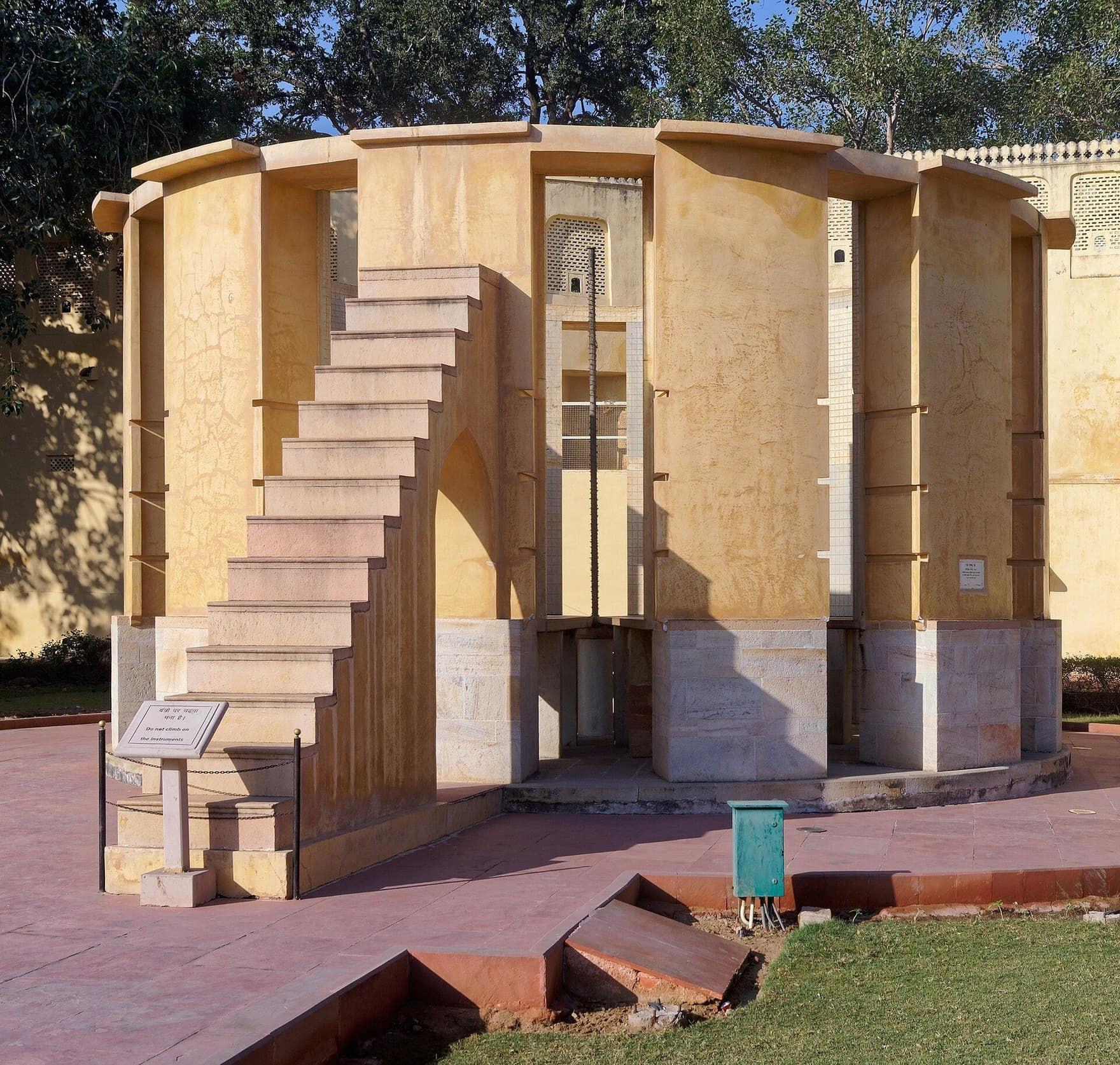
Two numbers place any star. The Ram Yantra, a pair of open drums for altitude and azimuth, rebuilt in stone in 1891, and the Digamsa, a small pillar inside two ring walls for azimuth alone; beside them, a plate thought unfinished.
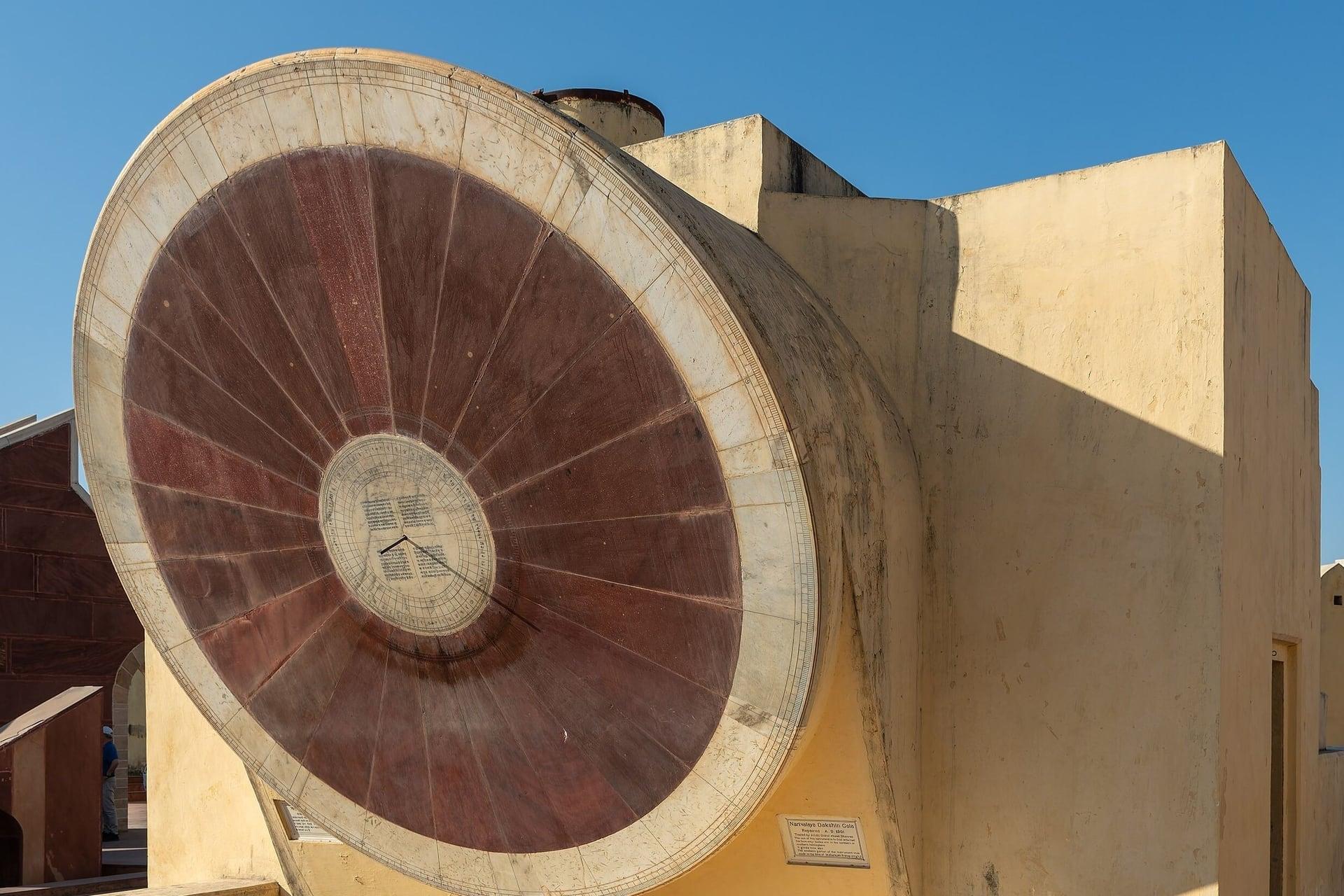
- 10
Narivalaya and Dhruva Darshak
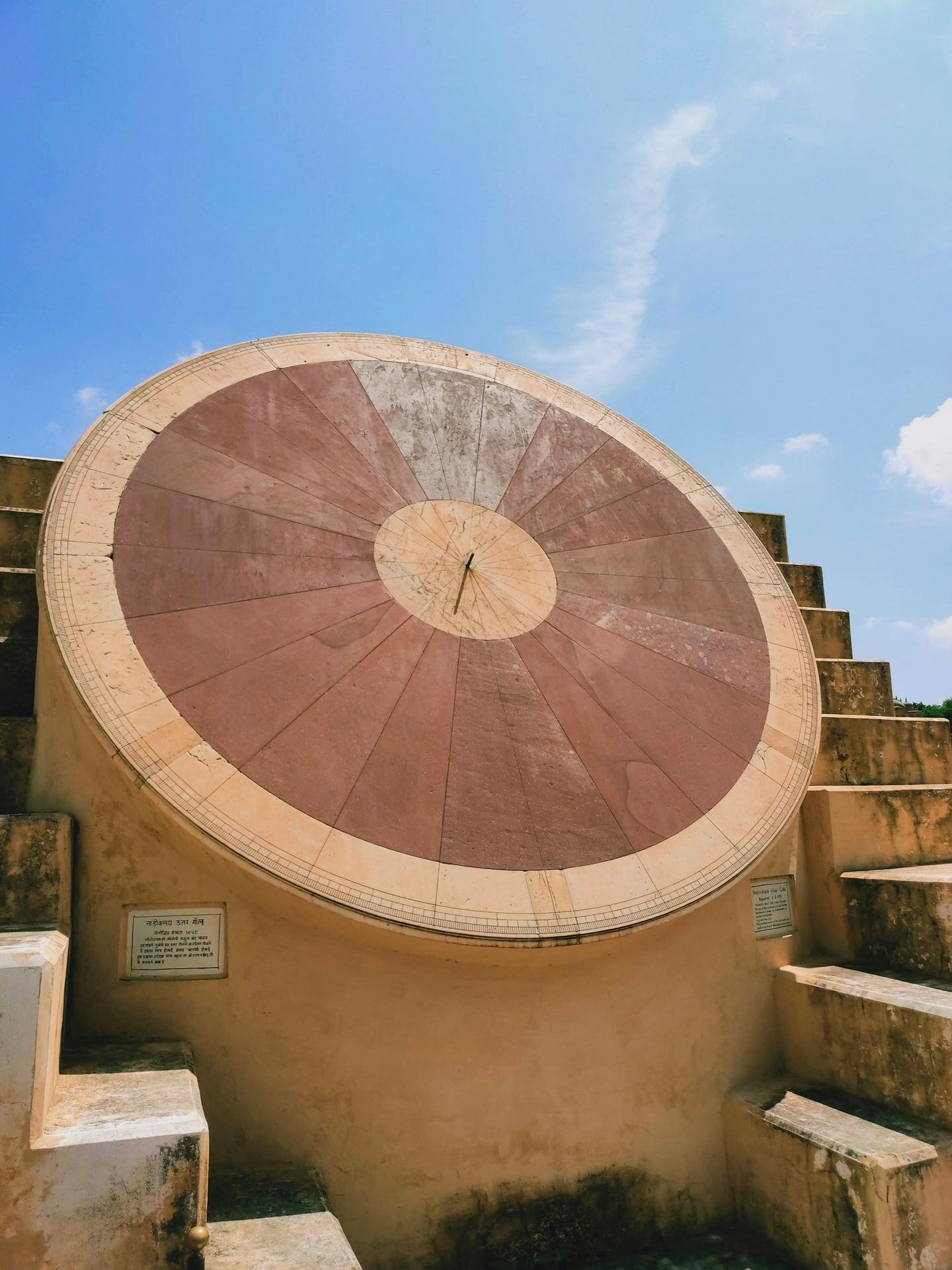
A clock with a summer face and a winter face. The Narivalaya, an equal-hour sundial in two halves, with the only scales on the site marked in English; nearby, the small Dhruva Darshak points at the pole star.
- 11
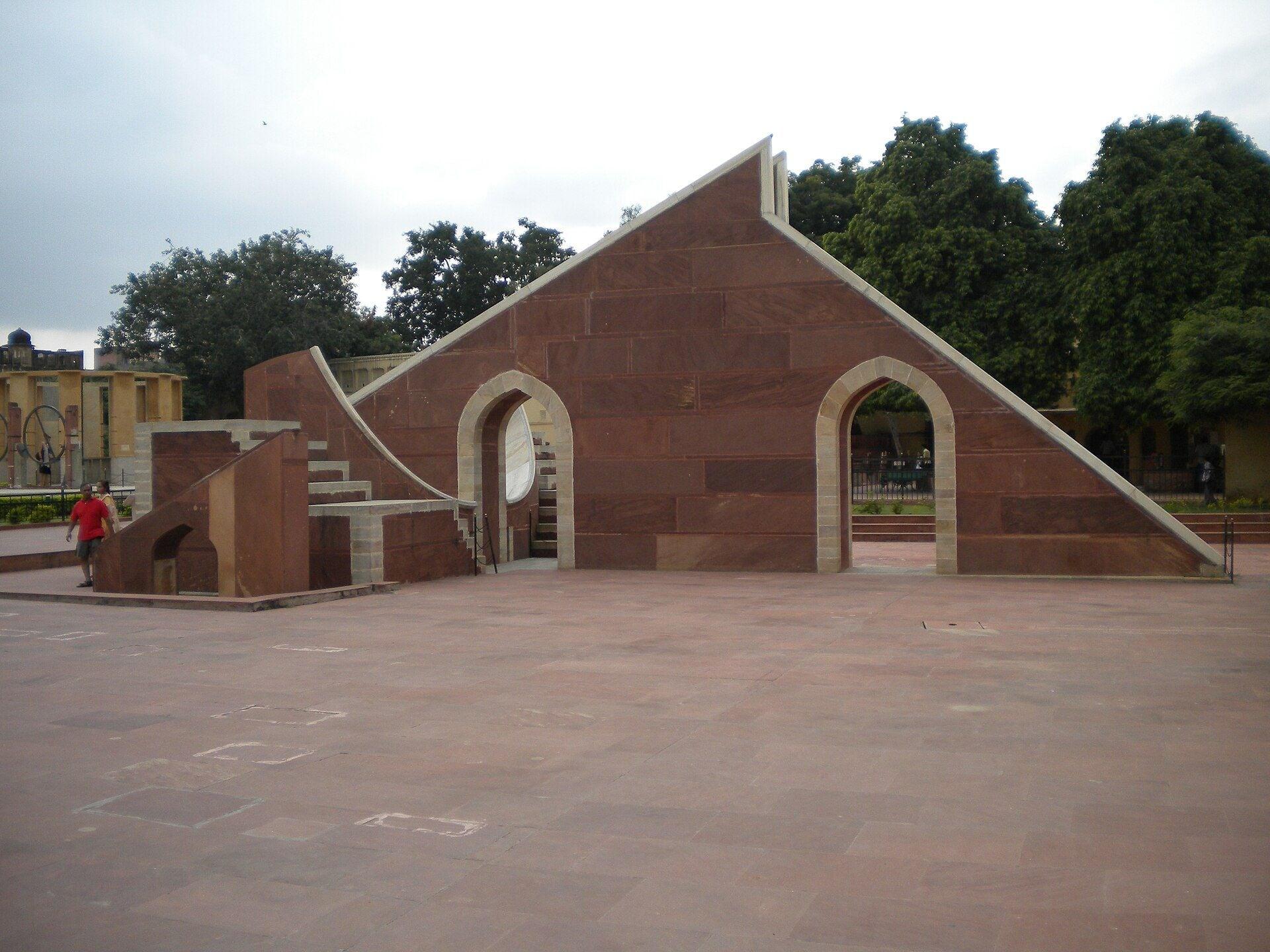
Laghu Samrat Yantra
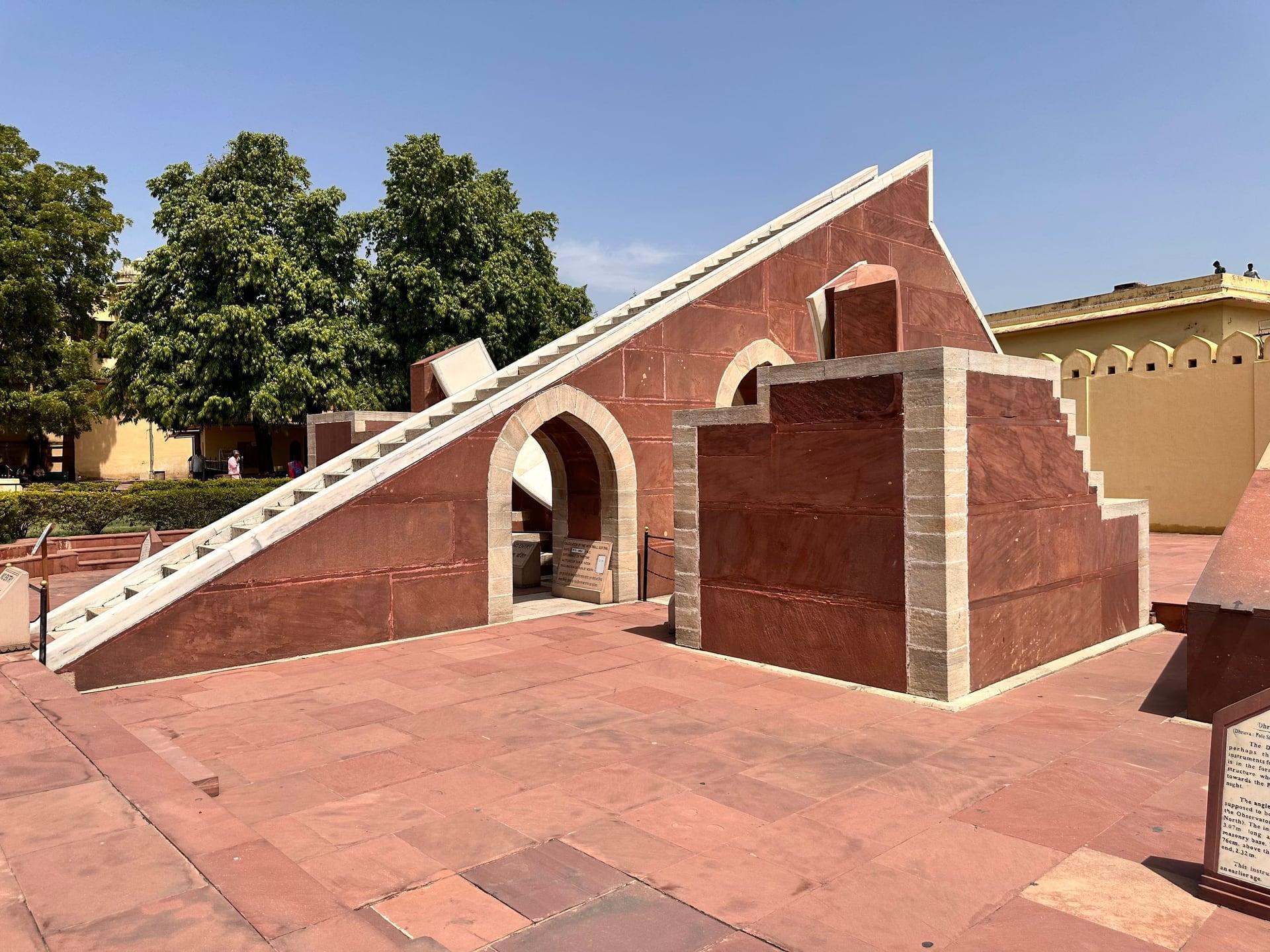
The great sundial made small enough to read. The Laghu Samrat Yantra, the small Samrat: a wall 6.9 m tall with curved scales under 3 m in radius whose smallest marks are 20 seconds apart, repaired in red stone in Ram Singh II's reign.
Details
Best Time to Visit
Morning from the 9:00 am opening, when the low sun throws long, sharp shadows on the western scales, or mid-afternoon, finishing by 5:00 pm. Open daily from 9:00 am; the closing time differs by source (5:00 pm Incredible India, 7:00 pm on the government's OBMS listing). A sunny day matters more than the hour: the time-reading needs a clear shadow. December and January highs about 22 to 25 C, lows about 8 to 10 C (IMD normals, 1991 to 2020); sunset about 5:33 pm in early December, 6:07 pm on 1 February, 6:42 pm at the end of March (computed). Checked 22 November 2026.
Pro Tips
- •Start just inside Jantar Mantar's north-east gate, on the road between the observatory and the City Palace, across from the palace's Gate 1, Virendra Pol.
- •Getting there by taxi, auto-rickshaw or a ride-hailing app: ask for Jantar Mantar, Jaipur. Jaipur Metro: Badi Chaupar station (Pink Line), about 450 to 500 m on foot through the walled city (OSM estimate). Badi Chaupar is an unsignalized roundabout: come up at the entrance on the side you need rather than cross it. Traffic keeps left, and drivers do not reliably stop, even at crossings (Government of Canada travel advice, updated 6 November 2026). Checked 22 November 2026.
- •The entry ticket is NOT included. Jantar Mantar's own ticket (from 1 January 2026): Indian adult Rs 100, Indian student Rs 50, foreign adult Rs 600, foreign student Rs 300; children below 7 free. The Jaipur composite ticket (Rs 550 / 180 / 1,700 / 800) shows on Amber Fort, Hawa Mahal, Jantar Mantar, Nahargarh, the Albert Hall Museum and Isarlat; its validity is not on the portal. A 10-day pass for all department sites in Rajasthan is Rs 1,300 Indian, Rs 5,500 foreign. The City Palace is on neither. Buy at the counter or on the government's OBMS portal (obms-tourist.rajasthan.gov.in), which may not load from outside India. Decline unsolicited guides and ticket offers (Government of Canada travel advice). Checked 22 November 2026.
- •Hours: open daily from 9:00 am; closing 5:00 pm on India's tourism ministry page, 7:00 pm on the OBMS listing (capture of 9 October 2026). Plan to be finished by 5:00 pm, so start by about 4:00 pm. Checked 22 November 2026.
- •For the time-reading at stop 5 you need sun. Local noon, when the shadow vanishes into the wall, is about 12:13 pm on 22 November, 12:24 pm on 21 December and 12:40 pm on 15 February (computed): an hour or two either side is best for watching the shadow move. The sundial runs about 10 to 40 minutes behind your phone in winter.
- •Pair it with the City Palace (across the road; its own Trust ticket, not on the composite) and Hawa Mahal (a few minutes on foot; a department ticket, on the composite). Our Pink City walk covers the streets around them.
- •The government's portal lists only commercial filming fees for Jantar Mantar; no personal-photography rule is published. Ask before photographing anyone.
Safety & Precautions
- •Stay behind the railings: never climb an instrument's stairs, step into the pits or bowls, or touch the engraved scales. Low railings have guarded the instruments' entry points since the 2007 conservation works (nomination dossier).
- •The paths, pits and instruments are open stone and marble with little shade: glare and heat at midday even in winter. Bring sunglasses, a hat and water.
- •Weather and air: in December and January highs are about 22 to 25 C and lows about 8 to 10 C (IMD normals, Jaipur, 1991 to 2020); mornings are often hazy. Several Jaipur stations read 220 to 285 on the US AQI scale in early November 2026 (aqi.in): check the day's air quality index; a mask helps if you have asthma.
- •School and guided groups gather at the great sundial (stops 4 and 5) and the Jai Prakash bowls (stop 7): wait or walk round them.
- •Some of the route runs along the edges of instrument floors and across a paved square that maps do not show as paths: stay on the paving, and if a stretch is roped off, go round it.
- •A temple on the observatory's west edge and small shrines along its walls are places of worship: be respectful near them. Ask before photographing anyone.
- •Outside, the road at the gates carries cars, tour vehicles and e-rickshaws: cross with care.
Travel advisory: Exercise Increased Caution (Level 2).
Gallery
Related Reading
Go deeper on what you'll see, hear, and walk through.
Overview
Jaipur Travel Guide: Days, Transport, Tickets, Timing, and Safety
5 min
Overview
One Day in Jaipur: A Walkable Pink City and Amber Fort Itinerary
5 min
Thematic
Best History Walking Tours in Jaipur (2026)
3 min
Thematic
Jaipur: The City That Was Planned Before It Was Built
4 min
Companion
City Palace: The Museum Built Around a Home
5 min
Companion
Jantar Mantar: Instruments the Size of Buildings
5 min
Companion
Pink City: Why Jaipur Was Built as a Machine for Trade
5 min
Read the walk
The full story of Jantar Mantar: Instruments the Size of Buildings, in words. Prefer to listen? Play it narrated, from home or on location.
Introduction
Jaipur's Jantar Mantar is an observatory with no telescope. Its entry ticket is not included with this tour: buy it at the observatory's ticket counter or on the Rajasthan government's online booking portal. For foreign visitors it is six hundred rupees, and Jaipur's composite ticket covers it too.
Sawai Jai Singh the Second, the king who founded Jaipur, built it beside his palace, mostly in the late seventeen twenties and the seventeen thirties. It was one of five observatories he built across India, and UNESCO calls it the best preserved of India's historic observatories. Here, accuracy came from size. The bigger the arc, the wider each degree, and the more finely it can be divided. So the instruments are walls, bowls, drums and stairs, about twenty of them, and the greatest is a sundial about nineteen meters high.
This walk begins with the metal instruments by the gate, circles the giant sundial and reads the time from its shadow, then crosses the zodiac floor, the sunken bowls and the drums, and finishes at a small sundial you can read up close, beside the exit. There are eleven stops over about half a kilometer, about a third of a mile, and it takes about fifty minutes. It is flat, mostly on paving, with no road to cross.
The observatory is open every day from nine in the morning. Official listings give different closing times, so plan to finish by five. The instruments need sun: on a bright day the shadows are sharp. Stay behind the railings; the stairs and pits are for the instruments, not for visitors.
From December to February the days are mild and the mornings cool and often hazy. Check the day's air quality index; a mask helps if you have asthma. The stone and marble reflect the midday sun.
When you arrive at Unnatamsa Yantra, begin with stop one.
1. Unnatamsa Yantra
Have your ticket ready: it is checked at or near this gate. Close to the gate, a huge metal ring hangs from a beam between two tall pillars, over a round pit with steps cut into it. This is the Unnatamsa Yantra. Yantra means instrument.
The ring is more than five meters across, and it turns on a vertical axis. An observer stood in the pit, swung the ring to face a star, and sighted through a tube at its center. The mark on the rim gave the star's height above the horizon. It may be one of Jai Singh's original instruments. Its great wooden beam has sagged with age.
Now find the corner of the big square platform with a circle drawn on it. Beside that corner, three round pillars carry a large metal disc. That is the Yantra Raj, the king of instruments: an astrolabe about two and a half meters tall, engraved for this latitude. The experts who evaluated the observatory for UNESCO called it probably the largest instrument of its type in the world.
Jai Singh did not invent these tools. Rings and astrolabes were old. What he did, here and at four other observatories, was build known instruments far bigger than any hand could hold. Everything past this gate is that idea, in stone.
Follow the route along the north path, past the big square platform.
2. Dakshinottara Bhitti Yantra
Beside the path ahead stands a narrow block of masonry, a little over seven meters high, with stairs up its sides. On the face toward you is a white marble semicircle; on the far face are two quarter circles. This is the Dakshinottara Bhitti Yantra, the north south wall.
It measured one thing, carefully: how high the sun stood at the moment it crossed the meridian, the line from north to south, at local noon. Do that every day and you follow the seasons.
It was not built here. In the reign of Ram Singh the Second, in repairs finished by about eighteen seventy six, a new road cut across the observatory's north west corner, and this wall stood in its way. It was taken apart piece by piece and rebuilt here, lined up with the axis of the giant sundial further on. That is the rule of the whole site: where an instrument stands matters less than which way it faces.
The stairs are for the instrument, not for visitors. Stay behind the railings.
Follow the route down the path beside this wall, to the corner of the big platform.
3. Disha Yantra
The big square platform beside you, raised a little above the path, has a circle about thirty meters across laid into it in red stone, with lines crossing at its center. This is the Disha Yantra. Disha means direction.
Every other instrument here has a known job. This one does not. The observatory's own nomination to UNESCO says plainly that its function is not clear. Over the years it has been called a horizontal dial, a building for a water machine, and Jai Singh's Seat, though nothing shows that he sat here.
The favorite theory is practical. The circle has the same radius as the curved scales of the giant sundial you are about to meet. It may have been a template, a full size drawing on the ground, for cutting and fitting their marble. Restoration work before its World Heritage listing also uncovered rings of stone within it, perhaps for leveling with water. Both are theories.
So a place built for exactness keeps one plain unknown. It is a good thing to stand beside.
Follow the route along the main path, then down the side of the giant sundial.
4. Great Samrat Yantra
Turn toward the great triangular wall rising beside the path, its sloping top edge climbing to a small pavilion. This is the Samrat Yantra, the great sundial, and the long curved band of marble below it, nearest you, is one of its two scales.
The wall is the gnomon, the part that casts the shadow. It rises about nineteen meters above the ground and goes three and a half meters further down, because the whole instrument stands in a pit. Its sloping edge is about fifty meters long. The observatory's nomination to UNESCO calls it the largest equinoctial sundial in the world; the experts who evaluated it said probably the largest of its type. It was planned around seventeen thirty two and finished around seventeen thirty five.
Why so big? On a scale this size, each degree is wide enough to divide very finely. Size was precision.
There is more inside. Within the masonry under the curved scales are two dark chambers. Nine meters up, a metal plate with a pinhole lets in the noon sun, and its small bright image falls on an arc of marks. It is a camera inside a sundial, measuring the sun's position.
The nomination also records a tradition: on a full moon day in June or July, local scholars raised a flag on top of this wall at sunset, to read the wind and forecast the monsoon.
Never climb: the stair and the pit are behind railings.
Follow the route round the corner of the pit, to the side where the shadow tells the time.
5. Samrat Yantra: Reading the Time
Turn to face the great wall. From here it rises straight away from you, its top edge climbing toward the pole star, with the two curved scales lying in their pits on either side. This is how to read it. In the morning the sun is in the east, so the wall's shadow falls on the…
Full narration for this stop unlocks with the tour.
6. Rashivalaya Yantra
Across the pale floor ahead stand twelve small sundials, each a triangle with its curved scales, and no two of them tilted the same way. This is the Rashivalaya Yantra. Rashi means a sign of the zodiac. There is one instrument for each of the twelve signs. Each is set at its…
Full narration for this stop unlocks with the tour.
7. Jai Prakash Yantra
On the raised platform nearby, two white bowls are sunk into it side by side, each with wires stretched across its top. This is the Jai Prakash Yantra, named for its builder. Imagine the sky as a dome over your head, then turn it inside out and press it into the earth. Each…
Full narration for this stop unlocks with the tour.
8. Kapala and Chakra Yantras
On the low white platform beside the path are two smaller bowls, with two metal rings on posts between them. The bowls are the Kapala Yantra. A survey of nineteen eighteen called this design peculiar to Jaipur. The western bowl observes: it reads the sun's position and the…
Full narration for this stop unlocks with the tour.
9. Ram Yantra and Digamsa Yantra
You have just passed two large round drums, open to the sky, each with a pillar at its center. They are the Ram Yantra. Between them and the path, a small pillar stands inside two low ring walls: the Digamsa Yantra. To place a star you need two numbers: how high it stands above…
Full narration for this stop unlocks with the tour.
10. Narivalaya and Dhruva Darshak
Close beside you stands a tilted round stone drum with a dial on each face, one face tilted up and the other down. This is the Narivalaya Yantra. Both faces are set parallel to the equator, each with a rod at its center. From the spring equinox, around the twenty first of…
Full narration for this stop unlocks with the tour.
11. Laghu Samrat Yantra
Turn round. The long wall with the stepped sloping edge, its high end nearest you and a curved scale on each side near its middle, is the Laghu Samrat Yantra, the small Samrat. The exit gate is just behind you. It is the same instrument as the giant you met earlier, a sundial…
Full narration for this stop unlocks with the tour.
- Measuring angular height of an object in the sky, Jantar Mantar, Jaipur, India — Srilakshmi1991, CC BY 4.0 · source
- Jantar Mantar in Jaipur in India — Gerd Eichmann, CC BY 4.0 · source
- This is a photo of ASI monument number — Chetan, CC BY-SA 3.0 · source
- Dakshino Bhitti Yantra, dual sundial measuring the position of a celestial body in relation to the meridia. — Daniel Villafruela., CC BY-SA 3.0 · source
- Seen from the Disha Yantra the Vrihat Samrat Yantra ,staircases whose calibrated steps serve as an astrolabe for observing the sky — Daniel VILLAFRUELA, CC BY-SA 3.0 · source
- Rashivilaya Yantra, Jantar Mantar astronomical observatory in Jaipur — Jakub Hałun, CC BY-SA 4.0 · source
- Jaya Prakash Yantra of Jantar Mantar of Jaipur — Chainwit., CC BY 4.0 · source
- In the Jantar Mantar at Jaipur, scientists created two marble hemispherical structures in the ground, each representing one half of the sky — Pramiti, CC BY-SA 4.0 · source
- Rama Yantra gnomon and Chakra Yantra at the Jantar Mantar astronomical observatory in Jaipur — Jakub Hałun, CC BY-SA 4.0 · source
- Kapali yantra B,Jantar mantar ,Jaipur — Swapnil.Karambelkar, CC BY-SA 4.0 · source
- Rama Yantra gnomon at the Jantar Mantar astronomical observatory in Jaipur — Jakub Hałun, CC BY-SA 4.0 · source
- yantra,Jantar mantar ,Jaipur Front view 1 — Swapnil.Karambelkar, CC BY-SA 4.0 · source
- Laghu Samrat Yantra (Small Sundial) at Jantar Mantar, Jaipur. More information — Vssun, CC BY-SA 3.0 · source
Images may be cropped or resized. Other photos via Unsplash and Pexels.