A walk through Munich, Germany that reads a Bavarian genius no other city shares: the art of drinking beer outdoors, under chestnut shade, on ground that rulers opened, again and again, to everyone.
Start · Hofbräuhaus am Platzl: the historic state beer hall
DirectionsStops
- 1
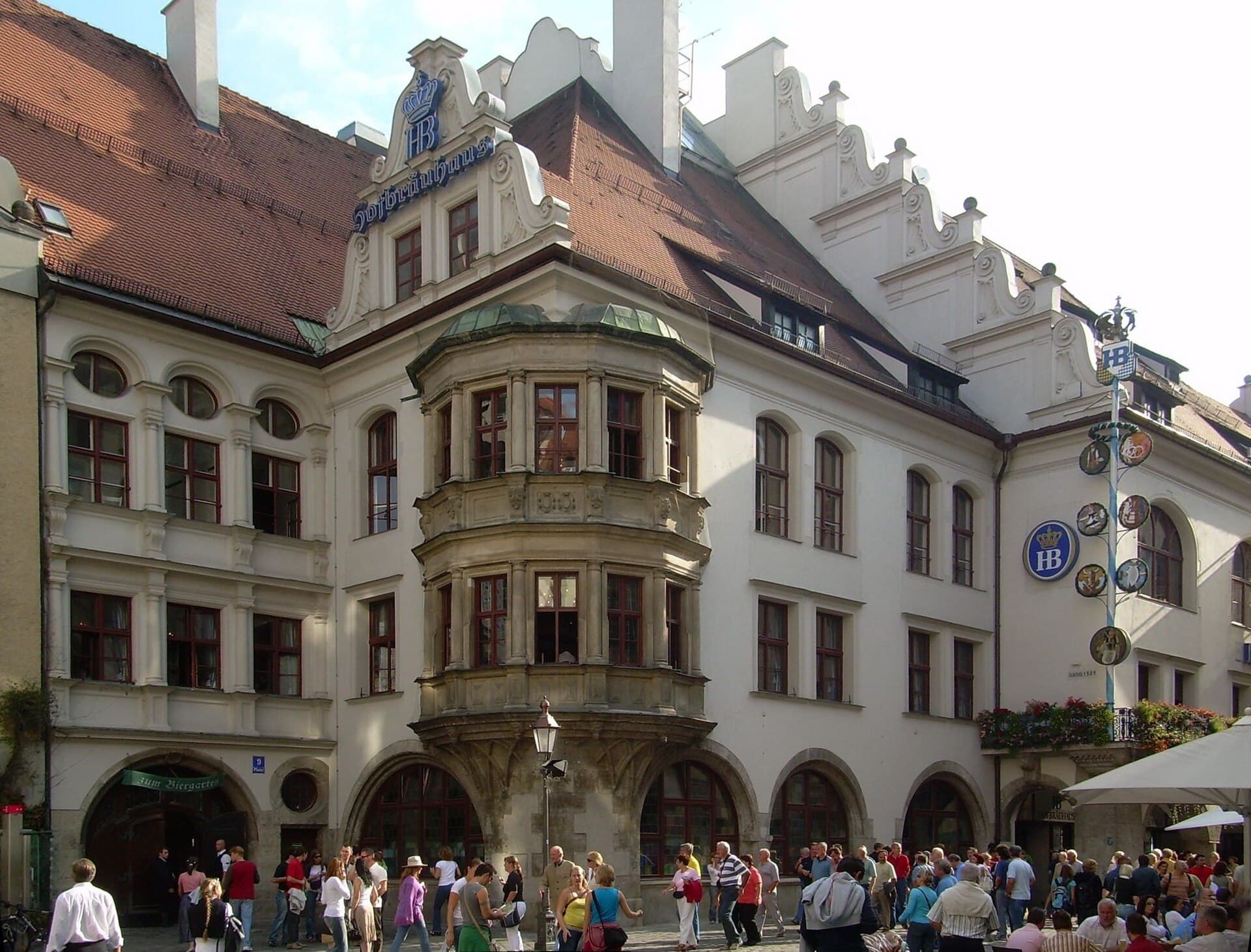
Hofbräuhaus am Platzl: the historic state beer hall
The vaulted ducal court brewery on the Platzl, founded in the late fifteen hundreds and opened to the general public two centuries later, where the beer-hall idea took its enclosed, communal form.
- 2
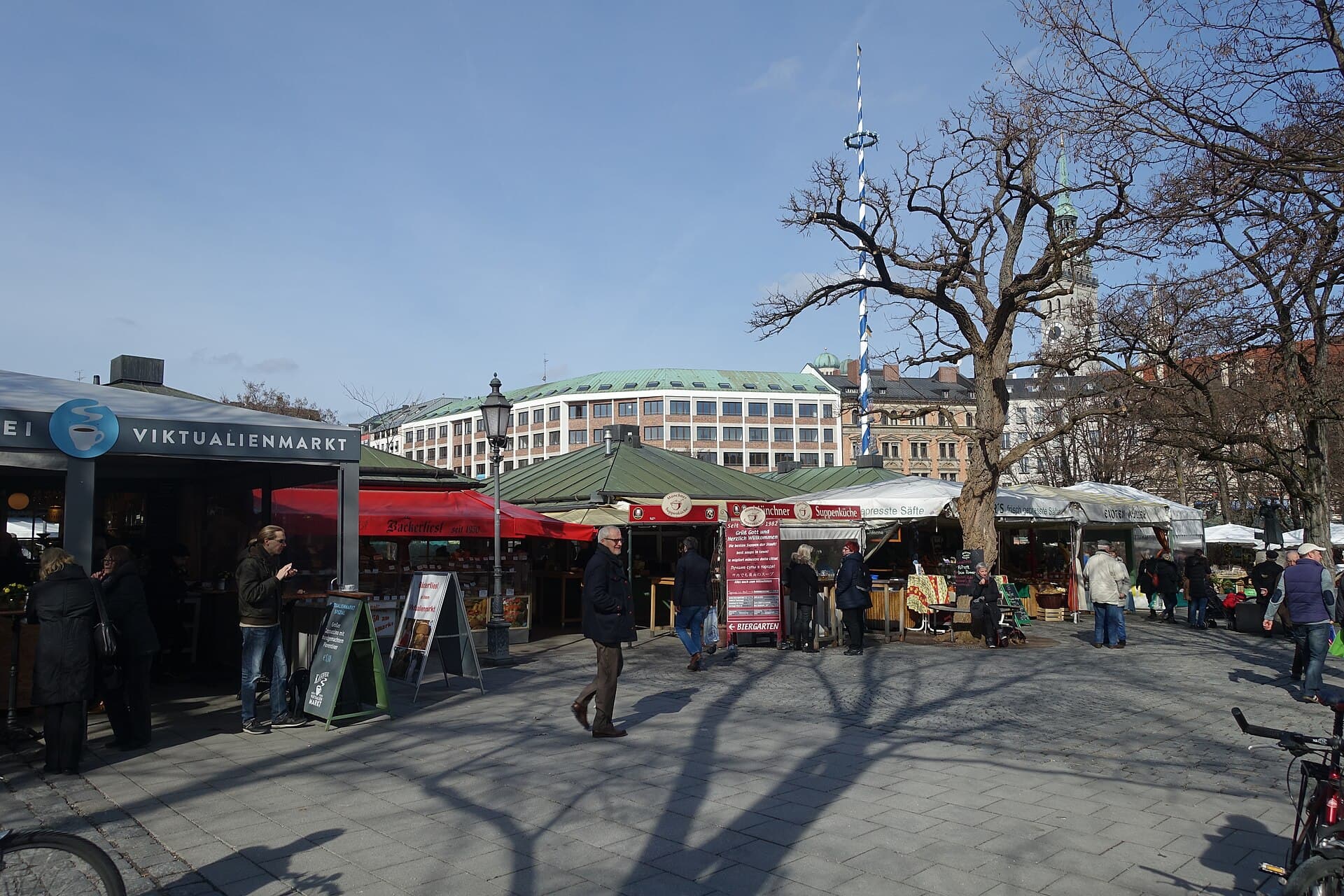
Viktualienmarkt: the open-air market and its beer garden
A daily open-air food market with a painted maypole, moved here from Munich's main square by royal decree in the early eighteen hundreds, and home to a beer garden woven into the stalls.
- 3
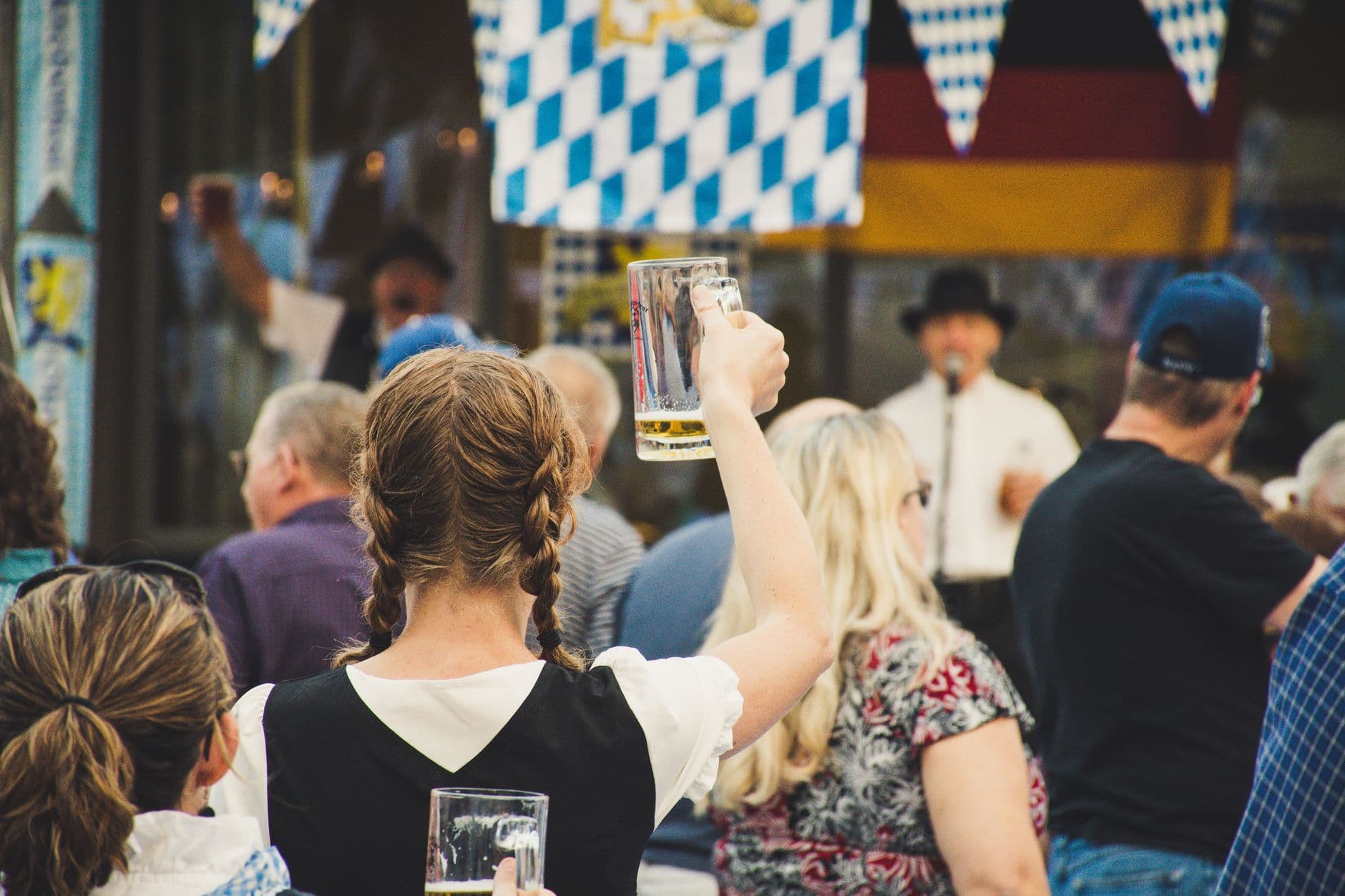
The Reinheitsgebot: the Bavarian Beer Purity Law of fifteen sixteen
A thematic pause on the fifteen-sixteen decree that limited beer to water, barley, and hops, issued jointly by two Bavarian dukes and still shaping the beer in every mug around you.
- 4
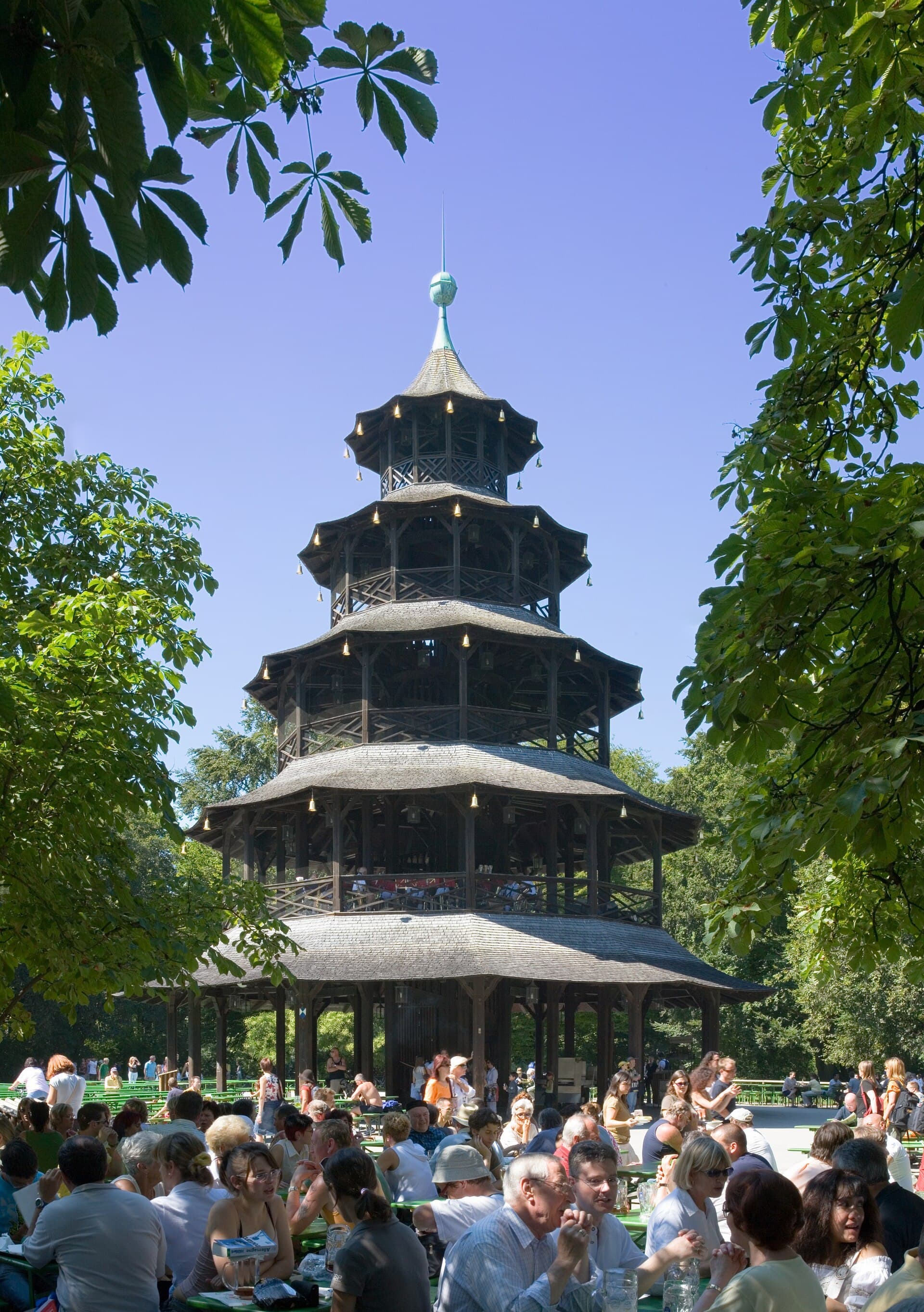
Englischer Garten and the Chinesischer Turm beer garden
A vast royal hunting ground opened as a public park in the late seventeen hundreds, and the pagoda-shaped Chinese Tower whose beer garden seats thousands beneath the trees.
- 5
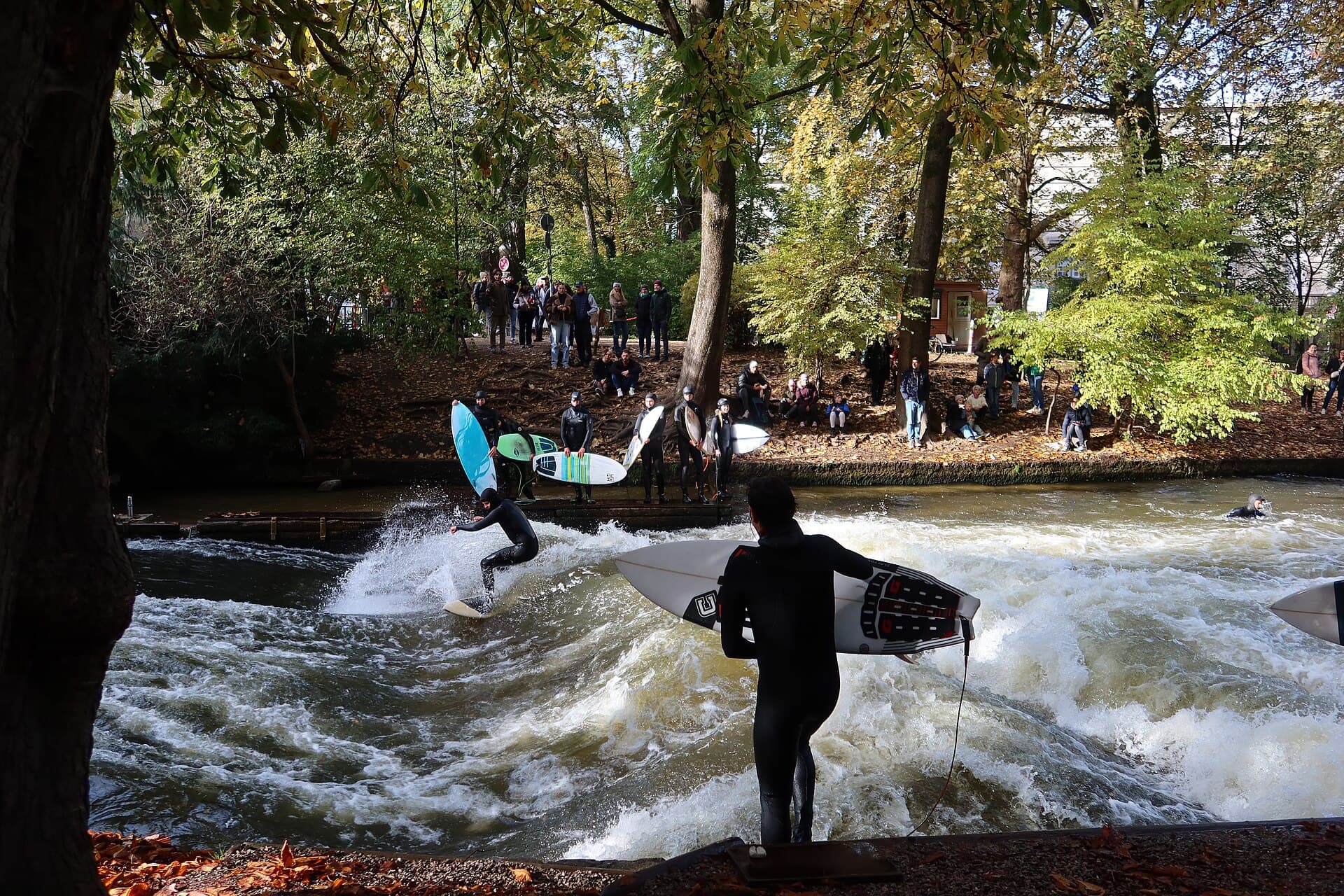
The Eisbachwelle: the standing wave surfers ride downtown
A permanent standing wave on an artificial channel at the park's southern edge, surfed since the early nineteen seventies and a celebrated everyday spectacle in the middle of the city.
- 6
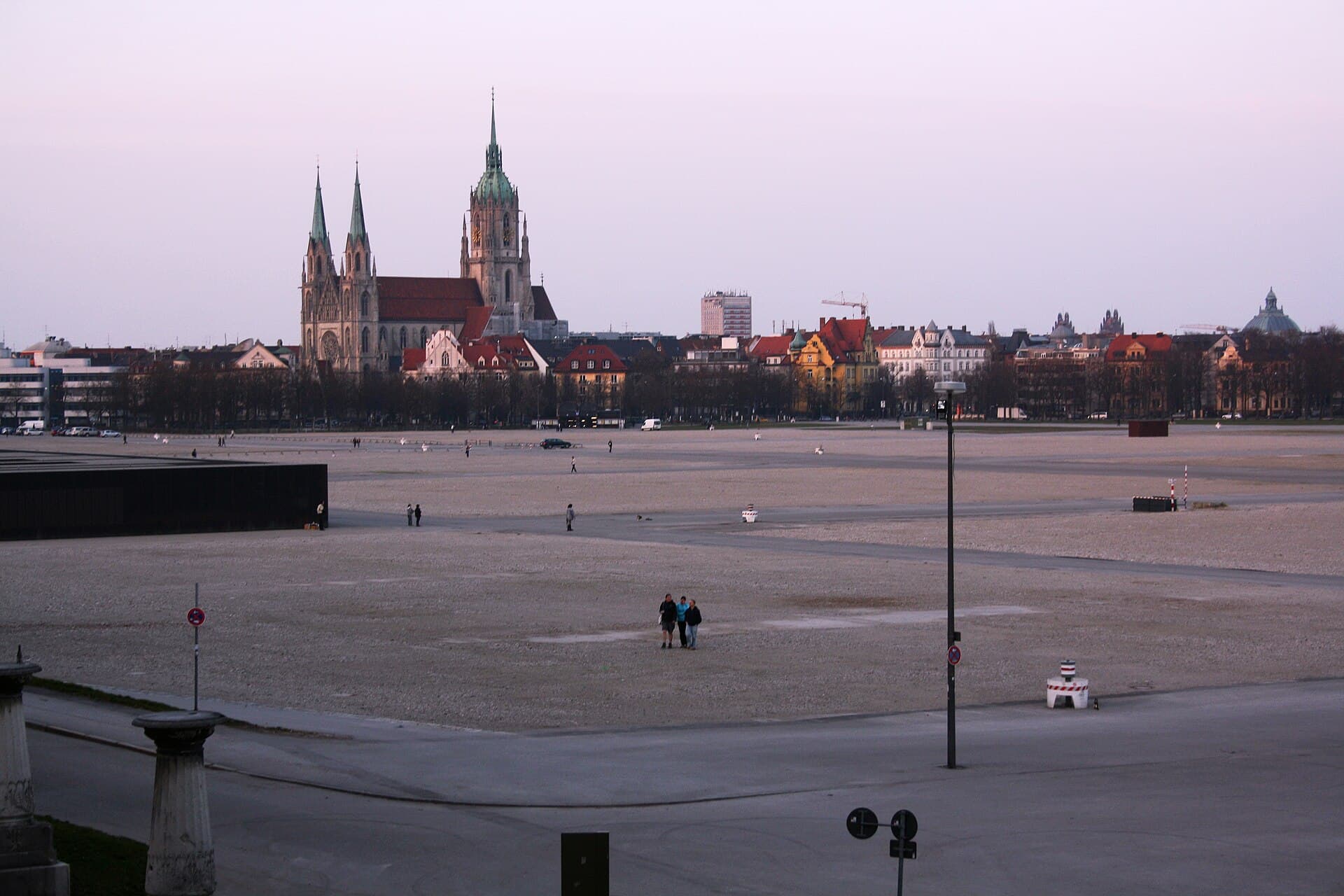
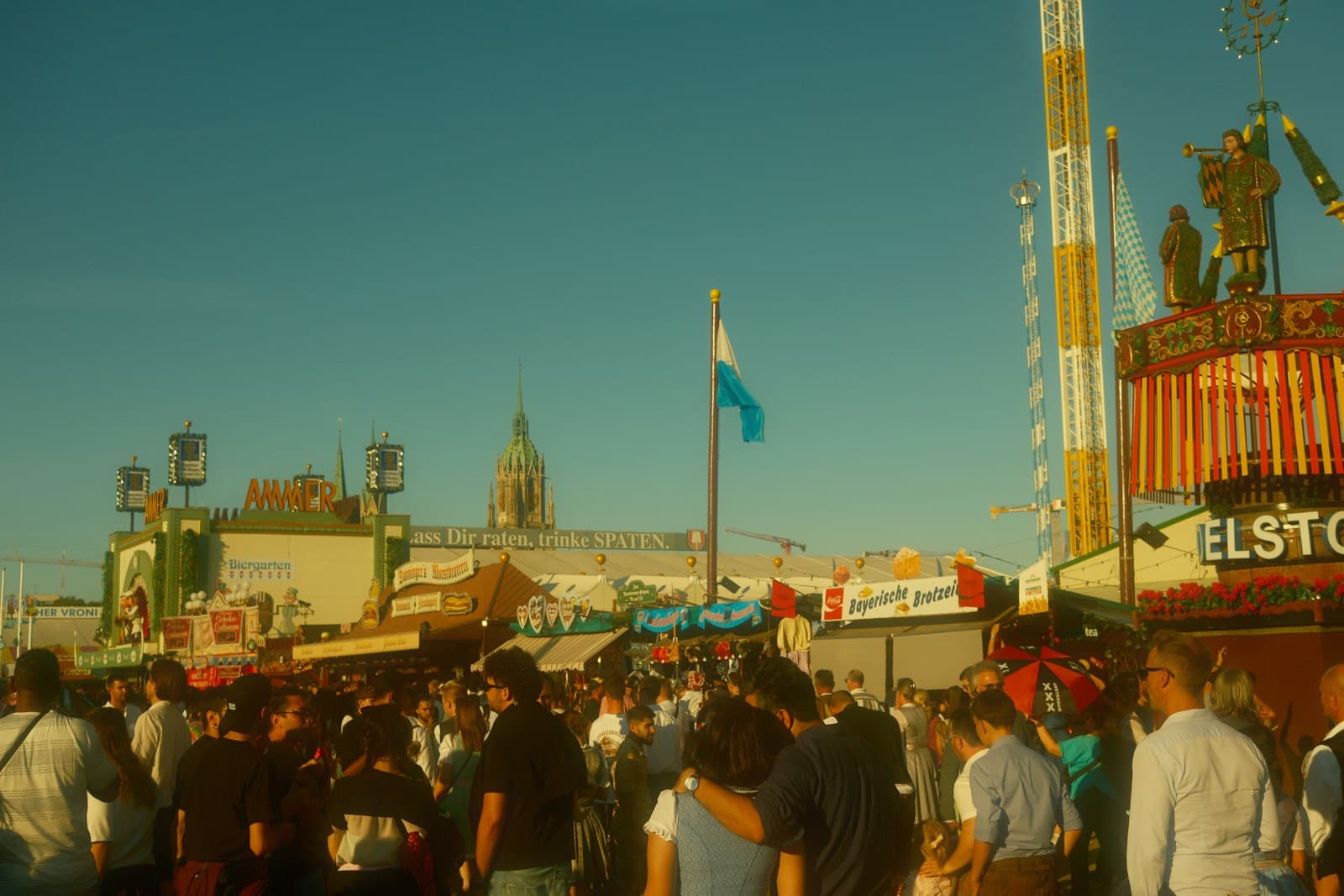
Theresienwiese: the meadow where Oktoberfest began
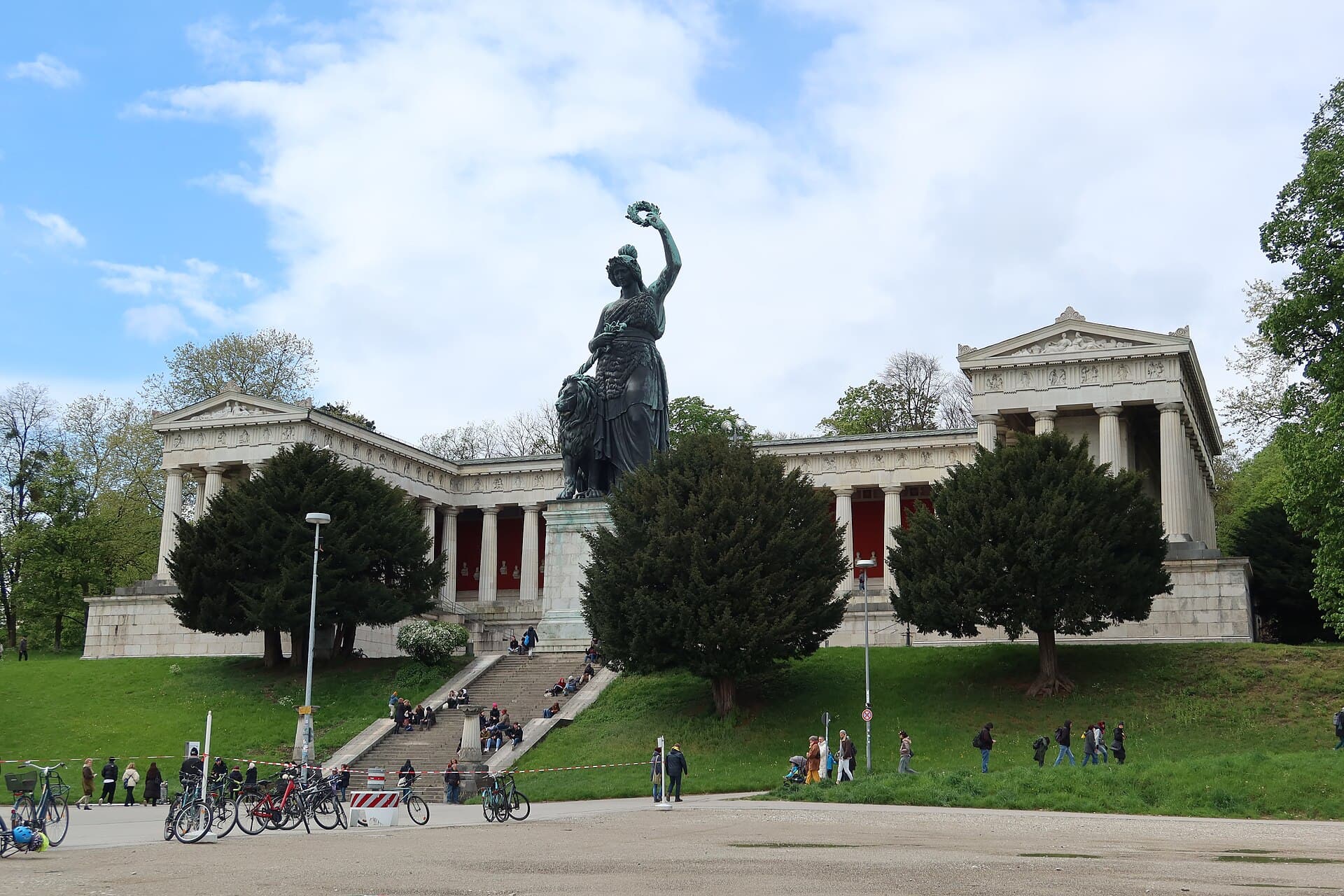
A wide public field named for a princess, where the first Oktoberfest celebrated a royal wedding in eighteen ten, watched over by the bronze Bavaria statue and the Hall of Fame.
- 7
The Munich breweries and the cellar-and-chestnut origin
A closing look at the six great Munich breweries and the eighteen-twelve royal compromise, born from riverbank cellars and chestnut shade, that made the shared bench the whole point.
Details
Best Time to Visit
Late spring through early autumn, when the chestnut trees are in full leaf and the beer gardens are open, is the heart of this walk. A late morning or early afternoon start on a weekday gives you softer crowds at the Hofbräuhaus and the Viktualienmarkt and warm light for the Englischer Garten and the Eisbach wave. Weekends and the Oktoberfest weeks in late September bring the biggest crowds; if you want the meadow and the market quiet, avoid them. Winter still rewards the walk indoors and along the park paths, though many beer gardens close for the season.
Pro Tips
- •Go early on a weekday if you want the Hofbräuhaus and the Viktualienmarkt calm, then let the crowds build behind you as you walk out toward the park.
- •In a Munich beer garden you may bring your own food to the self-service benches and buy only the beer, so pack bread, cheese, or fruit from the Viktualienmarkt stalls for the Chinese Tower.
- •Look for the shade of the horse-chestnut trees when you choose a bench; that canopy is the whole point of a Munich beer garden and stays cooler on a hot afternoon.
- •Wear comfortable, sturdy shoes: the old town is cobbled and the park paths are long, so this level three-kilometre walk is easy on your feet only if they are well shod.
- •At the Eisbach wave, watch from the bridge or the bank and give the surfers room; it is a celebrated spectacle to enjoy, not a spot to test yourself.
- •Carry a little cash, since some market stalls and beer-garden counters move faster with coins and small notes than with cards.
Safety & Precautions
- •Munich's cyclists and trams move fast and nearly silently: look both ways before stepping into any bike lane or across tram tracks, and never linger on the rails, which can also catch a shoe or wheel on the cobbles.
- •At the Eisbach the water is cold and strong and the banks have low or no railings; swimming is not allowed and the current is dangerous, so keep back from the edge and simply watch.
- •If you ride the U-Bahn or S-Bahn or a tram between points, validate your ticket before boarding or at the platform; fare inspectors are frequent and fines are steep.
- •Treat the beer gardens and meadows with the same care you would any shared public space, keep a sober and respectful manner, and remember that on hot days shade and water matter more than another round.
Travel advisory: Exercise Increased Caution (Level 2).
Gallery
Related Reading
Go deeper on what you'll see, hear, and walk through.
Overview
Best Self-Guided Walking Tours in Munich (2026)
3 min
Overview
Munich Travel Guide: Days, Transport, Timing, Safety, and Budget
6 min
Overview
One Day in Munich: A Walkable Morning-to-Evening Itinerary
9 min
Thematic
The City the Monks Named: How Munich Turns Privilege Into Public Life
7 min
Companion
The Chinese Tower Beer Garden: Munich's Whole Idea in One Clearing
6 min
Deep dive
Hofbräuhaus am Platzl: How a Duke's Private Brewery Became Munich's Public Beer Hall
6 min
Read
What to Eat in Munich
6 min
Read the walk
The full story of Englischer Garten: The Art of the Beer Garden, in words. Prefer to listen? Play it narrated, from home or on location.
Introduction
No city has turned drinking beer outdoors into a shared public art quite the way Munich has, and this walk is about how that happened. Over seven stops, roughly three hours of gentle walking and about eight and a half kilometres, you will move from the dense old town of Munich, in Bavaria, in southern Germany, outward to a royal park and an open meadow. The through-line is one repeated civic gesture: rulers who kept opening their own privileges to ordinary people. First a ducal brewery, then a court market, then a purity law, then a royal hunting ground thrown open as a park, and finally a wedding field that became a fairground. Along the way you will meet the idea Bavarians call Gemütlichkeit, that warm, unhurried, communal ease of sitting shoulder to shoulder with strangers. You will learn why the beer garden works the way it does, where a royal compromise once let breweries pour the beer while patrons brought their own bread and cheese, so the grand and the humble literally share a bench. This is a solo walk at your own pace. Every stop is short and skippable, and you can linger under the trees as long as you like. I will point out what is verified history and flag what is only legend, so you can trust what you carry away. Keep an ear out for chestnut shade, the scrape of a shared bench, and the reach of a painted maypole. When you arrive at the Hofbräuhaus am Platzl, begin with stop one.
1. Hofbräuhaus am Platzl: the historic state beer hall
Start here at the Platzl, and Platzl means little square. In front of you is the Hofbräuhaus, the historic state beer hall, and its name unpacks the whole story: Hof means court, Brauhaus means beer hall, so this was the court beer hall. As Wikipedia records, the brewery itself was founded in fifteen eighty-nine by Duke Wilhelm the Fifth of Bavaria, as the brewery to the old royal residence. For its first decades this beer belonged to the court. Ordinary Munich did not drink here. The change came in eighteen twenty-eight, under King Ludwig the First, when the general public was finally admitted. Hold onto that pattern, because you will see it again and again on this walk: a privilege that begins as a ruler's and is then handed to the city. Step inside if you like, into the vaulted ground floor. That great arched room, called the Schwemme, was the only part of the building to survive the bombing of the Second World War, and reconstruction was completed in the nineteen fifties. Notice the small lockers along some walls. Regulars keep their personal mugs there, part of a long tradition of the Stammtisch, the regulars' table. Beer arrives in a one-litre mug called a Mass. What I want you to feel here is the enclosed version of the idea. This is beer culture indoors, vaulted, communal, ducal in origin. The rest of the walk pushes that same idea outward into open air and open lawn, until the shared bench under the sky becomes the whole point. Take your time, then carry on toward the market.
2. Viktualienmarkt: the open-air market and its beer garden
Now the idea steps outdoors. This is the Viktualienmarkt, and Markt means market. Around you spread the stalls, well over a hundred of them, selling flowers, fruit, game, poultry, spices, cheese, and fish, a daily market that runs every day but Sundays and holidays. It has not always stood here. As the city tells it, and as Wikipedia records, this market was moved by decree of King Maximilian the First Joseph, dated the second of May, eighteen oh seven. The main square nearby, Marienplatz, had simply grown too small to hold the produce trade, so the market was relocated and later expanded in the eighteen twenties. Note that name carefully: Maximilian the First Joseph. It was not Ludwig, and it had nothing to do with the beer purity dukes you will meet at the next stop. Look for the maypole, the Maibaum, rising painted and banded above the stalls. It is a living Bavarian tradition, a village pole planted in the middle of a modern city market. And here, tucked among the stalls, is a beer garden. Munich tourism sources often say this is one of the few beer gardens in the city where the beer rotates among all of Munich's major breweries, rather than serving just one house. I will flag that as tradition and as widely reported, not as something the market's own history strictly documents, so take it as local lore worth knowing. What matters is the shape of the thing. A royal decree again opened a court privilege, the produce trade, to the whole city, and around it grew exactly the kind of shared, open-air table this walk is chasing. Wander the aisles, then move on.
3. The Reinheitsgebot: the Bavarian Beer Purity Law of fifteen sixteen
Pause here, in the beer heart of the old town, for an idea rather than a building. This is where I want to talk about the Reinheitsgebot, the Bavarian beer purity law. There is no monument to it here, but its logic is in every mug on this walk. As Wikipedia records, it was proclaimed on the twenty-third of April, fifteen sixteen, in the town of Ingolstadt, by two Bavarian dukes ruling jointly: Wilhelm the Fourth and Ludwig the Tenth. It permitted only three ingredients in beer: water, barley, and hops. That is the famous rule. Now, two honest footnotes. First, yeast was in fact used in brewing at the time, but the text does not name it, because its biological role was not yet understood. Second, and this is the one people get wrong, you will often hear this called the oldest food-quality regulation still in force. Frame that carefully. Wikipedia itself notes that claim is not really accurate, because earlier food-safety laws trace all the way back to ancient Rome. So call it commonly described that way, not proven that way. The law also loosened over time. Within decades Bavaria allowed things like coriander and wheat, and a modern revision permits yeast and other agents. What I love about this stop is how it fits the walk's spine. A pair of rulers, again, reached down and set a standard for something ordinary people drank every day. The purity law is the invisible backbone under every shared bench you will sit on. Hold that thought as we leave the old town and head for open green.
4. Englischer Garten and the Chinesischer Turm beer garden
Now the walk breaks fully into the open. This is the Englischer Garten, and Garten means garden. It is one of the world's largest urban parks, about three point seven square kilometres of lawn, stream, and woodland, and it began, like so much here, as a royal privilege opened to…
Full narration for this stop unlocks with the tour.
5. The Eisbachwelle: the standing wave surfers ride downtown
Here is the surprise. At the southern edge of the Englischer Garten, where an artificial channel called the Eisbach runs beneath a bridge near the Haus der Kunst, and Haus means house, the water folds up into a permanent standing wave. Eisbach means ice brook, and Welle means…
Full narration for this stop unlocks with the tour.
6. Theresienwiese: the meadow where Oktoberfest began
Now the open ground reaches its widest. This is the Theresienwiese, and Wiese means meadow. It is named for Princess Therese of Saxe-Hildburghausen, and its story is the clearest version of this walk's whole idea. As Wikipedia records, the first Oktoberfest was held here on the…
Full narration for this stop unlocks with the tour.
7. The Munich breweries and the cellar-and-chestnut origin
Let us close by naming where the beer garden itself was born, and why. As Wikipedia records, in the nineteenth century Munich's breweries dug cooling cellars into the banks of the Isar, and to keep the beer colder still they layered gravel over the cellars and planted…
Full narration for this stop unlocks with the tour.