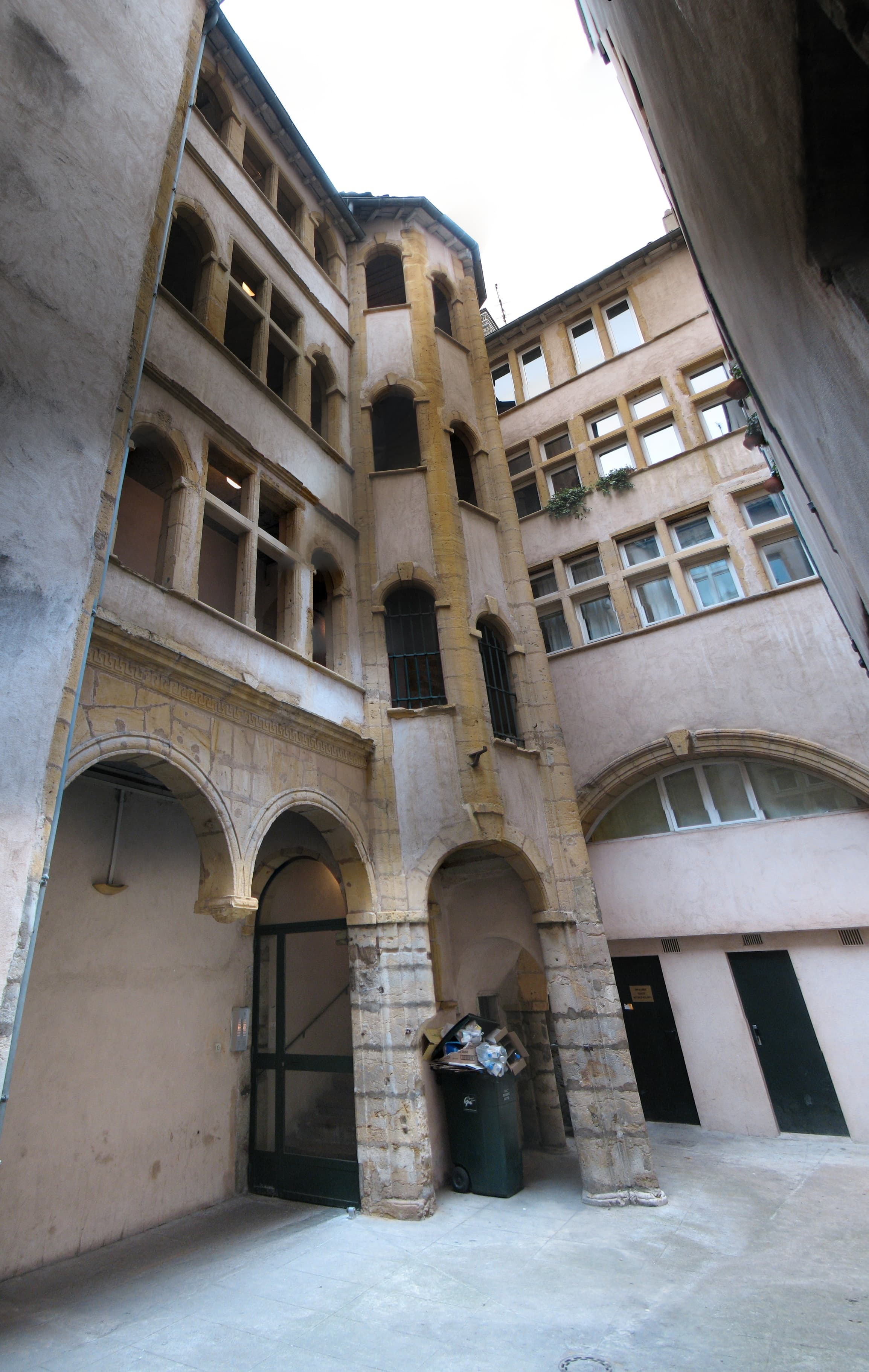
Seven stops. About one and a half kilometres along the rue Saint-Jean spine and the Saône embankment. The largest Renaissance ensemble in France, approximately two hundred and fifteen traboule passages cut through the interiors of Italian-banker silk-merchant townhouses, and the four-century doubling that made the same passages, in nineteen forty-two, the circulation network of the Lyon Resistance.
Start · Place Saint-Jean: The Spine of the Renaissance Quarter
DirectionsStops
- 1

Place Saint-Jean: The Spine of the Renaissance Quarter
Cathédrale Saint-Jean-Baptiste, seat of the Primate of the Gauls. Construction 1175 to 1480 across the Romanesque-to-Flamboyant-Gothic transition. Houses the Lyon astronomical clock, first documented 1383, partially destroyed in the 1562 Wars of Religion raid, reconstructed 1661 by Guillaume Nourrisson.
- 2

Place du Change: The Commercial Heart at the Saône-Bridge Head
Medieval and Renaissance financial heart of Lyon at the Saône-side foot of the Pont du Change, the only bridge over the Saône until the 17th century. Place de la Draperie in 1487. First formal Loge du Change 1631 to 1653 by Simon Gourdet; enlarged 1748 to 1750 by Jacques-Germain Soufflot. Reassigned as Protestant Temple du Change in 1803.
- 3

Hôtel Bullioud: Where the French Renaissance Arrives in Lyon
8 rue Juiverie. Renaissance hôtel particulier connecting two 15th-century houses owned by Antoine Bullioud, treasurer of Brittany. The inner-courtyard Galerie Philibert Delorme was commissioned in 1536 from the 22-year-old Lyonnais architect upon his return from three years in Rome. Four corbelled trompes (squinches) cantilever the gallery off the walls. Monument Historique.
- 4

Hôtel de Gadagne: The Florentine Merchant-Banker Made Concrete
Place du Petit Collège. The most extensive Renaissance complex in Vieux Lyon, about 6,500 m² across six adjoining buildings around a central courtyard. Purchased circa 1470 by the Pierrevive brothers (Italian merchants from Piedmont); Renaissance expansion 1511 to 1527; rented from 1538 and purchased outright in 1545 by the Florentine merchant-banker family Guadagni, gallicised to Gadagne. Houses the Musée d'Histoire de Lyon and the Musée des Marionnettes du Monde.
- 5

La Longue Traboule: Walking the Grammar
Entry 54 rue Saint-Jean, exit 27 rue du Bœuf. The longest traboule of Vieux Lyon. Four contiguous Renaissance buildings, four interior courtyards, about 50 metres of east-west passage. Built across the 15th to 17th centuries as the contiguous townhouses were constructed and connected. Approximately 215 traboules and courtyards in Vieux Lyon per the Lyon Tourist Office canonical figure; about 40 publicly accessible under a 1990 city-private-owner agreement.
- 6

Maison des Avocats: The Preservation Fight That Kept the Network Walkable
60 rue Saint-Jean, courtyard onto rue de la Bombarde. Eastern building first half of the 14th century for André Berchet (dit de la Croys); converted to the inn Ostel de la Croys in 1406; renamed Auberge de la Croix d'Or in 1471. Courtyard building added circa 1516 with three superimposed Tuscan-arcade galleries. Monument Historique 1937. Saved 1968 by the SEMIRELY. Sold 2004 to become the Musée Miniature et Cinéma, opened 10 February 2005.
- 7

Saône Vantage: Silk to Resistance, Across the Rhône
Quai Romain-Rolland, west bank of the Saône, with sightline east across the Presqu'île and the Rhône to 14 avenue Berthelot in Lyon's 7th arrondissement. The CHRD (Centre d'Histoire de la Résistance et de la Déportation) opened in 1992 on the site of the former École du Service de Santé Militaire, which served as the Gestapo's Lyon headquarters under SS-Hauptsturmführer Klaus Barbie from spring 1943 to the Liberation of Lyon in September 1944.
Details
Best Time to Visit
Late morning to mid-afternoon on a weekday, ideally Tuesday through Saturday. The traboules close around six or seven in the evening under the 1990 city-private-owner agreement, so plan to enter the Long Traboule at Stop 5 no later than five in the afternoon. Sundays bring heavier foot traffic on rue Saint-Jean, especially around lunch; the cathedral and the rue Saint-Jean spine read most calmly mid-morning. Avoid Mondays if you want the Musée Gadagne or the Musée Miniature et Cinéma interiors, which close that day.
Pro Tips
- •The audio anchors on the exterior at every stop, and the Long Traboule at Stop 5 is the only stop that requires entering a building. You do not need to buy a museum ticket to follow the route; the Musée Gadagne and the CHRD are optional add-ons after the walk.
- •The Long Traboule entrance at 54 rue Saint-Jean is unmarked beyond a small sign. Push the door if it looks closed; the residents have agreed to keep it open during the published traboule visiting hours (roughly 9am to 7pm). Walk quietly through the courtyards. People live in these buildings, and the agreement that keeps the passages public is contingent on visitors respecting that.
- •The Hôtel Bullioud courtyard at Stop 3 is sometimes locked when the residents are away. If the gate is closed, the trompes are partially visible from the rue Juiverie archway entrance, and the same trompe-cantilever-gallery grammar reads at the Musée Gadagne courtyard at the next stop.
- •Stop 7 anchors on a sightline from the Saône embankment east toward avenue Berthelot. If you want to see the CHRD building itself, you can extend the route by about one kilometre: cross the Pont Bonaparte to the Presqu'île, walk south along quai Claude-Bernard, cross the Pont de l'Université to the 7th arrondissement, and arrive at 14 avenue Berthelot. The museum is open Wednesday to Sunday and is free on the first Sunday of the month.
- •Lyon Tourist Office runs a paid guided 'Traboules of Vieux Lyon' walk in French and in English that visits about eight traboules with longer interior dwell time than this audio tour. If you want to see more of the network after this walk, book through visiterlyon.com.
- •The rue Saint-Jean has a dense cluster of bouchons, the traditional Lyonnais small restaurants. They are a pleasure after the tour, not during; the audio anchors on the architectural register and the dates, and bouchon lunch service runs long.
- •Casa-style funiculars run from Vieux Lyon Saint-Jean metro station up to Fourvière and to Saint-Just. If you want to chain this tour with the Roman Lugdunum and Fourvière tour (a separate Roamer route), the funicular at the south end of rue Saint-Jean is the connection.
Safety & Precautions
- •The Long Traboule at Stop 5 crosses four privately owned residential buildings under a 1990 city-private-owner agreement. Speak quietly, do not enter individual apartment entrances, do not photograph through residents' windows, and do not loiter in the courtyards. The agreement that keeps these passages public depends on visitor restraint, and Vieux Lyon residents have raised concerns about over-tourism. Treat the walk through the four courtyards as a passage, not a museum.
- •The rue Saint-Jean spine and the courtyards inside the traboules are paved with original sixteenth- and seventeenth-century cobblestones, frequently uneven and slick when wet. Wear closed shoes with grip. The Long Traboule has low vaulted passages where taller walkers will need to duck.
- •The traboules are closed in the evening, typically from around 7pm. If you arrive at Stop 5 after closing, the entry door at 54 rue Saint-Jean will be locked, and the route bypass is to walk south on rue Saint-Jean to the rue du Bœuf intersection and continue to Stop 6 on the surface.
- •Stop 7 closes on a Saône-bank vantage that involves looking across to the 7th arrondissement east of the Rhône. The walk to the embankment from the Maison des Avocats is on a public sidewalk with cyclists on the protected lane; cross at the marked pedestrian signals.
- •Pickpocketing is documented on the rue Saint-Jean spine during peak hours (lunch and late afternoon). Keep wallets and phones in front pockets or zipped bags, especially when stopped to look up at façades or into courtyards.
Travel advisory: Exercise Increased Caution (Level 2).
Gallery
Related Reading
Go deeper on what you'll see, hear, and walk through.
Overview
Best Self-Guided Walking Tours in Lyon (2026)
4 min
Overview
Lyon Travel Guide: How Many Days, Getting Around, When to Go (2026)
5 min
Overview
One Day in Lyon: A Walkable Riverside Itinerary (2026)
5 min
Thematic
Best History Walking Tours in Lyon (2026)
3 min
Thematic
The City Silk Built: How One Fabric Made Three Different Lyons
4 min
Thematic
What to Eat in Lyon: A Food Guide (2026)
4 min
Companion
Vieux Lyon's Traboules: A Renaissance Trade Route That Became a Resistance Network
4 min
Deep dive
La Longue Traboule: Walking Through Four Buildings Without Touching a Street
4 min
Read the walk
The full story of Vieux Lyon's Hidden Passages: From Silk to Resistance, in words. Prefer to listen? Play it narrated, from home or on location.
Introduction
The merchant who passed through the Long Traboule in fifteen forty-five carrying a roll of Lyonnais silk, and the Resistance courier who passed through it in March nineteen forty-four carrying a sealed envelope, occupied the same physical space. Same passages. Two regimes. Four centuries apart.
Vieux Lyon's Renaissance silk-merchant townhouses connect through more than two hundred hidden traboule passages cut through their interiors, and the tour you think you are taking through sixteenth-century commerce is also, since nineteen forty-two, the network through which the Lyon Resistance moved bodies, documents, and arms under the noses of the Gestapo headquartered six blocks east, across the Rhône, in the requisitioned École de Santé Militaire on avenue Berthelot.
The Italian banker families who built these houses, the Pierrevives from Piedmont and the Guadagnis from Florence, settled here in the late fifteenth and sixteenth centuries when the four annual Lyon Fairs, established by the ordinance of Louis the Eleventh in fourteen sixty-two, made Lyon one of the great European financial centres. The merchants cut passages through their interiors to move silk and spices and bills of exchange between the rue Saint-Jean and the Saône embankment without using the public street. The Lyon Tourist Office counts approximately two hundred and fifteen of these passages in Vieux Lyon today.
Seven stops. About one point six kilometres. Roughly seventy-five minutes including stop dwell. From the cathedral forecourt north to Place du Change, then south through the Renaissance hôtels on rue Juiverie and Place du Petit Collège, into the Long Traboule at fifty-four rue Saint-Jean, on to the Maison des Avocats, and closing on the Saône bank.
When you arrive at Place Saint-Jean, begin with stop one.
1. Place Saint-Jean: The Spine of the Renaissance Quarter
Stop one. You are standing in Place Saint-Jean, in front of the west façade of the Primatial Cathedral of Saint John the Baptist. Per the Wikipedia entry on Lyon Cathedral and the Lyon Tourist Office, the cathedral is the seat of the Primate of the Gauls, the senior ranking of the French Catholic clergy. Construction ran from eleven seventy-five to about fourteen eighty, three hundred years of building across the transition from late-Romanesque to Flamboyant Gothic, with the west façade finished in the final quarter of the fifteenth century.
Look up at the façade. The lower courses, the carved portals, the rose window. The stone is the local Lyonnais limestone the merchant townhouses behind you are also built from. The same quarries fed the cathedral and the houses on the rue Saint-Jean across three hundred years of construction.
Now step inside, if you wish, to look at the astronomical clock. The clock is first documented in cathedral records in thirteen eighty-three, partially destroyed by the Baron des Adrets during the fifteen sixty-two Wars of Religion raid on the cathedral, reconstructed in sixteen sixty-one by the Lyonnais master clockmaker Guillaume Nourrisson, and attacked again with a metal rod on the twenty-third of March two thousand and thirteen. Per the Wikipedia entry on the Lyon astronomical clock and Atlas Obscura, it is one of the oldest surviving astronomical clocks in Europe, and it still chimes the hour.
The cathedral forecourt is the orientation anchor for the tour. The narrow street running north from here, the rue Saint-Jean, is the spine of Vieux Lyon, leading to Place du Change at the medieval Saône-bridge head. Renaissance silk-merchant townhouses on both sides, the Italian banker class who built them in the fifteenth and sixteenth centuries, and the traboule passages cut through their interiors. That is what we are walking.
The thesis sits here, on the cathedral forecourt, before any traboule. The same Renaissance silk-merchant quarter you are about to walk through served, four centuries later, as the circulation network of the Lyon Resistance. We will read both registers on the same stones.
Walk north on rue Saint-Jean. About three hundred and twenty metres up the spine. You will arrive at an open square at the foot of the medieval Saône bridge, with a free-standing classical building. That is Place du Change.
2. Place du Change: The Commercial Heart at the Saône-Bridge Head
Stop two. You are now at Place du Change. Look around the square. The free-standing classical building in front of you is the Loge du Change, today the Temple du Change.
Per the Wikipedia French entry on Place du Change, the Ville de Lyon Patrimoine portal, and the Visit Lyon archive, this square sat at the foot of the Pont du Change, the only bridge over the Saône until the seventeenth century. That single fact made this the commercial axis of medieval and Renaissance Lyon. Money-exchange operations are attested on this site from the thirteenth century. The square is recorded as Place de la Draperie in fourteen eighty-seven.
The four annual Lyon Fairs, established by the ordinance of Louis the Eleventh in fourteen sixty-two, made Lyon one of the great European financial centres of the sixteenth century, alongside Antwerp and Genoa. Italian bankers, Florentine and Piedmontese, settled in this quarter to handle the bills of exchange the fairs generated.
The building you are looking at is younger. The first formal exchange building, the Loge du Change, was constructed between sixteen thirty-one and sixteen fifty-three by the Parisian architect Simon Gourdet, called Griard. Roughly a century later, between seventeen forty-eight and seventeen fifty, the building was enlarged by Jacques-Germain Soufflot, the architect who later designed the Paris Panthéon. Soufflot lengthened the structure and added a story. In eighteen oh three the building was reassigned as a Protestant temple, and it has functioned as the Temple du Change ever since.
Now notice the Saône a few metres behind the building. The river is the commercial substrate of everything we are about to walk. The silk arrived by boat on this water. The bills of exchange were settled in the building behind you. The Italian banker who walked from here south down the rue Saint-Jean to his townhouse on Place du Petit Collège in fifteen forty-five carried, in his ledger, the financial substrate of the architecture this tour is about to read.
Now walk south, back the way you came on rue Saint-Jean, then take the first right onto rue Juiverie. About two hundred metres. The house at number eight, with a small archway opening into a courtyard, is the next stop. Hôtel Bullioud.
3. Hôtel Bullioud: Where the French Renaissance Arrives in Lyon
Stop three. You are standing at eight rue Juiverie, in front of the Hôtel Bullioud. The archway opens onto a small interior courtyard. Step through, if the gate is open, and look up.
What you are looking at is a two-storey gallery cantilevered off the inner walls of the courtyard on four corbelled squinches. The squinches, called trompes in French, are the curved stone brackets that throw the gallery out from the wall, leaving the courtyard floor unencumbered. They are the load-bearing innovation of this building.
Per the Wikipedia French entry on the Hôtel de Bullioud, the Ville de Lyon Patrimoine portal, and the Tribune de Lyon historical feature, the patron was Antoine Bullioud, treasurer of Brittany, who owned two existing fifteenth-century houses on this site and wanted them connected through the courtyard. In fifteen thirty-six, Bullioud commissioned the gallery from a twenty-two-year-old Lyonnais architect named Philibert Delorme, who had just returned from three years studying antique vaulting in Rome.
Delorme is the architect to hold in mind. Per the Wikipedia entry on Philibert de l'Orme, he would later become royal architect to Henri the Second, design the Château d'Anet for the king's mistress Diane de Poitiers, draw the first plans for the Tuileries, and author Le Premier Tome de l'Architecture in fifteen sixty-seven, the first major French treatise on architecture. The Bullioud gallery is his first significant commission. He was twenty-two.
Notice the street name. Rue Juiverie. The Jewry Street. The name memorializes the medieval Jewish community of Lyon, who lived in this part of the city before the French Crown's expulsion order of thirteen ninety-four ended Jewish residence in the Kingdom of France. By the time Bullioud bought his two houses and called Delorme to the courtyard in fifteen thirty-six, the Jewish community had been gone for a hundred and forty years and the street kept the name.
The stop reads the silk-merchant townhouse as architectural artifact. This is the building grammar of the sixteenth-century mercantile city, the moment the French Renaissance arrives in Lyon. The interior passages cut through houses like this one, four centuries later, will carry a different cargo.
Now walk back to rue Saint-Jean and turn right, south, toward Place du Petit Collège. About a hundred and fifty metres. The large Renaissance complex on the square is the next stop. Hôtel de Gadagne.
4. Hôtel de Gadagne: The Florentine Merchant-Banker Made Concrete
Stop four. You are on Place du Petit Collège, in front of the Hôtel de Gadagne. The Renaissance complex in front of you is, per the Gadagne-lyon.fr institutional history, the most extensive Renaissance complex in Vieux Lyon, about six thousand five hundred square metres built…
Full narration for this stop unlocks with the tour.
5. La Longue Traboule: Walking the Grammar
Stop five. You have entered at fifty-four rue Saint-Jean. Walk slowly. The passage you are in is the Long Traboule, the longest traboule of Vieux Lyon, traversing four contiguous Renaissance buildings and four interior courtyards from the rue Saint-Jean east to twenty-seven rue…
Full narration for this stop unlocks with the tour.
6. Maison des Avocats: The Preservation Fight That Kept the Network Walkable
Stop six. You are at the Maison des Avocats, at the corner of rue de la Bombarde and sixty rue Saint-Jean. Step into the courtyard, if you can, and look up. Three superimposed open galleries on Tuscan-style arcades, with flat-capital columns, climbing the courtyard wall. This…
Full narration for this stop unlocks with the tour.
7. Saône Vantage: Silk to Resistance, Across the Rhône
Stop seven. You are on Quai Romain-Rolland, on the west bank of the Saône. Look east. The water in front of you is the Saône. Beyond it lies the Presqu'île, the long peninsula between Lyon's two rivers. Beyond the Presqu'île lies the Rhône. And beyond the Rhône, in the seventh…
Full narration for this stop unlocks with the tour.