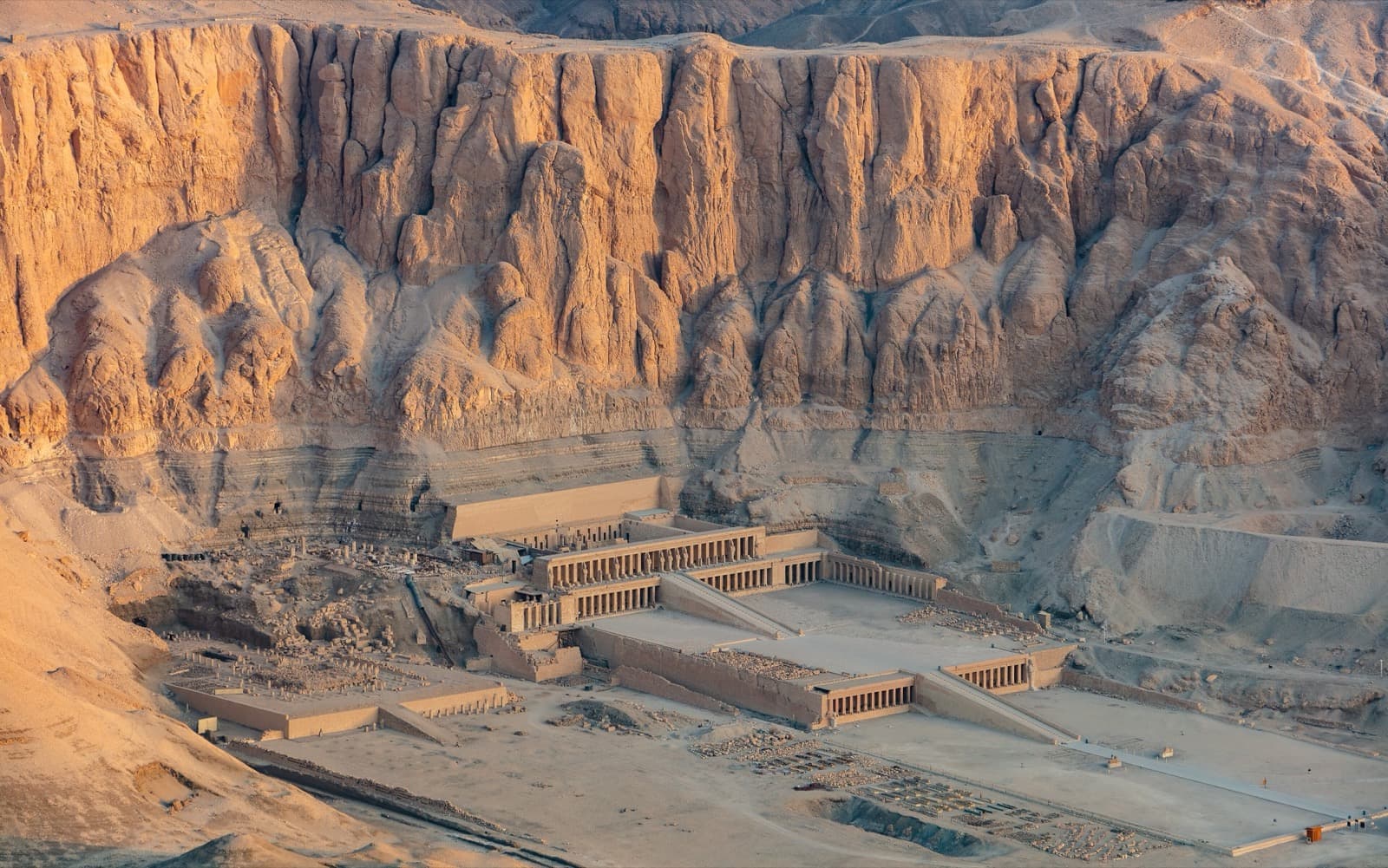
Read the West Bank of the Nile the way its builders meant it: the temples of remembrance blazing on the plain and the painted royal tombs hidden deep in the desert cliffs behind them.
Start · The Colossi of Memnon: Two Giants Guarding a Temple That Is Gone
DirectionsStops
- 1
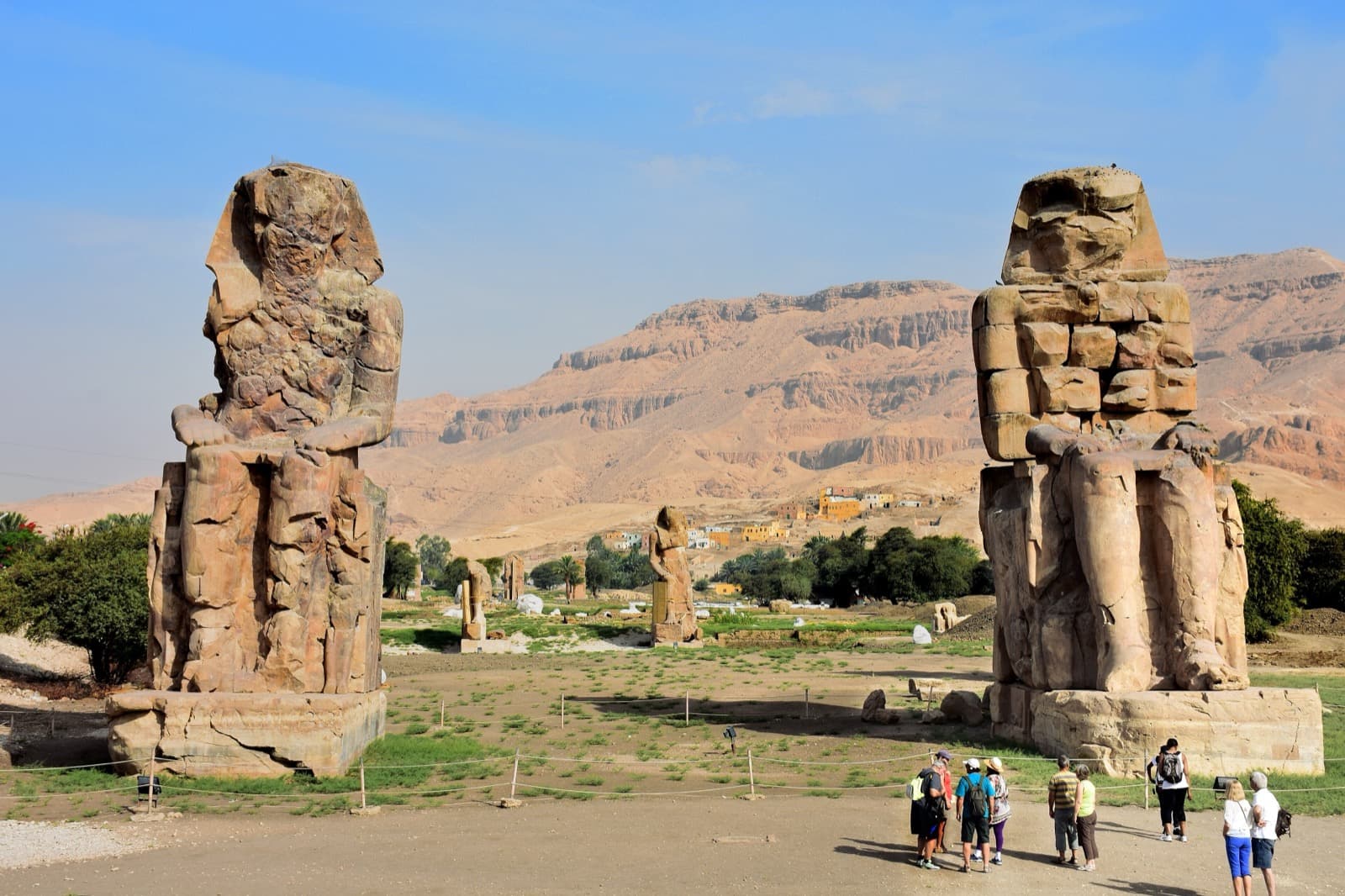
The Colossi of Memnon: Two Giants Guarding a Temple That Is Gone
Two eighteen-metre seated statues of Amenhotep the Third, all that stands above ground of what was once the largest mortuary temple in the Theban necropolis.
- 2
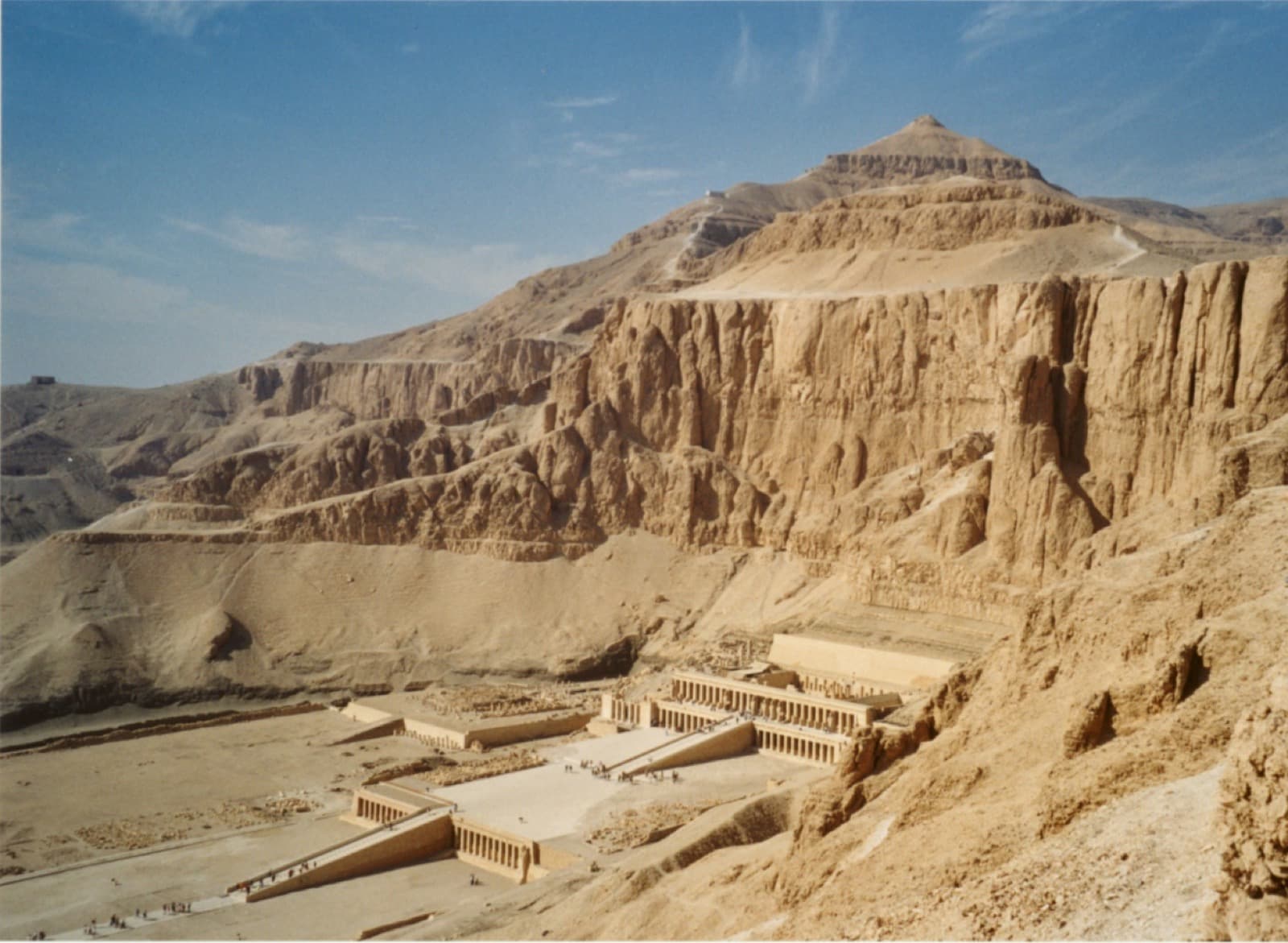
The Temple of Hatshepsut at Deir el-Bahari: The Woman Who Ruled as King
The three-terraced mortuary temple of the female pharaoh Hatshepsut, rising into a sheer cliff, whose name was later attacked but whose architecture endured.
- 3
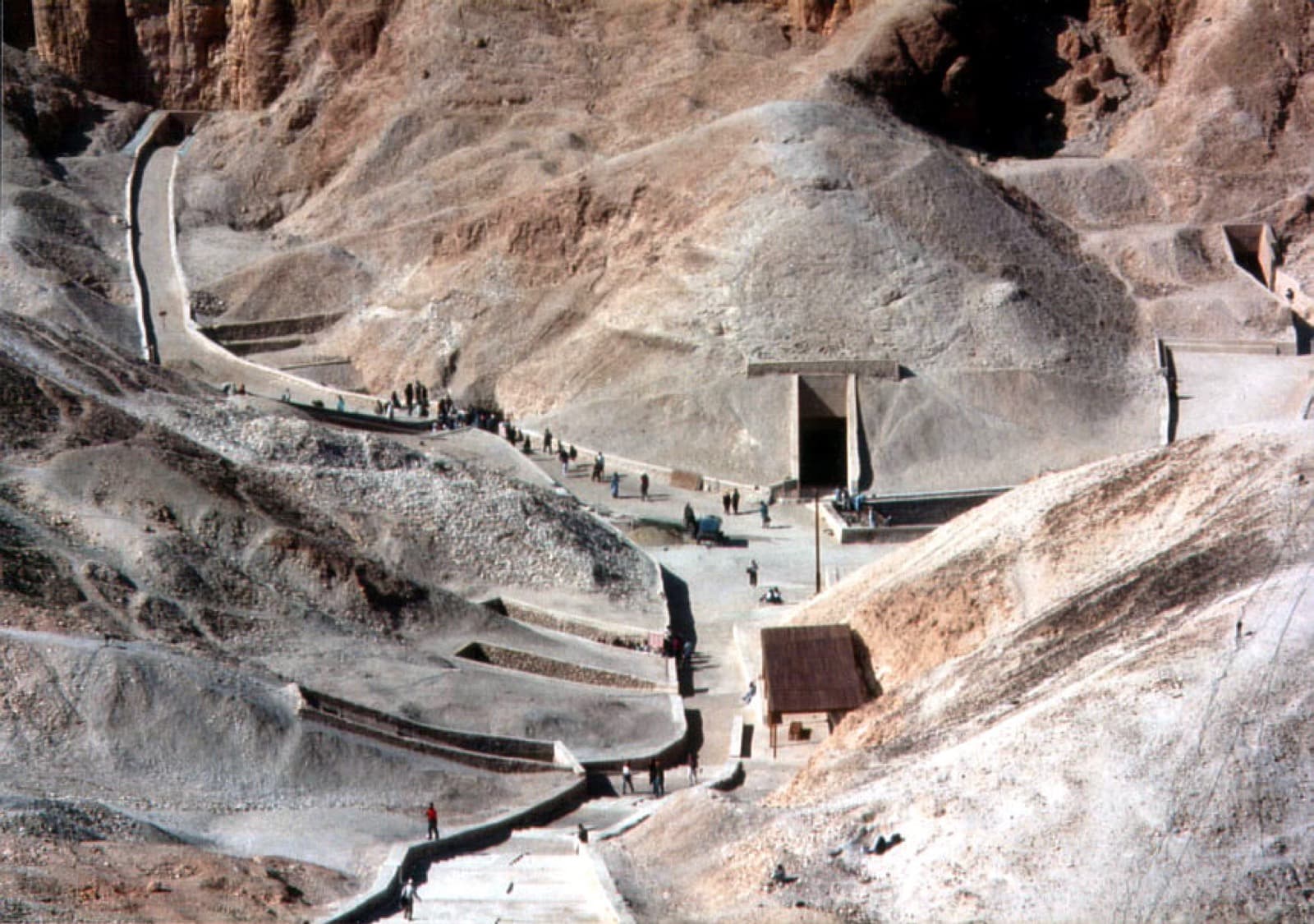
The Valley of the Kings: Where the Pharaohs Hid Themselves
The hidden desert valley behind the cliffs where New Kingdom pharaohs were buried in rock-cut tombs for roughly five hundred years, deliberately concealed from robbers.
- 4
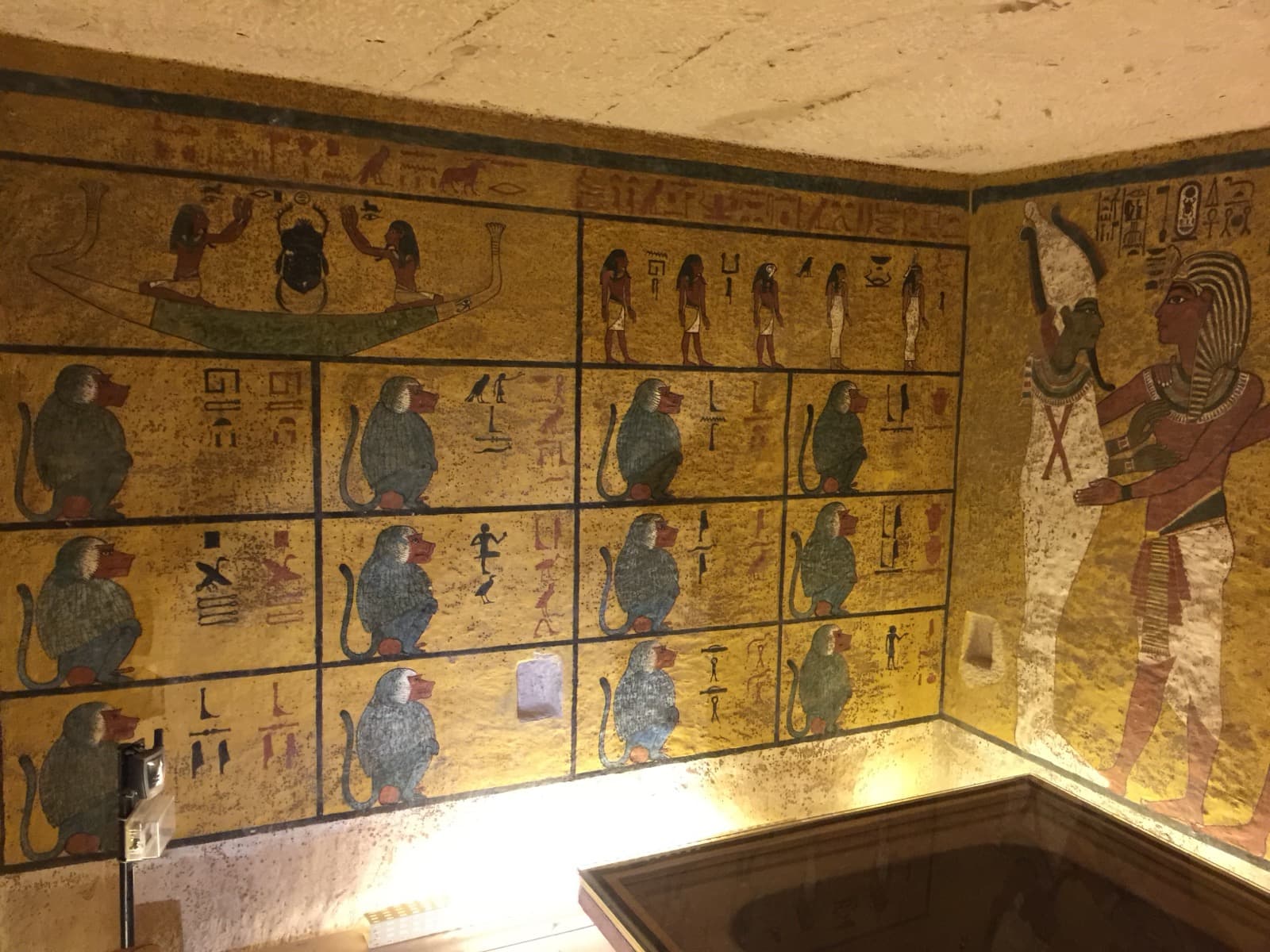
The Tomb of Tutankhamun: The One Tomb the Robbers Missed
K V sixty-two, the small tomb of the boy pharaoh Tutankhamun, discovered in nineteen twenty-two with its burial goods almost intact, the only substantially unrobbed royal burial found in the valley.
- 5
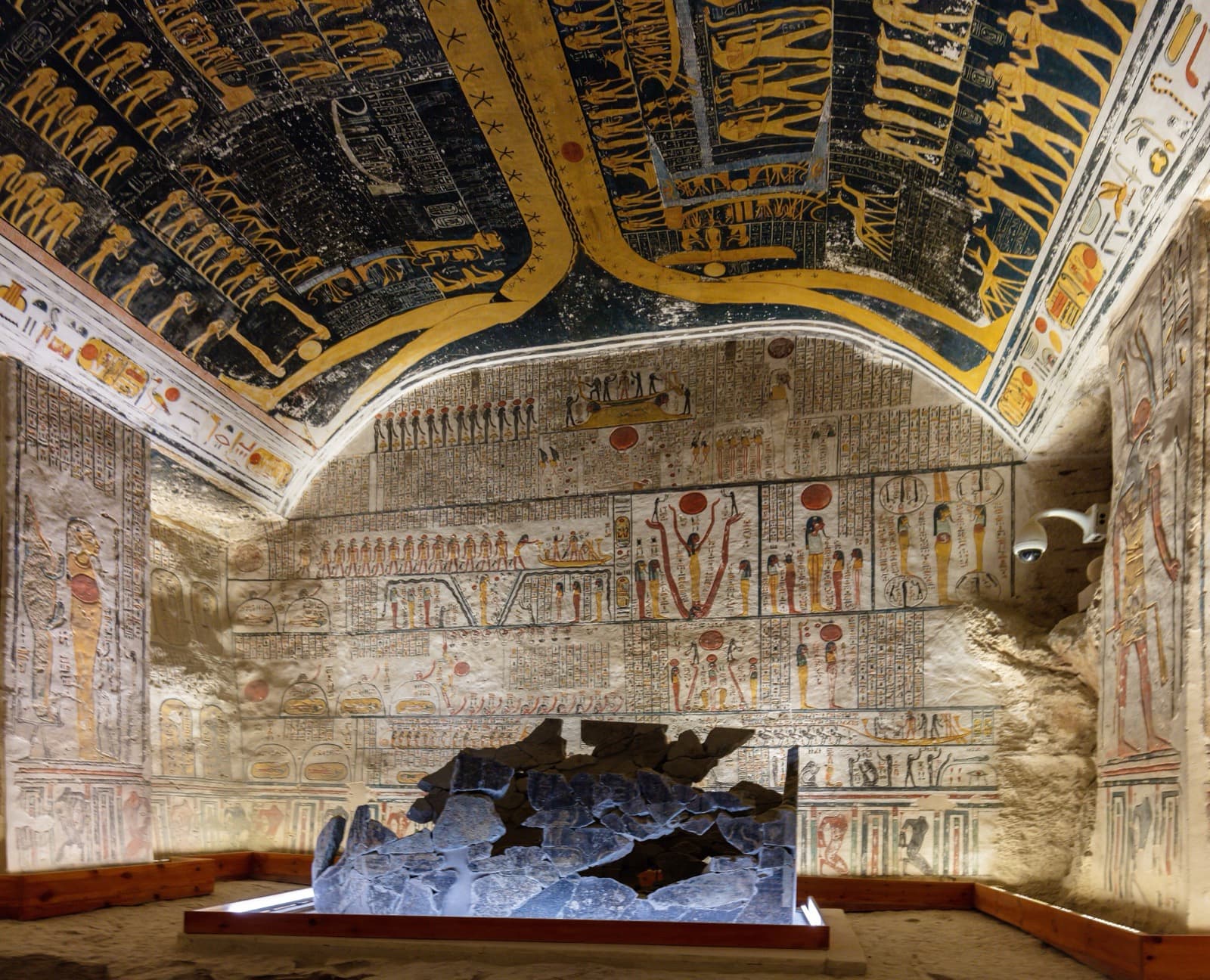
A Great Decorated Tomb: The Painted Map of the Underworld
A brilliantly painted royal tomb such as K V nine or the tomb of Seti the First, its long corridors covered in funerary texts and astronomical ceilings that chart the sun's night journey.
- 6
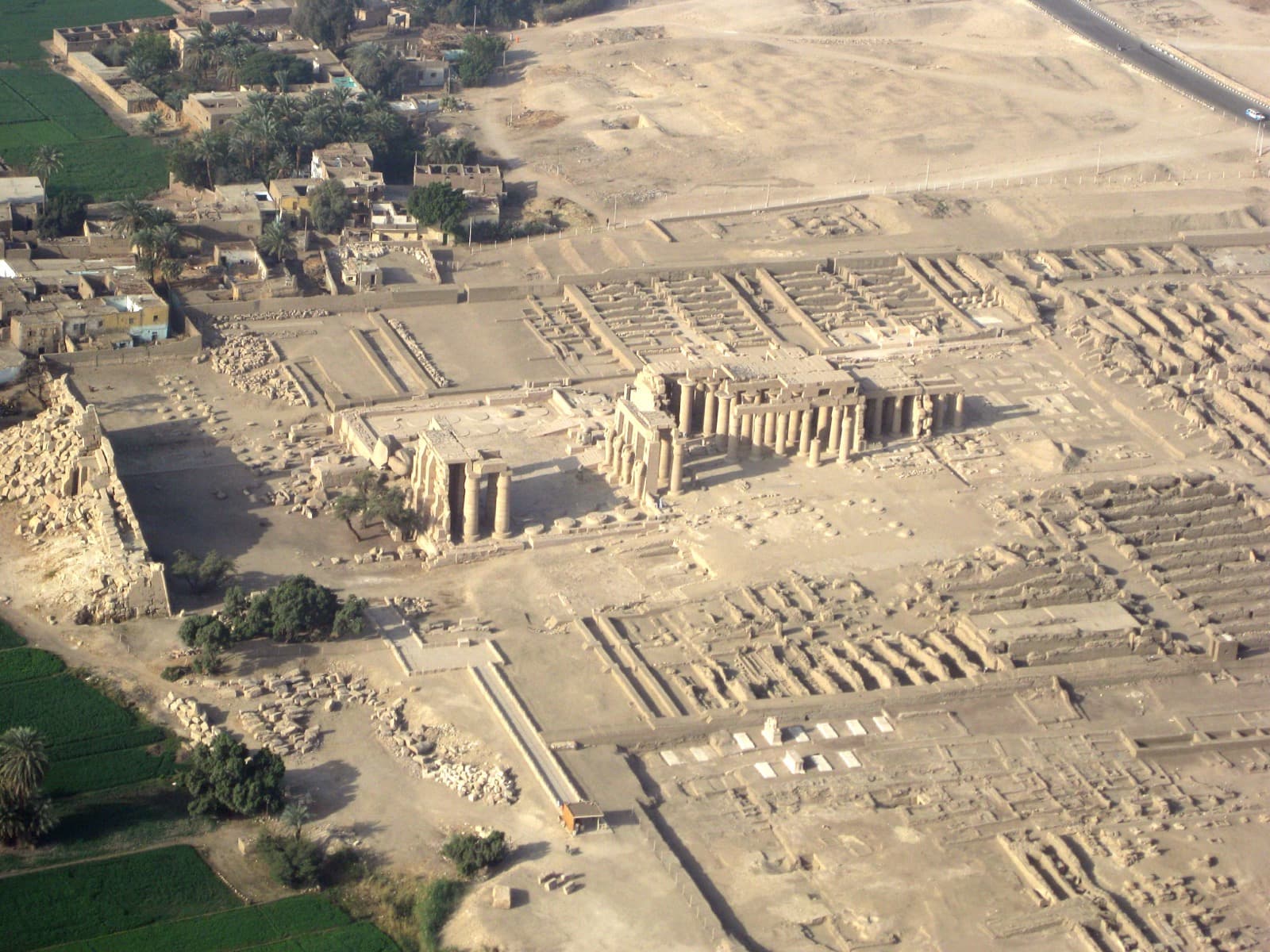
The Ramesseum: The Fallen Giant and the Poem About Empire
The ruined mortuary temple of Ramesses the Second, home to a shattered colossal statue whose Greek name, Ozymandias, inspired Shelley's sonnet on the vanity of empire.
- 7
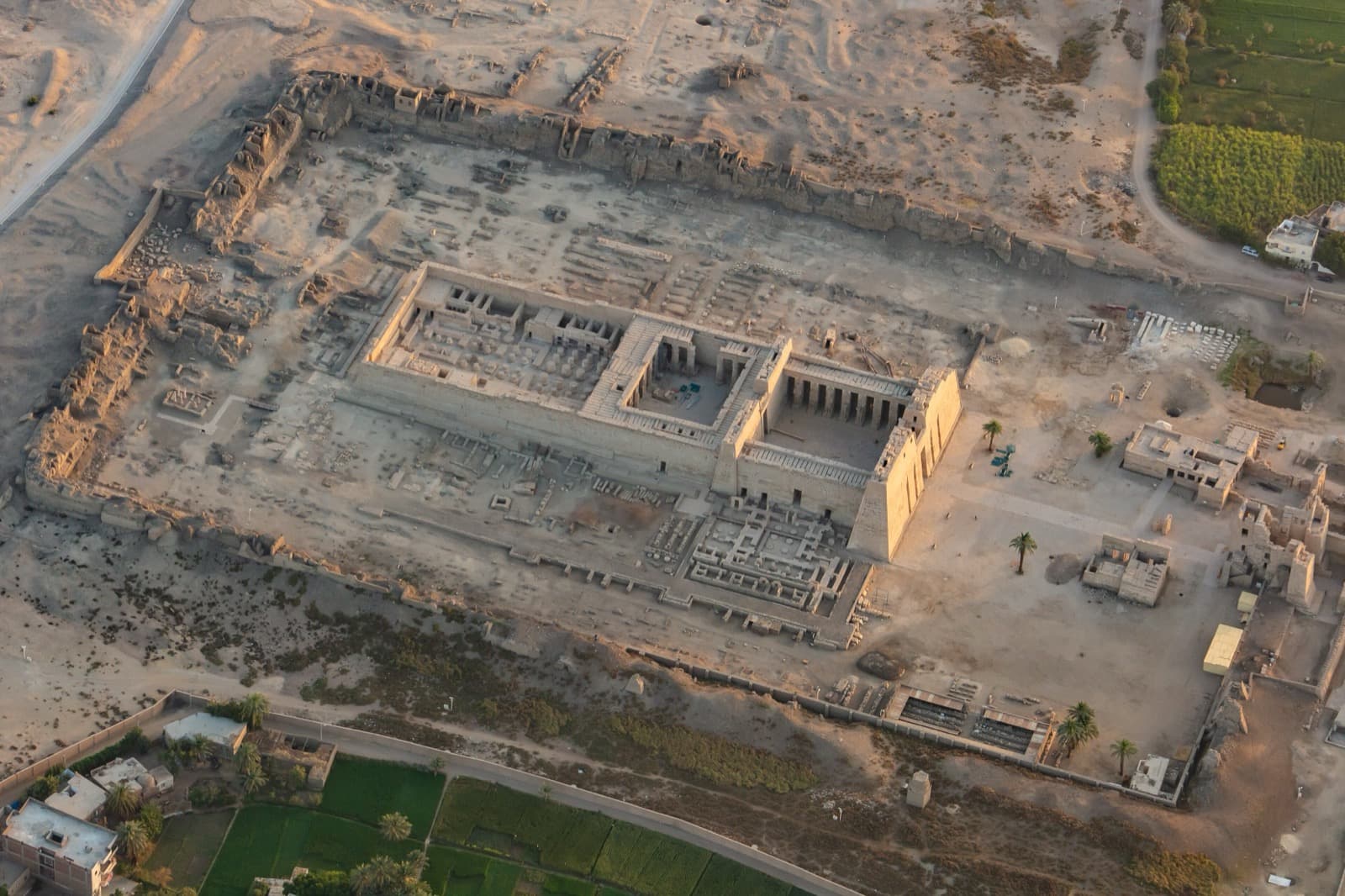
Medinet Habu: The Best-Kept Temple Where the Color Still Survives
The remarkably well-preserved mortuary temple of Ramesses the Third, where more than seven thousand square metres of deep-carved relief still hold much of their original painted color.
Details
Best Time to Visit
Come in the cooler months, roughly October through April, when Luxor's daytime heat is bearable for open-desert sites. Start at sunrise or in the early morning: the Valley of the Kings and the mortuary temples have almost no shade, the light is beautiful on the cliffs, and you avoid both the midday sun and the largest tour crowds. A full unhurried day of five to seven hours lets you move at your own pace between sites.
Pro Tips
- •Tickets at most West Bank sites are card-only as of twenty twenty-six, but keep small Egyptian pound cash for taxis, tips, and incidentals.
- •The Valley of the Kings standard ticket includes a rotating set of open tombs; the tombs of Tutankhamun and Seti the First carry separate premium tickets, so decide in advance which splurges are worth it to you.
- •The sites are spread far apart across the West Bank and are reached by taxi; agree the fare and a wait-and-return arrangement before you set off.
- •Photography is often restricted or requires a separate ticket inside tombs, and flash is usually banned to protect the paint, so check the rules at each entrance.
- •Bring more water than you think you need, a hat, sunglasses, and strong sun protection, because the valley and the temples offer essentially no shade.
- •Because you are on your own schedule, front-load the Valley of the Kings and Hatshepsut's temple in the cool early hours, then save the temples on the plain for later in the day.
Safety & Precautions
- •The tombs and the Valley of the Kings have steep descents and long stair-like ramps in intense heat with no shade or airflow; pace yourself, carry water, and rest if you feel lightheaded.
- •The West Bank sites sit in open desert with strong sun, little shade, and persistent vendors and camel or horse touts; carry sun protection and water, and a firm, polite no is your best tool with touts.
- •The living villages of the West Bank and the mosques of Luxor are active places of worship: the working Abu al-Haggag mosque built inside Luxor Temple, and local West Bank mosques, ask for modest dress, quiet, awareness of prayer times, and shoes removed if you are invited in, and women may be asked to cover their hair.
- •Use ordinary awareness of your bag and valuables in crowds and in the tourist bazaars near the temples and ferry landings, and keep small cash accessible for tickets and tips rather than opening a full wallet in public.
Travel advisory: Exercise Increased Caution (Level 2).
Gallery
Related Reading
Go deeper on what you'll see, hear, and walk through.

Overview
Best Self-Guided Walking Tours in Luxor (2026)
3 min
Overview
Luxor Travel Guide: Days, Transport, Season, Safety, Budget
6 min
Overview
One Day in Luxor: A Walkable Morning-to-Evening Itinerary
7 min
Thematic
Best History Walking Tours in Luxor (2026)
2 min
Thematic
Luxor: Ancient Thebes and the Two Banks of the Nile
7 min
Companion
The Valley of the Kings: Reading Luxor's Hidden Tombs and the Temples They Answer
6 min
Deep dive
The Tomb of Tutankhamun (KV62): Why the Smallest Royal Tomb Survived
7 min
Read
What to Eat in Luxor: Upper Egyptian Dishes and How to Order Them
7 min
Read the walk
The full story of Valley of the Kings: The Hidden Tombs of the West Bank, in words. Prefer to listen? Play it narrated, from home or on location.
Introduction
Across the Nile from Luxor, in Egypt, on the West Bank where the ancient Egyptians watched the sun set, lies one of the most extraordinary landscapes ever engineered for death. For roughly five centuries the pharaohs of the New Kingdom split their monuments in two. Grand mortuary temples stood out on the open plain to keep their names alive forever, while their bodies went into secret rock-cut tombs, tunnelled deep into a hidden desert valley behind the cliffs, their painted walls blazing with maps of the afterlife. That contradiction is the whole story here: the temples shout, the tombs whisper. The pharaoh needed to be remembered, yet feared the tomb robber, so remembrance was surrendered underground for the sake of concealment. This walk covers seven stops across about twelve kilometres of the West Bank, spread over a full unhurried day of roughly five to seven hours including travel between sites, since the temples and the valley sit far apart and are reached by taxi. All of it belongs to UNESCO's World Heritage site, Ancient Thebes with its Necropolis, inscribed in nineteen seventy-nine. This is a solo traveler's route through Egypt at your own pace, no group, no schedule, no tip pressure. You can linger at the painted walls of a single tomb or move straight on to the next temple, and the choice is entirely yours. We begin on the plain, with two giants, and end at a temple where the ancient paint still holds its color. When you arrive at the Colossi of Memnon, begin with stop one.
1. The Colossi of Memnon: Two Giants Guarding a Temple That Is Gone
Two enormous stone figures sit side by side on the plain, about eighteen metres tall counting their platforms and weighing something like seven hundred tons each, staring east across the Nile toward Luxor. They are the Colossi of Memnon, twin portraits of the pharaoh Amenhotep the Third of the Eighteenth Dynasty, carved and set here in about thirteen fifty B C. What you see is almost all that survives of his mortuary temple, once described as the largest in the whole Theban necropolis, covering some thirty-five hectares. An earthquake around twelve hundred B C and centuries of Nile flooding brought the rest down, and later builders carried the stone away. So these two guardians now watch over an empty field where a vast temple stood. The name Memnon comes from later visitors. Greeks and Romans linked the northern statue to Memnon, a hero of the Trojan War, though that identification is their tradition, not the statue's real subject. Here is the strange part. After a twenty-seven B C earthquake cracked the northern colossus, travelers reported that at dawn it made a sound, a kind of singing or ringing, most likely air and moisture moving through the fractured stone as it warmed. Roman inscriptions carved right onto the legs record visitors who came to hear it. The last reliable mention of the sound is around one ninety-six A D, and after Roman repairs near the end of that century, it fell silent for good. A fitting opening: two giants keeping watch, and the temple they were built to remember already gone.
2. The Temple of Hatshepsut at Deir el-Bahari: The Woman Who Ruled as King
Set against a wall of golden cliff, three great colonnaded terraces climb from the desert floor as if the temple were growing out of the rock. This is the mortuary temple of Hatshepsut at Deir el-Bahari, and it is one of the masterpieces of ancient architecture. Hatshepsut was a woman who ruled Egypt as king, of the Eighteenth Dynasty, reigning in the fifteenth century B C, roughly fourteen seventy-nine to fourteen fifty-eight B C. She did not rule as a queen consort but took on the full titles and image of a pharaoh. The Overseer of Works Senenmut is usually credited as the temple's likely designer, and the ramps and clean horizontal terraces still feel astonishingly modern. Inside, the reliefs tell two stories she wanted remembered. One is her divine birth, presenting her as the daughter of the god Amun-Re, a claim to legitimate kingship. The other is her famous trading expedition to the Land of Punt, somewhere along the Red Sea, with carved ships and porters bringing back incense trees, exotic animals, and gold to Thebes. Now the sober part of her story. About two decades after her death, her successor Thutmose the Third attempted to erase her name and her images, chiselling her out of the record, an effort that was eventually abandoned and never completed. So this stop carries the walk's tension in miniature. Remembrance is fragile. Someone tried to unmake her memory, and yet here you stand, before the enormous building she raised into the cliff, still speaking her name. Take your time on the terraces. There is no group to keep pace with.
3. The Valley of the Kings: Where the Pharaohs Hid Themselves
Behind the cliffs, in a dry, sun-hammered valley with almost no shade, the New Kingdom pharaohs made a radical decision. Instead of building a pyramid, a giant marker announcing exactly where the treasure lay, they hid. For roughly five hundred years, from the Eighteenth through the Twentieth Dynasty, kings were buried here in tombs cut straight down into the rock, their entrances concealed and often unmarked. This is the turn in our story. Every pyramid that had ever been built had already been robbed, so remembrance on the surface was surrendered for concealment underground. The valley is known to contain sixty-five tombs and chambers, ranging from a simple burial pit to a sprawling tomb with more than a hundred and twenty chambers built for the many sons of Ramesses the Second. The tombs carry the label K V, for Kings' Valley, followed by a number. That numbering system was set in eighteen twenty-seven by the English Egyptologist John Gardner Wilkinson, who painted the numbers over the entrances he could find. Today the Ministry of Tourism and Antiquities administers the valley, and a rotating selection of tombs is open on any given day, so exactly which ones you can enter changes. A practical note, and it plays right to traveling on your own terms here. The descents are steep, it is hot, and there is no shade in the valley. Your standard ticket lets you into a set number of tombs, and you choose which. Enter the ones that draw you, rest when you need to, and skip the rest. No guide is rushing you back to a bus.
4. The Tomb of Tutankhamun: The One Tomb the Robbers Missed
This tomb is small and rather plainly decorated compared with the great royal tombs around it, and that modesty is exactly why it survived. It is K V sixty-two, the tomb of the boy pharaoh Tutankhamun, and it is the reason the whole valley is famous around the world. In nineteen…
Full narration for this stop unlocks with the tour.
5. A Great Decorated Tomb: The Painted Map of the Underworld
Step down a long, steep corridor into one of the great decorated tombs, and the plain rock of the valley gives way to walls and ceilings covered edge to edge in painted figures, hieroglyphs, and stars. This is what the concealment was protecting: not just a body, but a painted…
Full narration for this stop unlocks with the tour.
6. The Ramesseum: The Fallen Giant and the Poem About Empire
Back out on the plain stands a temple half in ruins, and among the fallen stone lies one of the most eloquent wrecks in Egypt. This is the Ramesseum, the mortuary temple of Ramesses the Second of the Nineteenth Dynasty, built in the thirteenth century B C. Its most famous…
Full narration for this stop unlocks with the tour.
7. Medinet Habu: The Best-Kept Temple Where the Color Still Survives
We end at the best-kept temple on the West Bank, and it answers the question the whole walk has been circling. After all that hiding, all that robbery, did remembrance actually endure? Here, at Medinet Habu, the answer is yes. This is the mortuary temple of Ramesses the Third of…
Full narration for this stop unlocks with the tour.