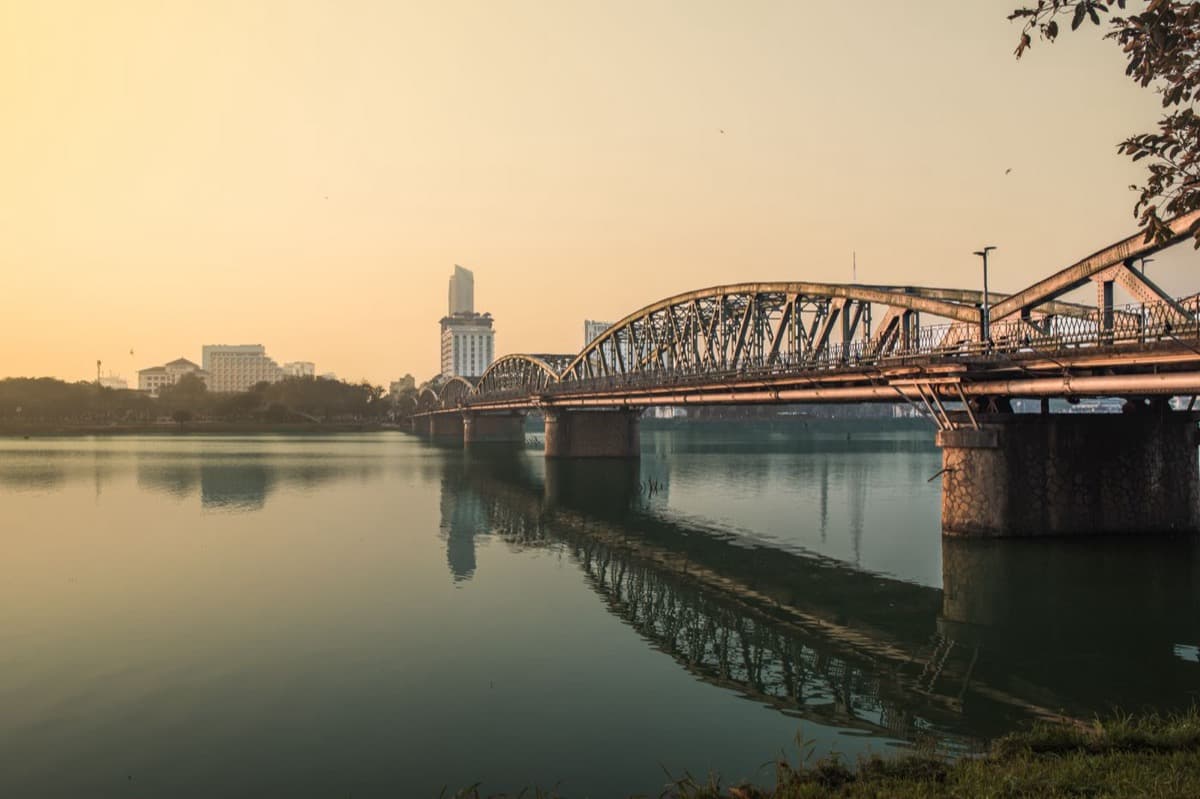
France built a second Hue on the south bank of the Perfume River to civilize and to rule: a bridge, a boulevard, a cathedral, and above all schools. This walk follows the paradox of a colonizer whose proudest institutions raised the very generation that would end both the dynasty and the empire.
Start · Truong Tien Bridge: The Threshold
DirectionsStops
- 1
Truong Tien Bridge: The Threshold
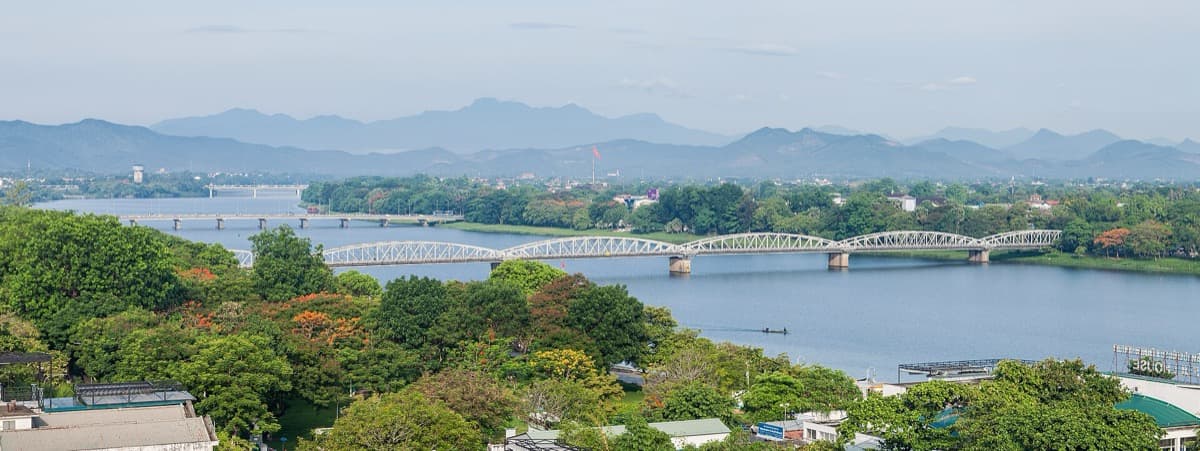
The iron bridge across the Perfume River that links the old walled Hue of the north bank to the French second Hue this walk explores.
- 2
Le Loi Riverside Boulevard: The Face of Empire
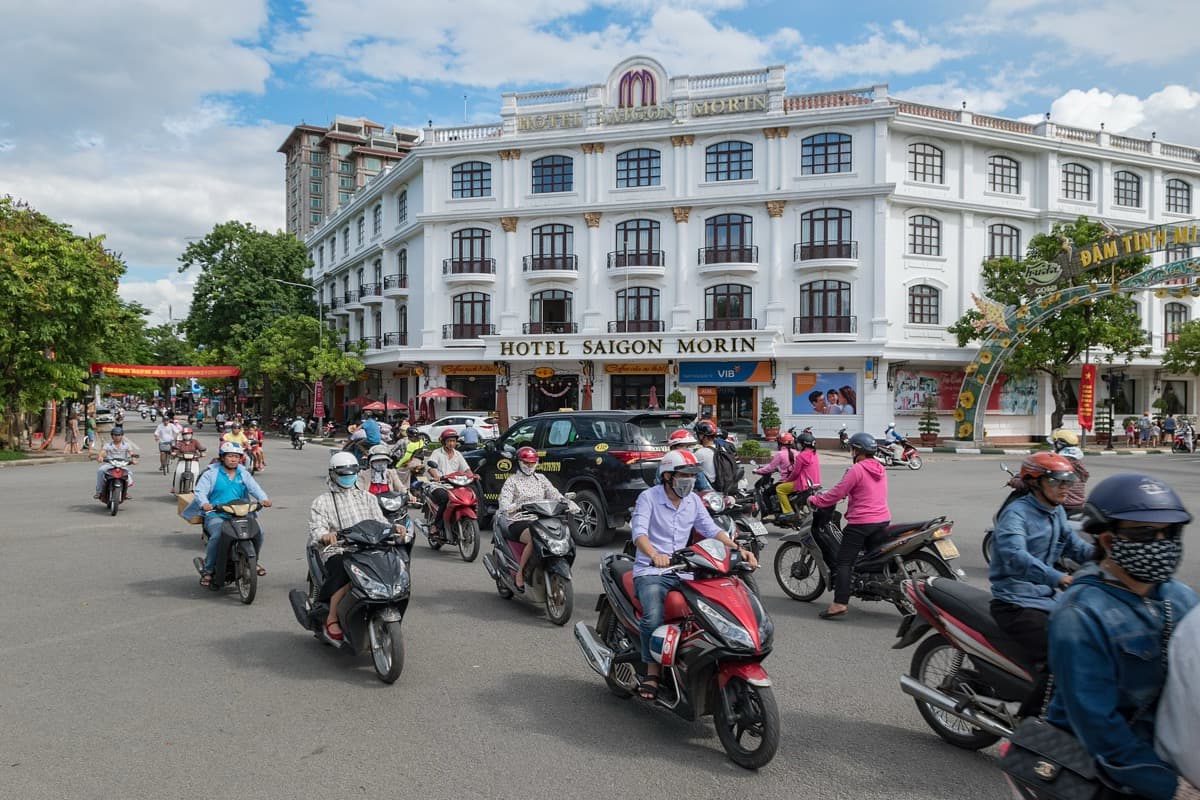
The tree-lined colonial boulevard along the south bank, anchored by the grand Hotel Saigon Morin at the foot of the bridge.
- 3
Ho Chi Minh Museum: The Famous Student
A riverfront museum on Le Loi street dedicated to the Hue childhood of the city's most famous student.
- 4
Quoc Hoc National Academy: The Paradox's Heart
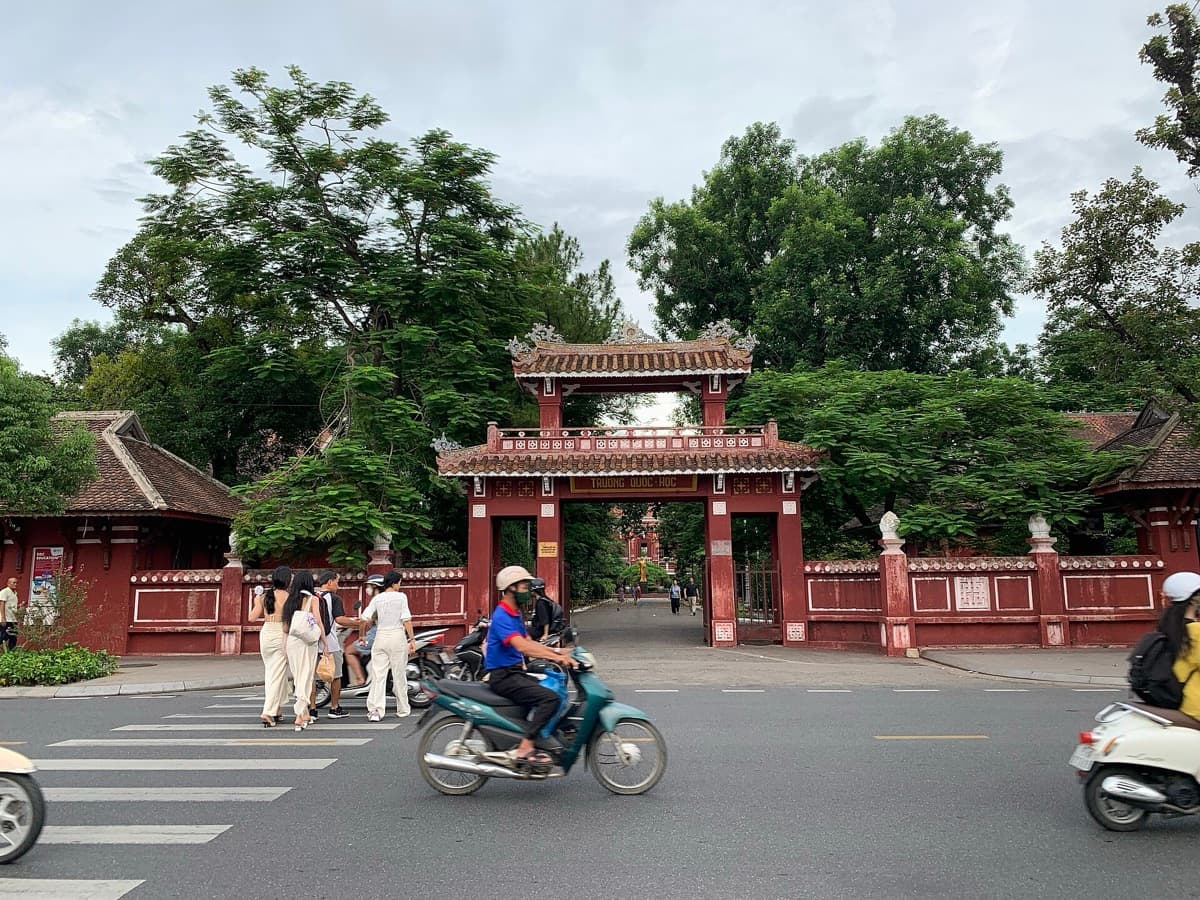
The colonial French lycee whose alumni roster reads like the guest list at the empire's own funeral.
- 5
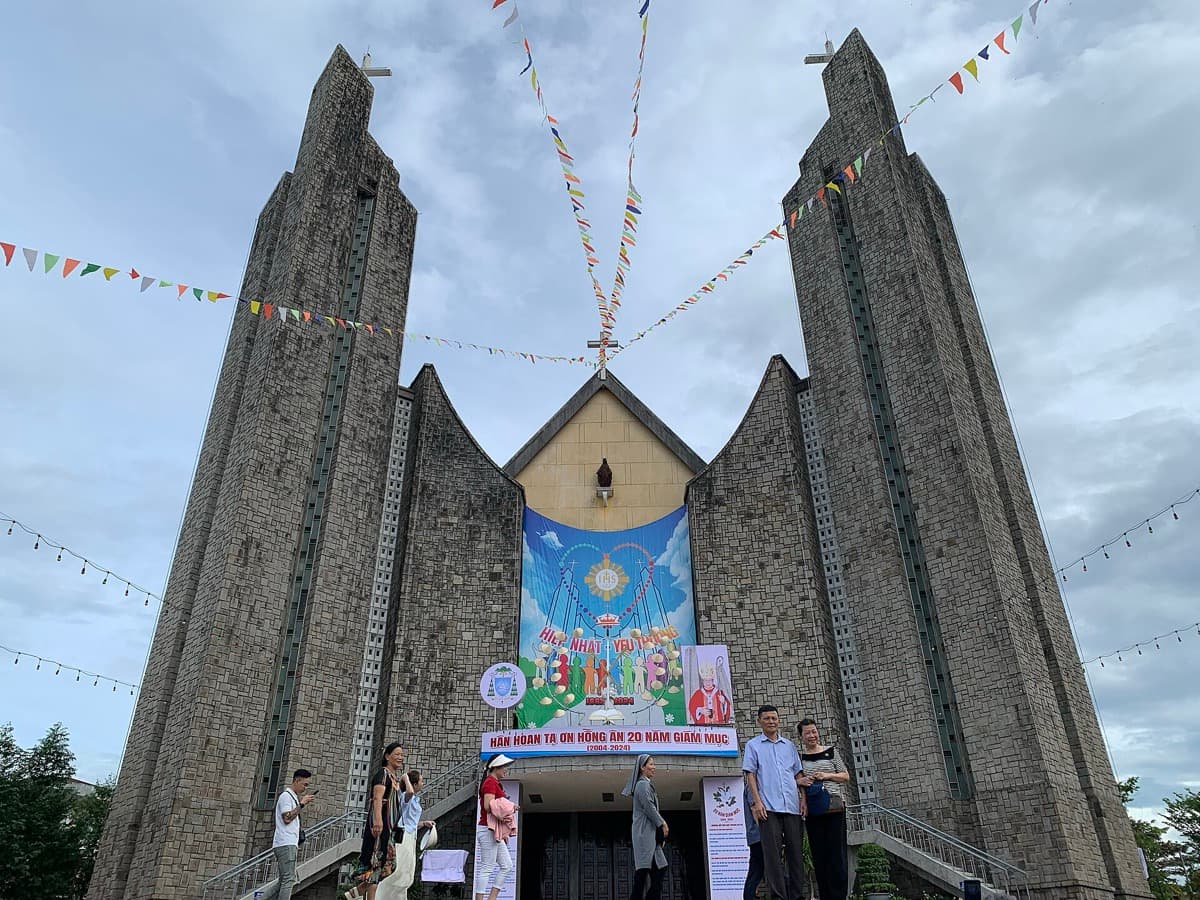
Phu Cam Cathedral: The Colonial Faith
The seat of the Archdiocese of Hue on Phuoc Qua Hill, where a colonial-era faith wears a boldly modern shape.
- 6
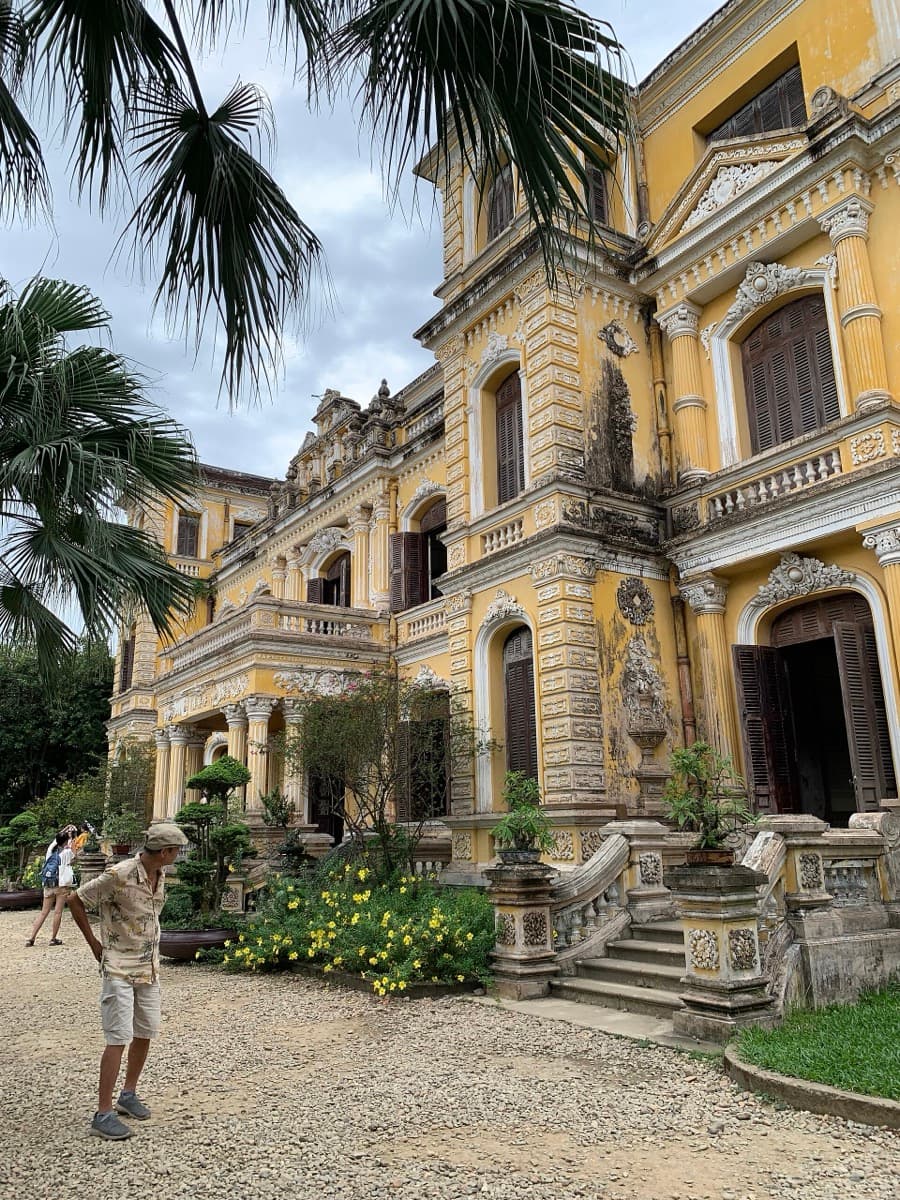
An Dinh Palace: The Dynasty's Last Act
The gilded Euro-Vietnamese palace on the An Cuu canal where the hollowed-out Nguyen dynasty lived out its final chapter.
Details
Best Time to Visit
The cooler, drier months from roughly February to April offer the most comfortable walking, with milder temperatures and lower humidity. Start in the morning to beat the midday heat, and note that Hue's heaviest rains fall between about September and December, when the Perfume River can flood the low riverfront streets. Late afternoon light on the bridge and the river is especially lovely if you can time the finish for then.
Pro Tips
- •Wear light, breathable clothing and carry water; central Vietnam is hot and humid for much of the year, and long stretches of this walk sit in open sun along the river.
- •Bring modest cover for your shoulders and knees if you plan to step inside Phu Cam Cathedral; it is an active place of worship, so keep quiet and avoid visiting during Mass unless you intend to attend respectfully.
- •An Dinh Palace charges a small entrance ticket, roughly fifty thousand dong, around two US dollars; carry a little cash, as smaller sites do not always take cards.
- •Quoc Hoc and the Ho Chi Minh Museum are best appreciated from the street and grounds; the school is a working institution, so admire the historic gate and facade rather than expecting a full interior visit.
- •Cross Truong Tien Bridge on foot at least once for the view up and down the Perfume River, but stay on the pedestrian lane, as the bridge carries steady motorbike traffic.
- •Consider renting a bicycle or hiring a cyclo for the slightly longer stretch inland to the cathedral and palace if the heat is heavy; the riverfront section is very walkable, but the last stops sit farther apart.
Safety & Precautions
- •Hue is genuinely hot and the sun is strong; open courtyards at the palace and long boulevard stretches offer little shade, so use sunscreen, a hat, and water to avoid heat exhaustion.
- •The rainy season, roughly September to December, brings heavy downpours and periodic flooding along the low south-bank riverfront; check the forecast, as streets near the Perfume River can become impassable quickly.
- •Traffic in Hue moves in a constant flow of motorbikes; cross streets and the bridge deliberately and predictably, and keep children close near the boulevard and bridgeheads.
- •Treat religious and royal sites with respect: lower your voice, dress modestly, avoid photographing worshippers at the cathedral, and follow posted rules and ticketing at An Dinh Palace and other monuments.
Travel advisory: Exercise Normal Precautions (Level 1).
Gallery
Related Reading
Go deeper on what you'll see, hear, and walk through.
Overview
Best Self-Guided Walking Tours in Hue (2026)
3 min
Overview
How to See Hue: One City, Written Twice and Partly Erased
6 min
Overview
Hue Travel Guide: How Many Days, Getting Around, When to Go (2026)
5 min
Overview
One Day in Hue: The Imperial City in a Single Day (2026)
6 min
Thematic
What to Eat in Hue: A Food Guide (2026)
5 min
Companion
The City France Built: How Hue's Colonial Schools Raised the Empire's Undoing
7 min
Read the walk
The full story of Perfume River: The Second Hue, in words. Prefer to listen? Play it narrated, from home or on location.
Introduction
There are two cities called Hue, and they face each other across a river. On the north bank stands the walled imperial capital of the Nguyen emperors, moated and gated and old. On the south bank stands a newer Hue, the one France built after it crushed a court uprising in the eighteen eighties and reduced the emperors to figureheads. This walk stays on that south bank, the colonial second Hue, and it follows a strange thread through it. France built boulevards, a hotel, a bridge, a cathedral, and above all schools here, meaning to civilize and to rule. Yet the finest of those schools educated the very generation who would end both the dynasty and the French empire in Indochina. Every monument you will pass is double-edged, a gift and a grave. This is a tour of six stops. Set aside about a hundred and twenty minutes, some two hours, and expect to cover roughly four kilometres at your own pace, in the city of Hue, in central Vietnam. You will begin at an iron bridge over the Perfume River, walk the old riverfront boulevard past a grand colonial hotel, meet the most famous student the city ever raised and the school that shaped him, turn inland to the cathedral of the archdiocese, and finish at a gilded palace where the last emperors lived out their final act. Stops are short, and you can linger or skip as you please. Move slowly. The paradox at the center of this walk reveals itself best without hurry. When you arrive at the south foot of Truong Tien Bridge, begin with stop one.
1. Truong Tien Bridge: The Threshold
You are standing at the threshold between two cities. Behind you, across the water, rise the walls of the old imperial capital, the walled Hue of the Nguyen emperors. Ahead lies the south bank, the newer Hue that France built. And spanning the Perfume River between them is this iron bridge, Truong Tien, the enduring symbol of the city. It was among the first bridges to span the Perfume River, and one of the first major steel bridges built in Indochina. The French Resident Superior of Annam assigned the work to a French engineering firm, Schneider et Cie, in eighteen ninety-seven. Groundbreaking came in May of eighteen ninety-nine, and the bridge was inaugurated on the eighteenth of December, nineteen hundred. It runs four hundred three metres across six graceful steel spans, each shaped like a comb. You may hear a local guide or a plaque credit the design to Gustave Eiffel, the man behind the Paris tower. It is a lovely story, and it is legend. The records attribute the original construction to Schneider et Cie. The Eiffel company did touch this bridge, but only later, carrying out a major renovation beginning in nineteen thirty-seven. Stand here a moment and consider what a bridge does. It was built to bind the colonial south bank to the imperial north, to move officials and goods and soldiers between the two Hues. It made French control convenient. And yet a bridge carries traffic in both directions. Everything that empire sent across it, ideas, schooling, ambition, could come back the other way. This bridge was damaged during the fighting of nineteen sixty-eight, the Battle of Hue, and rebuilt afterward. It has been crossing, and recrossing, this river ever since.
2. Le Loi Riverside Boulevard: The Face of Empire
Turn and walk the boulevard that runs along the south bank of the river. This is Le Loi street, the tree-lined riverfront avenue that France laid out as the social and administrative face of its second Hue. Once it was lined with colonial offices, villas, and hotels, the confident architecture of a power that meant to stay. At the south foot of the bridge stands the grandest survivor of that era, the hotel now known as Saigon Morin. It opened in nineteen oh-one as the Grand Hotel de Hue, built by a Frenchman named Henri Bogaert, who owned the local Long Tho brick and tile factory. The Morin brothers later took it over and gave it the name it still carries in part today. In its prime it was described as the first hotel in central Vietnam, and one of the largest in all of Indochina, the place where the protectorate lodged its visitors. Four facades wrap around a central courtyard, a full block of colonial grandeur. But durable buildings outlive the empires that raise them. Between December of nineteen forty-six and February of nineteen forty-seven, this hotel became a site of fighting between Viet Minh forces and the French. And until nineteen fifty-seven, part of it served as premises for Hue University, a French luxury turned over to the education of the Vietnamese. You do not need to go inside. Stand on the boulevard and read it as a whole: the shade trees, the river on one side, the deep colonial facades on the other. This was the stage set of empire, built to impress and to govern. Keep it in mind as you walk on, because the next few stops will show you who was quietly being educated just down this same street.
3. Ho Chi Minh Museum: The Famous Student
A few steps down Le Loi, overlooking the Perfume River, stands a two-storey museum at number seven. It is dedicated to the most famous student this city ever raised: Ho Chi Minh. The museum opened on the sixteenth of September, nineteen eighty, and it gathers the story of his…
Full narration for this stop unlocks with the tour.
4. Quoc Hoc National Academy: The Paradox's Heart
Here is the beating heart of this walk, at number twelve Le Loi: the Quoc Hoc National Academy, the National School. It was founded in eighteen ninety-six, on the twenty-third of October, on the site of a former Admiral's Palace, a royal naval base that dated back to eighteen…
Full narration for this stop unlocks with the tour.
5. Phu Cam Cathedral: The Colonial Faith
Turn inland now, away from the river, toward Phuoc Qua Hill, where the cathedral of Phu Cam stands as the seat of the Archdiocese of Hue. Catholicism came to this region early and struck deep roots; a church has stood on this very hill since the sixteen hundreds, after a…
Full narration for this stop unlocks with the tour.
6. An Dinh Palace: The Dynasty's Last Act
The walk ends at a palace, but not one of the moated halls across the river. This is An Dinh, on the bank of the An Cuu canal, at number one hundred seventy-nine Phan Dinh Phung street. It was built in nineteen seventeen under Emperor Khai Dinh, who reigned from nineteen sixteen…
Full narration for this stop unlocks with the tour.