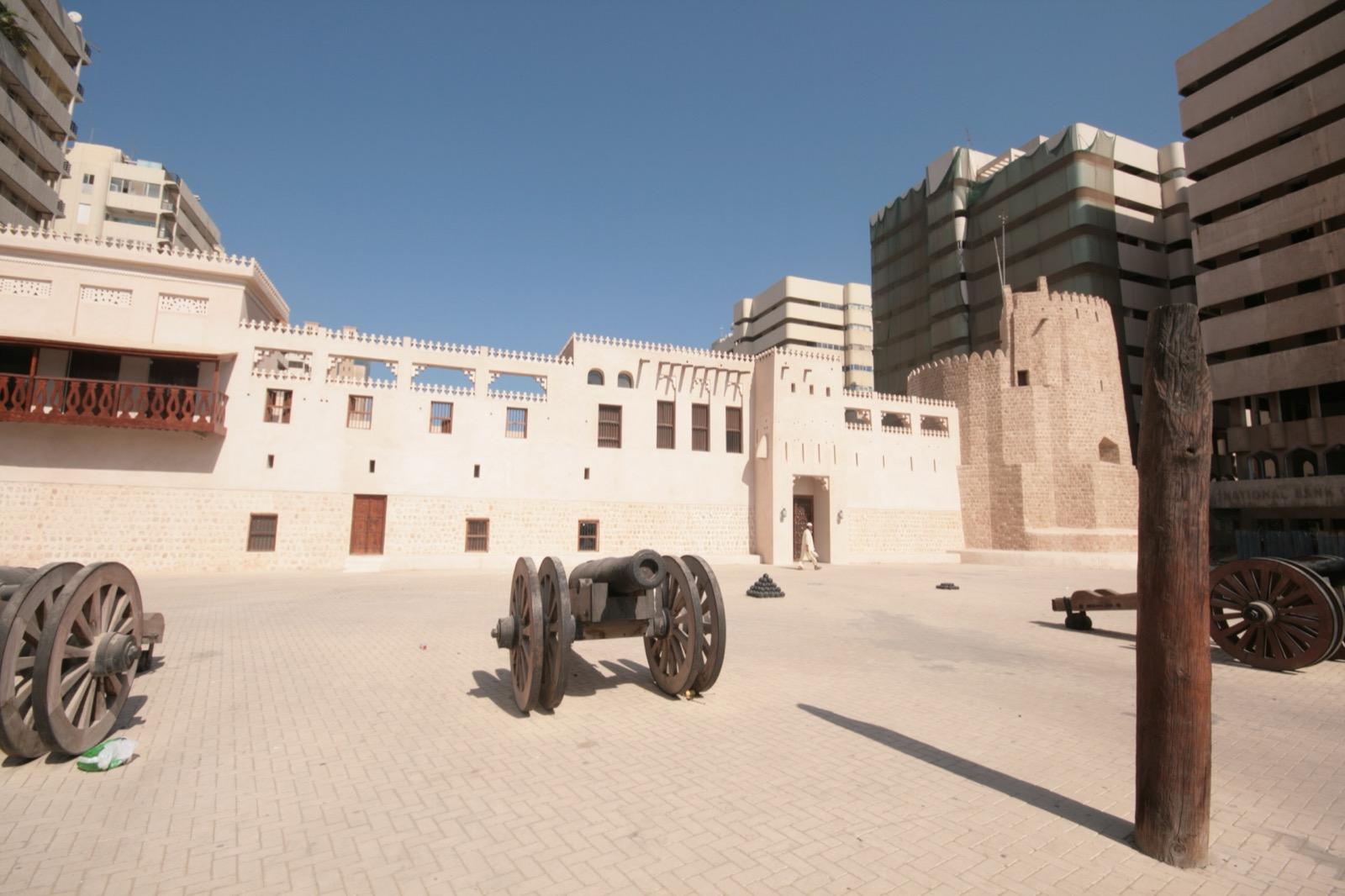
A walk through the coral-and-gypsum old town of Sharjah, the small emirate that bet on heritage and learning instead of height, and rebuilt its historic quarter rather than sweep it away. From the fort raised again from memory to a museum of Arabic calligraphy, this is the story of a cultural capital told stone by stone.
Start · Al Hisn Sharjah: The Fort Raised From Memory
DirectionsStops
- 1
Al Hisn Sharjah: The Fort Raised From Memory
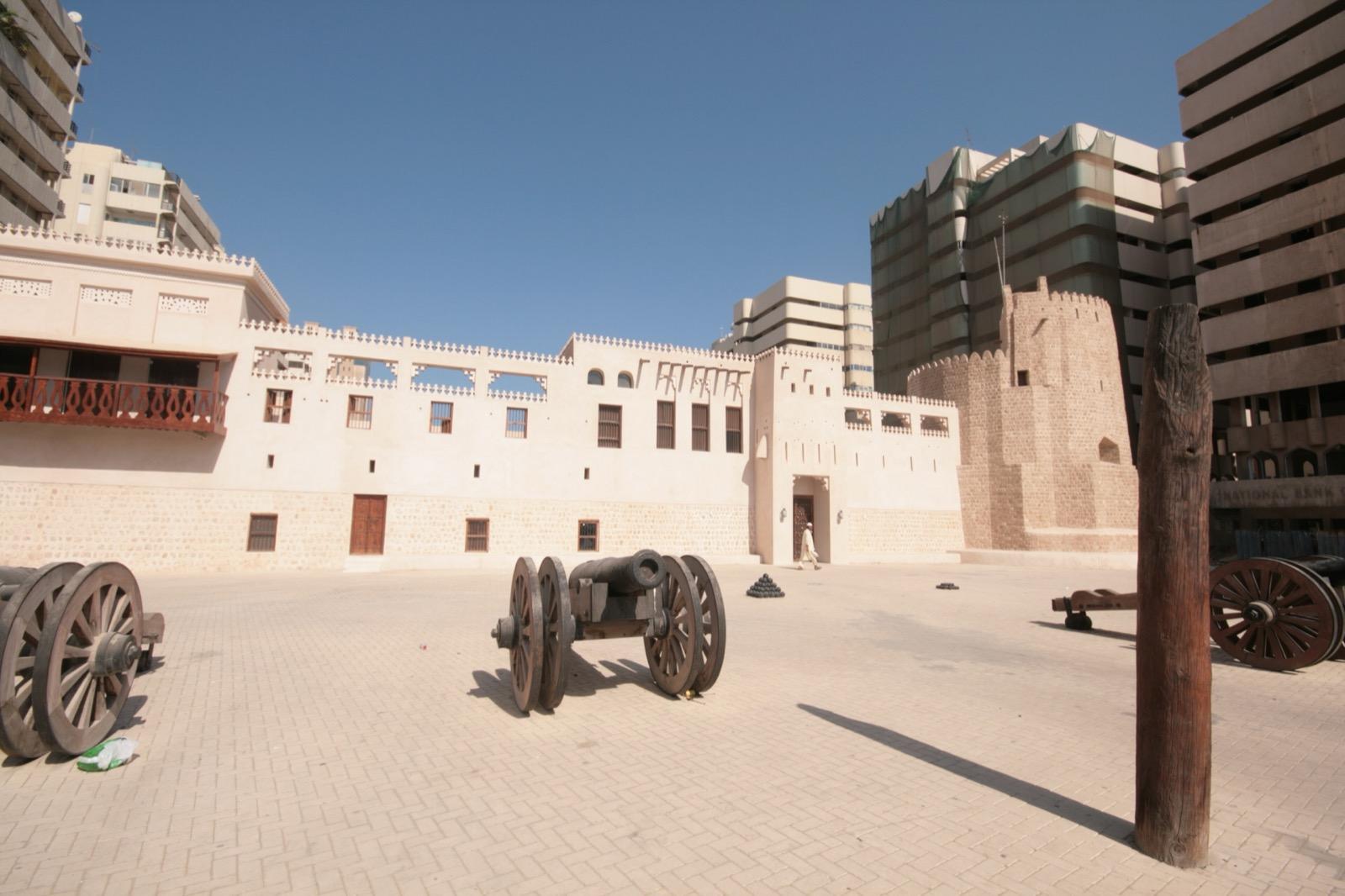
The white fort at the heart of the old town, seat of the ruling Al Qasimi family, demolished in nineteen seventy and rebuilt decades later from the ruler's notes and saved fittings.
- 2
The Heart of Sharjah: A Decision Not to Demolish
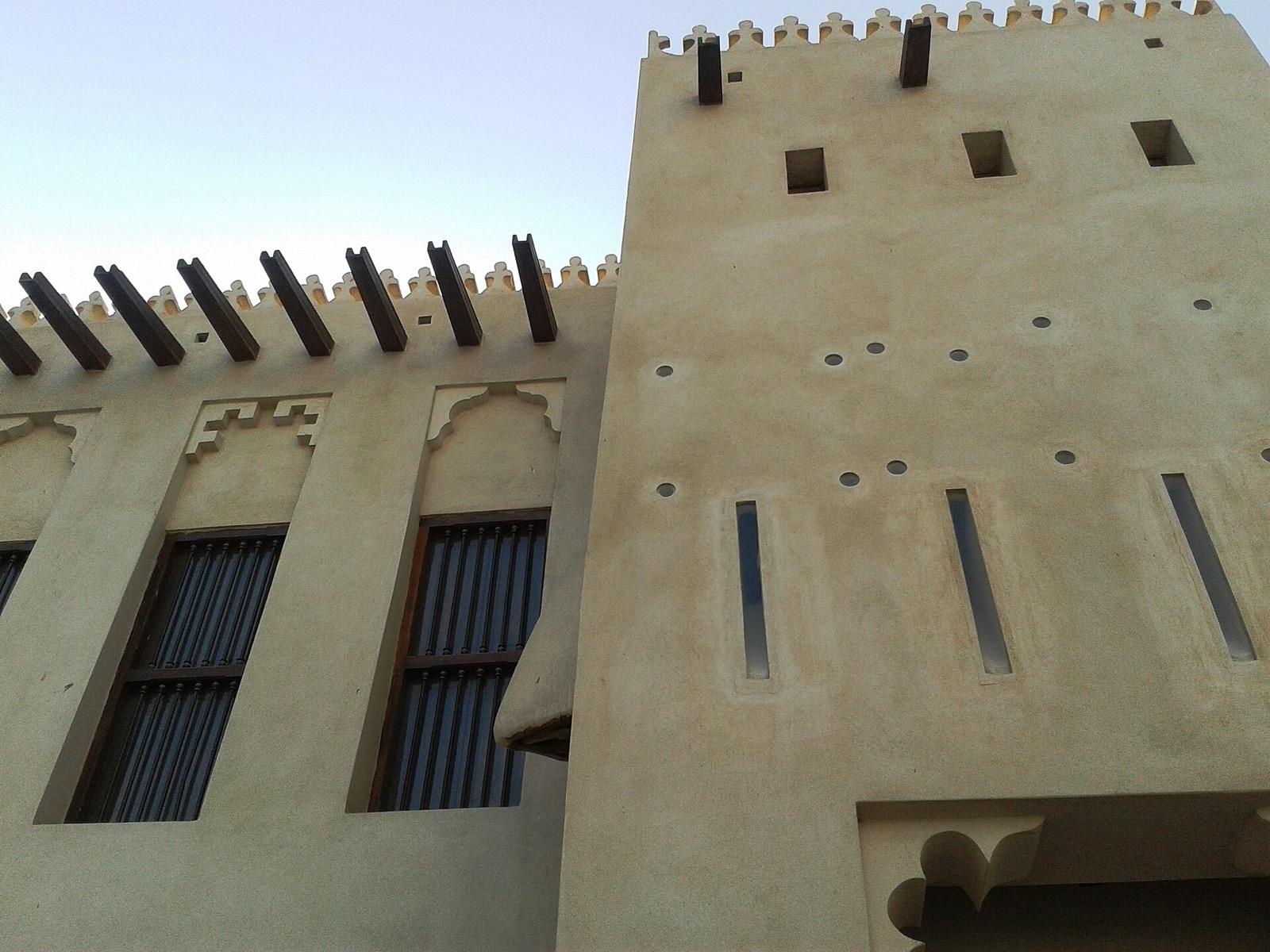
The old town rebuilt in coral and gypsum around the Creek, a ruler-historian's deliberate alternative to clearing away the past.
- 3
Souq Al Arsah: The Coral Market Older Than the Country
A covered coral-stone market, one of the oldest in the United Arab Emirates, where Bedouin and traders from Persia and India once bartered goods around a central coffee house.
- 4
Bait Al Naboodah: The Merchant's Courtyard House
A two-storey coral and gypsum courtyard house built around eighteen forty-five for a pearl merchant, with wind towers, wind-catchers and a colonnade of teak columns from India.
- 5
The Sharjah Heritage Museum: Life on the Coast Before Oil
A social-history museum in a restored coral house, telling the everyday life of the Sharjah coast, from pearling and Bedouin traditions to crafts, dress and jewellery.
- 6
The Calligraphy Square: The Art of the Written Word
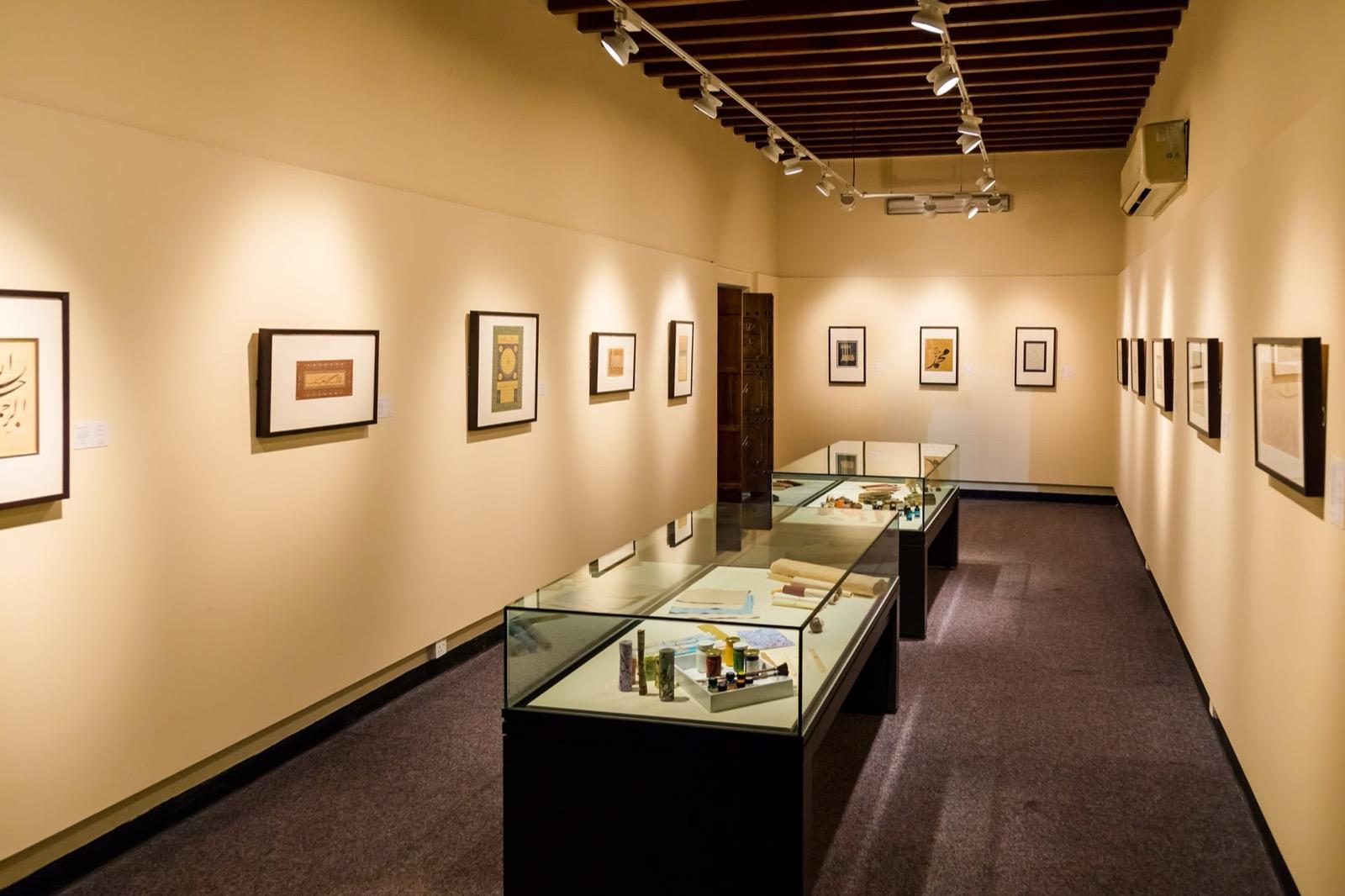
A restored house on Calligraphy Square holding the Sharjah Calligraphy Museum, described as the first museum in the Arab world devoted entirely to Arabic calligraphy.
- 7
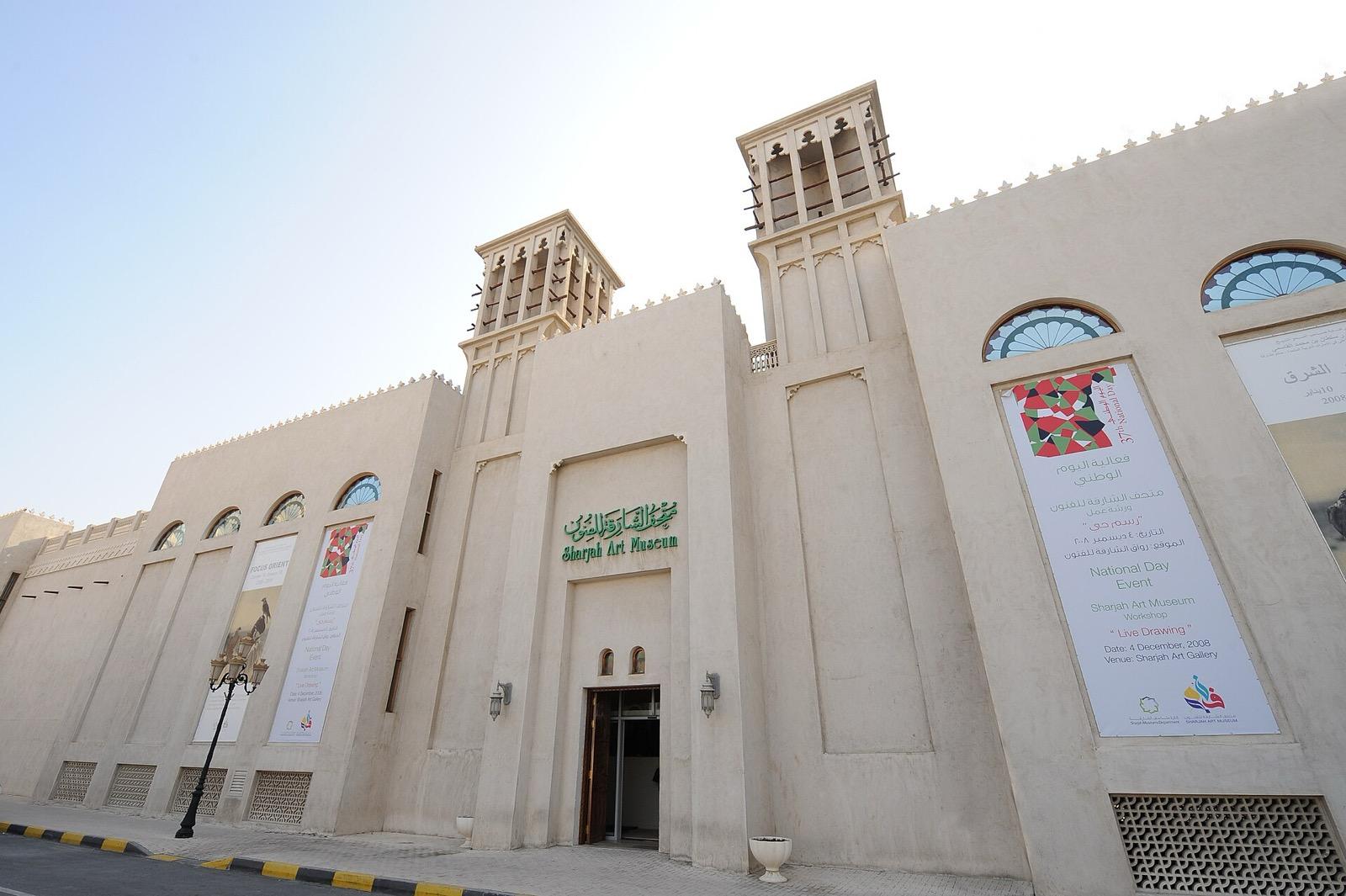
The Sharjah Art Museum: A Capital of Culture, Not Height
The anchor of the Arts Area, opened in nineteen ninety-seven, among the leading art museums in the Gulf and holding the ruler's orientalist collection alongside modern Middle Eastern art.
Details
Best Time to Visit
The most comfortable months are the mild winter, roughly November to March, when daytime temperatures are pleasant for walking and the shaded coral lanes are a genuine delight. Avoid the extreme summer heat from about June to September, when midday temperatures on the coast can be dangerous for extended walking; if you must visit in summer, go in the early morning or after sunset and move between the air-conditioned museums. Early morning any time of year is quietest and coolest. If you visit during Ramadan, note that daytime hours are restrained, some cafes and shops keep shorter or shifted hours, and the quarter comes alive in the evening after the fast is broken.
Pro Tips
- •Buy a combined heritage ticket if you plan to enter several museums, as sites such as the fort, Bait Al Naboodah, the Heritage Museum and the Calligraphy Museum each charge a small separate entry in dirhams and a joint ticket can save money.
- •Carry cash in small dirham notes for museum entry, the coffee house in Souq Al Arsah, and small purchases, as some heritage vendors prefer it.
- •Start early in the day to walk the open sections in cool air, then move into the air-conditioned museums as the sun climbs.
- •Pause at the traditional coffee house at the centre of Souq Al Arsah for Arabic coffee or a glass of Sulaimani tea; it is part of the experience, not a tourist add-on.
- •The whole route is flat and compact, roughly half a kilometre end to end, so wear comfortable shoes but expect an easy, unhurried walk rather than a hike.
- •Look up inside the courtyard houses to see the barjeel wind towers and wall-set wind-catchers working, which is the clearest way to understand how families lived with the heat before electricity.
Safety & Precautions
- •The summer heat from about June to September is extreme and can be genuinely hazardous; carry water, seek shade, avoid the open lanes at midday, and use the air-conditioned museums to break up your walk, whatever the season.
- •Sun protection matters year-round on this coast, so bring a hat, sunglasses and sunscreen even on the milder winter days.
- •Sharjah is a conservative emirate, so dress modestly in the older quarters and especially at any working mosque; women should carry a scarf to cover the head, shoulders and knees when entering places of worship, and everyone should keep quiet and respectful inside them and ask before photographing people.
- •Some museums charge entry in UAE dirhams and keep set opening hours that can shift during Ramadan, when eating, drinking and smoking in public during daylight are restricted out of respect for those fasting; keep normal city street-awareness with your belongings as you would anywhere.
- •The heritage lanes are calm, but busier roads ring the quarter, and the leg out to the Sharjah Art Museum skirts the Corniche. Traffic here moves fast and drivers may not yield, so cross only at marked crossings, wait for the signal, and stay alert near the wider roads.
Travel advisory: Reconsider Travel (Level 3).
Gallery
Related Reading
Go deeper on what you'll see, hear, and walk through.
Overview
Best Self-Guided Walking Tours in Sharjah (2026)
4 min
Overview
One Day in Sharjah: A Walkable Morning-to-Evening Itinerary
7 min
Overview
Sharjah Travel Guide: Days, Transport, Best Time, Safety, Budget
7 min
Thematic
Sharjah: The Emirate That Banked on Culture Instead of Height
7 min
Companion
Heart of Sharjah: The Old Town That Was Rebuilt on Purpose
7 min
Deep dive
Al Hisn Sharjah: The Fort Rebuilt From Memory
6 min
Read
What to Eat in Sharjah: A Local Food Guide to Emirati Dishes
6 min
Read the walk
The full story of Heart of Sharjah: The Restored Old Town, in words. Prefer to listen? Play it narrated, from home or on location.
Introduction
Along the tidal creek at the northern edge of the United Arab Emirates sits a quarter of white coral walls, wind towers and shaded markets that feels far older than the country around it. This is the Heart of Sharjah, the restored old town of the emirate of Sharjah, and its calm is deceptive. Nearly all of it was rebuilt on purpose. Where its neighbours largely cleared away their historic cores in the rush that followed oil, Sharjah, under a ruler who is himself a working historian, chose to reconstruct its pre-oil quarter in coral and gypsum, and to fill it with museums, markets and art. That single decision is the story this tour tells, and it is an honest one: what you see is authentic in intent but reconstructed in fact, a deliberate act of memory rather than a surviving relic.
This is a continuous walk on foot, entirely flat, seven stops across roughly a kilometre and a half around the heritage cluster, and it takes about sixty-five minutes at an unhurried pace. Along the way you will meet a fort torn down and raised again, a market older than the country, a pearl merchant's courtyard house kept whole, and a square given over to the written word. Arabic is the official language here and English the everyday one, so each Arabic word is glossed once and then used plainly. Numbers, dates and the sober history of the pearling coast are told without spectacle and without selling. When you arrive at Al Hisn Sharjah, the white fort at the centre of the old town, begin with stop one.
1. Al Hisn Sharjah: The Fort Raised From Memory
The white, square structure before you is Al Hisn Sharjah, the fort at the centre of the old town. Hisn means the fort, and for most of the emirate's modern history this was its seat of government and the home of its ruling family, the Al Qasimi. The Al Qasimi dynasty has ruled Sharjah for about three centuries, its founding placed in the seventeen twenties, so this ground has been the centre of power here for a very long time. The fort itself was first built in eighteen twenty by Sheikh Sultan bin Saqr Al Qasimi, of rock, coral and adobe, a double-storey building set around a central yard with towers at its corners.
Here the honest story begins. In January of nineteen seventy, on the order of Sheikh Khalid bin Muhammad Al Qasimi, the fort was demolished. Only one tower survived, called the Kubs and later the Burj, which simply means tower, and its name passed to the square around it. Nearly two decades later the current ruler, Sheikh Sultan bin Muhammad Al Qasimi, who is himself a historian, set out to bring the fort back. He worked from the line of the remaining foundation, from old photographs, and from original doors and windows that had been saved from the demolished building. The restoration was completed in April of nineteen ninety-seven. So the qasr, the great fort you stand before, is a reconstruction, raised again from memory and from salvaged pieces of the original. That is not a flaw in the story. It is the story. Sharjah chose to rebuild its past rather than clear it away, and everything on this walk flows from that one decision. The fort is now a museum, the anchor of the whole restored quarter.
2. The Heart of Sharjah: A Decision Not to Demolish
Standing here in the fort square, you are at the centre of a much larger idea. This whole quarter is the Heart of Sharjah, a restoration project that recreates the old town of the emirate as it stood in the nineteen fifties, built around the tidal creek, in coral and gypsum with ceilings of teak and barasti, which is palm frond. The work began in January of nineteen ninety-six as a five-phase project structured to be completed in the year two thousand and twenty-five. It is one of the largest historic-restoration projects in the region.
What drove it is worth saying plainly. In the decades after oil transformed this coast, many towns in the Gulf swept their old cores away and built anew. Sheikh Sultan bin Muhammad Al Qasimi, the Ruler of Sharjah and a historian, chose the opposite path. Rather than demolish what remained, he set out to rebuild the old quarter faithfully and to fill it with meaning. The project is managed by the Sharjah Investment and Development Authority, known as Shurooq, together with the Sharjah Institute for Heritage, the Sharjah Museums Department and the Sharjah Art Foundation. Around you it gathers the fort, the old market of Souq Al Arsah, merchant houses including Bait Al Naboodah, heritage museums and a historic school.
And here is the hidden layer of everything you will see today. This is preservation by rebuilding. The walls are new coral, the wind towers reconstructed, the streets laid to a remembered plan. It is a deliberate, documented act of memory rather than a relic that simply survived. That is the whole argument of this old town, made quietly in stone: a small emirate that decided its past was worth reconstructing.
3. Souq Al Arsah: The Coral Market Older Than the Country
Under this roof runs Souq Al Arsah, a covered market of coral stone in the heart of the old town. Souq, sometimes written souk, simply means the market, and this one carries the longest memory in the quarter. By tradition it is called one of the oldest markets in the country, and while that oldest claim belongs to local memory rather than a dated record, its age is real. Long before oil, this was a meeting place. Bedouin would come in from the desert with their camels, and traders arrived from across the Gulf and the Indian Ocean, from Persia and from India, bartering goods such as charcoal for rice. At its centre sits a traditional coffee house, where you can still pause over Arabic coffee or a small glass of Sulaimani tea.
Think about what passed through here. This coast lived for centuries on the sea, above all on pearling, and a market like this was where the wealth of a good pearling season turned into rice, cloth, spices and dates carried from far away. The solid wooden doors, the coral brick walls, the lanterns hanging in the shade are all part of the restored old town, but the pattern of life they held is genuine. A merchant would sit in his shop, a diver's family would spend the little they had earned, and news travelled from door to door.
The pearling economy that filled this market for generations would not last, and its collapse is the subject of the stops ahead. For now, let the market do what it always did, which is to shelter you from the sun and slow you down.
4. Bait Al Naboodah: The Merchant's Courtyard House
This large house is Bait Al Naboodah. Bait means the house, and this one belonged to a pearl merchant. It was built around eighteen forty-five for Obaid Bin Isa Bin Ali Al Shamsi, known as Al Naboodah, a trader who dealt with India and with Europe, including France. Built of…
Full narration for this stop unlocks with the tour.
5. The Sharjah Heritage Museum: Life on the Coast Before Oil
This restored coral house is Bait Saeed Al Taweel Al Shamsi, and it holds the Sharjah Heritage Museum, standing opposite Souq Al Arsah and next to Bait Al Naboodah. It first opened in two thousand and five, and reopened in two thousand and twelve after renovation. Where the…
Full narration for this stop unlocks with the tour.
6. The Calligraphy Square: The Art of the Written Word
You have reached Calligraphy Square, and here the walk turns. Until now this old town has been about daily life, trade, houses and markets. In the restored house of Hamad Al Midfaa on this square stands the Sharjah Calligraphy Museum, and it points toward the deeper bet the…
Full narration for this stop unlocks with the tour.
7. The Sharjah Art Museum: A Capital of Culture, Not Height
The walk ends here, at the northern edge of the old town, in the Arts Area, and its anchor is the Sharjah Art Museum. It opened on the seventh of April, nineteen ninety-seven, during the third Sharjah International Arts Biennial. It is among the leading art museums in the Gulf…
Full narration for this stop unlocks with the tour.