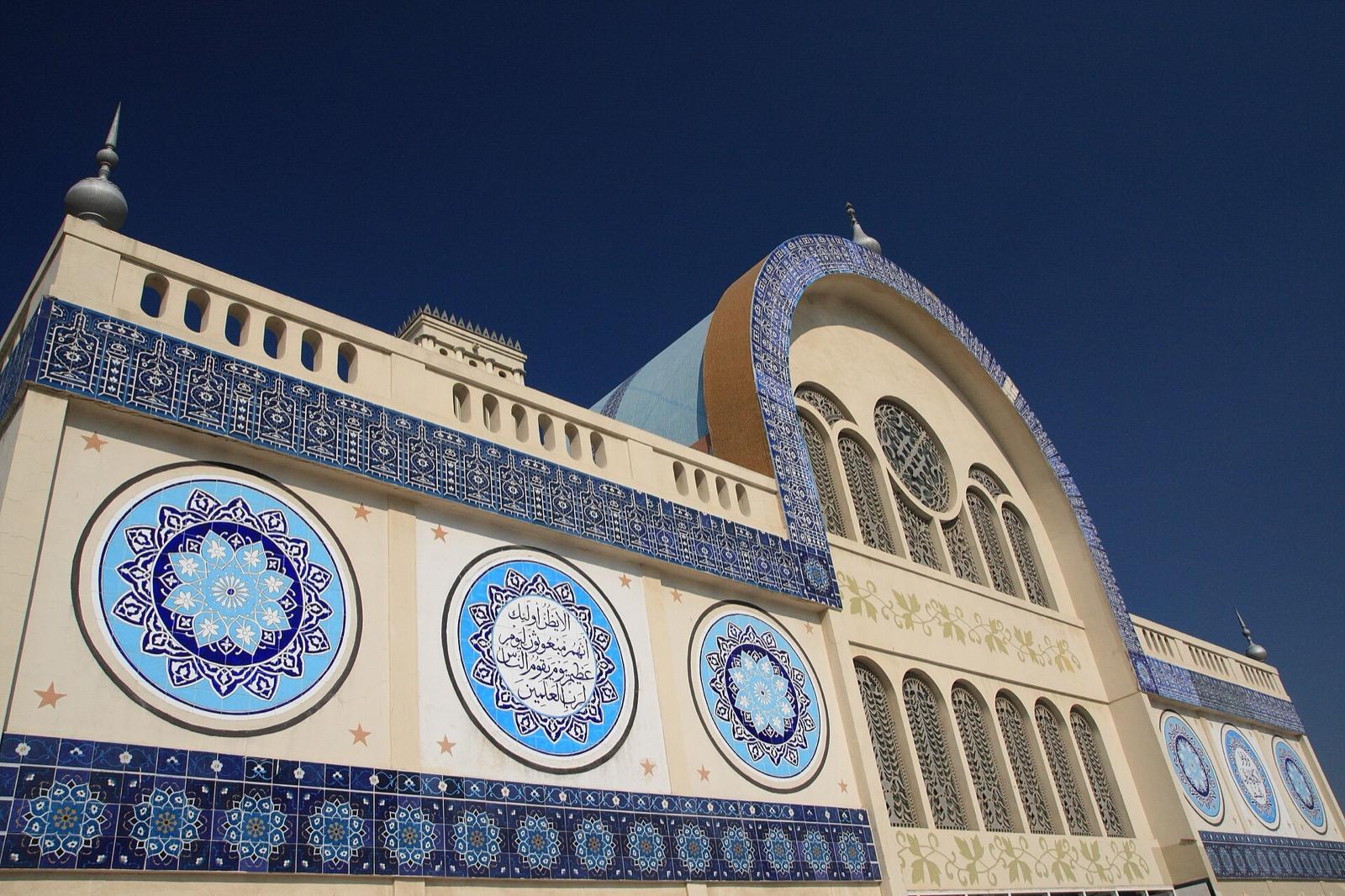
A dusk walk around the man-made Khalid Lagoon in the heart of Sharjah, past the blue-tiled souk that sits on the money, a giant musical fountain, an Ottoman-style mosque that opens its doors to visitors, and the corniche that walks the whole of it.
Start · The Blue Souk: The Market on the Money
DirectionsStops
- 1
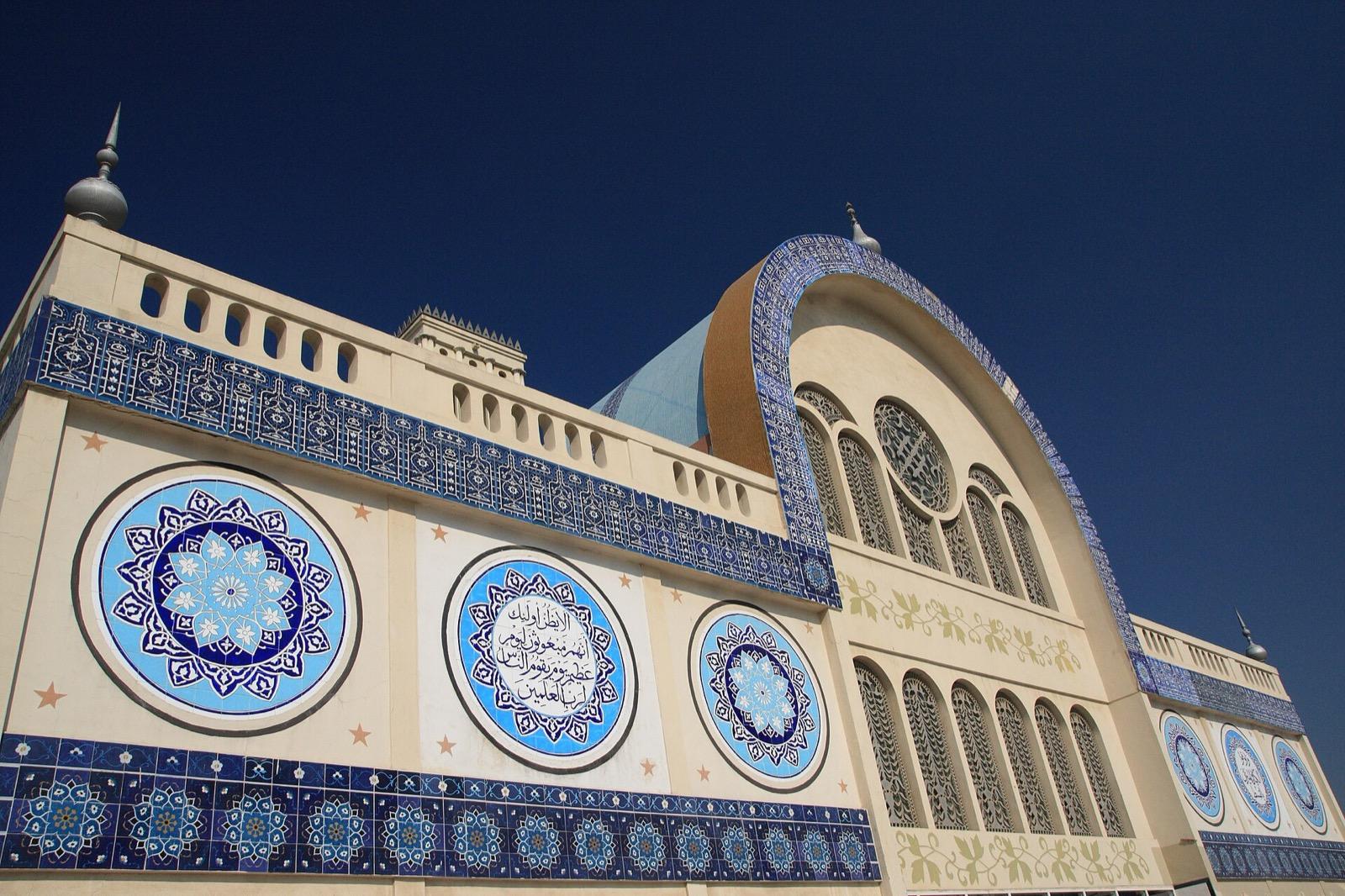
The Blue Souk: The Market on the Money
Sharjah's twin blue-tiled market halls, crowned with twenty wind towers and famous enough to sit on the five-dirham banknote.
- 2
The Al Noor Mosque: The Cascade of Domes in the Water
An Ottoman-style mosque of thirty-four domes and two slender minarets, mirrored in the lagoon, and the first in Sharjah to open its doors to visitors of every faith.
- 3
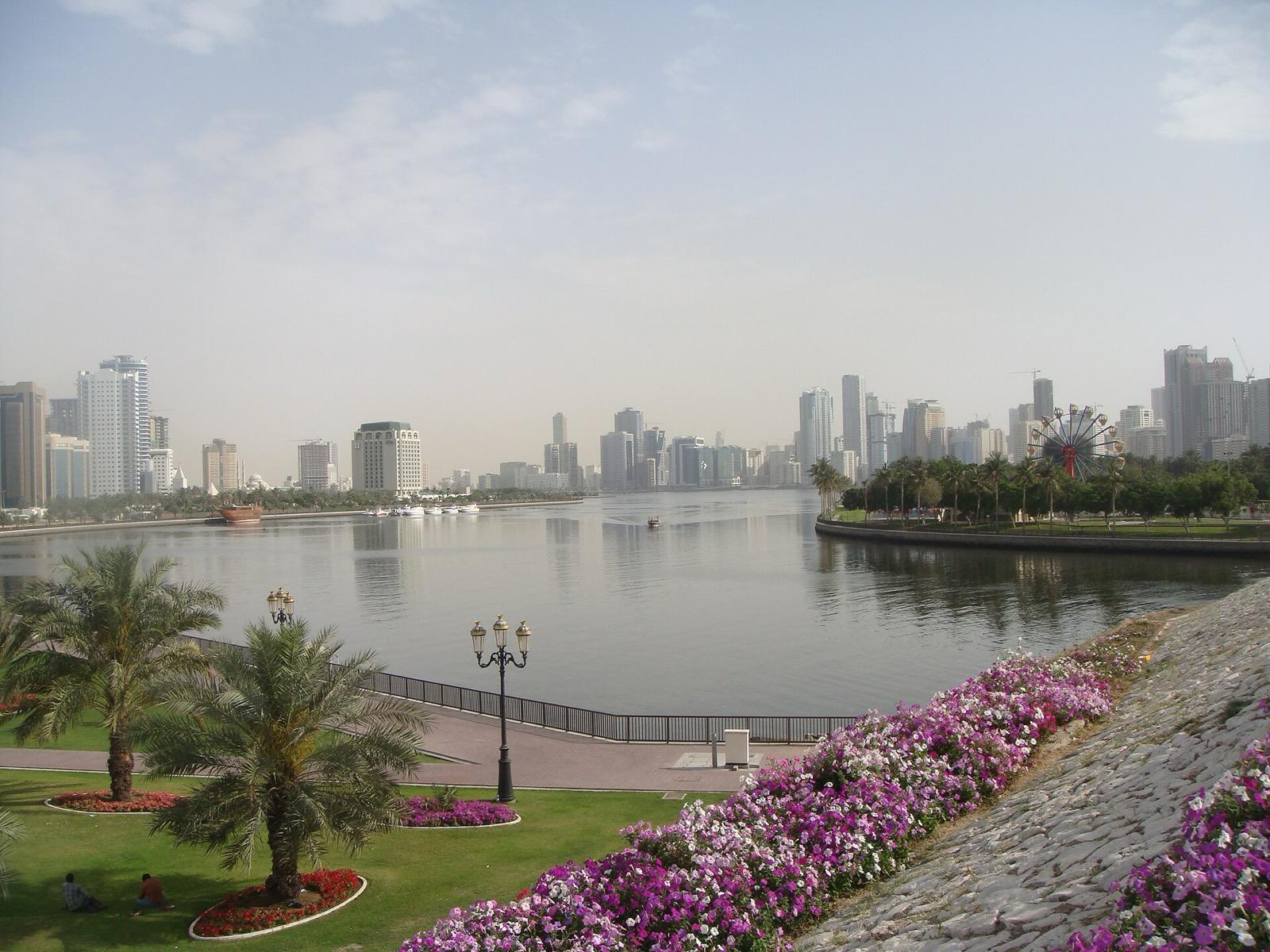
The Buhaira Corniche: The Whole Lagoon at Dusk
The promenade view that gathers the entire lagoon at dusk, souk and fountain and mosque together, the quieter capital of the coast.
- 4
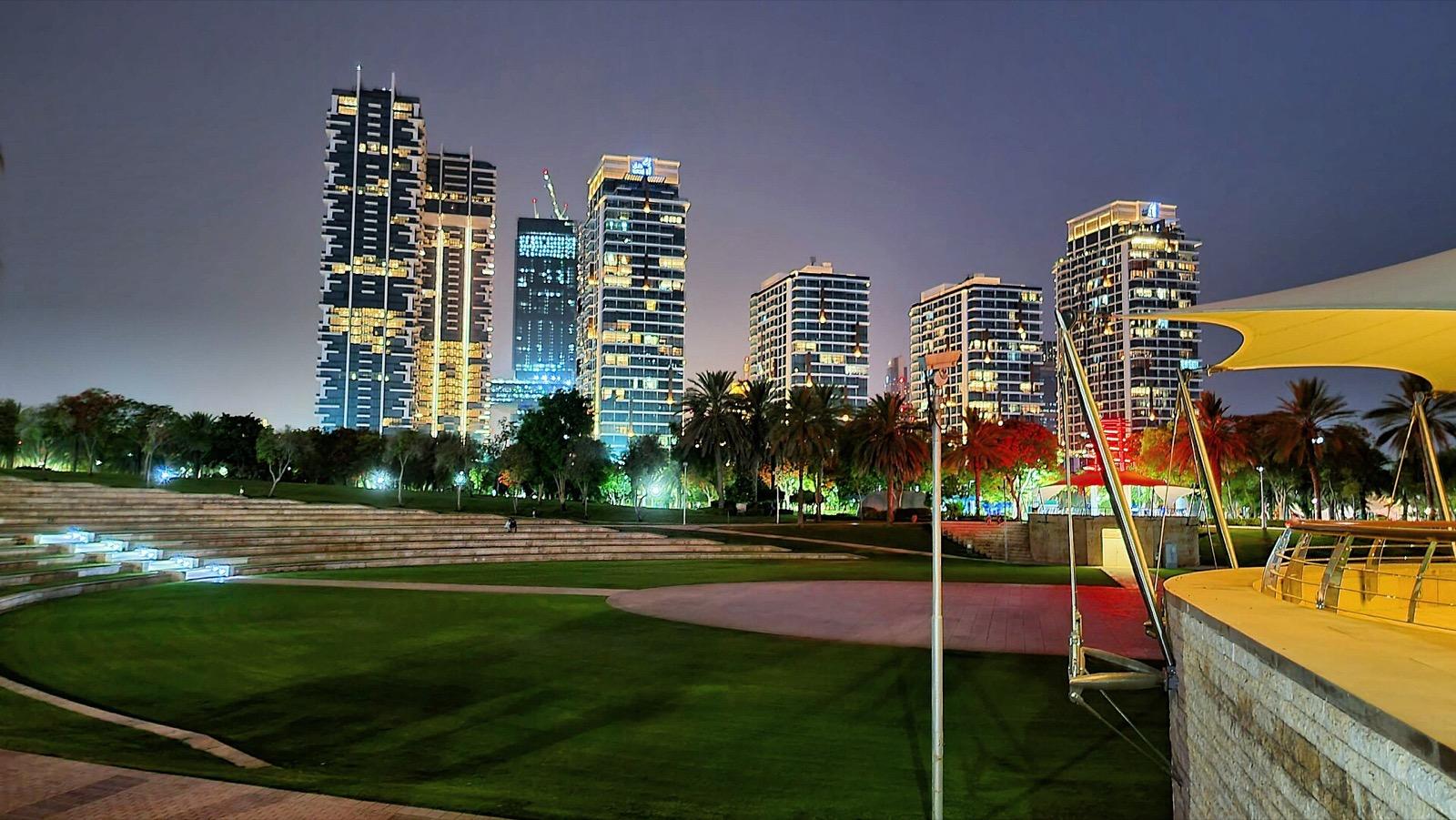
Al Majaz Waterfront: The Pleasure Ground by the Water
A landscaped lagoon-side park of gardens, cafes and family attractions, the everyday pleasure ground of the cultural capital.
- 5
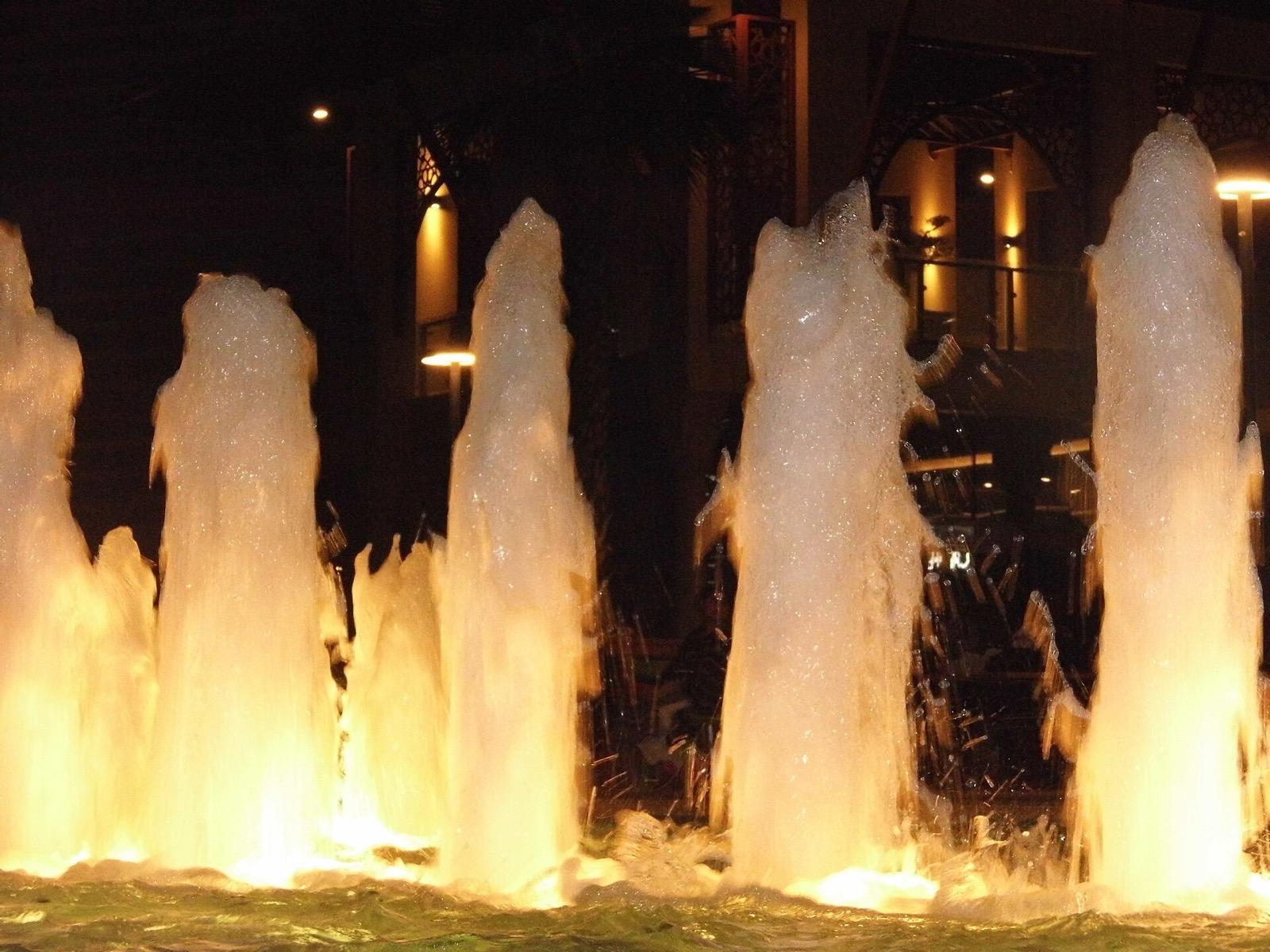
The Sharjah Fountain: Light on the Dark Water
A giant musical fountain on the lagoon whose jets rise up to one hundred metres, among the largest of its kind in the region.
Details
Best Time to Visit
The kindest window is the mild winter, from about November to March, when daytime temperatures are pleasant and an evening walk around the lagoon is a genuine delight. Avoid the extreme heat of summer, from about June to September, when midday temperatures and humidity make walking outdoors uncomfortable and even risky; if you must visit then, do the whole tour after sunset. Whatever the season, dusk is the ideal hour for this route, when the light softens on the water, the crowds come out, and the fountain shows run after dark. During the holy month of Ramadan, plan around the daytime fast: eating, drinking and smoking in public are restricted during daylight, many cafes open only after sunset, and the waterfront comes alive in the evenings once the fast is broken.
Pro Tips
- •Start in the late afternoon and walk into the evening so you reach the fountain after dark; check the current show times before you set out, as they run in the evening and can change.
- •Carry water on every leg, even in winter, and refill when you pass the cafes at Al Majaz Waterfront; there is little natural shade along the open promenade.
- •Most of the walk costs nothing: the corniche, the souk halls, the fountain and the mosque exterior are all free. Budget dirhams only for individual rides, mini-golf, boat trips or purchases in the souk.
- •To go inside the Al Noor Mosque, join one of its scheduled guided tours rather than expecting to wander in; dress modestly, and women should bring a scarf to cover the hair.
- •English is widely spoken across the United Arab Emirates, so you can shop, ask directions and take a mosque tour comfortably in English, but a greeting in Arabic is always warmly received.
- •The full lagoon loop runs about six and a half to seven kilometres; if you tire, the corniche is dotted with benches and the cafe stops at Al Majaz make a natural halfway rest.
Safety & Precautions
- •The summer heat here is genuinely dangerous. From about June to September, avoid the midday and afternoon sun entirely, keep to shade, drink water constantly, and consider walking the whole route only after sunset.
- •Use strong sun protection year round: a hat, sunglasses and sunscreen. The reflection off the lagoon and the open, largely unshaded promenade intensify the sun even on mild winter days.
- •Sharjah is the most conservative of the coast's emirates, so dress modestly throughout, keeping shoulders and knees covered, and be especially careful at the Al Noor Mosque, where a modest dress code applies and women must cover their hair to enter. Keep your voice low and ask before photographing worshippers at any working mosque.
- •During Ramadan, do not eat, drink or smoke in public during daylight hours out of respect for those fasting. As with any city, keep normal street awareness on busy evenings, and note that mosque tours and some attractions charge or take donations in UAE dirhams.
- •Prices in the souk are negotiable and the opening figure quoted to visitors runs high, so compare a few shops, agree the number before you buy rather than under pressure, and for gold ask for a hallmarked, itemised receipt showing purity and weight.
Travel advisory: Reconsider Travel (Level 3).
Gallery
Related Reading
Go deeper on what you'll see, hear, and walk through.
Overview
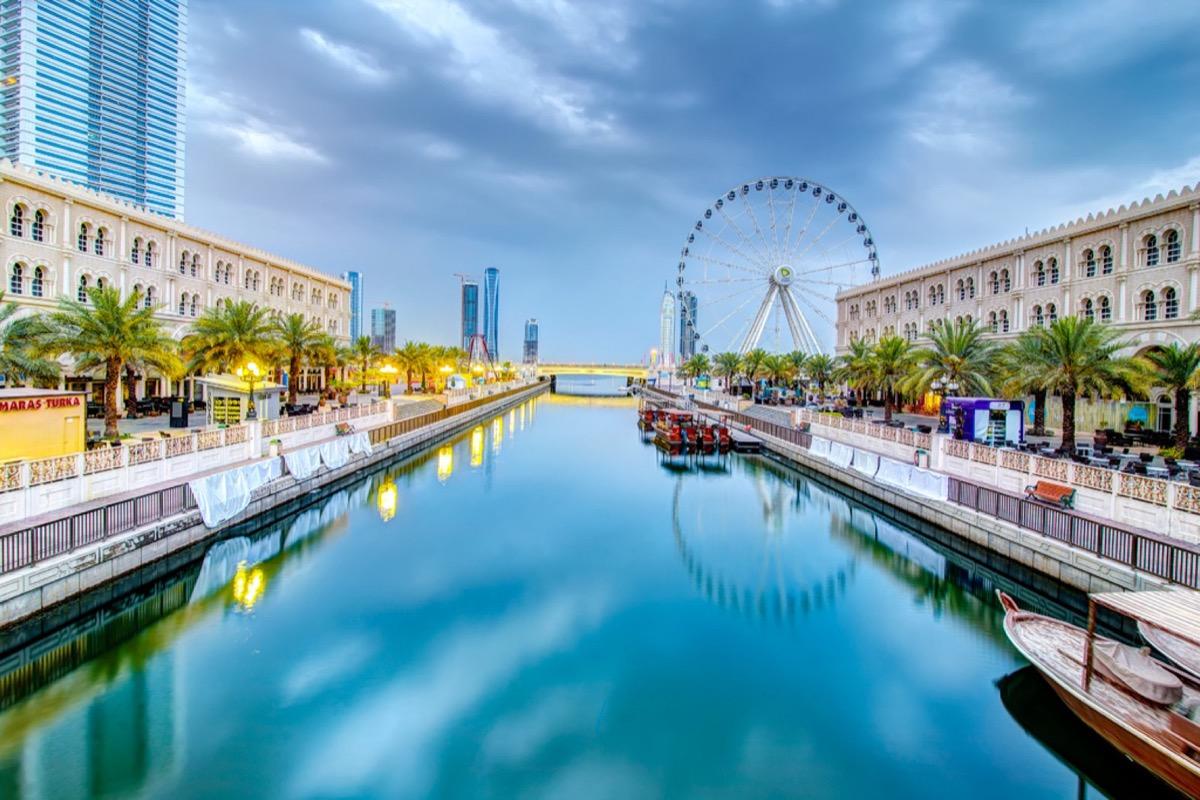
Best Self-Guided Walking Tours in Sharjah (2026)
4 min
Overview
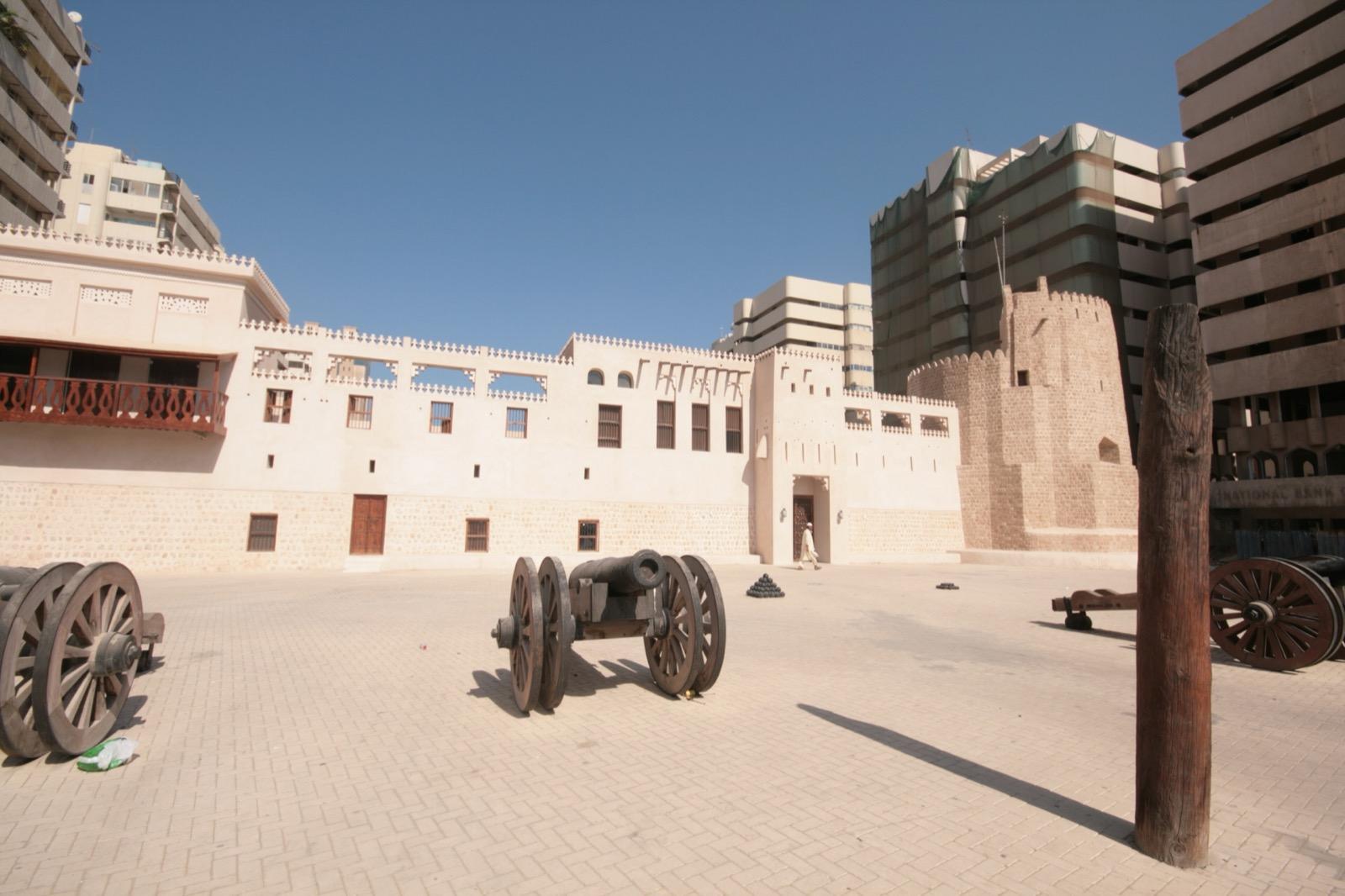
One Day in Sharjah: A Walkable Morning-to-Evening Itinerary
7 min
Overview
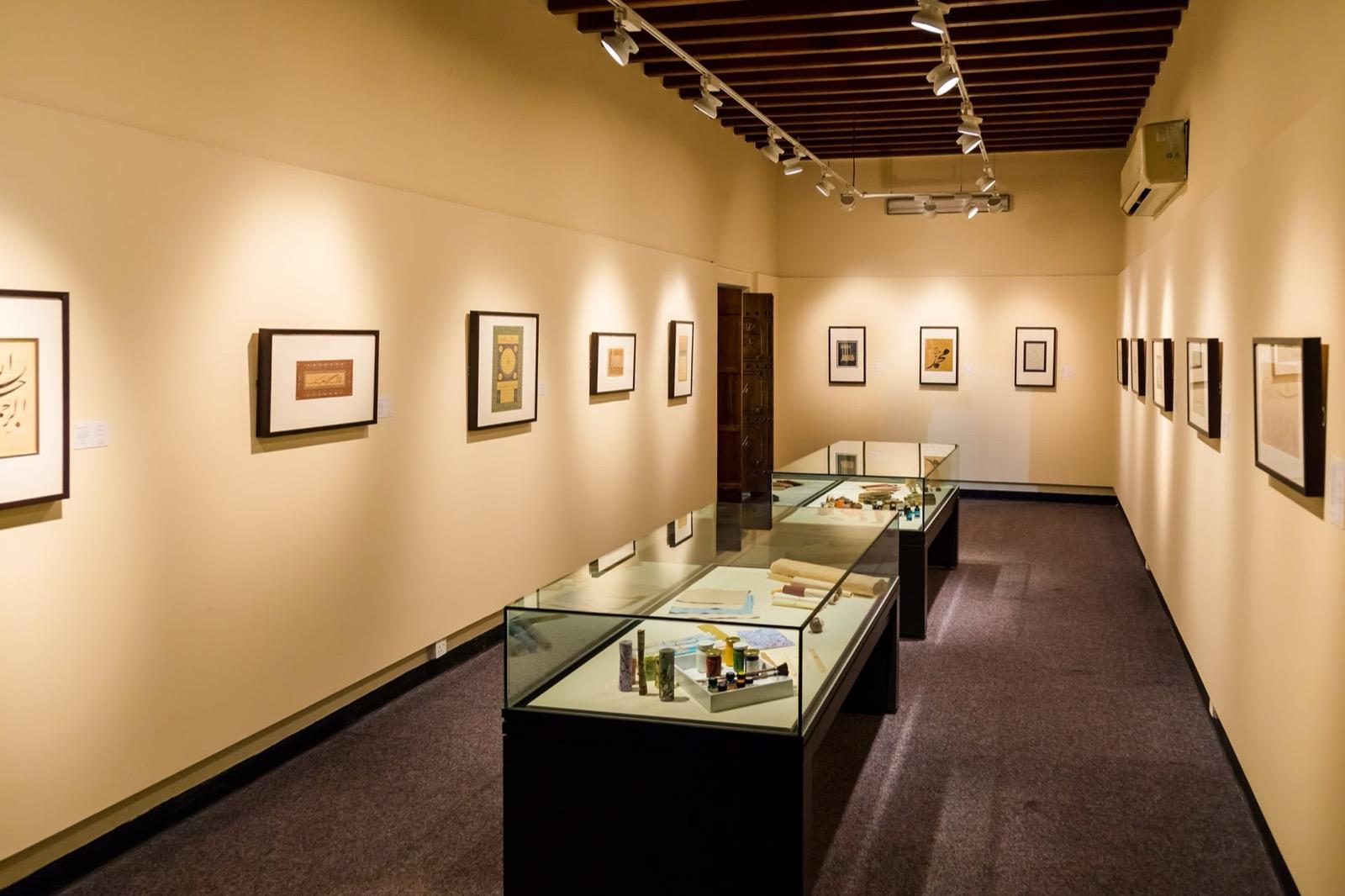
Sharjah Travel Guide: Days, Transport, Best Time, Safety, Budget
7 min
Thematic
Sharjah: The Emirate That Banked on Culture Instead of Height
7 min
Companion
The Buhaira Corniche: Reading All of Sharjah From One Dusk View
6 min
Deep dive
The Blue Souk in Sharjah: The Market on the Five-Dirham Banknote
6 min
Read
What to Eat in Sharjah: A Local Food Guide to Emirati Dishes
6 min
Read the walk
The full story of Sharjah Corniche & the Blue Souk: The Cultural Capital, in words. Prefer to listen? Play it narrated, from home or on location.
Introduction
Sharjah is the quieter of the three great cities on this coast of the United Arab Emirates, the sober sibling that leads with culture and heritage rather than superlatives. It is the emirate that the United Nations cultural body, UNESCO, named Cultural Capital of the Arab World in nineteen ninety-eight, and that was later named Capital of Islamic Culture in twenty fourteen. Yet around one stretch of water it arranged its own quiet pleasures, and that is where this walk goes. This tour is a continuous walk on foot, five stops, roughly four kilometres and about ninety minutes at an easy pace, following the promenade that rings the lagoon at the heart of the city. Along the way you will read a market so beautiful the country put it on a banknote, a mosque with a cascade of domes mirrored in the water that welcomes visitors of every faith, a waterfront promenade and gardens where families gather in the cool of the evening, and a giant fountain thrown high over the dark water at night. The word to carry with you is souq, the market, and buhaira, the small sea or lagoon, because both shape everything you are about to see. This is the leisure of the cultural capital, held together with its restraint: the pleasure ground and the place of worship, the everyday family evening and the deeper claim of the city. Take your time, and read the lagoon at walking pace. When you arrive at the Blue Souk, begin with stop one.
1. The Blue Souk: The Market on the Money
The building in front of you is officially the Sharjah Central Souq, but everyone calls it the Blue Souk, for the blue tiles that sheath its outer walls, some of them carrying verses from the Quran. Souq is simply the word for the market, the covered trading hall that has been the beating heart of every town on this coast for as long as anyone can remember. This one is grander than most. It was designed by a British firm, Michael Lyell Associates, under the guidance of the Ruler of Sharjah, Sheikh Doctor Sultan bin Mohammed Al Qasimi, and completed in nineteen seventy-eight, then inaugurated in nineteen eighty. Two large halls run side by side, joined together, spanning some eighty thousand square metres, holding more than six hundred shops. Along the roofline you can count the wind towers, twenty of them in silhouette against the sky. The wind tower is called a barjeel, the tall open shaft that catches any breeze and funnels it down to cool the rooms below, the old air conditioning of the desert courtyard house. Here they are largely decorative, a memory of the old architecture wearing a modern skin. Inside, under the barrel vaults, the trades sort themselves: gold and jewellery glowing behind glass on one side, carpets and antiques, perfumes, souvenirs and crafts on the other. And here is the detail that tells you how the country feels about this building. Look at a five-dirham banknote, the money in your own pocket, and you will find this souq printed on it. A market so admired it became a national symbol. Take a slow turn through the halls, then follow the promenade down toward the water.
2. The Al Noor Mosque: The Cascade of Domes in the Water
Across the water, its domes doubled in the lagoon, stands the Al Noor Mosque, and this is the deepest note of the whole walk. Masjid is the word for the mosque, the place of worship, and al-noor means the light. Its foundation was laid on the sixth of April, two thousand and three, and it was completed in two thousand and five. The design is Turkish Ottoman, openly inspired by the great Sultan Ahmed Mosque in Istanbul, the one the world calls the Blue Mosque. You can read that lineage in the shape of it: a central dome surrounded by a cascade of smaller half-domes tumbling down around it, thirty-four domes in all, the inner dome rising about thirty-one and a half metres, and two slender minarets, each fifty-two metres tall, standing at the corners. Inside it can hold around twenty-two hundred worshippers. Now here is what makes it special, and it matters. This was the first mosque in Sharjah to open its doors to non-Muslim visitors, offered as a bridge between people, and it runs guided tours for exactly that purpose. So this is a place you may enter and walk through, respectfully, on a tour, with a modest dress code, and for women a covering of the hair. It remains a working place of worship first, so it asks for the quiet and the care you would give any sacred space. But the fact that the cultural capital chose to open this door, to say to every visitor, come in and see, is the truest expression of what Sharjah means when it calls itself a capital of culture. Stand a while with the domes and their reflection, then follow the corniche to the last view.
3. The Buhaira Corniche: The Whole Lagoon at Dusk
This is the last stop, a viewpoint on the Buhaira Corniche looking back across the lagoon, and from here the whole thing gathers into one image. The corniche is the waterfront road and promenade, and this one rings Khalid Lagoon for roughly four and a half kilometres,…
Full narration for this stop unlocks with the tour.
4. Al Majaz Waterfront: The Pleasure Ground by the Water
This is Al Majaz Waterfront, and it is the everyday pleasure ground of Sharjah. It was developed by Shurooq, the Sharjah Investment and Development Authority, launched in twenty ten and opened to the public in late twenty eleven in two phases, at a cost of around one hundred and…
Full narration for this stop unlocks with the tour.
5. The Sharjah Fountain: Light on the Dark Water
Out on the lagoon in front of Al Majaz Waterfront stands the Sharjah Fountain, and if you can time your walk for after dark, it is worth the wait. The giant musical fountain opened here in twenty twelve. Its jets rise up to one hundred metres into the night air, and it spreads…
Full narration for this stop unlocks with the tour.