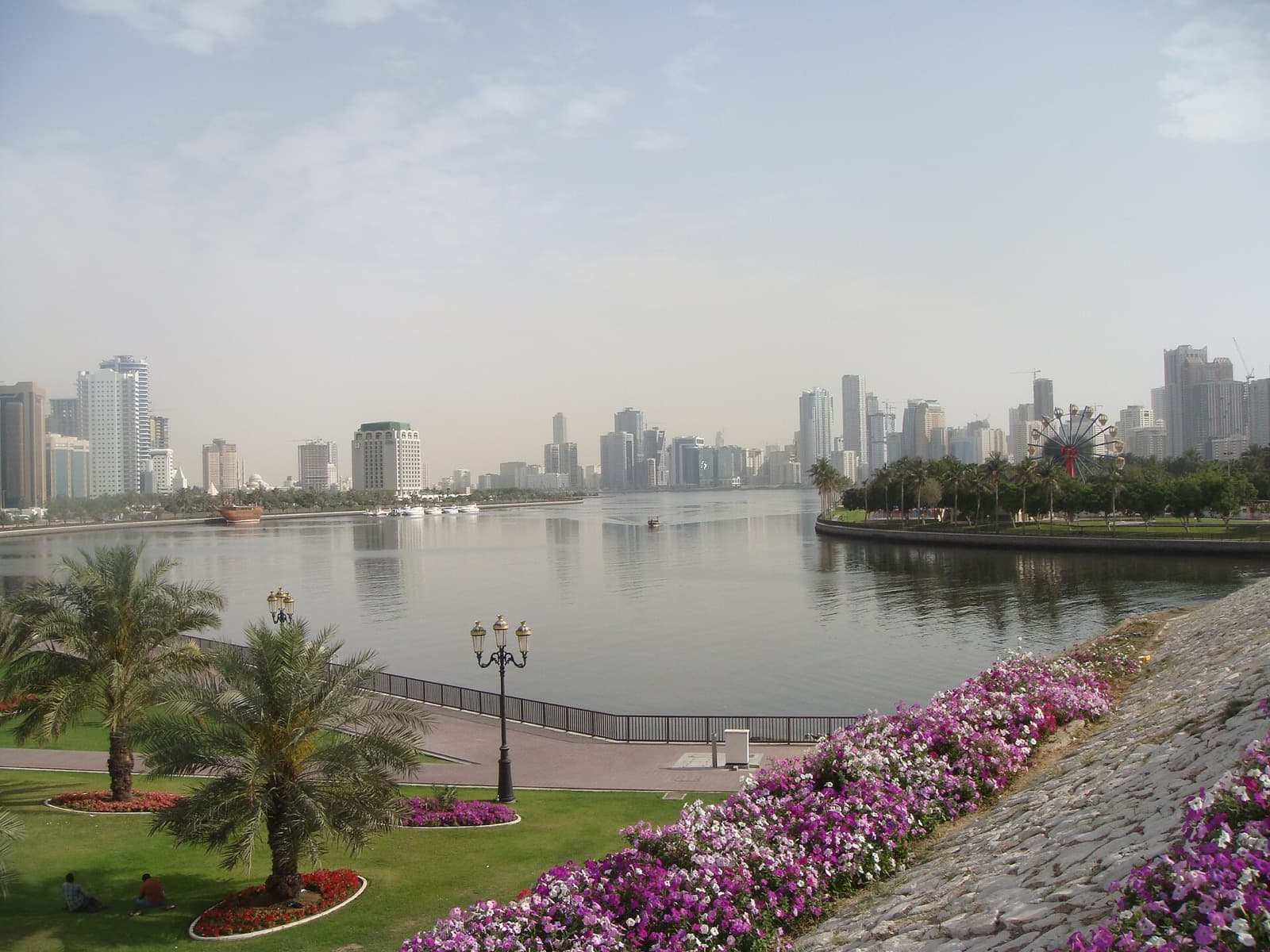
Sharjah dug a lagoon into its own center and then arranged a city around the water instead of over it. Stand on the Buhaira Corniche at dusk and the whole argument of this walk gathers into one view across Khalid Lagoon: the blue-tiled souk at the far end, a musical fountain rising over the surface, the cascade of domes on the Al Noor Mosque doubled in the reflection, and the modern towers catching the last light behind all of it. This is the sober, cultured sibling among the three great cities of the coast, Dubai, Abu Dhabi, and Sharjah, and the corniche viewpoint is where that character reads clearest. It reaches not for the tallest tower but for something on a human scale, open to everyone, walked at an easy pace.
Why the viewpoint is the key to the whole walk
Most walking tours save the summary for the end. This one gives you the summary as a place you can stand. The Buhaira Corniche is the waterfront road and promenade that rings Khalid Lagoon for roughly four and a half kilometers, palm-lined, benched, laid out for exactly the slow evening walk this route asks of you. From the viewpoint marked as stop three on the Roamer route, the entire cast of the tour is legible at once. You do not have to imagine how the pieces connect. You can see them connect.
That matters because the pieces are, on the surface, a strange set to put together: a market, a mosque, a public garden, a giant fountain. What links them is not a single style or a single century. It is a posture. Everything around this lagoon is on a human scale and open to the public. A market you can walk through for free and pay only for what you buy. A mosque that opens its doors to visitors of every faith. A garden you enter for the price of a coffee, or for nothing at all. A fountain that costs nothing to watch. The corniche viewpoint is where you understand that the water was the point. Sharjah cut a sheet of water into its own middle so the city would have something to gather around, and then it built its quieter pleasures along the edge.
Two Arabic words unlock the geography, and both appear on the route. Buhaira means the small sea or lagoon. Souq means the market. Carry those two and the map of the walk explains itself.
What you are looking at across the water
Hear a stop from this walk
The Buhaira Corniche: The Whole Lagoon at Dusk
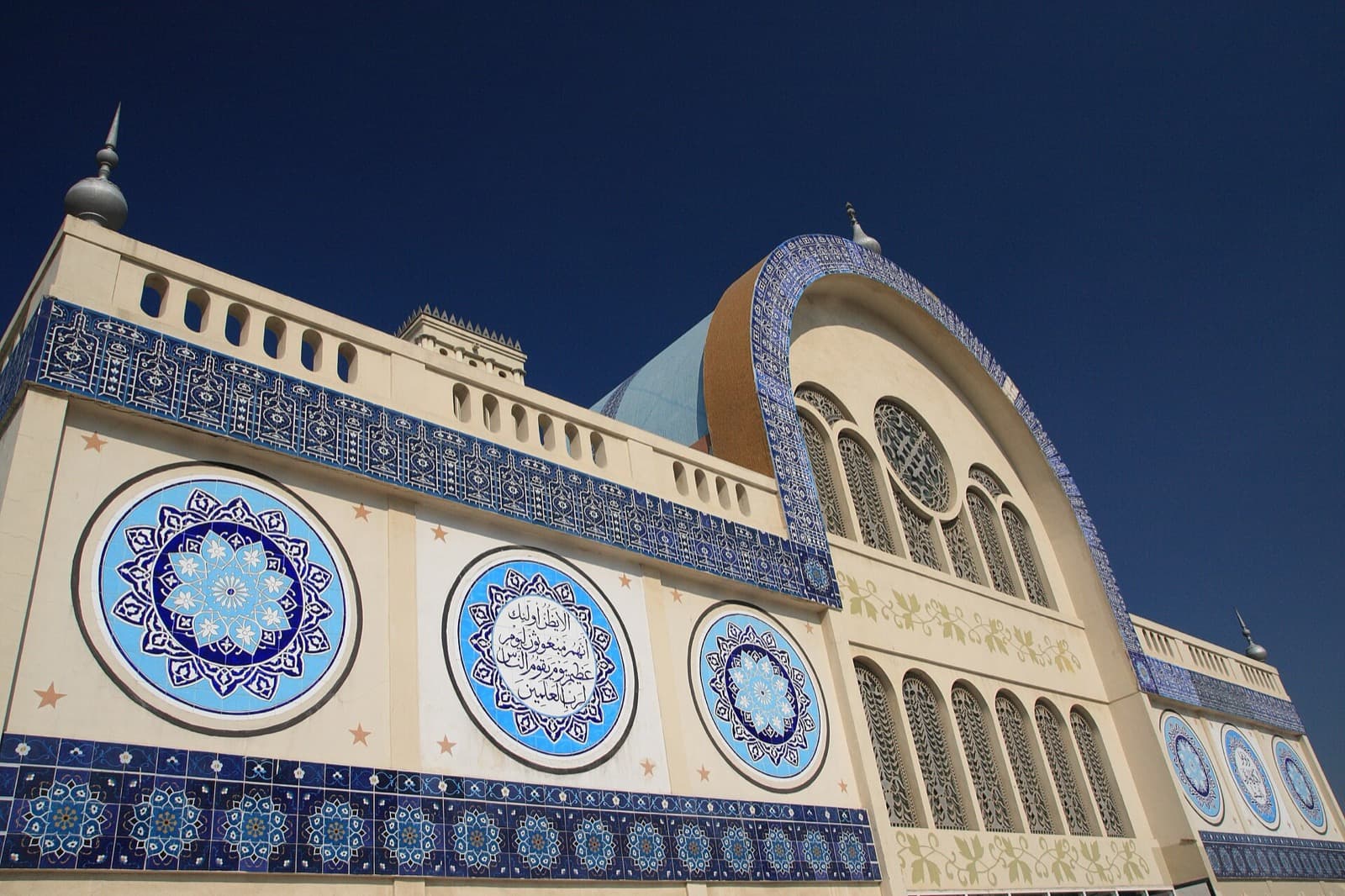
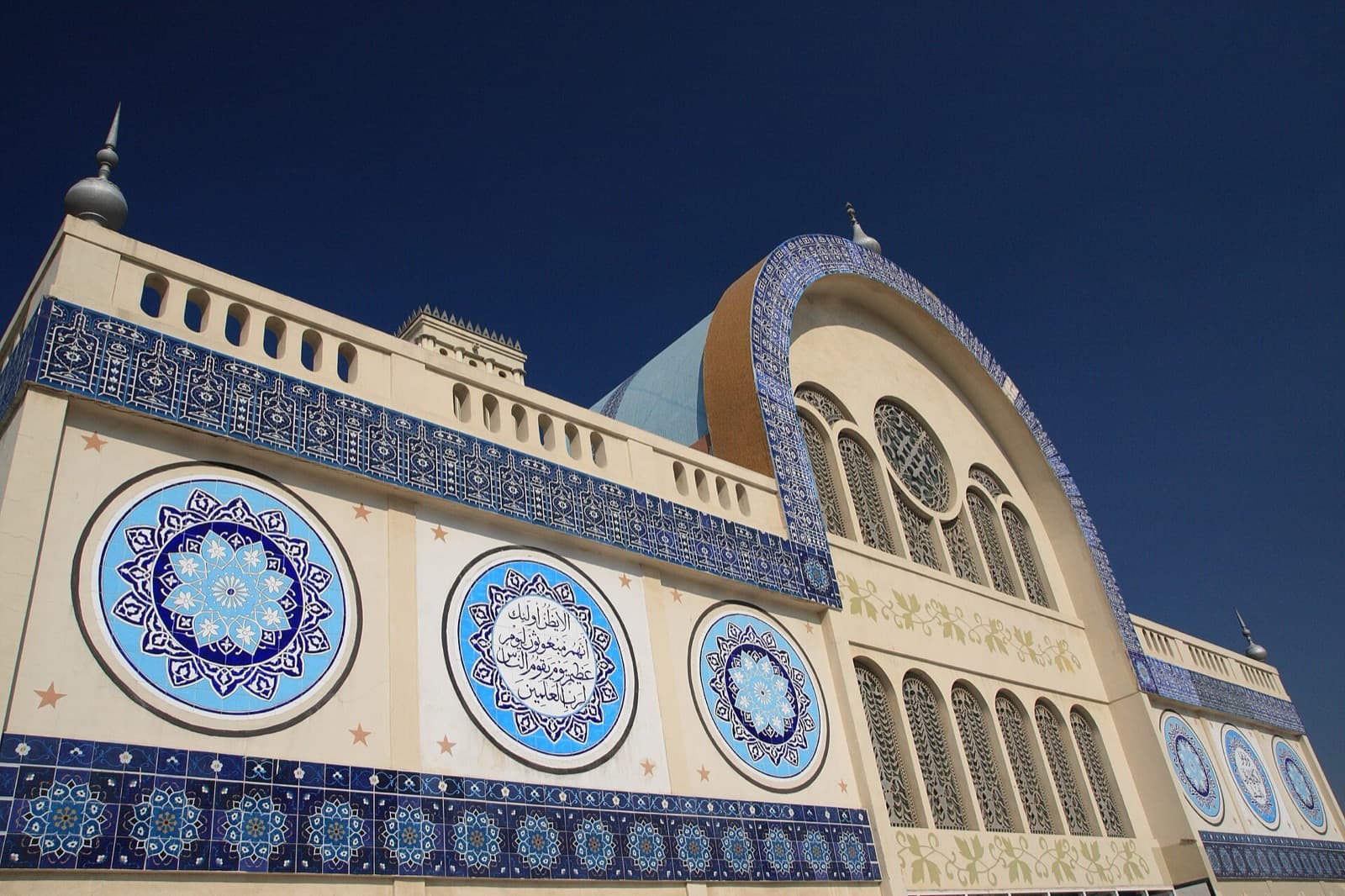
From the viewpoint, the far end of the lagoon holds the Sharjah Central Souq, which everyone calls the Blue Souk for the blue tiles on its outer walls, some carrying verses from the Quran. It was designed by the British firm Michael Lyell Associates under the guidance of the Ruler of Sharjah, Sheikh Doctor Sultan bin Mohammed Al Qasimi, completed in nineteen seventy-eight and inaugurated in nineteen eighty. Two joined halls run side by side across some eighty thousand square meters, holding more than six hundred shops, with twenty decorative wind towers, called barjeel, ranged along the roofline. The building is admired enough that it appears on the country's five-dirham banknote. A market printed on the money is a fair measure of how a place feels about itself.
Nearer the viewpoint, the domes of the Al Noor Mosque tumble down toward the water. Its foundation was laid on the sixth of April, two thousand and three, and it was completed in two thousand and five. The design is Turkish Ottoman, openly modeled on the Sultan Ahmed Mosque in Istanbul that the world calls the Blue Mosque, with thirty-four domes in all, an inner dome rising about thirty-one and a half meters, and two minarets each fifty-two meters tall. Inside it holds around twenty-two hundred worshippers. The detail that matters most: this was the first mosque in Sharjah to open its doors to non-Muslim visitors, running guided tours as a deliberate bridge between people. When the cultural capital says come in and see, it means it literally.
Then the fountain, out on the lagoon in front of Al Majaz Waterfront. The giant musical fountain opened in twenty twelve, its jets rising up to one hundred meters, spreading about two hundred and twenty meters across the water, with two water screens for light and projection choreographed to music. It was inaugurated by Sheikha Bodour Bint Sultan Al Qasimi, Chairperson of Shurooq, the Sharjah Investment and Development Authority, and Marwan Jasem Al Sarkal, its Chief Executive. Notice how it is described: among the largest of its kind in the region, meaning the Arabian Gulf, not a claim to be the biggest in the world. That understatement is very Sharjah.
The claim underneath the leisure
The viewpoint carries the tour's deeper point, the one the audio guide lands on here. Sharjah was named Cultural Capital of the Arab World by UNESCO in nineteen ninety-eight, and Capital of Islamic Culture in twenty fourteen. You can feel the difference from the corniche. Like the whole of the United Arab Emirates, this city rose within a single lifetime, out of a coast that once lived by the sea and the pearl, built up by a workforce drawn from South Asia and far beyond. The population here is today a majority of people who came from elsewhere, and in the cool of the evening you see all of them at ease by the same water. Al Majaz Waterfront, developed by Shurooq and opened in phases in late twenty eleven at a cost of around one hundred and twenty million dirhams, is where that everyday scene plays out: gardens, cafes, mini-golf, a splash park, an art park called Maraya, boat rides, most of it free.
Time your walk for dusk. The light softens on the water, the crowds come out, and the fountain runs after dark. The kindest season is the mild winter, roughly November to March. In the summer heat, from about June to September, walk only after sunset. To go inside the Al Noor Mosque, join a scheduled guided tour, dress modestly, and bring a scarf if you are a woman covering your hair.
The corniche viewpoint tells you what Sharjah is. The walk tells you how it got there. Plan the rest of your route with the Sharjah walking tours guide, and see the city hub at Sharjah before you set out.
Sources
- Sharjah Central Souq, Wikipedia. Design firm, completion and inauguration dates, scale, and the five-dirham banknote appearance.
- Al Noor Mosque (Sharjah), Wikipedia. Foundation date, Ottoman lineage, dome count, minaret height, and the open-to-visitors program.
- Al Majaz Waterfront, Visit Sharjah (official). The park's amenities, free-access model, and development by Shurooq.
- Musical shows begin at Sharjah fountain, Khaleej Times. The fountain's opening, jet height, span, and inauguration.
- Culture in Sharjah, Visit Sharjah (official). The UNESCO Cultural Capital of the Arab World and Capital of Islamic Culture designations.
Ready to experience it?
Sharjah Corniche & the Blue Souk: The Cultural Capital
90 min · 4 km · easy
More from Sharjah
Explore more at your own pace.
One Day in Sharjah: A Walkable Morning-to-Evening Itinerary
Sharjah Travel Guide: Days, Transport, Best Time, Safety, Budget
Sharjah: The Emirate That Banked on Culture Instead of Height
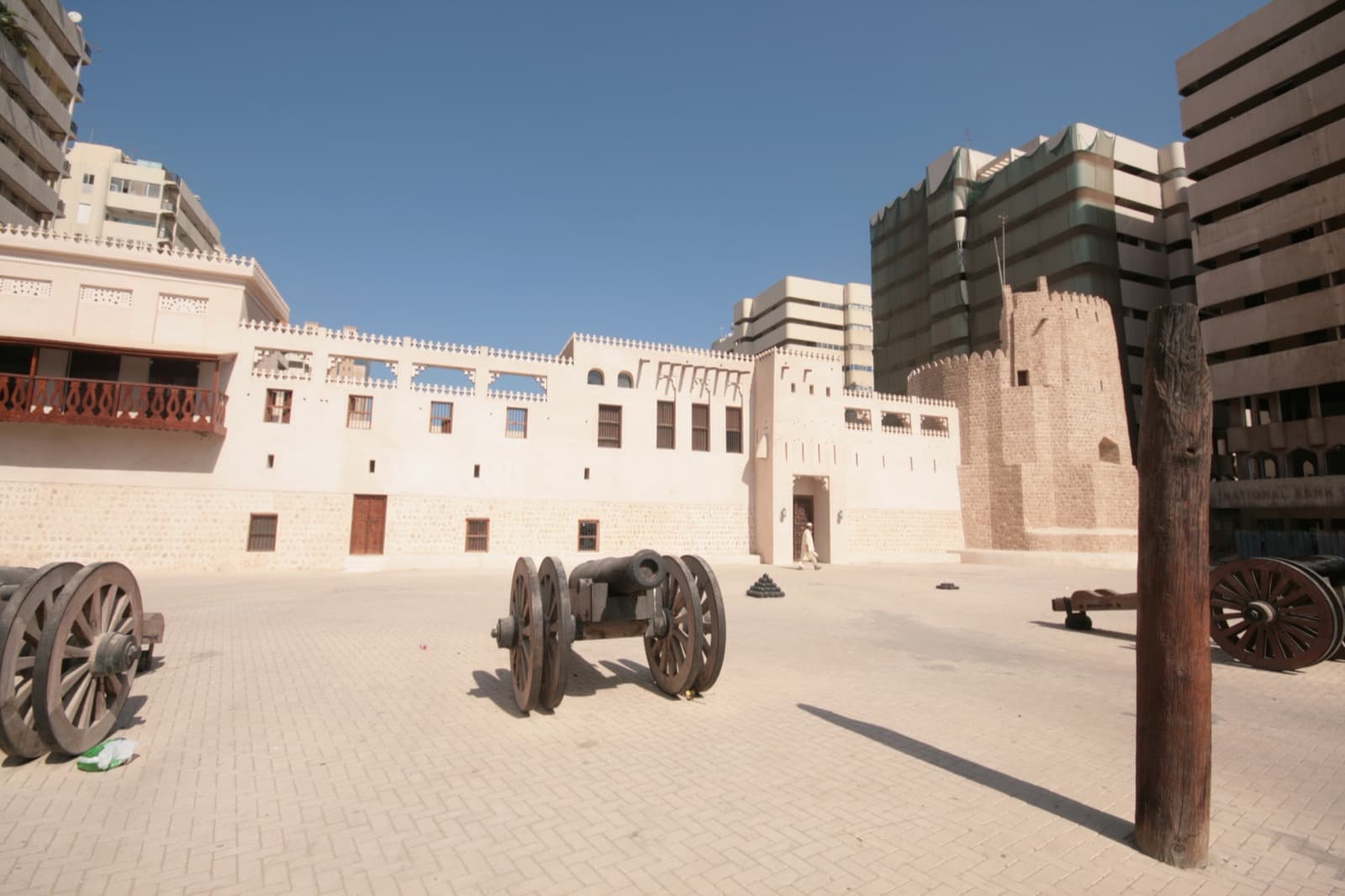
Heart of Sharjah: The Old Town That Was Rebuilt on Purpose
Al Hisn Sharjah: The Fort Rebuilt From Memory