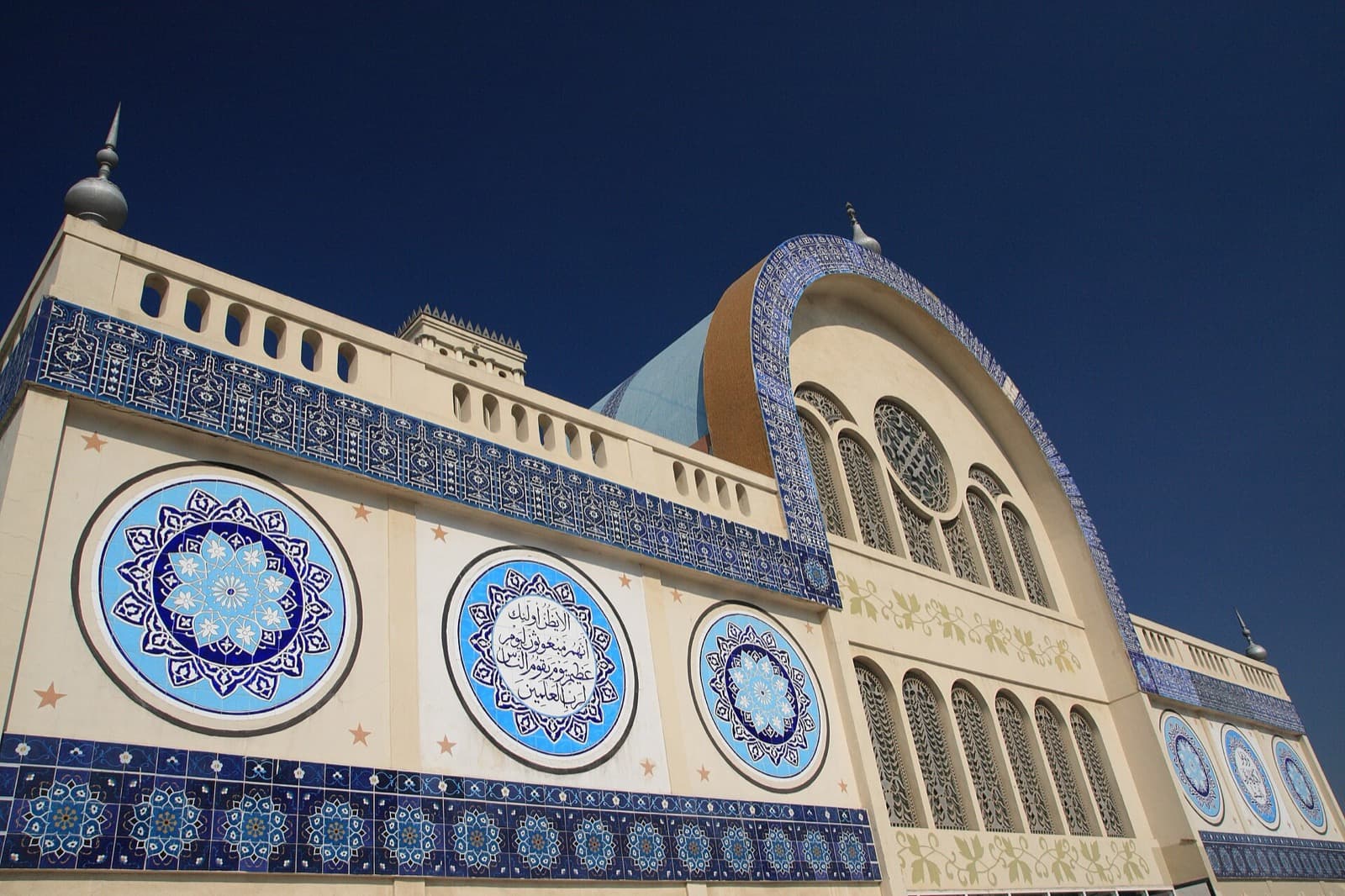
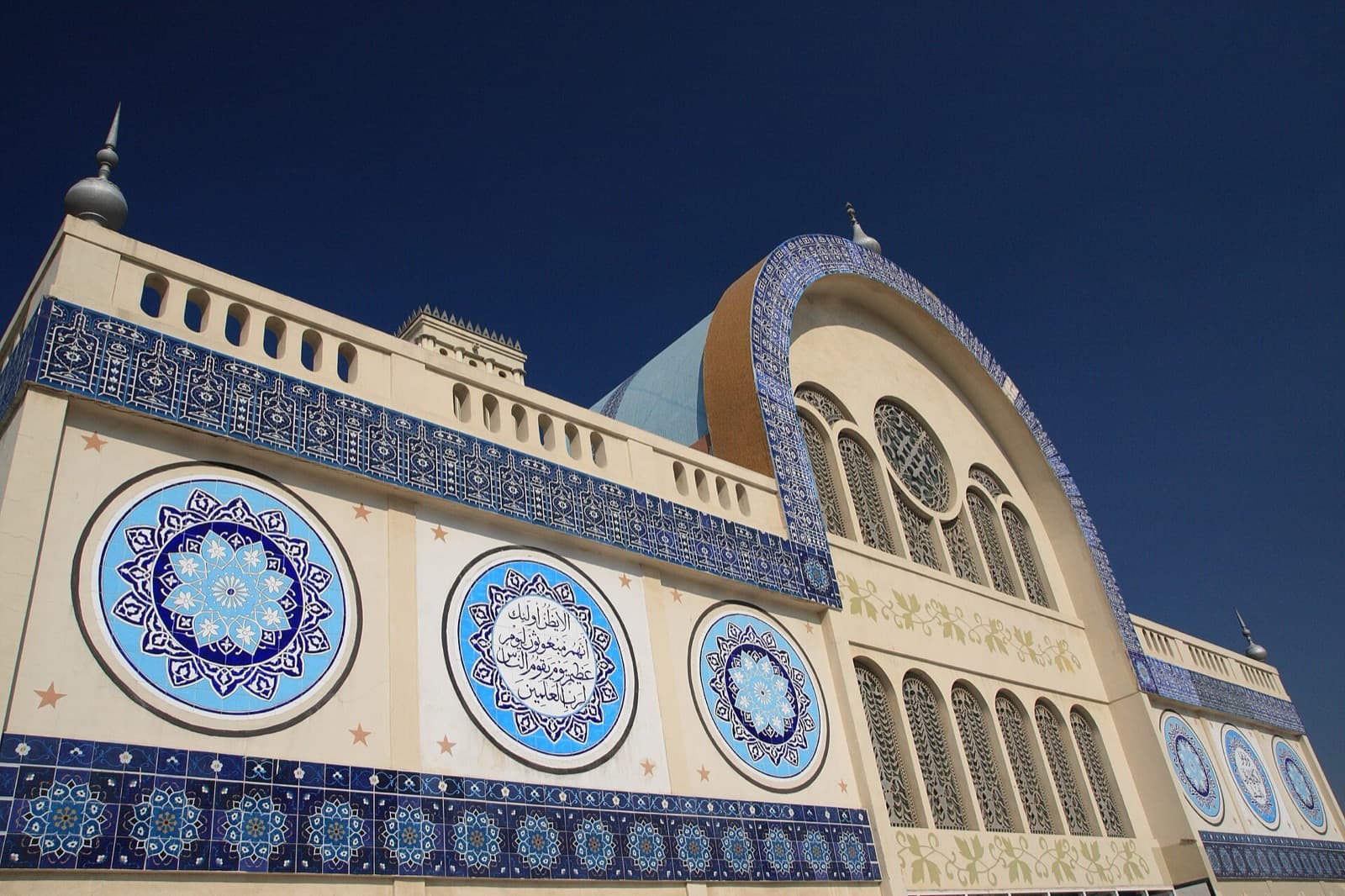
Stand in front of the Blue Souk in central Sharjah and you are looking at a market so admired that the country printed it on its money. Officially it is the Sharjah Central Souq, a pair of blue-tiled trading halls completed in 1978 and crowned with twenty wind towers, but almost nobody uses that name. The tiles decide it. The blue skin, some panels carrying verses from the Quran, gives the building its everyday name and its identity, and that identity is national: the souq appears on the United Arab Emirates five-dirham banknote, the note you may well be carrying as you read this. That single fact is the whole story in miniature, and it tells you why this building is the right place to start understanding Sharjah.
A market dressed as a memory
A souq is simply the covered market, the trading hall that has anchored every town on this coast for as long as anyone can remember. This one is grander than most and much younger than it looks. Two large halls run side by side, joined together, spanning some eighty thousand square metres and holding more than six hundred shops. The scale is modern, and so is the construction. What makes the Blue Souk worth slowing down for is the argument it makes about how to be modern without erasing the past.
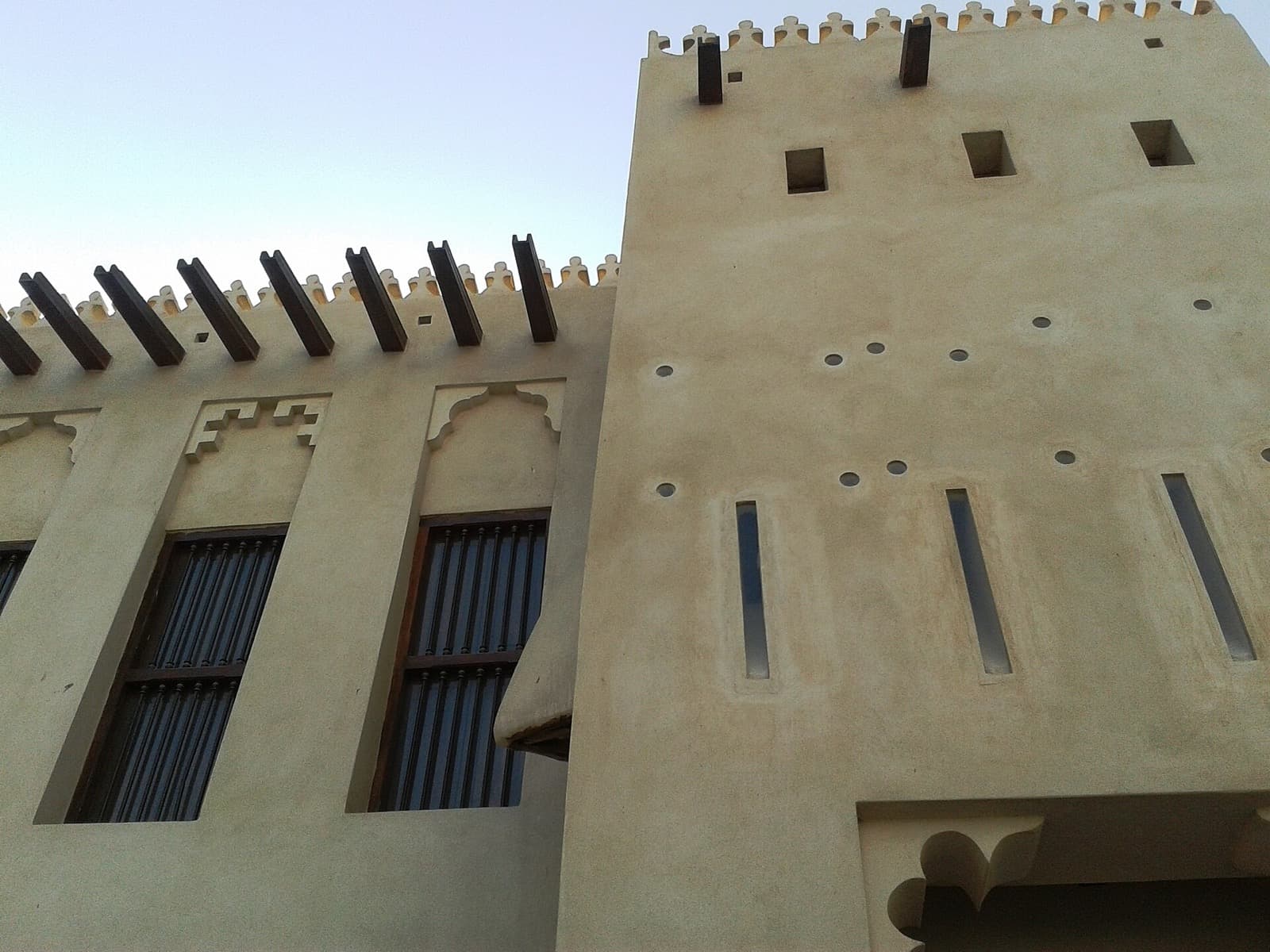
Look along the roofline and count the silhouettes. There are twenty of them, tall open shafts standing against the sky. Each one is a barjeel, a wind tower, and in the old courtyard houses of the Gulf the barjeel was the air conditioning of the desert. The shaft caught whatever breeze crossed the rooftops and funnelled it down into the rooms below, where evaporating water cooled it further. It was ingenious, low technology that made a brutal climate livable for centuries. Here, on the Blue Souk, the wind towers do almost none of that work. They are largely decorative, a memory of the old architecture wearing a new skin. That could read as costume, and in a lesser building it might. Instead it reads as a deliberate choice: a market built as the region grew wealthy, refusing to forget the shape of the thing it replaced.
The 1970s, oil, and a ruler with a doctorate
Hear a stop from this walk
The Buhaira Corniche: The Whole Lagoon at Dusk
The timing matters. The Blue Souk went up as Sharjah modernised in the 1970s, when oil revenue on this coast was reshaping a society that for centuries had lived by pearling, fishing, and trade across the Gulf. Within a single lifetime, towns that had lived by the sea and the pearl were remaking themselves in concrete and glass. The pressure to simply import a foreign idea of the modern was enormous, and much of the coast did exactly that.
The souq was designed by a British firm, Michael Lyell Associates, but the guiding hand was the Ruler of Sharjah, Sheikh Doctor Sultan bin Mohammed Al Qasimi. The building was completed in 1978 and inaugurated in 1980. It is fair to read the barjeel roofline as a decision made at the top, by a ruler whose scholarly bent shaped the emirate's whole character. Sharjah is the one among the three great cities of this coast, alongside Dubai and Abu Dhabi, that leads with culture and heritage rather than with superlatives. It was named Cultural Capital of the Arab World by UNESCO in 1998, and later named Capital of Islamic Culture in 2014. The Blue Souk, finished decades before either title, already carried that same instinct in its walls: keep the memory of the old form, even when you no longer need it to keep cool.
Inside the halls
Step in under the barrel vaults and the trades sort themselves out by hall. On one side, gold and jewellery glow behind glass, case after case of it, the traditional Gulf souq trade still very much alive. On the other side sit carpets and antiques, perfumes, souvenirs, and crafts, the goods that carry the scent of the wider trading world the Gulf has always been plugged into. It is free to walk in; you pay only if you buy. That openness is worth registering. This is not a museum piece behind a rope. It is a working market where residents and visitors mingle, and where a slow browse costs nothing at all.
The thing to hold onto, standing among the vaults, is the banknote. A country puts a building on its currency when that building says something the country wants to say about itself. Sharjah did not choose its tallest tower or its newest mall. It chose a market that quotes its own past in the shape of its roof. That is the argument of the whole emirate compressed into a single structure: modern, prosperous, and quietly determined not to lose the memory of what came before.
Walk the lagoon it sits beside
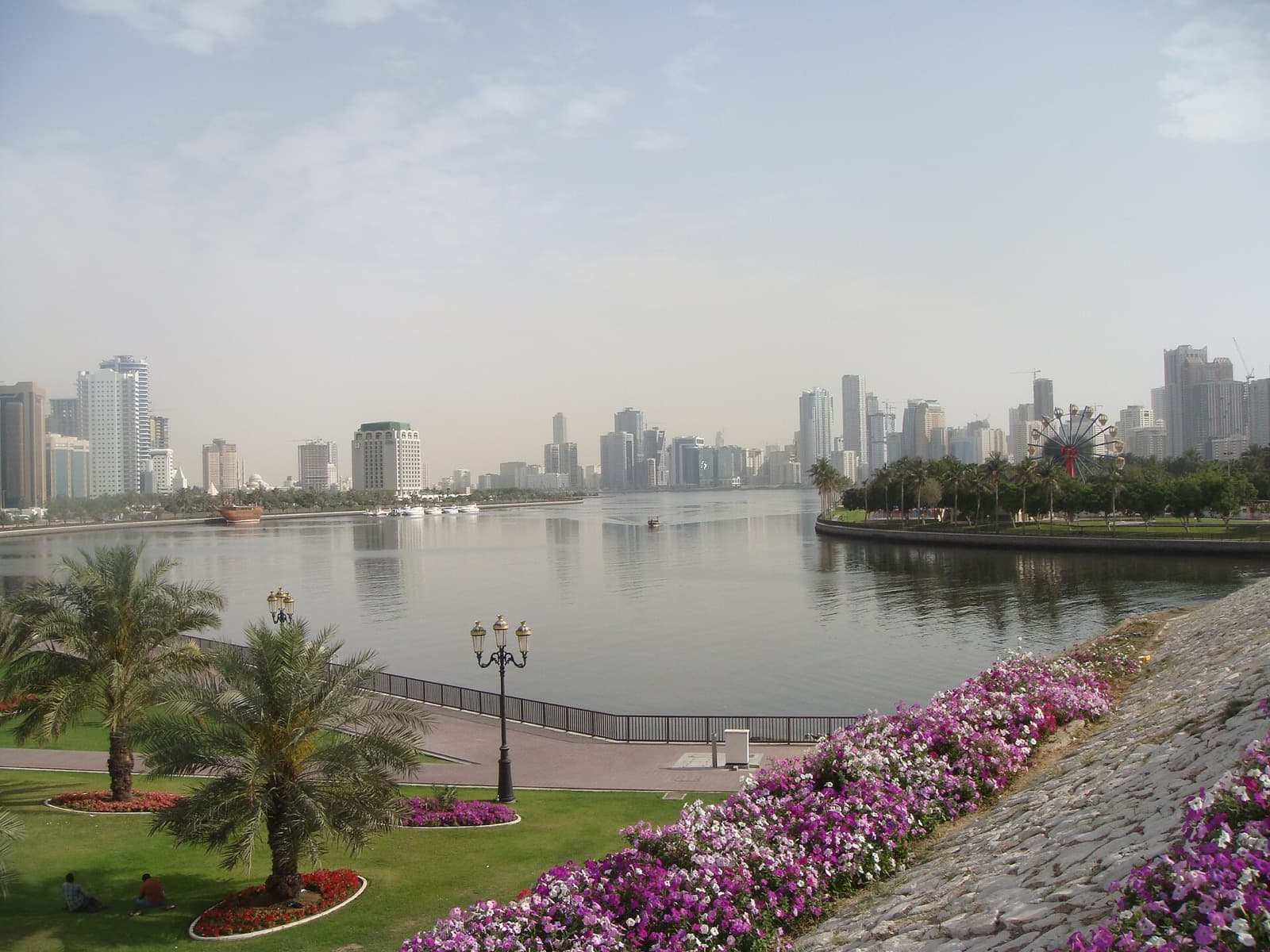
The Blue Souk sits at one end of Khalid Lagoon, the sheet of water Sharjah cut into the centre of the city, and the market is the opening move of a longer evening walk. From here the promenade rings the lagoon past an Ottoman-style mosque with a cascade of domes mirrored in the water, a landscaped waterfront where families gather in the cool of the evening, and a giant musical fountain thrown high over the dark water after nightfall. Taken together they read as one image: a city that built a pleasure ground and a place of worship and a market around a lagoon of its own making, all on a human scale and open to everyone.
The best way to understand the Blue Souk is to see it as the first note in that sequence rather than a stop in isolation. The self-guided Sharjah Corniche and the Blue Souk audio walk begins right here, at stop one, and carries you around the lagoon at dusk, when the light softens on the water and the whole cast of the walk reads across at once. Go in the mild winter months if you can, roughly November to March, and start in the late afternoon so you reach the fountain after dark. To plan the full route, browse Sharjah walking tours, and to see what else the emirate holds, start with Sharjah. Then let the blue tiles send you down toward the water.
Sources
- Sharjah Central Souq, Wikipedia: overview of the market's design, halls, wind towers, and its appearance on the five-dirham banknote.
- Blue Souk, Archnet: architectural reference for the building, its architect Michael Lyell Associates, and its 1978 completion.
- Visit Sharjah (official emirate tourism site): context on Sharjah as UNESCO Cultural Capital of the Arab World and Capital of Islamic Culture.
- Roamer tour transcript, Sharjah Corniche and the Blue Souk (fact-audited): verified detail on the souq's scale, trades, and role in the wider lagoon walk.
Ready to experience it?
Sharjah Corniche & the Blue Souk: The Cultural Capital
90 min · 4 km · easy
More from Sharjah
Explore more at your own pace.
One Day in Sharjah: A Walkable Morning-to-Evening Itinerary
Sharjah Travel Guide: Days, Transport, Best Time, Safety, Budget
Sharjah: The Emirate That Banked on Culture Instead of Height
Heart of Sharjah: The Old Town That Was Rebuilt on Purpose
The Buhaira Corniche: Reading All of Sharjah From One Dusk View