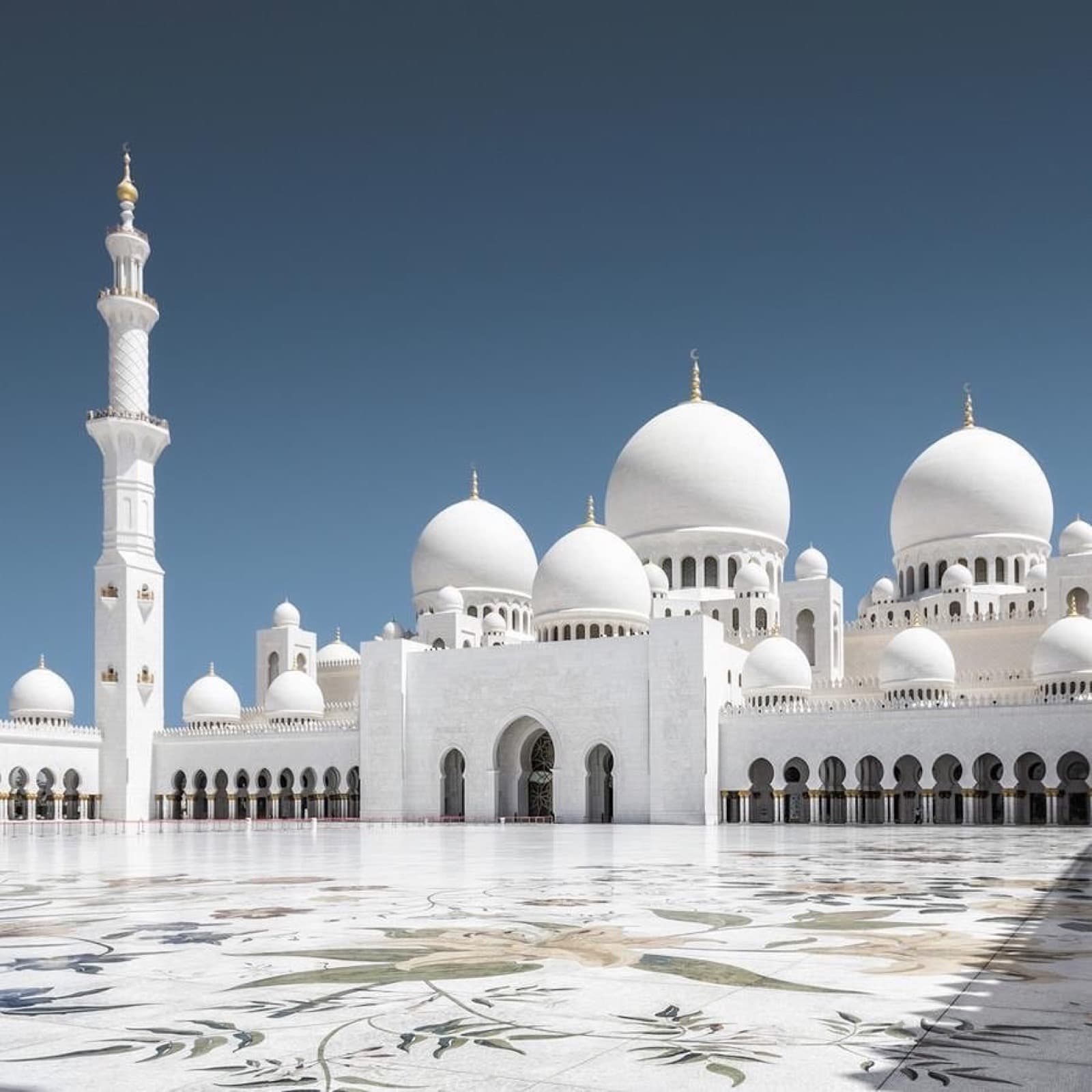
The story of a founding father's final great project: a white-marble mosque that gathers the craft of the whole Islamic world under one crowd of domes, and opens its doors to visitors of every faith.
Start · The Main Entrance: A Founder's Last Vision
DirectionsStops
- 1
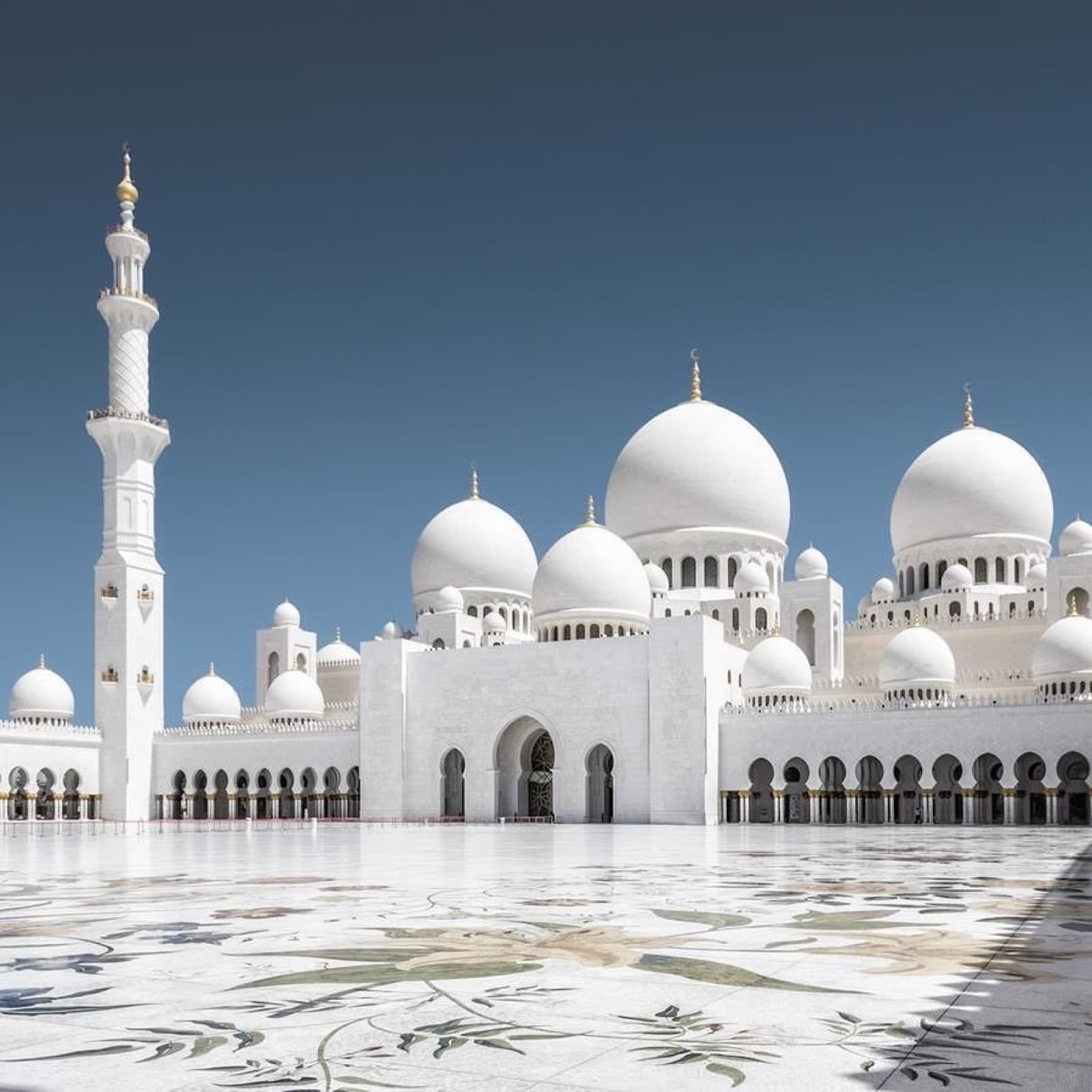
The Main Entrance: A Founder's Last Vision
The threshold of the founder's final project, a mosque built to gather the craft of the whole Islamic world and to open its doors to visitors of every faith.
- 2
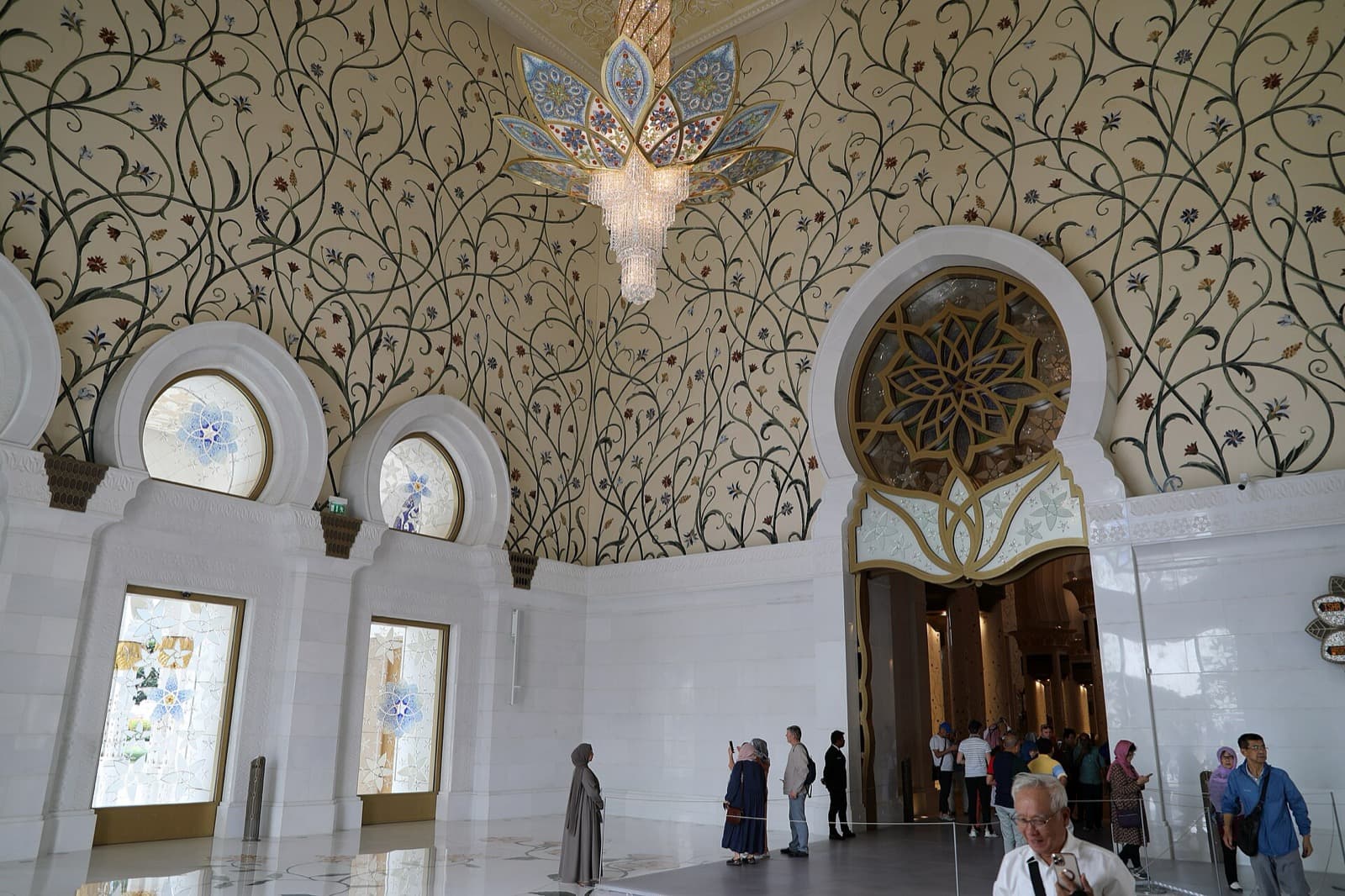
The Main Courtyard: A Garden Carved in Marble
An immense white marble courtyard inlaid with a flowing garden of coloured flowers, one of the largest marble mosaics anywhere.
- 3
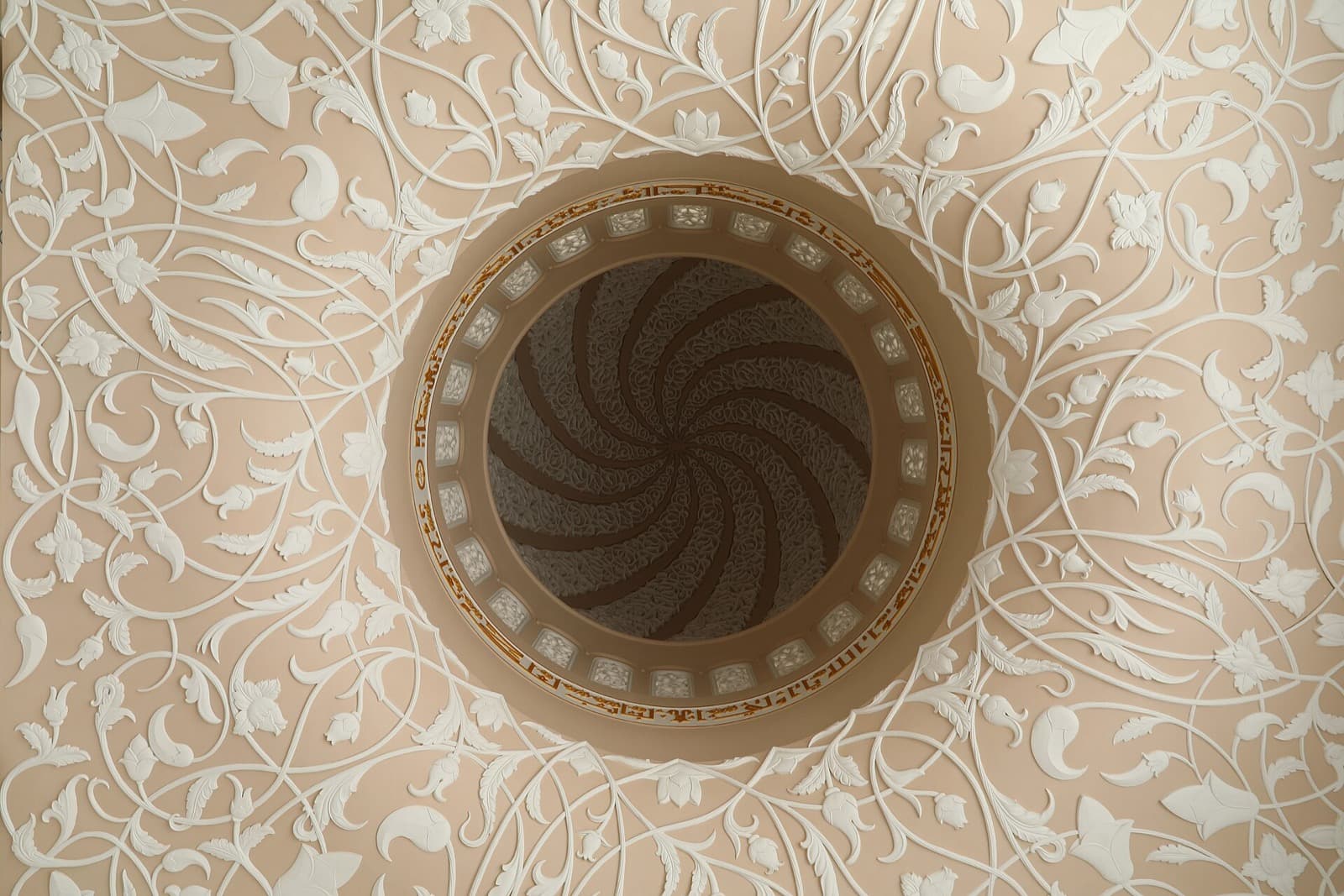
The Colonnades and the Domes: A Borrowed Grammar
A forest of marble columns flowering with inlaid vines beneath a crowd of white domes borrowed from Mughal India and Moorish Spain.
- 4
The Reflective Pools: The Mosque Doubled in Water
Dark, still pools that mirror the white domes and columns, doubling the whole mosque in water and shifting colour with the phases of the moon.
- 5
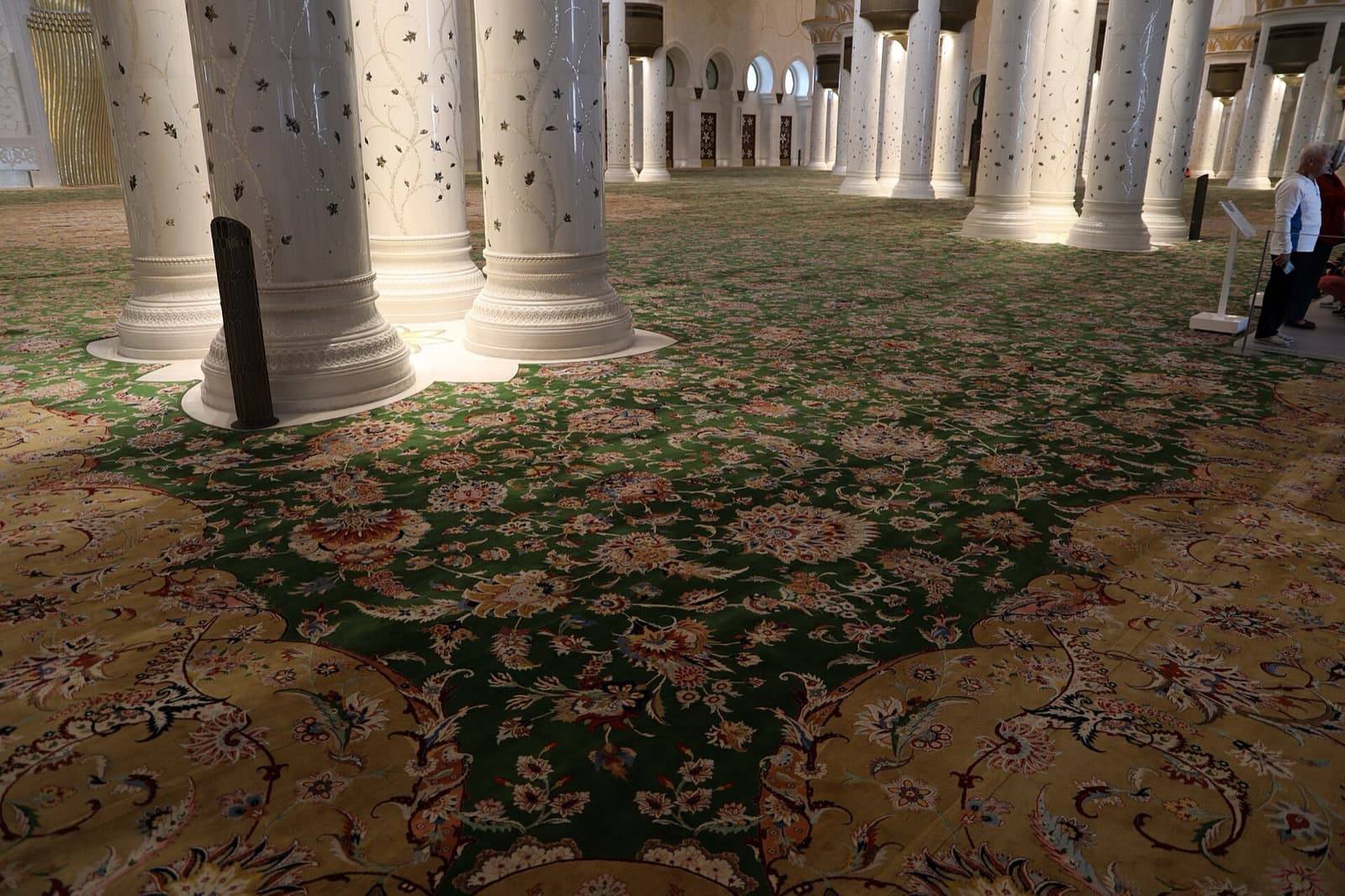
The Main Prayer Hall and the Carpet: A Thousand Hands' Work
The sacred heart of the mosque, floored with a single hand-knotted carpet recorded as the world's largest and walled with the ninety-nine names of God.
- 6
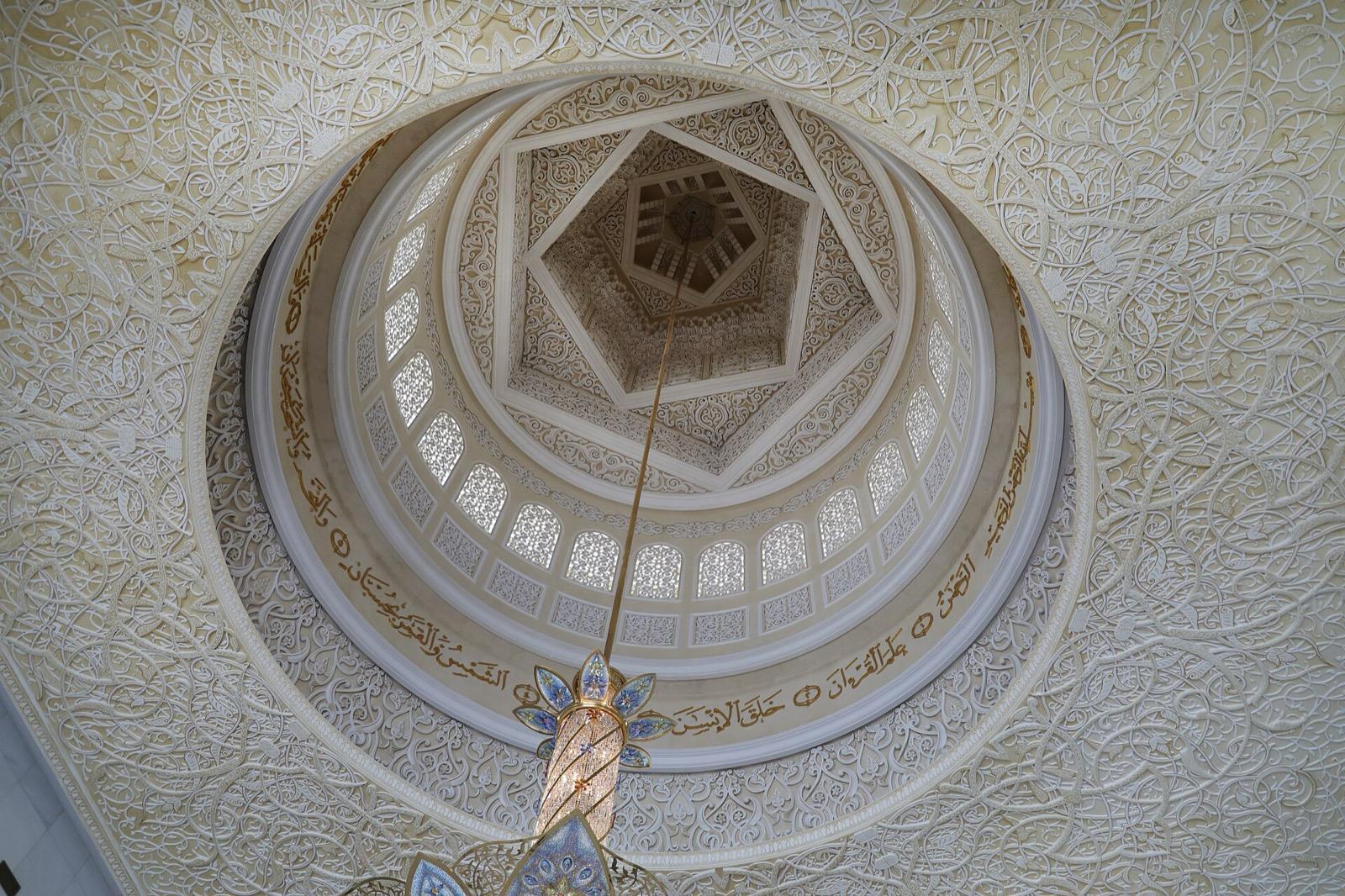
The Chandeliers: Frozen Light Under the Dome
Colossal crystal chandeliers hanging beneath the main dome like frozen light, among the largest ever made.
- 7
The Resting Place of Sheikh Zayed: The Recitation That Never Stops
A quiet courtyard beside the mosque where the founder of the United Arab Emirates lies buried, and reciters read the Quran without pause, day and night.
Details
Best Time to Visit
The comfortable season is the mild winter, roughly November to March, when daytime temperatures are pleasant and the marble complex is a joy to walk. Avoid the extreme summer heat from about June to September, when midday temperatures on open marble can be punishing; if you must visit then, come early or in the evening, when the lunar lighting also comes into its own. Weekday mornings are quietest. During Ramadan visiting hours are shorter and shift around prayer times, and the mosque grows especially busy around iftar and the two Eid festivals; check current hours before you go, and remember that Friday midday is the main congregational prayer when access for visitors is restricted.
Pro Tips
- •Entry is free, but the dress code is enforced: women need full-length loose clothing and a headscarf, men need long trousers and covered shoulders. Abayas are lent to women at the entrance if needed, and shoes come off before the prayer halls.
- •Take the free guided cultural tour offered in Arabic and English if you can time it. A guide brings the numbers, the countries and the craft to life far better than wandering alone.
- •Come at two different registers if you have the time: daylight shows the marble, the inlay and the reflecting pools, while dusk and after dark reveal the moon-phase lighting and the mosque floating above its pools.
- •Give yourself at least ninety minutes to two hours. The complex is large, the marble walk is longer than it looks, and the prayer hall and mausoleum reward slowing down.
- •Bring water and, in the warmer months, plan around the midday sun. Much of the walk is across open, reflective marble with limited shade, and the heat builds fast.
- •Treat the prayer hall and especially the mausoleum as the sacred places they are: lower your voice, follow the marked visitor routes, and respect photography restrictions, which are stricter at the founder's grave.
Safety & Precautions
- •Summer heat in Abu Dhabi is genuinely extreme from about June to September, and open marble amplifies it. Carry water, wear sun protection, seek shade, and avoid the midday hours; heat exhaustion is a real risk on the exposed courtyard.
- •This is a working mosque, not just a monument. Observe the dress code, keep quiet in the prayer halls, do not photograph worshippers without consent, and follow all photography restrictions, which are tightest at the Sheikh Zayed mausoleum.
- •During Ramadan, eating, drinking and smoking in public during daylight hours are restricted out of respect for those fasting, and mosque hours change around prayer times; plan your visit and refreshments accordingly.
- •Keep ordinary city awareness for traffic and crowds around the entrances and car parks, and note that many other Abu Dhabi museums and attractions charge admission in UAE dirhams even though the mosque itself is free.
Travel advisory: Reconsider Travel (Level 3).
Gallery
Related Reading
Go deeper on what you'll see, hear, and walk through.
Overview
Abu Dhabi Travel Guide: Days, Transport, Season, Costs, and Safety
8 min
Overview
Best Self-Guided Walking Tours in Abu Dhabi (2026)
3 min
Overview
One Day in Abu Dhabi: A Walkable Morning-to-Evening Itinerary
5 min
Thematic
Abu Dhabi: The Capital That Turned Oil Into a Country
7 min
Companion
The Grave at the Center of Abu Dhabi's Grand Mosque
6 min
Deep dive
The Colonnades and Domes of the Sheikh Zayed Grand Mosque: A Building Assembled From Quotations
6 min
Read
What to Eat in Abu Dhabi: Emirati Dishes and How to Order Them
7 min
Read the walk
The full story of Sheikh Zayed Grand Mosque: A Vision in Marble, in words. Prefer to listen? Play it narrated, from home or on location.
Introduction
There are two things people expect when they hear the words grand mosque in a wealthy Gulf capital. One is that it will be enormous and expensive, a statement of a young oil nation's faith and fortune. The other is that its doors will be closed to anyone outside the faith. The Sheikh Zayed Grand Mosque here in Abu Dhabi, the capital of the United Arab Emirates, is the first of those things and, surprisingly, not the second. It welcomes visitors of every faith, with a dress code, and it invites you to walk its courtyard, its colonnades and its prayer hall. That openness is the whole point of the building.
This mosque was the last great vision of Sheikh Zayed bin Sultan Al Nahyan, the man who founded the United Arab Emirates in nineteen seventy-one and served as its first president. He wanted a mosque that gathered the craft of the entire Islamic world into a single building, and he is buried at its side. Thousands of artisans from Italy, Germany, India, Iran, Turkey, Morocco and beyond spent more than a decade making it real. It opened in two thousand and seven.
This walk has seven stops and covers a little over one kilometre, unhurried, over about an hour across the marble complex. You will read the vision stone by stone: the courtyard, the domes, the pools, the prayer hall, the carpet, the chandeliers, and the quiet grave. When you arrive at the main entrance, begin with stop one.
1. The Main Entrance: A Founder's Last Vision
The man whose name this mosque carries was born around nineteen eighteen, into a world of desert and sea that would be almost unrecognizable today. Sheikh Zayed bin Sultan Al Nahyan came from the Bani Yas, the confederation of tribes from which the ruling Al Nahyan of Abu Dhabi descend. For centuries this coast lived on pearling, sending divers down into the Gulf in conditions of real hardship and danger, until Japanese cultured pearls and the Great Depression collapsed the trade in the nineteen thirties. These were the Trucial States then, coastal emirates bound to Britain by treaty since the early nineteenth century. Oil was found in Abu Dhabi in the late nineteen fifties and exported from nineteen sixty-two, and within a single lifetime a poor desert-and-sea society was transformed.
Sheikh Zayed became Ruler of Abu Dhabi in nineteen sixty-six, and on the second of December nineteen seventy-one he brought the emirates together as the United Arab Emirates and became its first president. He died in two thousand and four. This mosque was his last great vision, a place, in the words of the mosque's own foundation, meant to mirror the moderation of Islam and unite the cultural diversity of the Islamic world.
Construction began in the nineteen nineties and ran for more than a decade, employing more than three thousand workers and dozens of sub-contracting companies, with materials and artisans drawn from many countries. It opened in two thousand and seven. And unlike most working mosques, it was designed to receive you. Entry is free, women are lent an abaya and headscarf, men wear long trousers and cover their shoulders, and free guided tours run in Arabic and English. This is a living place of worship. Enter it as a guest.
2. The Main Courtyard: A Garden Carved in Marble
The word for this space is sahan, the mosque courtyard, and it is the first surprise of scale. The marble mosaic underfoot covers roughly seventeen thousand square metres, recorded as among the largest marble mosaics in the world. What makes it more than a floor is the design. Across that vast white surface flows a pattern of flowers and vines worked in coloured marble, a garden laid flat in stone.
The technique has a name and a lineage: pietra dura, an Italian art of inlaying cut, coloured stone into stone, which took shape in Italy in the sixteenth century. Here it was carried out on a scale few buildings have ever attempted. Look closely and you will see that the floral motifs, where they reach the edges of the courtyard, are drawn to complete their forms rather than to be cut off abruptly, a design intention rooted in the tradition of these gardens in stone. The effect is that the whole floor reads as a single continuous meadow rather than a grid of tiles.
This is also the working heart of the mosque on the great occasions. At major prayers and the two Eid festivals, this courtyard fills with worshippers. The complex as a whole is recorded as holding somewhere between forty-one thousand and fifty thousand people, with the figures varying across sources. Standing here on an ordinary day, in the bright quiet, it can be hard to picture. But the openness is deliberate. The founder wanted a mosque of light and welcome, and a courtyard this generous, ringed by white arcades and open to the sky, is the argument made in marble.
3. The Colonnades and the Domes: A Borrowed Grammar
Around the courtyard runs a forest of columns, and above them a crowd of domes, and both are lessons in borrowing. There are eighty-two domes in total, in seven different sizes, gathered across the roofline like a family. And there are one thousand and ninety-six columns in the outer colonnades, with another ninety-six inside the main prayer hall.
Each of those columns is clad in white marble and inlaid, once again in floral pietra dura, this time with mother-of-pearl and semi-precious stones such as amethyst and jasper, and topped with gilded capitals shaped like palm fronds. So the vines that flowed across the floor now climb the columns and burst into gold at the top. It is one idea, a garden in stone, carried up from the ground into the air.
The domes tell a different story, one of geography. The mosque's architect, a Syrian named Yusef Abdelki, drew on the Mughal, Ottoman and Fatimid traditions, and you can read that reach in the silhouettes overhead. The dome forms borrow from Mughal India and from Moorish, Andalusian Spain at the same time, two ends of the historic Islamic world quoted in one roofline. The main dome measures about thirty-two metres across, and the domes are built to stand free, so the structure can flex and resist an earthquake. Four minarets rise at the corners, each over one hundred metres tall. Nothing here is invented from nothing. Every form is a citation, and the citation is the message: this is the craft of the whole Islamic world, gathered into one building.
4. The Reflective Pools: The Mosque Doubled in Water
Here is the turn in the story, and it is a quiet one. After all that scale, all those numbers, the building does something that has nothing to do with size. Along the edges of the courtyard and the colonnade walkways lie shallow reflecting pools, covering about seven thousand,…
Full narration for this stop unlocks with the tour.
5. The Main Prayer Hall and the Carpet: A Thousand Hands' Work
This is the sacred heart of the building, so before anything else: this is a working place of worship. Shoes come off, women cover their hair, and voices drop. Narrate it in your own mind gently. What you are standing on is one of the reasons people cross the world to see this…
Full narration for this stop unlocks with the tour.
6. The Chandeliers: Frozen Light Under the Dome
Now raise your eyes from the carpet to the ceiling, and the building answers the two years of knotting with something equally extravagant, hanging in the air. Beneath the domes of the prayer hall hang the chandeliers, seven of them, imported from Munich, Germany, where they were…
Full narration for this stop unlocks with the tour.
7. The Resting Place of Sheikh Zayed: The Recitation That Never Stops
The walk ends not at a throne or a treasure but at a grave. Beside the mosque, in a separate quiet courtyard set a little apart from the grandeur, lies the mausoleum of Sheikh Zayed bin Sultan Al Nahyan, the man who imagined all of this, and the country around it. Born around…
Full narration for this stop unlocks with the tour.