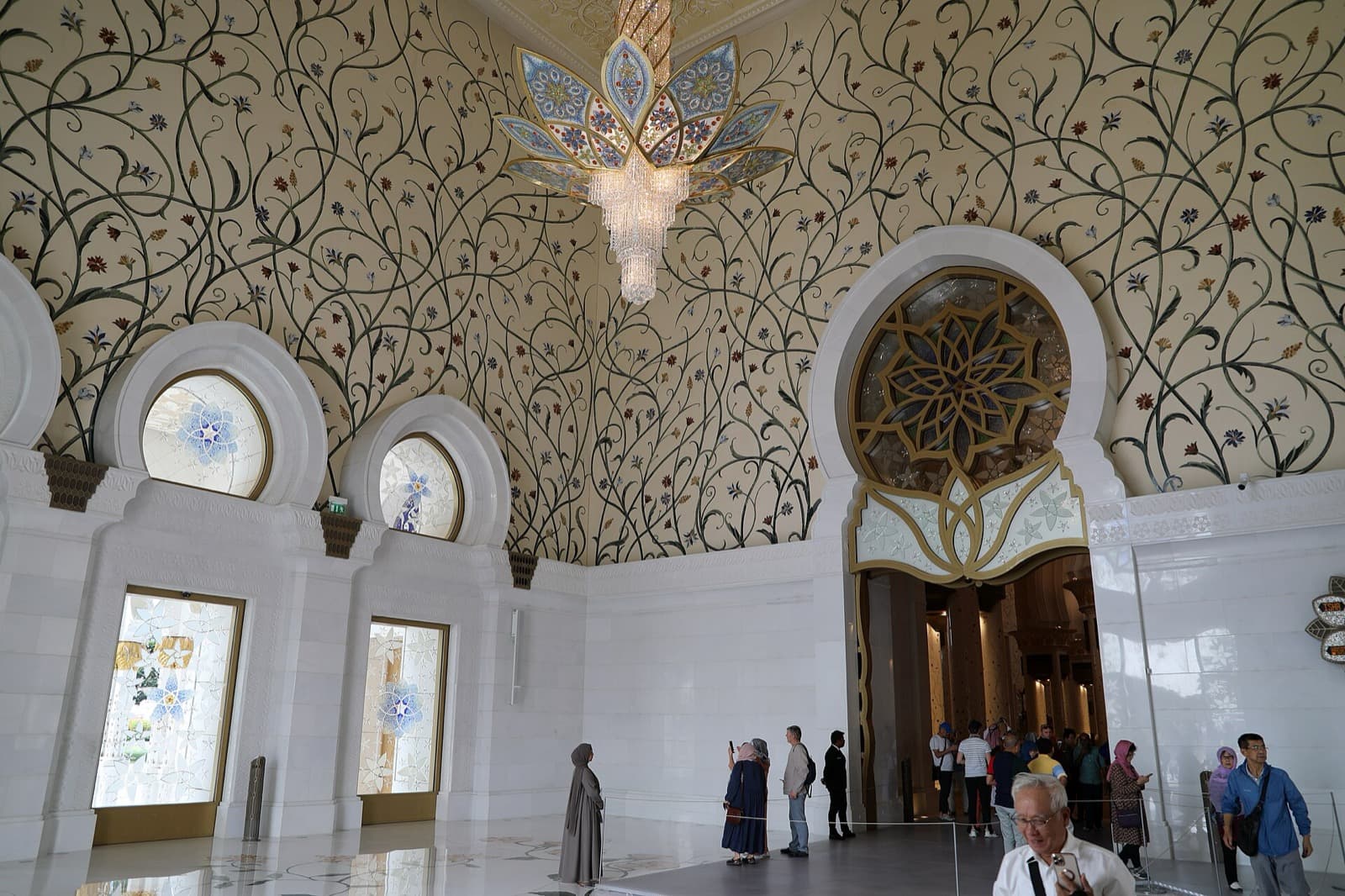
The Sheikh Zayed Grand Mosque assembles the craft of the entire Islamic world into one white-marble building, and every record of scale it holds exists to frame a single quiet grave. The mosque gathers eighty-two domes, more than a thousand marble columns, the largest hand-knotted carpet ever recorded, and colossal crystal chandeliers, all built by artisans drawn from Italy, Germany, India, Iran, Turkey, Morocco and beyond. Yet the whole design closes on the mausoleum of Sheikh Zayed bin Sultan Al Nahyan, the man who founded the United Arab Emirates and imagined this place as his final project. Understand that grave, and you understand why the rest of the building is built the way it is.
The grave the building leads toward
Sheikh Zayed bin Sultan Al Nahyan was born around 1918 and died in 2004, three years before the mosque he conceived opened in 2007. He became Ruler of Abu Dhabi in 1966, and on the second of December 1971 he brought the emirates together as the United Arab Emirates and served as its first president. His life ran from the collapse of the Gulf pearling economy through the discovery of oil to a modern federation, a span that would be almost unrecognizable end to end.
He is buried not inside the grand prayer hall but in a separate, quieter courtyard set a little apart, beside the mosque rather than at its ceremonial center. That placement is the engineering decision that matters most here. A building designed to overwhelm you with magnitude deliberately routes the visit so it ends at the simplest thing a person can be reduced to: a grave in a garden. At the grave, certified reciters read the Quran aloud continuously, day and night, taking turns and pausing only for shift changes and prayer times. Since the founder was laid to rest, that recitation has not stopped.
Scale as a load-bearing argument
Hear a stop from this walk
The Main Entrance: A Founder's Last Vision
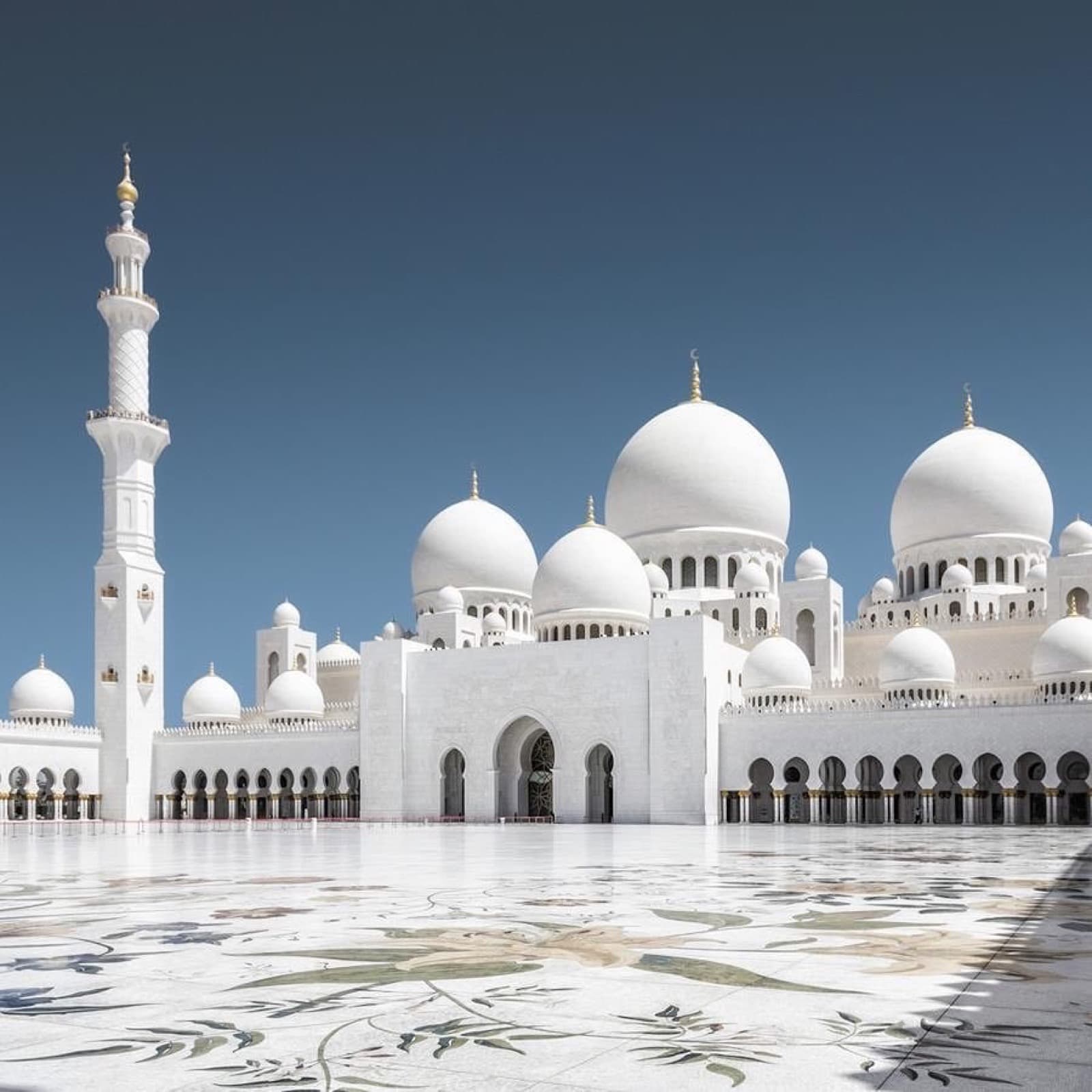
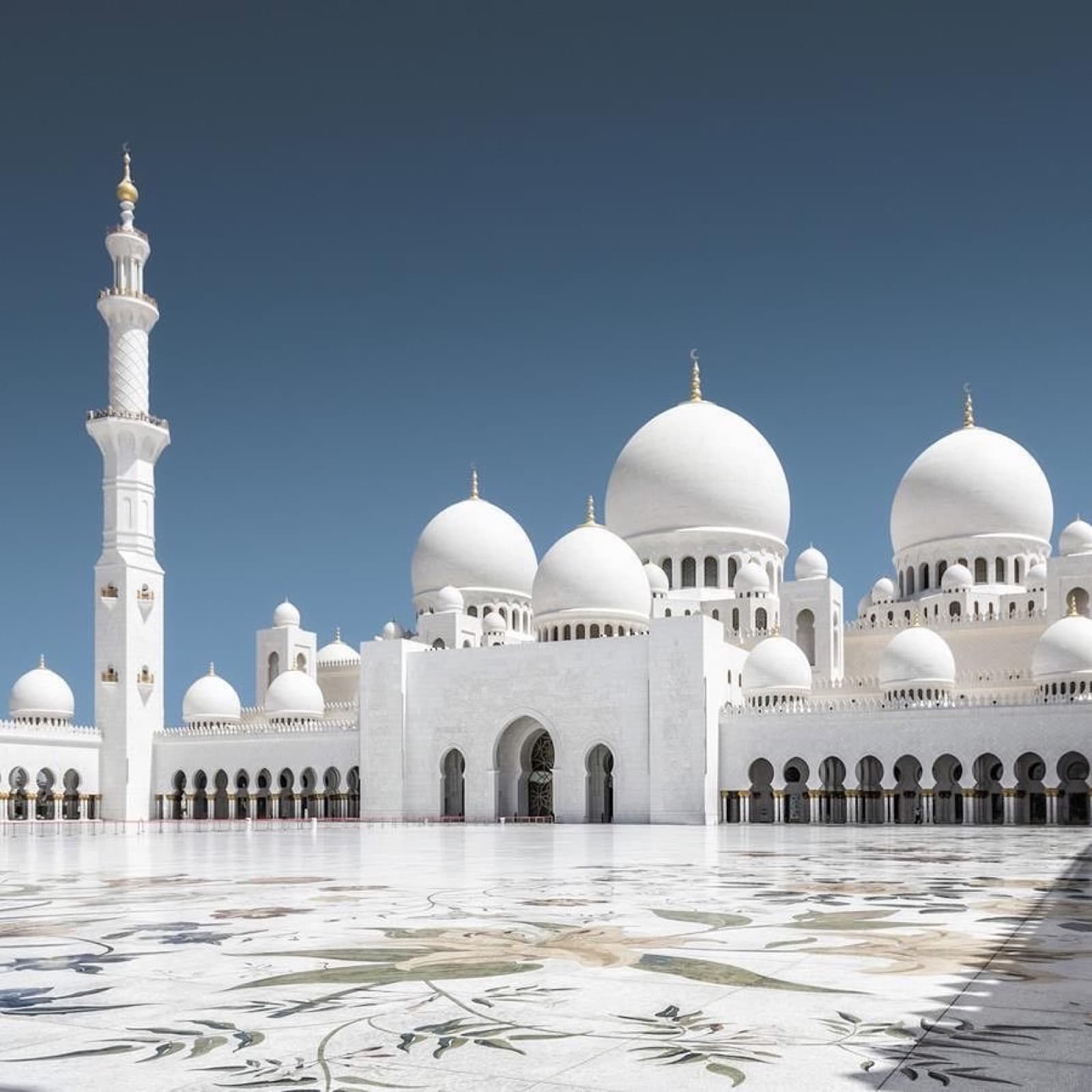
Walk the complex in sequence and you can read the specification like a drawing set. The main courtyard, the sahan, is paved with a marble mosaic of roughly 17,000 square metres, recorded as among the largest marble mosaics in the world, roughly the footprint of two full football pitches. Across that white surface flows a garden of flowers and vines worked in coloured stone using pietra dura, an Italian inlay art that took shape in the sixteenth century. Where the floral motifs reach the courtyard edges they are drawn to complete their forms rather than being cut off, so the floor reads as one continuous meadow instead of a grid.
Around the courtyard stand the colonnades: 1,096 columns in the outer arcades, with another 96 inside the main prayer hall, each clad in white marble and inlaid with mother-of-pearl and semi-precious stones such as amethyst and jasper, topped with gilded capitals shaped like palm fronds. Above them sits a crowd of 82 domes in seven sizes, the main dome about 32 metres across, with four minarets at the corners each rising over 100 metres. The Syrian architect Yusef Abdelki drew on Mughal, Ottoman and Fatimid traditions, so the dome silhouettes quote Mughal India and Moorish Spain at the same time. The domes are built to stand free, which lets the structure flex and resist an earthquake. Nothing here is invented from nothing. Every form is a citation, and the citation is the point.
The turn: water, then labor
The tour has a deliberate pivot. Shallow reflecting pools of roughly 7,874 square metres border the courtyard and colonnades, tiled dark on purpose so that instead of shining they hold. In them the domes, columns and arcades appear a second time, upside down. Scale asks you to crane your neck and count. Reflection asks you to see the whole thing at once. The exterior lighting, by the firm Speirs and Major with designer Jonathan Speirs, follows the moon: cool white at full moon, deepening through about fourteen shades of blue as the moon wanes, projected so the whole building shifts with the lunar cycle.
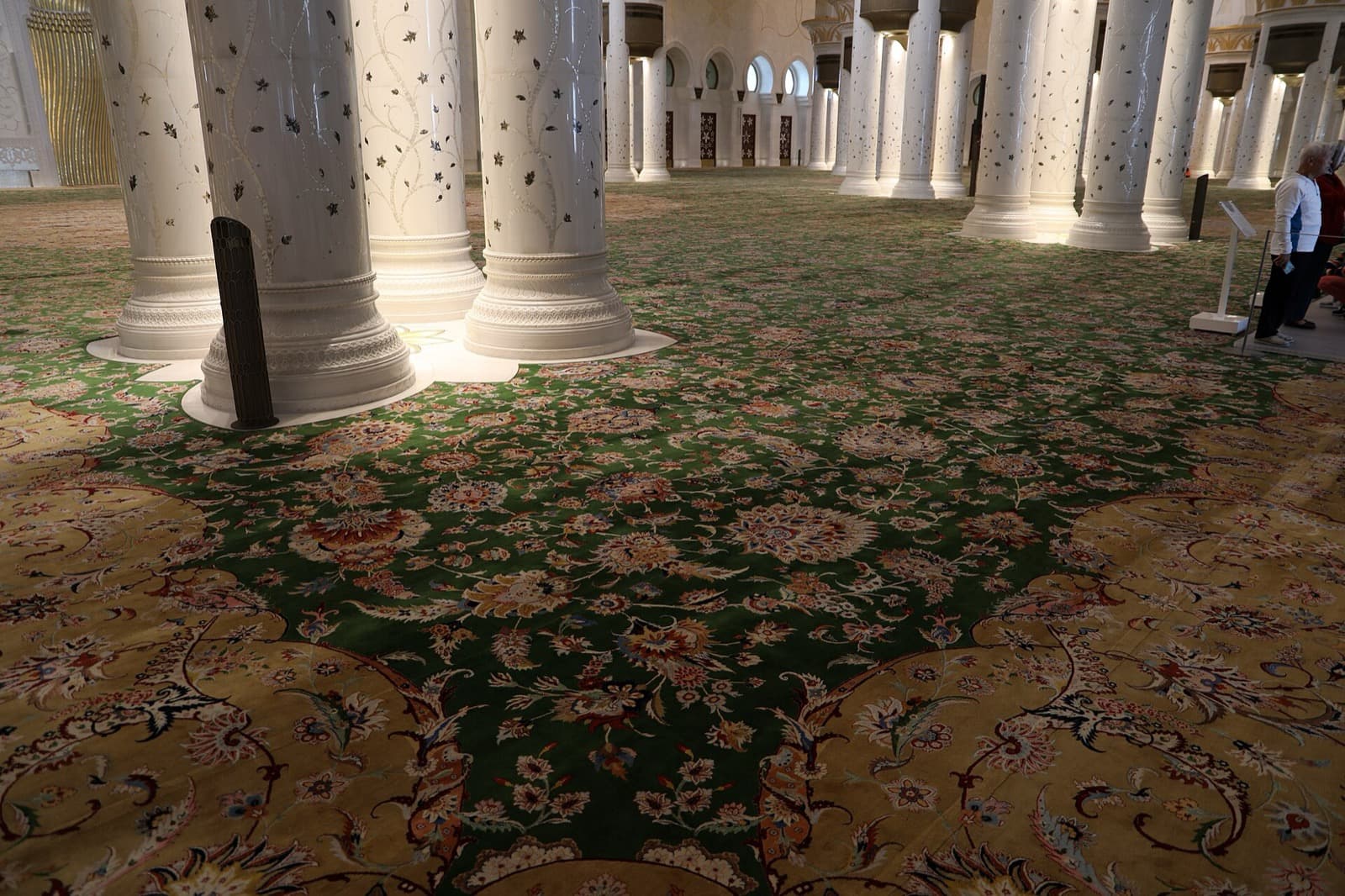
Inside, the sacred heart of the building holds the object people cross the world to see. The main prayer hall is floored with a single hand-knotted carpet recorded as the world's largest, covering about 5,627 square metres, made in one piece by Iran's Carpet Company and designed by the Iranian artist Ali Khaliqi. Somewhere between 1,200 and 1,300 weavers, most of them women, worked it over roughly two years, tying about 2.268 billion knots in wool from New Zealand and Iran. Finished, it weighs around thirty-five tonnes, and its pattern flows toward the qibla, the direction of prayer toward Mecca. That wall carries the ninety-nine names of God in gold-leaf Kufic calligraphy. Overhead hang seven chandeliers imported from Munich, Germany, made by the firm Faustig and studded with millions of Swarovski crystals. The largest measures about ten metres across and fifteen metres tall, with the principal chandelier weighing around twelve tonnes, among the largest ever made. One country's floor, another continent's ceiling, and between them the room where more than seven thousand people can pray.
Why the openness is the whole point
Two expectations usually come with the phrase grand mosque in a wealthy Gulf capital: that it will be enormous, and that its doors will be closed to outsiders. This building is the first and, deliberately, not the second. It welcomes visitors of every faith under a dress code, women lent an abaya and headscarf, men in long trousers with shoulders covered, and it runs free guided tours in Arabic and English. Entry is free. The founder wanted a place, in the words of the mosque's own foundation, meant to mirror the moderation of Islam and unite the cultural diversity of the Islamic world. More than three thousand workers and dozens of sub-contracting companies built it over roughly a decade to make that literal.
That is the argument the whole route makes, and the reason to walk it in order rather than wander. Every superlative, the carpet, the chandeliers, the mosaic, the domes gathered from a dozen countries, resolves at a grave in a garden under a recitation that never stops. The grandeur was never the point. It was the setting. The self-guided walk runs seven stops over a little more than a kilometre, about an hour across the marble, and it saves the mausoleum for last on purpose. If you are planning a route through the capital, this mosque anchors any serious visit to Abu Dhabi, and it pairs naturally with the other Abu Dhabi walking tours that trace the city's older core.
Sources
- Sheikh Zayed Grand Mosque, Wikipedia. Overview of construction dates, dimensions, domes, columns, carpet and chandelier specifications.
- Sheikh Zayed Grand Mosque Centre (szgmc.gov.ae), official site. The carpet, courtyard and Islamic-architecture detail pages.
- Founder of the UAE, Sheikh Zayed bin Sultan Al Nahyan, UAE Ministry of Foreign Affairs. Biography, dates and the founding of the federation.
- Founders of the Union, UAE Government (u.ae). Details on Sheikh Zayed's role and burial at the mosque.
- WikiArquitectura, Sheikh Zayed Mosque. Architectural analysis of domes, columns and the pietra dura program.
Ready to experience it?
Sheikh Zayed Grand Mosque: A Vision in Marble
60 min · 1.2 km · easy
More from Abu Dhabi
Explore more at your own pace.
Abu Dhabi Travel Guide: Days, Transport, Season, Costs, and Safety
One Day in Abu Dhabi: A Walkable Morning-to-Evening Itinerary
Abu Dhabi: The Capital That Turned Oil Into a Country
The Well That Made Abu Dhabi: Reading a Capital From Its First Fort
Qasr Al Hosn: The Coral Fort Where Abu Dhabi Began