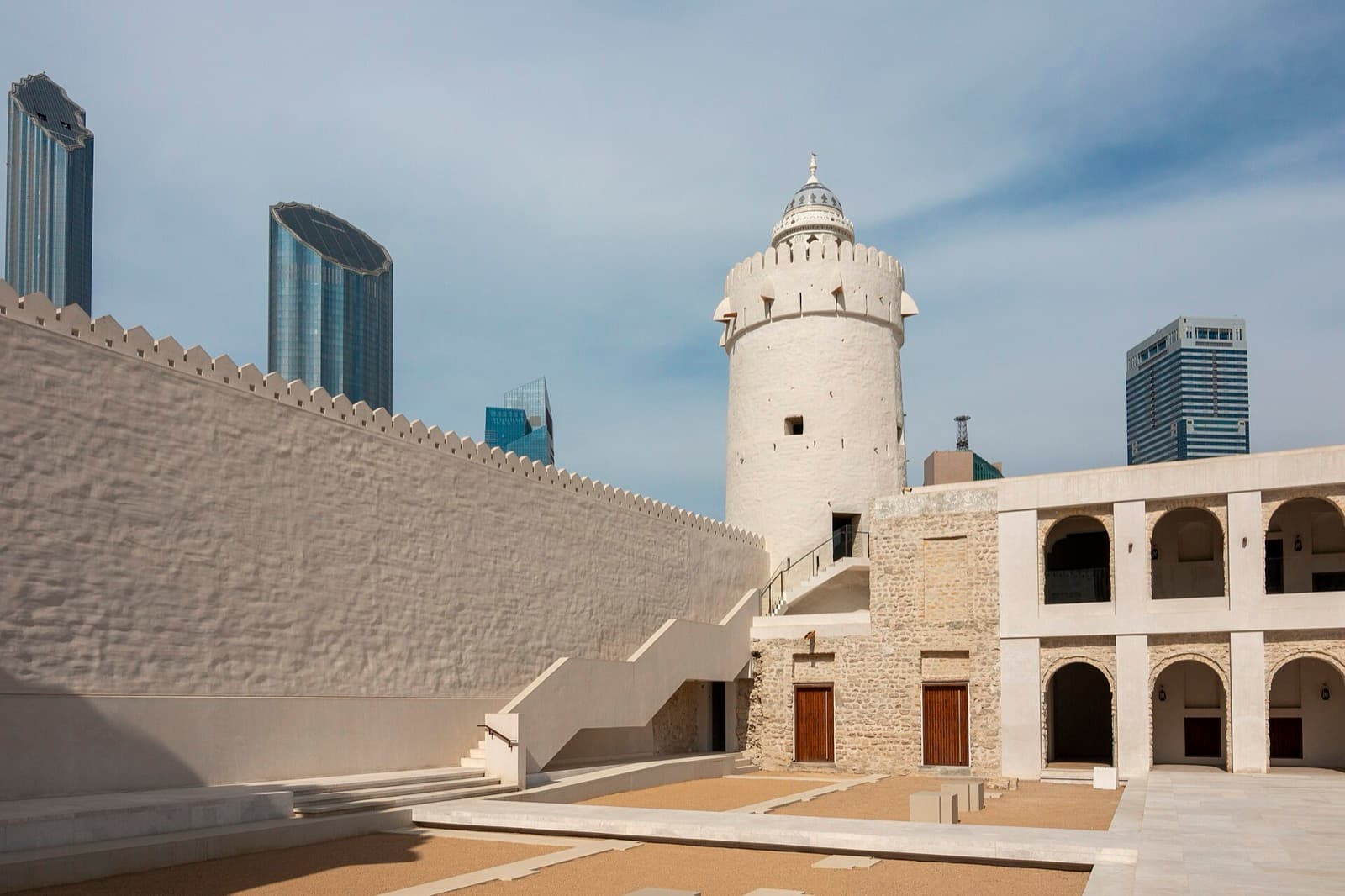
The founding of Abu Dhabi turns on one thing that seems too small to carry a national capital: a well of sweet water on a dry island. Everything a visitor sees today, the fort of coral and sea stone, the glass towers on reclaimed land, the eight-kilometre waterfront, grew outward from that single point of fresh water. A self-guided walk through the founding sites lets you read the whole capital outward from it, starting where the story starts, at the low white fort raised in the late eighteenth century to guard the well.
The clearest place to feel this is the second stop on the route, a few steps from Qasr Al Hosn on the same Al Hosn ground. It is not a building. It is the founding itself, and the tour is honest about the fact that the founding arrives in two voices.
A gazelle, a well, and two kinds of truth
The first voice is legend, and the walk tells it plainly as legend. Tradition dates the founding to about 1761. As the story goes, a Bani Yas hunting party, associated with a man named Dhiyab bin Isa Al Nahyan, tracked a gazelle across the coast until it led them to fresh water on this low island. In gratitude, the place took the name Abu Dhabi, popularly translated as father of the gazelle. It is a lovely story, and it is a story, passed down rather than documented. The tour holds it as tradition, which is the correct posture. You lose nothing by admitting a legend is a legend, and you gain the reader's trust.
The second voice is history, and it is firmer. The Bani Yas were the tribal confederation from which the ruling Al Nahyan descend, and it was the Al Bu Falah subsection that provided the rulers. Toward the end of the eighteenth century, the family shifted its permanent seat from the inland Liwa oasis to this island by the sea. The settlement that grew here lived by fishing and, above all, by pearling, sending divers down again and again on a single breath in a trade of real hardship and real danger.
What the legend and the documented history share is the well. That is the quiet insight the anchor stop hands you, and it reframes everything that follows. Sweet water on a dry island is not a decorative detail in a founding myth. It is the reason a hunting party would stay, the reason a ruling family would move its permanent seat here, and the reason a fort would be raised to guard it. Strip away the gazelle and you still have the well. From that one well, a capital eventually followed.
Why the fort comes first
Hear a stop from this walk
Qasr Al Hosn: The White Fort Where the City Began
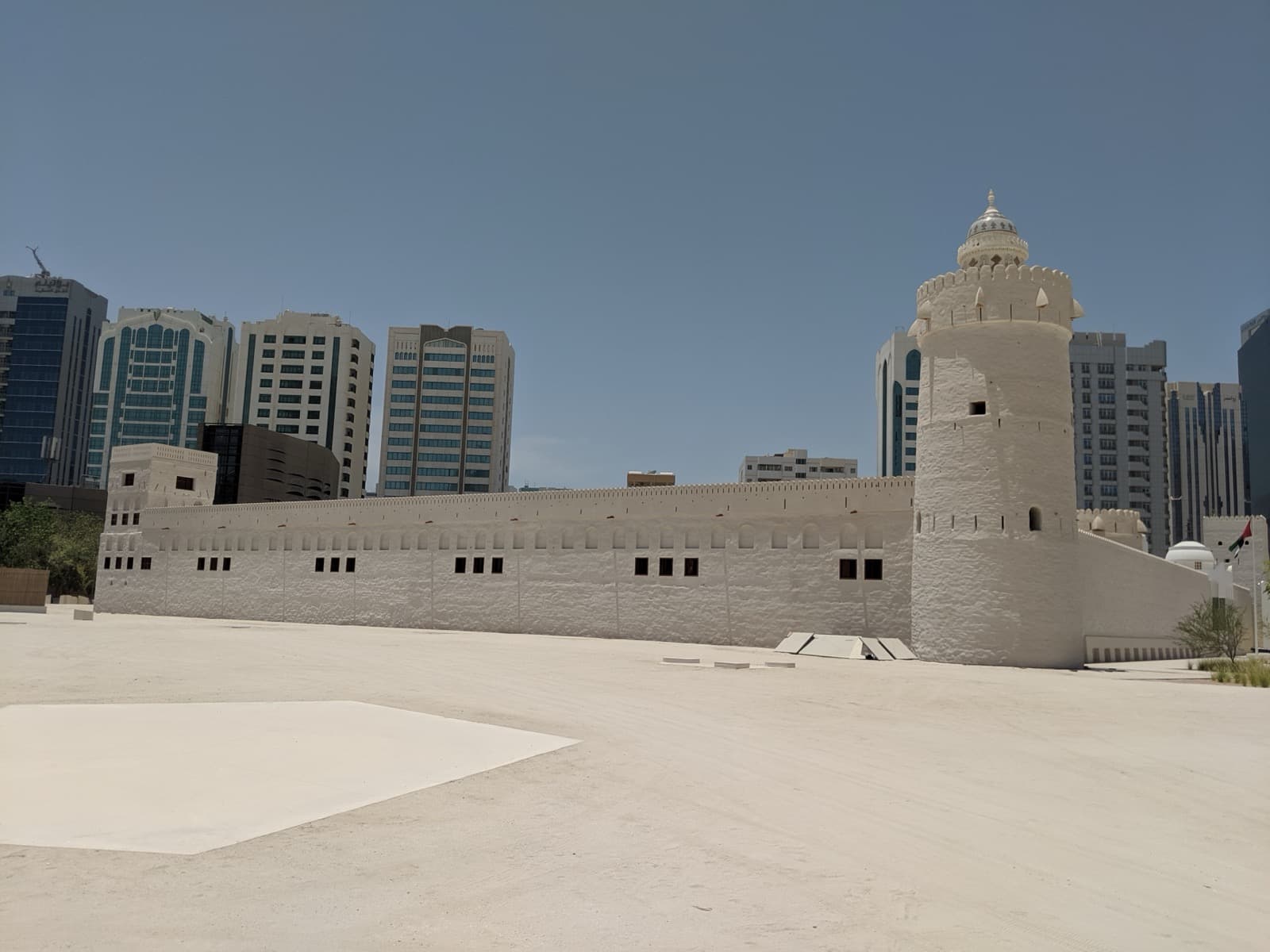
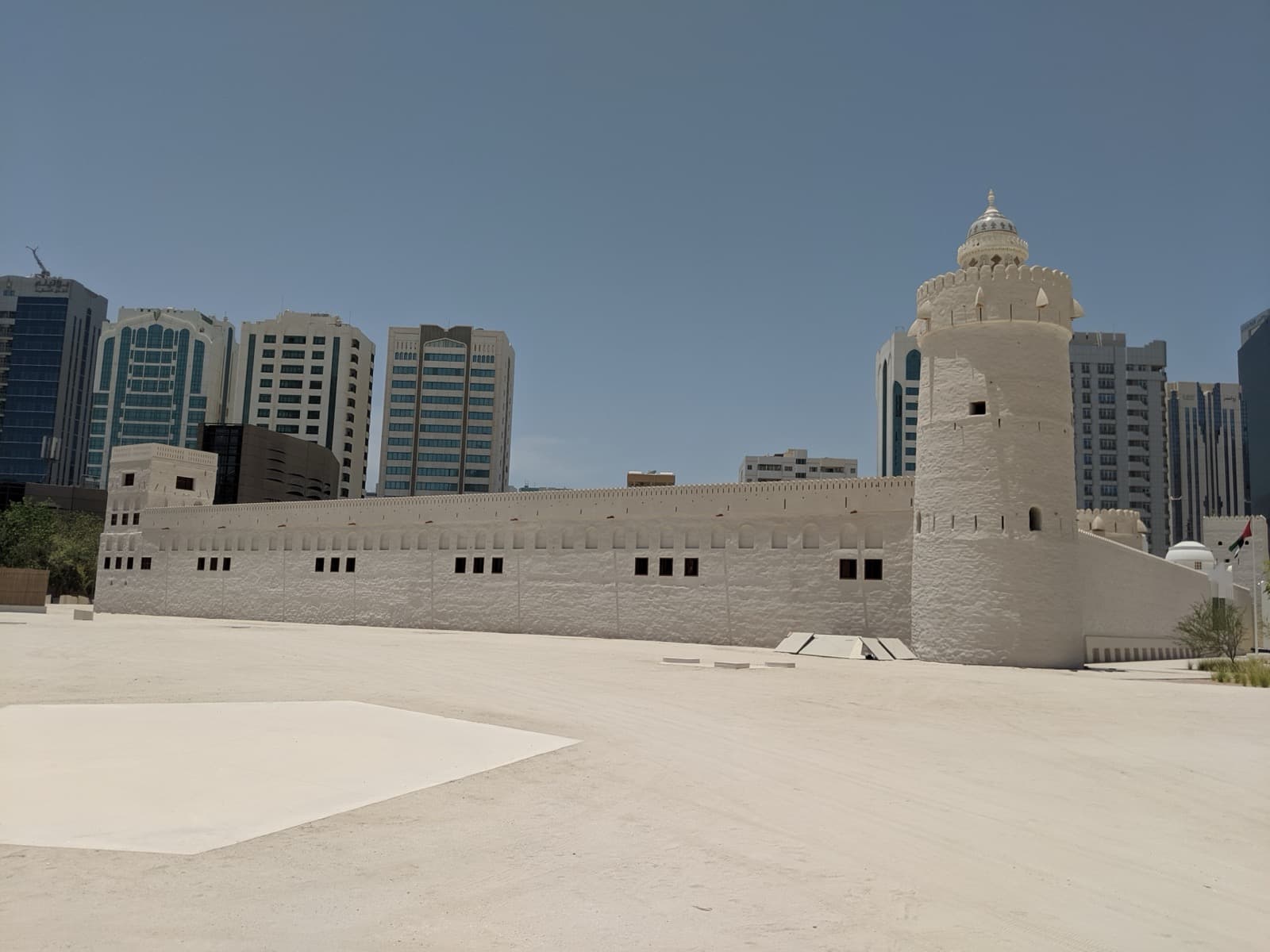
Standing beside the founding site is Qasr Al Hosn, the oldest stone building in Abu Dhabi. The word qasr means palace or great fort, and hisn means fort, so the name itself announces what the place was: the stronghold of the island. It began as a single watchtower of coral and sea stone in the late eighteenth century, guarding the one thing that made life possible.
The tour is careful with the date here too, and it is worth noticing how. Some sources place the inner conical watchtower in the 1760s under a supervisor named Mohammed Al Bastaki, with expansion into a fort in the 1790s under Shakhbut bin Dhiyab Al Nahyan. Others date the tower to about 1790 and the fort to 1795. Rather than pretend to a certainty the record does not hold, the walk asks you to hold it as the late eighteenth century. What is not in doubt is the long life that followed. The ruling Al Nahyan family lived and governed here until 1966, close to two centuries. After more than a decade of conservation, the fort reopened as a museum in December 2018.
Reading the fort right after the well makes the sequence legible. The well came first. The fort came to guard it. The family came to hold the fort. The city came around the family. That is the argument the whole route is built to prove, and it only lands if you walk it in order.
The capital fills itself in
From the founding ground the walk moves through the choices a very young country made about itself. Beside the fort sits the Cultural Foundation, opened in 1981 as the emirate's first cultural centre, when the United Arab Emirates was only a decade old. It held the first national library, a performance auditorium, and an exhibition centre. A nation ten years old chose to build its first proper home for art next door to its oldest fort, as if to insist that memory and imagination should live side by side.
At Al Ittihad Square, the word ittihad means the union, and the square commemorates the second of December 1971, when six emirates joined to form the United Arab Emirates, with Ras Al Khaimah following in 1972. Instead of monuments to kings or battles, oversized sculptures depict everyday objects: a dallah coffee pot poured for guests, a mabkhara incense burner, a fort tower, a cannon. A young nation wrote its own daily life large rather than borrowing the grand symbols of older empires.
Then the walk reaches the water and the scale of the story changes. The Corniche runs about eight kilometres along the island's northwestern shore, and much of the ground beneath it is new, extended by land reclamation principally between 2001 and 2005, roughly eight hundred thousand square metres of it. This is where the two halves of the founding meet. The pearl trade that sustained this coast for centuries collapsed in the 1930s, undone by Japanese cultured pearls and the Great Depression. Oil, first exported in 1962, is what let the city reshape its own shoreline and turn deliberately to face the Gulf.
The route ends at the Founder's Memorial, a tribute to Sheikh Zayed bin Sultan Al Nahyan, the first president, who died in 2004. Its centrepiece, The Constellation by the American artist Ralph Helmick, suspends 1,327 geometric shapes on 1,110 cables. From most angles it reads as a scattered cloud. From the right viewpoint, a portrait of Sheikh Zayed resolves out of the geometry. It is a fitting close: a founder shown not as a solid statue but as something you have to move to see, the same way the whole founding only makes sense once you stand at the well.
If you want the fuller picture of the city first, browse other Abu Dhabi walking tours or read about visiting Abu Dhabi. Then walk the founding route in order, from the well outward, and let the change from fort to skyline land as the astonishment it truly is.
Sources
- Qasr Al Hosn, Wikipedia. Background on the fort's coral-and-sea-stone construction, uncertain founding dates, the 1966 end of the ruling family's residence, and the 2018 museum reopening.
- Dhiyab bin Isa Al Nahyan, Wikipedia. The traditional founding figure and the roughly 1761 date associated with the gazelle legend, plus the Al Bu Falah lineage.
- History of Abu Dhabi, Abu Dhabi Registration Office (adro.gov.ae). Official account of the Bani Yas move from Liwa to the island and the pearling economy.
- The Founder's Memorial, Department of Culture and Tourism Abu Dhabi. Details on The Constellation, Ralph Helmick, and the memorial to Sheikh Zayed.
- Corniche (Abu Dhabi), Wikipedia. The scale of the promenade and its land reclamation.
Ready to experience it?
Qasr Al Hosn & the Corniche: Abu Dhabi's Founding Fort
90 min · 14 km · moderate
More from Abu Dhabi
Explore more at your own pace.
Abu Dhabi Travel Guide: Days, Transport, Season, Costs, and Safety
One Day in Abu Dhabi: A Walkable Morning-to-Evening Itinerary
Abu Dhabi: The Capital That Turned Oil Into a Country
The Grave at the Center of Abu Dhabi's Grand Mosque
Qasr Al Hosn: The Coral Fort Where Abu Dhabi Began