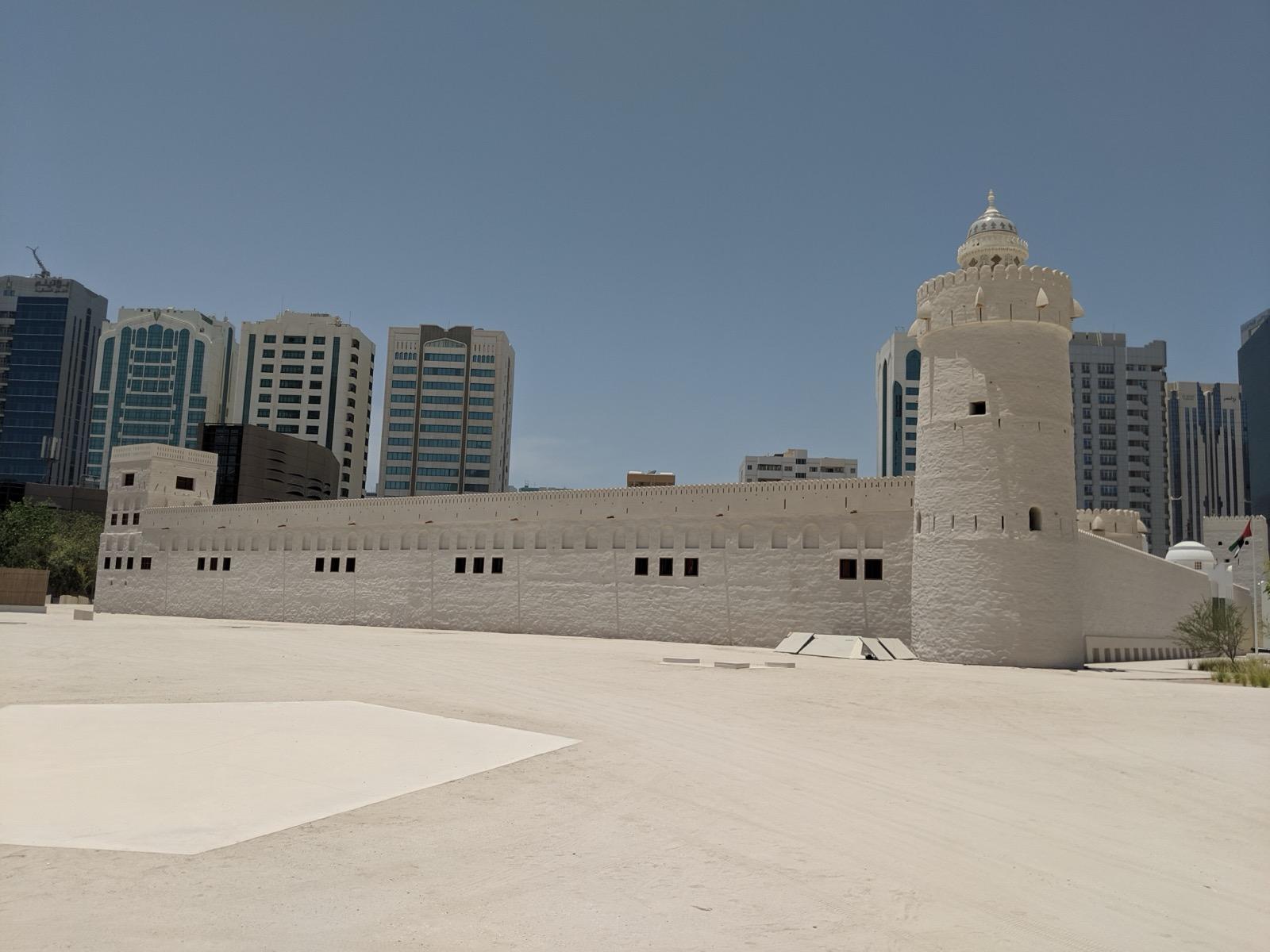
Qasr Al Hosn & the Corniche: Abu Dhabi's Founding Fort
4.20·6 Stops·90 minutes·14 km·Taxi between stops
A walk that reads a national capital outward from a single coral watchtower raised beside a well of sweet water, tracing how a Bani Yas pearling settlement became the seat of the United Arab Emirates within a single lifetime.
Start · Qasr Al Hosn: The White Fort Where the City Began
DirectionsStops
- 1
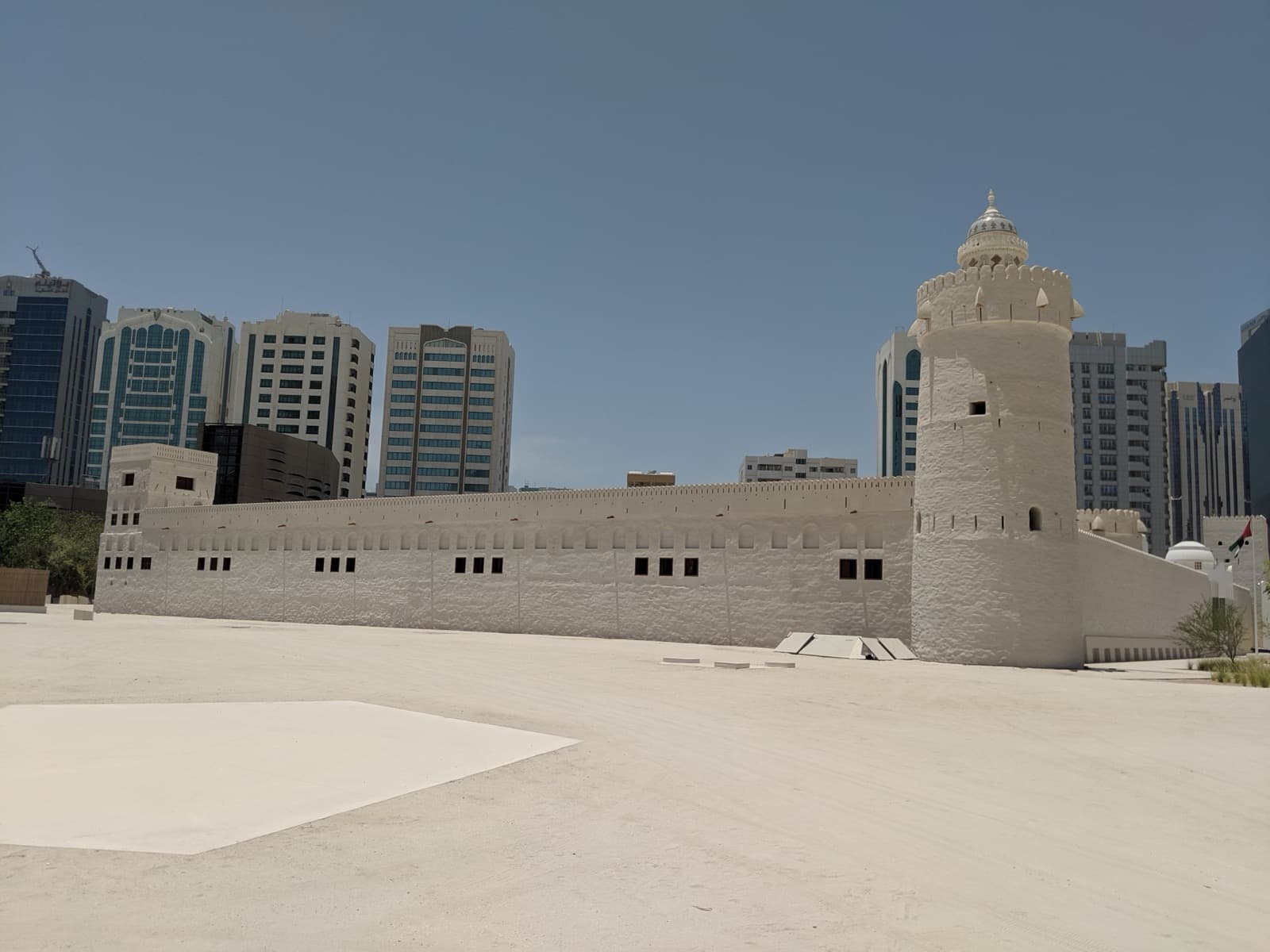
Qasr Al Hosn: The White Fort Where the City Began
The oldest stone building in Abu Dhabi, raised in the late eighteenth century to guard the island's only freshwater well and long the seat of its ruling family.
- 2
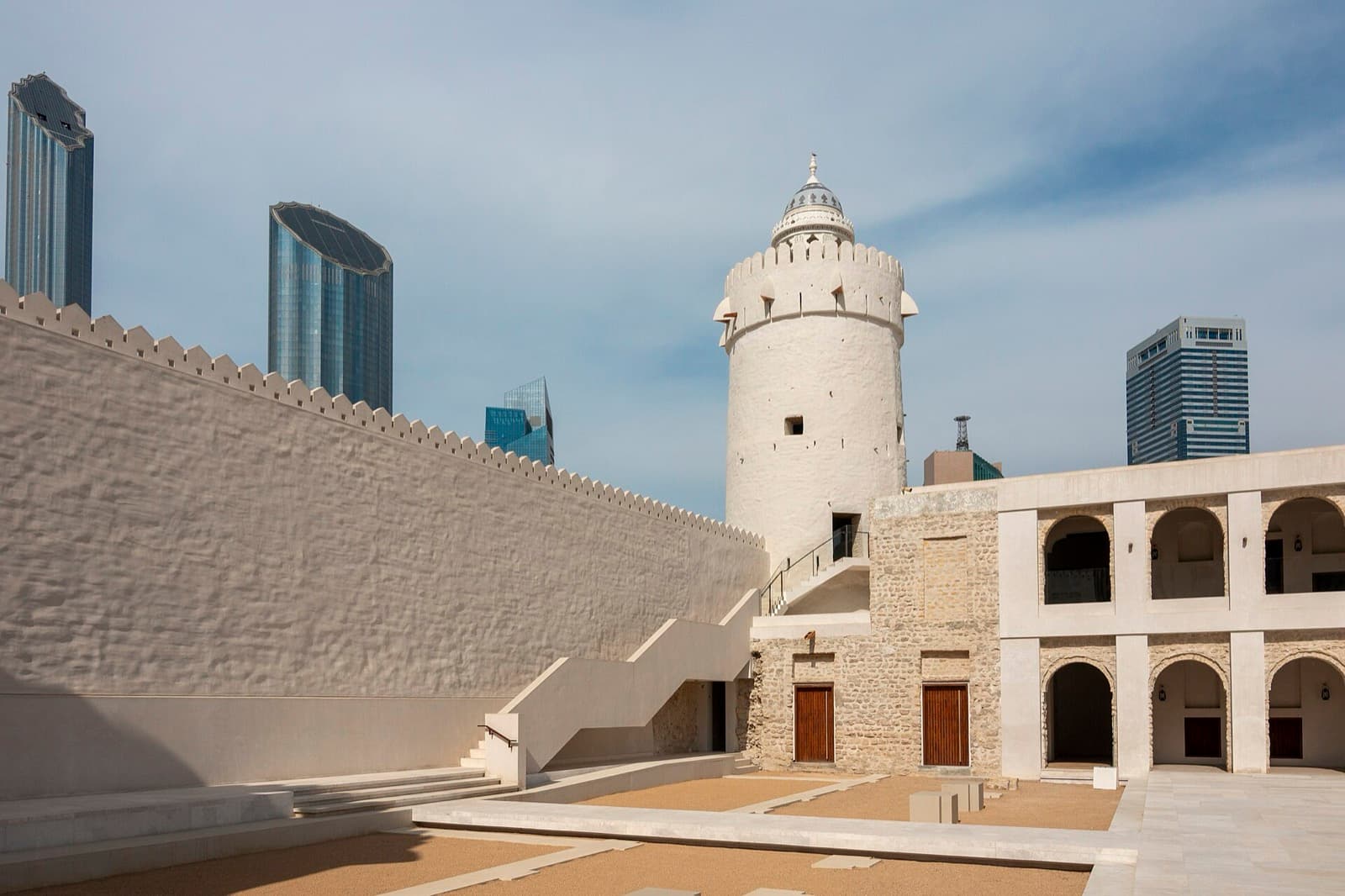
The Founding of Abu Dhabi: A Gazelle and a Well of Sweet Water
The traditional founding story of Abu Dhabi, held clearly as legend, alongside the documented history of the Bani Yas who settled the island.
- 3
The Cultural Foundation: The Young Capital's First Home for Art
Opened in nineteen eighty-one beside the fort, the emirate's first cultural centre gave the new capital a national library, a theatre and a place for public life.
- 4
Al Ittihad Square: A Young Country's Symbols Written Large
A public square whose oversized sculptures of everyday Emirati objects, a coffee pot, an incense burner, a fort tower and a cannon, celebrate the union of nineteen seventy-one.
- 5
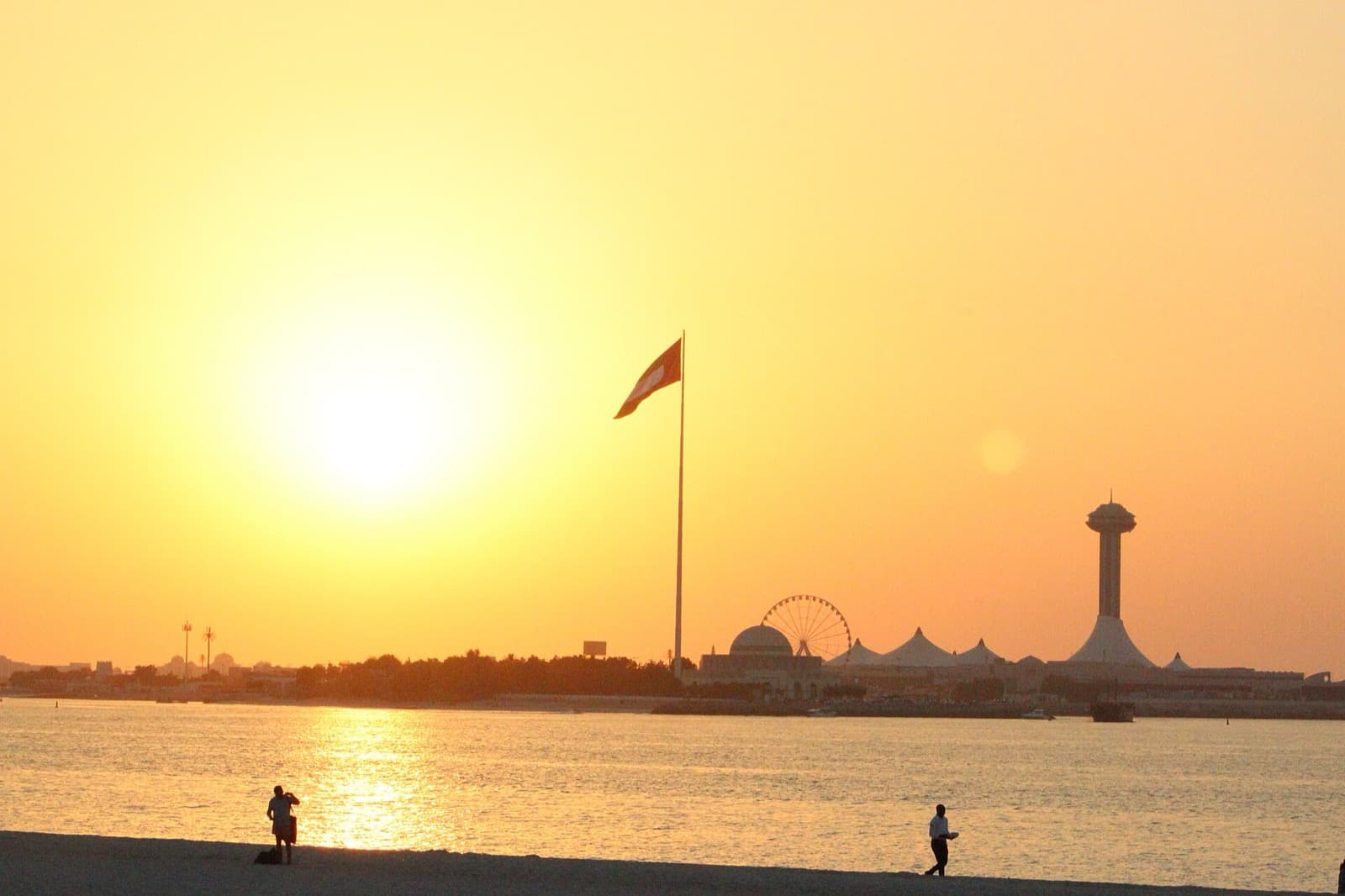
The Corniche: The Waterfront the City Turns to the Sea
An eight-kilometre landscaped promenade along the island's northwestern shore, extended by land reclamation and now the face the capital turns to the Gulf.
- 6
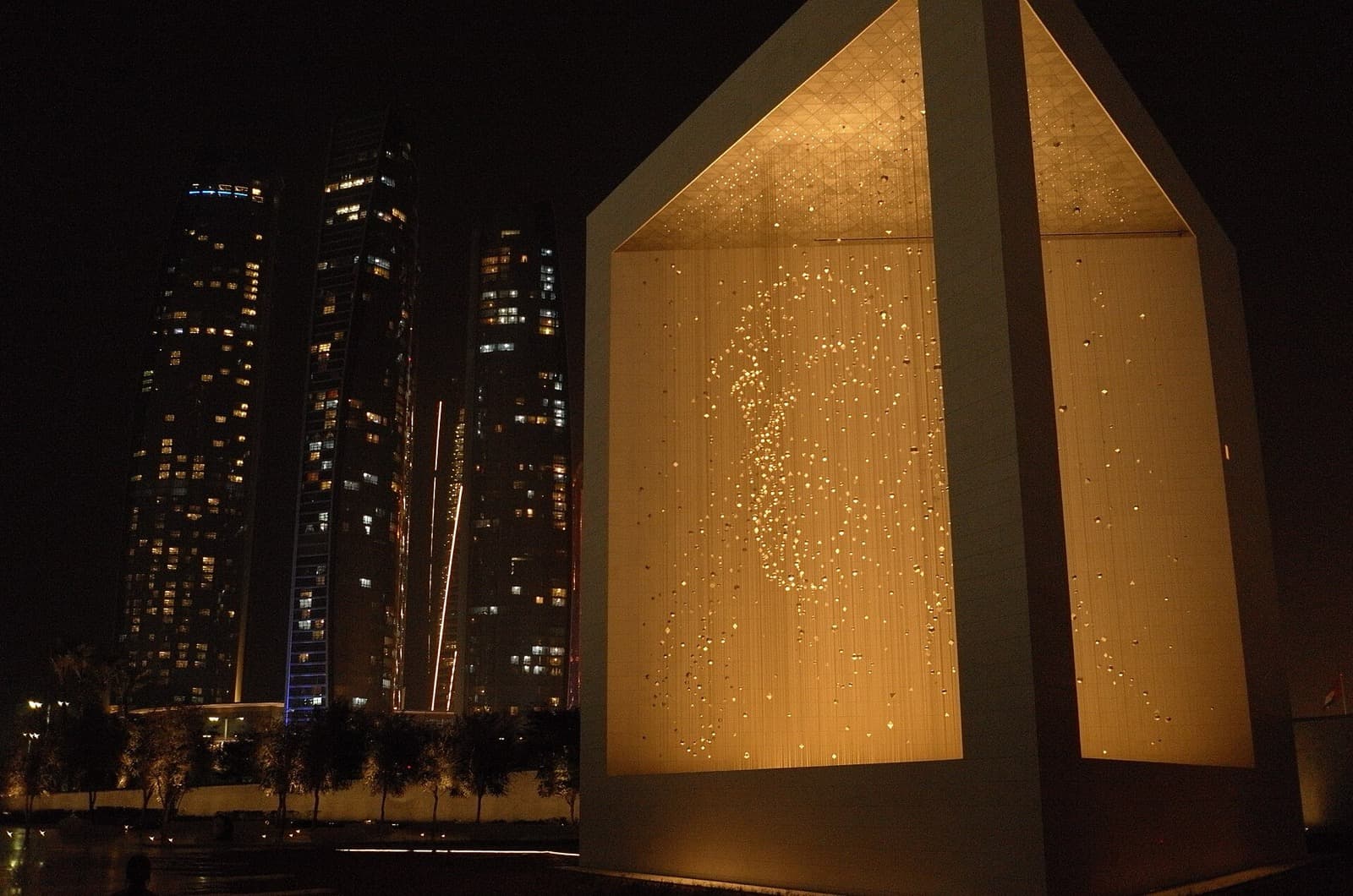
The Founder's Memorial: A Face Assembled From Light and Geometry
A tribute to Sheikh Zayed bin Sultan Al Nahyan whose centrepiece resolves thousands of suspended geometric shapes into a three-dimensional portrait of the founder.
Details
Best Time to Visit
The most comfortable months by far are the mild winter, from about November to March, when daytime temperatures are pleasant for a full outdoor walk and the Corniche is at its best. Avoid the extreme summer heat from about June to September, when midday temperatures and humidity make a long walk genuinely unsafe without frequent shade and water; if you visit in summer, walk in the early morning or after sunset only. Early morning or the late afternoon into evening are ideal in any season, when the light is soft on the fort and the memorial glows after dark. During Ramadan, eating, drinking and smoking in public during daylight hours are restricted, so plan your walk and any breaks with that in mind, and expect some venues to adjust their hours.
Pro Tips
- •Start early at Qasr Al Hosn, both to beat the heat and to see the white fort in soft morning light before the sun is high.
- •Carry more water than you think you need and refill whenever you can; the stretch along the open Corniche has little natural shade.
- •The Founder's Memorial rewards patience: move slowly around The Constellation to find the exact angles where the portrait of Sheikh Zayed resolves, and consider timing it for dusk when it lights up.
- •Free guided tours are available at the Founder's Memorial, and they help you find the best viewing points, so ask when you arrive.
- •Wear comfortable walking shoes and a hat, and plan a sit-down break at one of the Corniche cafes to break the roughly six-kilometre route into stages.
- •Keep some UAE dirhams or a card for museum entry at the Al Hosn site, since the fort interior is ticketed while much of the rest of the walk is free.
Safety & Precautions
- •Summer heat here is a real hazard, not a discomfort: from about June to September, avoid walking in the midday hours, seek shade, and drink water constantly, as heat exhaustion can come on quickly.
- •Sun protection matters year-round given the strong Gulf sun and the open, reflective waterfront; use sunscreen, a hat and sunglasses even in the milder winter months.
- •Dress modestly, especially in the older quarters and near working places of worship; women should carry a scarf and covering for the head, shoulders and knees if visiting any mosque, and everyone should keep voices low and be respectful with photography at religious sites and at the memorial honouring Sheikh Zayed.
- •During Ramadan, refrain from eating, drinking or smoking in public during daylight hours out of respect, keep normal city street-awareness of traffic when crossing busy roads near Al Ittihad Square and the Corniche, and remember that museums on the Al Hosn site charge entry in UAE dirhams.
- •Be mindful of what you photograph. Photographing government, military, police and other security buildings is prohibited in the UAE and enforced with heavy fines, and this route passes through central Abu Dhabi's government district around Al Ittihad Square. Keep your camera on the fort, the memorial and the waterfront, and when an official building is in doubt, leave it out of the frame.
Travel advisory: Reconsider Travel (Level 3).
Gallery
Related Reading
Go deeper on what you'll see, hear, and walk through.
Overview
Abu Dhabi Travel Guide: Days, Transport, Season, Costs, and Safety
8 min
Overview
Best Self-Guided Walking Tours in Abu Dhabi (2026)
3 min
Overview
One Day in Abu Dhabi: A Walkable Morning-to-Evening Itinerary
5 min
Thematic
Abu Dhabi: The Capital That Turned Oil Into a Country
7 min
Companion
The Well That Made Abu Dhabi: Reading a Capital From Its First Fort
7 min
Deep dive
Qasr Al Hosn: The Coral Fort Where Abu Dhabi Began
6 min
Read
What to Eat in Abu Dhabi: Emirati Dishes and How to Order Them
7 min
Read the walk
The full story of Qasr Al Hosn & the Corniche: Abu Dhabi's Founding Fort, in words. Prefer to listen? Play it narrated, from home or on location.
Introduction
Every city has a first stone, and in Abu Dhabi you can still stand beside it. This short self-guided tour follows the capital of the United Arab Emirates outward from a single low fort raised in the late eighteenth century to guard the island's only well of sweet water. From that coral watchtower, the story opens onto a well, a founding legend held honestly as tradition, a young country's first home for art, a square of everyday objects turned monumental, the great curved waterfront the city built to face the Gulf, and a memorial where the founder's face resolves out of floating geometry. Because Abu Dhabi is a spread-out capital and its founding sites sit a few kilometres apart across the island, the six stops are linked by short drives, a taxi or car ride between them, roughly fourteen kilometres in all, with an easy walk around each site. Allow about ninety minutes, with time to sit by the water. The tension you are walking through is real. A tiny brackish well on a desert island, and the poverty and danger of the pearl divers who sustained this coast, set against a planned modern capital of glass towers raised on reclaimed land after oil was exported in the nineteen sixties. The Bani Yas who settled here, the Trucial States treaties with Britain, the collapse of pearling in the nineteen thirties, and the union of the emirates in nineteen seventy-one all belong to this ground. The pace is slow on purpose, so the change from fort to skyline lands as the astonishment it truly is. When you arrive at Qasr Al Hosn, begin with stop one.
1. Qasr Al Hosn: The White Fort Where the City Began
This is the oldest stone building in Abu Dhabi, and everything else you will see today grew outward from it. The word qasr means palace or great fort, and hisn means fort, so the name itself tells you what this place was: the stronghold of the island. It began not as a palace but as a single watchtower of coral and sea stone, raised in the late eighteenth century to guard the one thing that made life here possible, a well of fresh water on an otherwise dry island. The exact year is genuinely uncertain. Some sources date the inner conical watchtower to the seventeen sixties, supervised by a man named Mohammed Al Bastaki, and its expansion into a fort to the seventeen nineties under Shakhbut bin Dhiyab Al Nahyan. Others date the tower to about seventeen ninety and the fort to seventeen ninety-five. Rather than pretend to a certainty the record does not hold, hold it as the late seventeen hundreds. What is clear is the long life that followed. The ruling Al Nahyan family lived here and governed from here until nineteen sixty-six, close to two centuries. The walls were built of coral and sea stone, then rendered with burned and crushed seashells mixed with white sand. The bright white you see came later, from renovations in the late nineteen seventies and early eighties, which is why people call it the white fort. After more than eleven years of careful conservation, it reopened to the public as a museum in December of two thousand and eighteen. Read it slowly. This small fort held the whole idea of Abu Dhabi before there was a city around it.
2. The Founding of Abu Dhabi: A Gazelle and a Well of Sweet Water
A few steps from the fort, on the same ground, it is worth pausing on how Abu Dhabi came to be, because the story arrives in two voices. The first is legend, and it is best told as exactly that. Tradition dates the founding to about seventeen sixty-one. As the story goes, a Bani Yas hunting party, associated with a man named Dhiyab bin Isa Al Nahyan, tracked a gazelle across the coast until it led them to fresh water on this low island. In gratitude, the place was named Abu Dhabi, which is popularly translated as father of the gazelle. That is a lovely story, and it is a story, passed down rather than documented, so hold it as the tradition it is. The second voice is history, and it is firmer. The Bani Yas were the tribal confederation from which the ruling Al Nahyan descend, and it was the Al Bu Falah subsection that provided the rulers. Toward the end of the seventeen hundreds, the family shifted its permanent seat from the inland Liwa oasis to this island by the sea. The settlement that grew here lived by fishing and above all by pearling, sending divers down again and again on a single breath in a trade of real hardship and real danger. What the legend and the history share is the well. Sweet water on a dry island is not a detail. It is the reason a hunting party would stay, the reason a ruling family would move its seat here, and the reason a fort was raised to guard it. From that one well, a capital eventually followed.
3. The Cultural Foundation: The Young Capital's First Home for Art
Standing right beside the fort is a building that marks a very different kind of founding. This is the Cultural Foundation, and it opened in nineteen eighty-one as the emirate's first cultural centre. Think about the timing. The United Arab Emirates had existed for only a…
Full narration for this stop unlocks with the tour.
4. Al Ittihad Square: A Young Country's Symbols Written Large
This square is called Al Ittihad, and the word means the union. That name is the whole point of the place. On the second of December nineteen seventy-one, six emirates came together to form the United Arab Emirates: Abu Dhabi, Dubai, Sharjah, Ajman, Umm Al Quwain, and Fujairah,…
Full narration for this stop unlocks with the tour.
5. The Corniche: The Waterfront the City Turns to the Sea
Here the walk reaches the water, and the whole scale of the story changes. This is the Abu Dhabi Corniche, a landscaped waterfront boulevard that runs about eight kilometres along the northwestern shore of the island. Along it are a beach, separate paths for cyclists and for…
Full narration for this stop unlocks with the tour.
6. The Founder's Memorial: A Face Assembled From Light and Geometry
This is the Founder's Memorial, a permanent tribute to Sheikh Zayed bin Sultan Al Nahyan, the first president of the United Arab Emirates, who died in two thousand and four. It stands on the Corniche in the district of Al Ras Al Akhdar, near the Breakwater. It was inaugurated on…
Full narration for this stop unlocks with the tour.