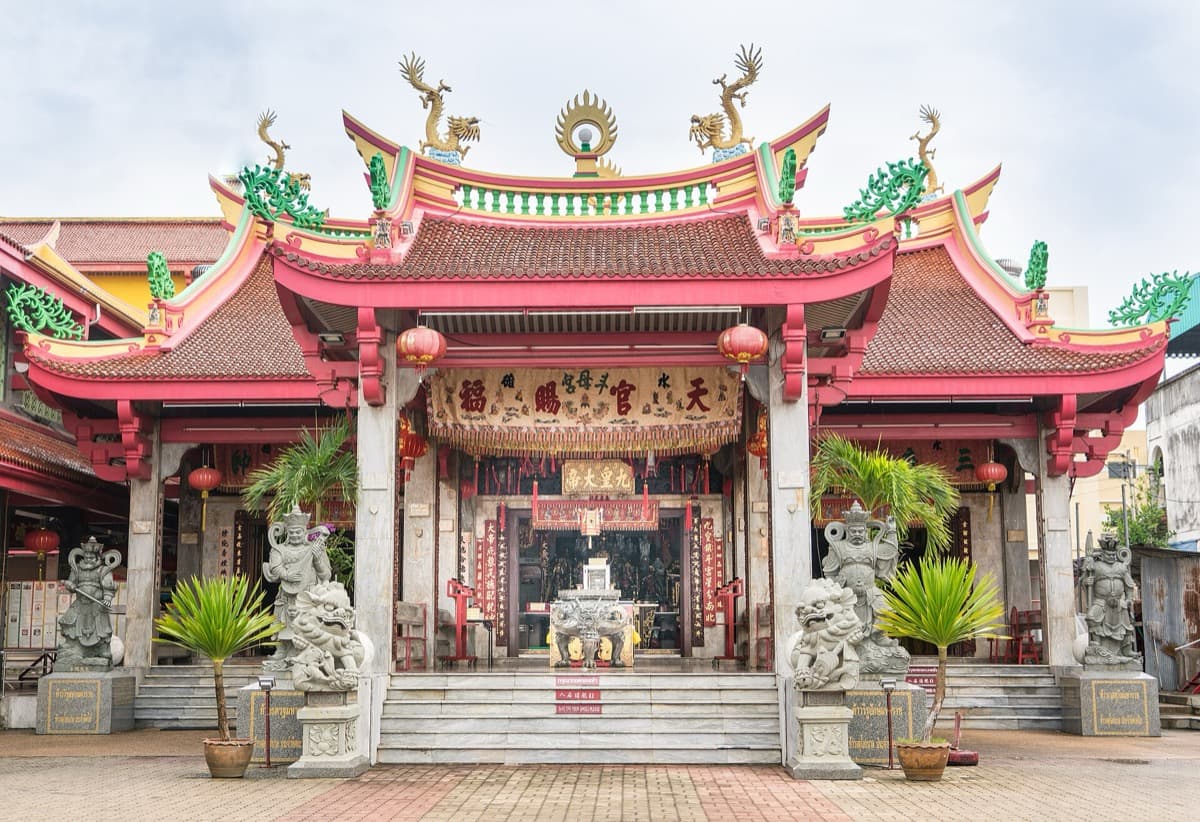
A walk through Phuket Town's Chinese shrines that reads the island's most intense festival from the inside, tracing the tin-mining migrants who crossed the sea and never let go of their gods.
Start · Put Jaw Shrine: The Goddess of Mercy
DirectionsStops
- 1
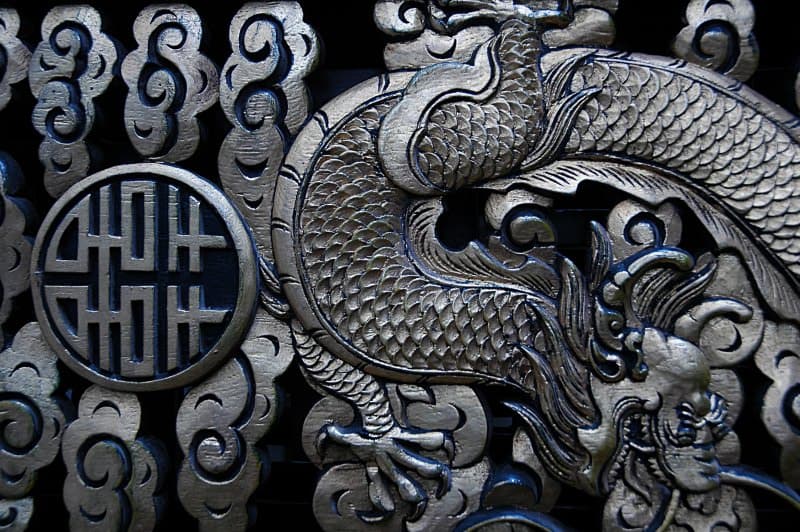
Put Jaw Shrine: The Goddess of Mercy
The shrine the island remembers as its oldest Chinese temple, dedicated to Kuan Im, the goddess of compassion and healing, and traditionally visited first.
- 2
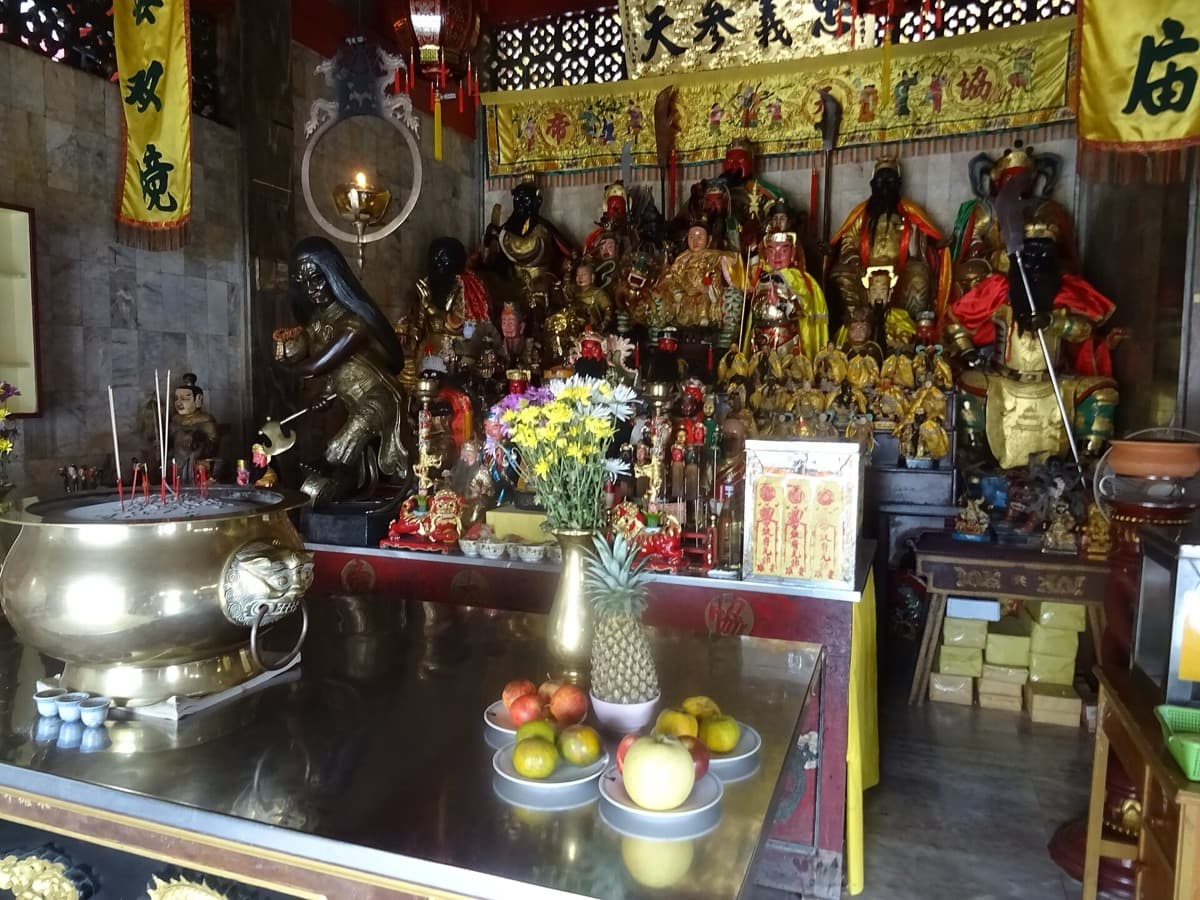
Jui Tui Shrine: The Ceremonial Engine
The Taoist shrine that serves as the ceremonial heart of Phuket's Vegetarian Festival, where a tall bamboo pole invites the Nine Emperor Gods to descend.
- 3
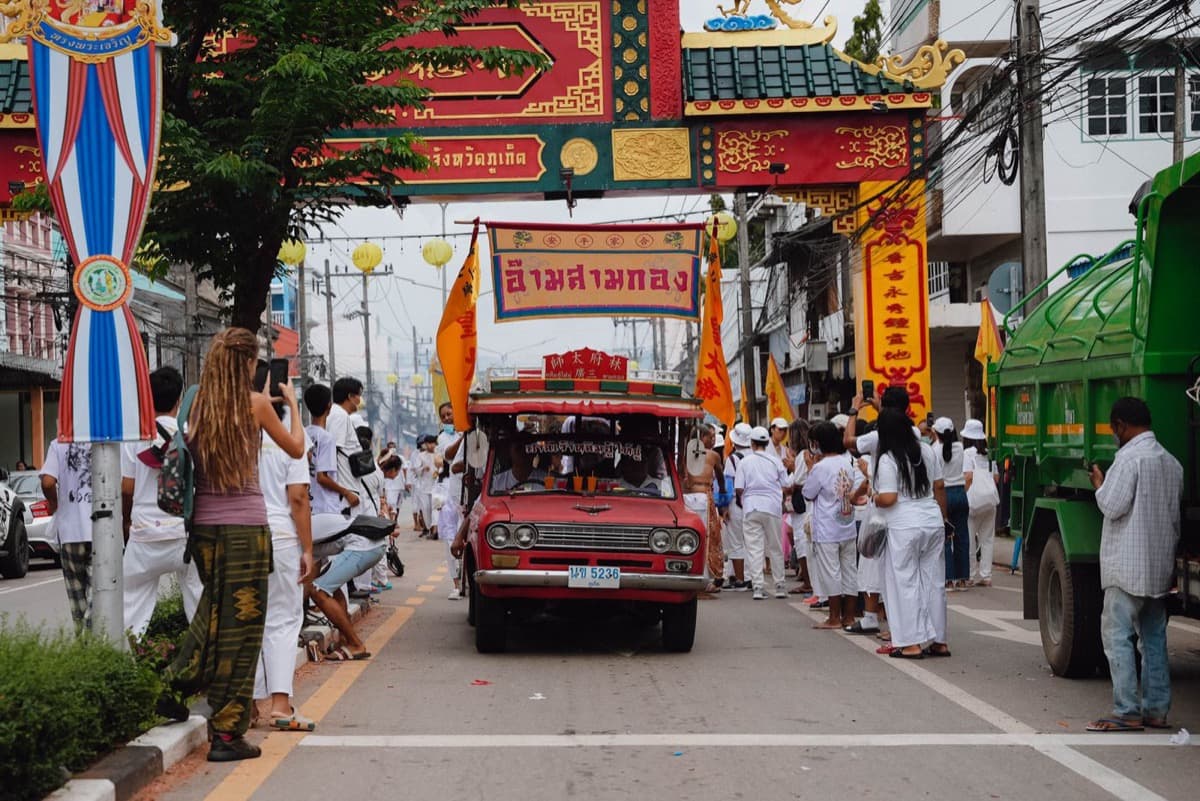
The Vegetarian Festival and the Nine Emperor Gods
The interpretive heart of the walk, explaining the nine-day festival, the star-god deities behind it, and the origin legend the island tells.
- 4
Bang Neow Shrine: The Whole Community Walks
One of Phuket's principal festival shrines, known for the largest street processions, blade-ladder climbing, and fire-walking.
- 5
Sam San Shrine: The Crossing
An eighteen fifty-three shrine to Mazu, the goddess of the sea, built by the Foochow community and still used to bless new boats.
- 6
Saphan Hin Tin Mining Monument: The Gods Go Home
The waterfront where a dredger-shaped monument marks the arrival of tin dredging, and where the festival's final procession returns the gods to heaven.
Details
Best Time to Visit
Early morning, from about seven to ten, when the shrines are open, the incense is fresh, and the old-town streets are cool and quiet before the midday heat. If you can time your visit to the Nine Emperor Gods Festival in September or October, the shrines transform entirely, but expect dense crowds, loud firecrackers, and processions that reroute traffic, so arrive very early and keep your plans flexible.
Pro Tips
- •Visit Put Jaw before Jui Tui. The two shrines sit side by side, and tradition holds you enter the goddess of mercy's shrine first, so following that order lets the walk unfold the way the community intends.
- •Carry small cash. Entry to every shrine on this walk is free, but you may want coins for incense, candles, or a donation box, and the old town is easiest to move through on foot.
- •Go early to beat both heat and crowds. The shrines open in the morning, and by midday the courtyards bake, so the first few hours give you cooler stone, softer light, and quieter spaces to actually notice the small daily rituals.
- •During the festival, watch the mah song and processions from a respectful distance and follow the crowd's lead on where to stand. Firecrackers are set off in bursts near the mediums, so keep back and protect your ears and eyes.
- •Pace yourself and skip freely. This is your walk at your own speed, so if a shrine courtyard is busy or a stop does not hold you, move on and come back later when it is quieter.
- •Combine the shrine walk with the surrounding Sino-Portuguese old town. The same tin-boom Hokkien and Peranakan families who built these shrines built the grand shophouse mansions nearby, so the streets between stops are part of the story.
Safety & Precautions
- •Phuket is hot and humid year round. Carry water, wear light breathable clothing, use sun protection, and rest in shade between stops, since heat exhaustion is a real risk on a midday walk.
- •These are active places of worship, not tourist attractions. Dress modestly with shoulders and knees covered, remove your shoes where signs or local practice indicate, speak quietly, and ask before photographing people at prayer or mediums in trance.
- •From roughly May to October, monsoon downpours arrive fast and heavy. Carry a light rain layer, watch for slick pavement and shrine floors, and be ready to shelter briefly until a squall passes.
- •Old-town streets carry motorbikes, cars, and, during the festival, dense crowds and firecrackers. Watch traffic when crossing, keep children close, and during festival processions stay clear of the mah song and the areas where firecrackers are being lit.
Travel advisory: Exercise Normal Precautions (Level 1).
Gallery
Related Reading
Go deeper on what you'll see, hear, and walk through.
Overview
Best Self-Guided Walking Tours in Phuket (2026)
3 min
Overview
One Day in Phuket Old Town: A Walkable Morning-to-Evening Plan
8 min
Overview
Phuket Travel Guide: How Many Days, Getting Around, Best Time, and Safety (2026)
7 min
Thematic
Best Culture Walking Tours in Phuket (2026)
2 min
Thematic
Phuket Before the Beaches: The Tin Island's Straits Chinese Port
7 min
Companion
Jui Tui Shrine: The Ceremonial Engine Behind Phuket's Vegetarian Festival
6 min
Read
What to Eat in Phuket: The Local Dishes and Where They Come From
6 min
Read the walk
The full story of Chinese Shrines: The Gods of the Miners, in words. Prefer to listen? Play it narrated, from home or on location.
Introduction
This is a walk about a migrant faith. Phuket, in southern Thailand, is famous for one of the most startling religious festivals on earth, the Vegetarian Festival, where mediums pierce their cheeks and climb ladders of blades. It is easy to read that as spectacle. It is not. It is the surviving spiritual machinery of a community, the tin-mining Hokkien Chinese who crossed the sea in the nineteenth century, married into the island, and kept their gods alive. Over the next six stops, across roughly four and a half kilometres and about two hours at your own unhurried pace, you will read that machinery from the inside. We begin at the source of mercy, the oldest Chinese shrine the island remembers, dedicated to the goddess of compassion. From there we move to the ceremonial engine where the gods are invited down, pause to understand the festival and the story the island tells about its origin, then stand where the processions run largest. We visit a seafaring shrine that reveals the crossing itself, the migration that brought all of this across the water. And we finish at the tin-dredging waterfront, where the gods are sent home and the mining history is cast in a monument. These are not tourist temples. They are the load-bearing institutions of a diaspora. Stop where a courtyard is quiet. Skip what does not hold you. Let the incense and the small daily rituals do their work before the intensity of the festival makes sense. When you arrive at Put Jaw Shrine, begin with stop one.
1. Put Jaw Shrine: The Goddess of Mercy
Start here, in the quiet. Put Jaw, whose Hokkien name means the Temple of Kuan Im, is the shrine local sources hold to be the oldest Chinese temple on the island, said to be over two hundred years old, built by the Hokkien settlers who came for tin. Nobody can hand you a founding date carved in stone, so the island simply says: this one came first. That matters, because it means a migrant community's very first relationship with its gods was not the blades and fire you may have come expecting. It was mercy. This shrine belongs to Kuan Im, the Chinese goddess of compassion and healing, and everything about the space is gentle. Watch what people actually do here. A worshipper kneels and shakes a bamboo cylinder until one numbered stick clatters out, then carries that number to a herbal shop for a prescription. Parents come to choose an auspicious name for a newborn. This is a working faith, not a museum. Put Jaw sits directly beside the much larger, busier Jui Tui shrine, physically connected to it, and by tradition you come here first, especially during the festival. There is a logic to that order. Before you meet the gods who are invited down in fire and procession, you meet the one who simply listens. Notice the incense, the low red light, the smoke curling toward the roof beams. On an ordinary day it is almost silent. Stand a moment. Let the compassion register before the intensity arrives. Entry is free. When you are ready, the engine of the whole thing is right next door.
2. Jui Tui Shrine: The Ceremonial Engine
Step next door and the mood changes. Jui Tui is the ceremonial heart of Phuket's Vegetarian Festival, the focal point where the whole nine-day observance opens each autumn. It is dedicated to Tean Hu Huan Soy, a Taoist deity associated with the performing arts, whom locals petition for health and protection. There is a nice symmetry in that: a festival the island traces to a troupe of performers is anchored to the god of performance itself. Do not mistake the building for something ancient. According to phuket101, the present shrine dates to about nineteen eleven. It once stood near the old town and was relocated here to Soi Phutorn after a devastating fire. So the faith is old, the migration is old, but this particular hall is a survivor of the twentieth century, rebuilt by a community that would not let its center go. The single most important object appears only during the festival. In the courtyard, worshippers raise the go teng, a tall bamboo pole, and by raising it they formally invite the Nine Emperor Gods to descend from the heavens and reside here for the nine days. Everything downstream flows from that pole. The processions that run through Phuket Town begin from shrines like this one, and on the festival's final day a great procession leaves Jui Tui and travels to the waterfront to send the gods back to heaven. Hold that thread. We will end exactly where that procession ends. For now, stand in the courtyard where the pole goes up, and picture this quiet square packed with white-clad devotees and drifting smoke. Entry is free.
3. The Vegetarian Festival and the Nine Emperor Gods
Pause here in the shrine courtyard, because this is where the festival makes sense. What visitors call the Vegetarian Festival is the Nine Emperor Gods Festival, a Taoist observance held over the first nine days of the ninth lunar month, which falls across September and October.…
Full narration for this stop unlocks with the tour.
4. Bang Neow Shrine: The Whole Community Walks
Now see the scale of it. Bang Neow, also called Tao Bong Keng, is one of Phuket's most revered Chinese shrines and one of the principal engines of the Vegetarian Festival. If Jui Tui invites the gods down, Bang Neow is where the community pours into the streets. This shrine is…
Full narration for this stop unlocks with the tour.
5. Sam San Shrine: The Crossing
Step back from the festival for a moment and look at the water underneath all of it. Sam San, on Krabi Road in the old town, was built in eighteen fifty-three, and it is dedicated not to a festival deity but to Mazu, also called Tianhou, the Chinese goddess of the sea. This…
Full narration for this stop unlocks with the tour.
6. Saphan Hin Tin Mining Monument: The Gods Go Home
End at the water, where everything closes the loop. Saphan Hin is the park at the south end of Phuket Road, once the island's chief trading port and the heart of its tin-dredging waterfront. Look for the monument shaped like a dredge. Built in nineteen sixty-nine, it is called…
Full narration for this stop unlocks with the tour.