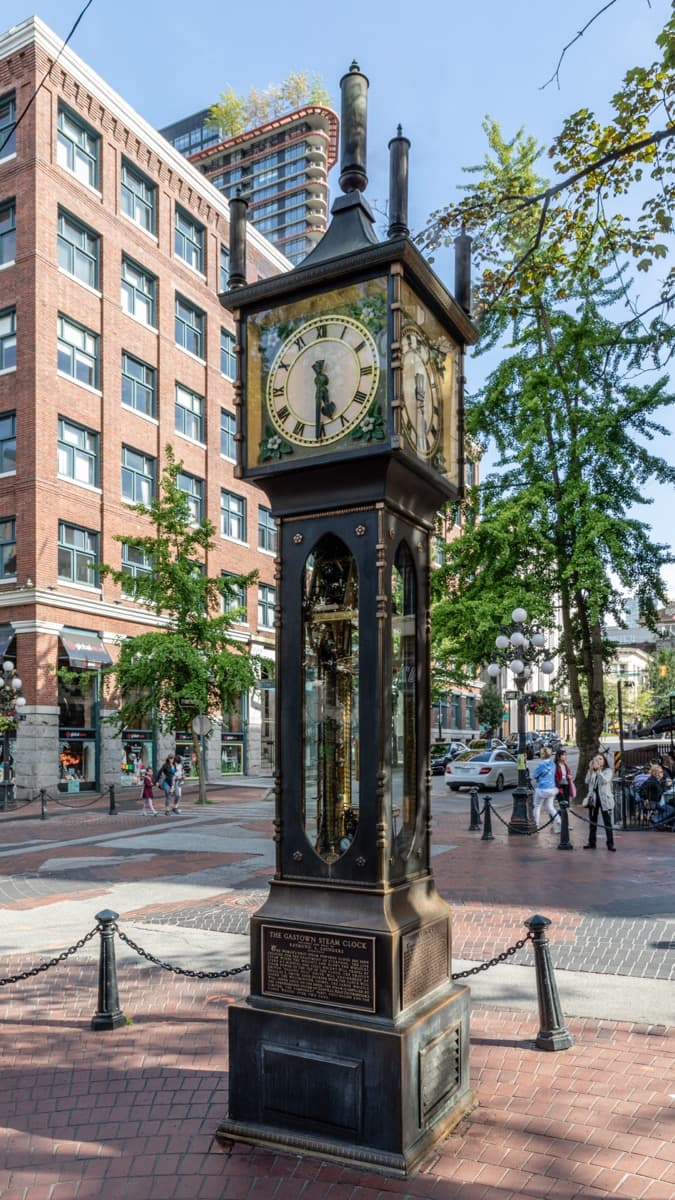
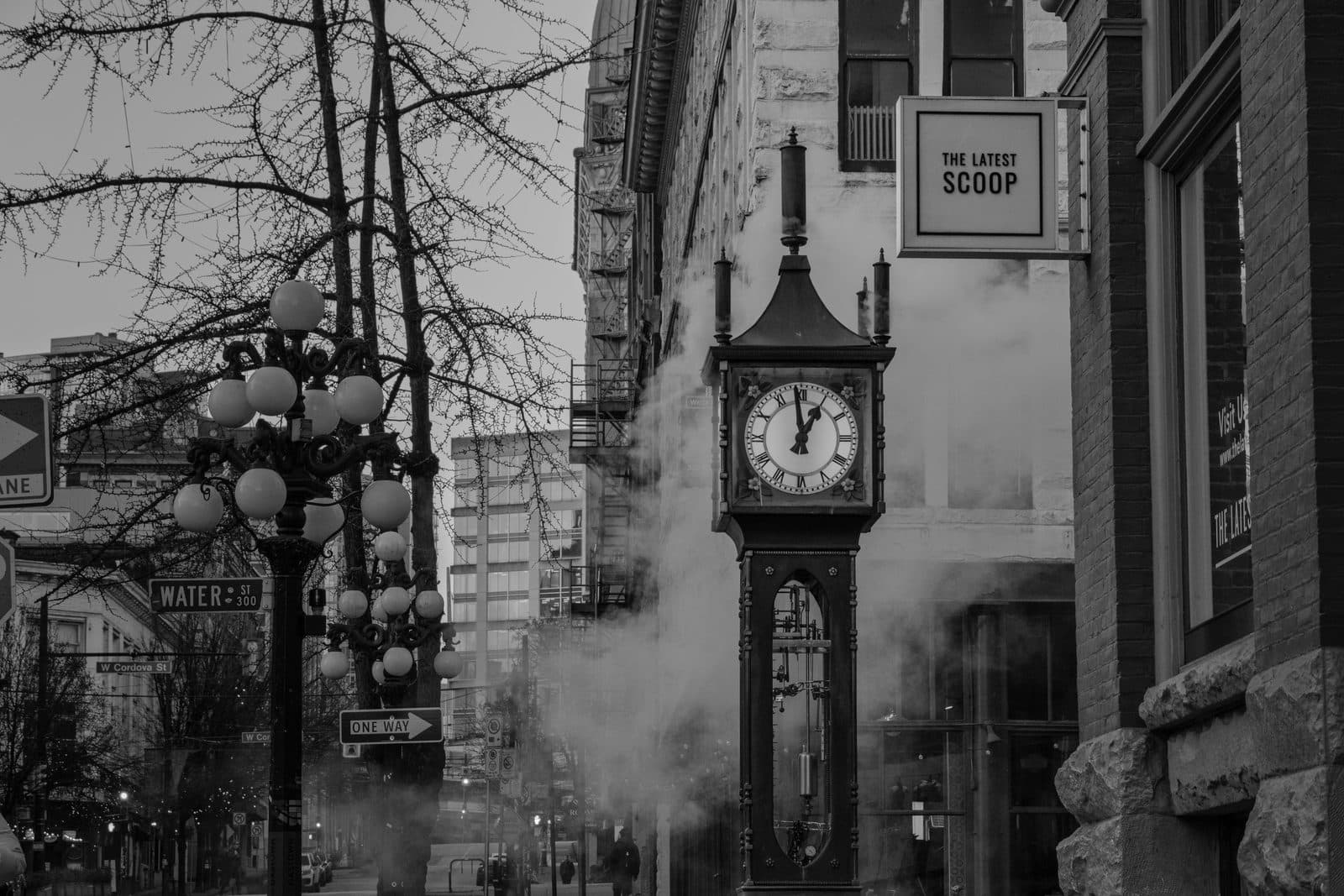
At the corner of Water and Cambie streets stands the most photographed object in Gastown: a four-faced brass-and-glass clock that vents a plume of steam on the hour and chimes the Westminster Quarters every fifteen minutes. Most visitors read it as a survival from Vancouver's founding era. Some guidebooks still call it Victorian.
It is not Victorian. And the gap between what it looks like and what it is happens to be the entire point of the Gastown walk.
Built in 1977, to hide a vent
The Gastown Steam Clock was built in 1977 by a Vancouver horologist named Raymond Saunders, born 7 February 1940, died 23 November 2024. He built it to cover a Vancouver Central Heat sidewalk steam vent. The neighbourhood's district-heating system needed an outlet on the corner, and rather than let it discharge steam straight onto the pavement, Saunders proposed a public-art commission that would route the steam up through a clock. The city agreed. He built six steam clocks in his life; this was the first.
The clock is the same age as the first Star Wars film. The brass cabinet is 1970s brass. The gear train is a contemporary mechanism in a deliberately old-fashioned housing. When Saunders died in November 2024, the CBC ran the obituary, and it is worth noting that even his design intent was not deception: he built it to reflect the era of the surrounding buildings, not to fool anyone. The tourists supplied the fooling on their own.
Steam is the plume, not the engine
Hear a stop from this walk
Maple Tree Square: The Climax
There is a second, smaller misreading worth clearing up. The steam is real and it does drive the whistle chime, but the clock is not primarily steam-powered. Electric motors wind the mechanism and run the ventilation. The plume you photograph is the working, theatrical part; the timekeeping is electric. So the "steam clock" is steam-decorated more than steam-driven.
Why this one object carries the whole tour
The Gastown walk is an argument that the district's founding-era look was largely assembled in the early 1970s. The steam clock is that argument in miniature, layer for layer:
- Surface: reads as 1880s.
- Date: 1977.
- Function: cover a utility vent.
- Reception: a tourist photograph.
- Frame: heritage.
- Reality: a contemporary public-art commission disguised as Victorian survival.
That is exactly the structure of Gastown's cobblestones, its gas-style lamps, and its renamed lanes, all installed as heritage a century after the actual founding. The clock just does it in one cabinet you can stand across the street and take in whole.
What to look at when you are there
Stand on the far side of Water Street so the entire cabinet is visible. Watch a full quarter-hour cycle: the chime on the quarter, the bigger plume on the hour. Then look at the brass, and read it as 1970s rather than 1870s. Once you see the costume as a costume, you will read the rest of Gastown the same way.
For the district's founding facts, from Gassy Jack's 1867 saloon to the 1886 fire that erased the wooden originals, read the Gastown founding companion. For the larger pattern of a city curating and re-narrating its own ground, see the thesis on erasure and reclamation. The clock will outlast the steam vent it was built to cover. It has already outlasted most of the beliefs people hold about it.
Ready to experience it?
Gastown: A Founding Story, Retroactively Curated
80 min · 1.1 km · easy
More from Vancouver
Explore more at your own pace.
One Day in Vancouver: A Walkable Downtown Itinerary (2026)
Chinatown After Hogan's Alley: What Displacement Did to Vancouver's Black and Chinese Blocks
Vancouver: The City Built on Erasure and Reclamation
Chinatown and Hogan's Alley: The Freeway Fight Vancouver Only Half-Won
Gastown: A Founding Myth Assembled in the 1970s