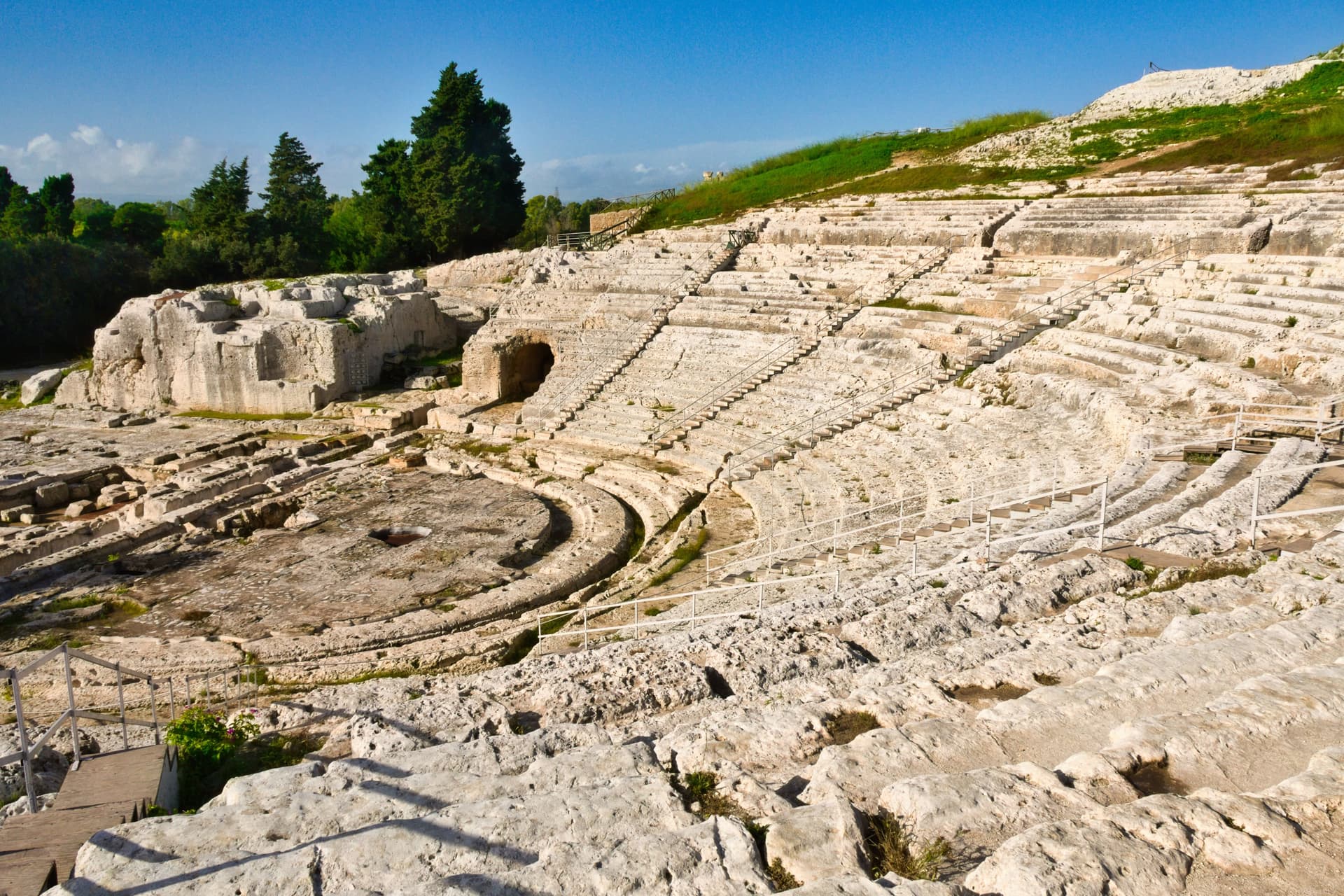
The Greek Theatre of Syracuse was cut rather than built: Hieron the Second carved its seats from the hill and wrote his family's names into them, and only the rows set on fill were carried away. Stand at the foot of the great semicircle in the Neapolis Archaeological Park and the evidence is all around you. The seats are not blocks laid on a slope. They are the slope, trimmed into steps.
A hillside turned into seats
The cavea, the bowl of seats, is more than 138 metres across. It originally held 67 rows, divided into nine wedges by eight stairways, and it was cut almost entirely out of the limestone of the hill. Look along any row and you can see the bedrock in it: the same pale stone as the quarry garden below, worked into seats, steps and drainage rather than hauled in from elsewhere.
That fits the hill's history. Archaeologists think stone was quarried here from the sixth century BC, and Maria Amalia Mastelloni, an archaeologist who worked for the park, suggests the theatre was set into ground the quarrymen had already emptied, a kind of architecture in the negative. The city's best seats were carved into a hole it had already dug.
Hieron's theatre
Hear a stop from this walk
Ear of Dionysius and Grotta dei Cordari: A Name With a Date
Syracuse had a theatre long before this one, but where it stood is not known. What you see is mostly the work of King Hieron the Second, who ruled Syracuse for fifty-four years until 215 BC. The city of Syracuse dates the present form to a rebuilding under him, roughly 238 to 215 BC, though specialists disagree about the earlier phases. Hieron is the same king behind the long rock-cut altar on the park street, and the theatre and altar together were the showpiece of the district Cicero called Neapolis, the New Town, with its great theatre on the highest ground.
Names on the seats
Now find the walkway that runs halfway up the seats, the diazoma. On the stone face above it, large Greek letters name a person at the centre of each wedge. The tour points to four: Queen Nereis, the wife of Hieron's son; Queen Philistis, Hieron's wife; King Hieron himself; and, at the centre, Olympian Zeus. A local historical encyclopedia lists further dedications along the same band, including one to Heracles and a badly damaged one to King Gelon, Hieron's son. Weather has worn the letters, so do not expect to read every name from below.
What makes the inscriptions remarkable is their job. They seem to have marked the wedges, so a spectator could find a section by its name. A king put his family's names beside a god's on the signs that told you where to sit.
Where the rows stop
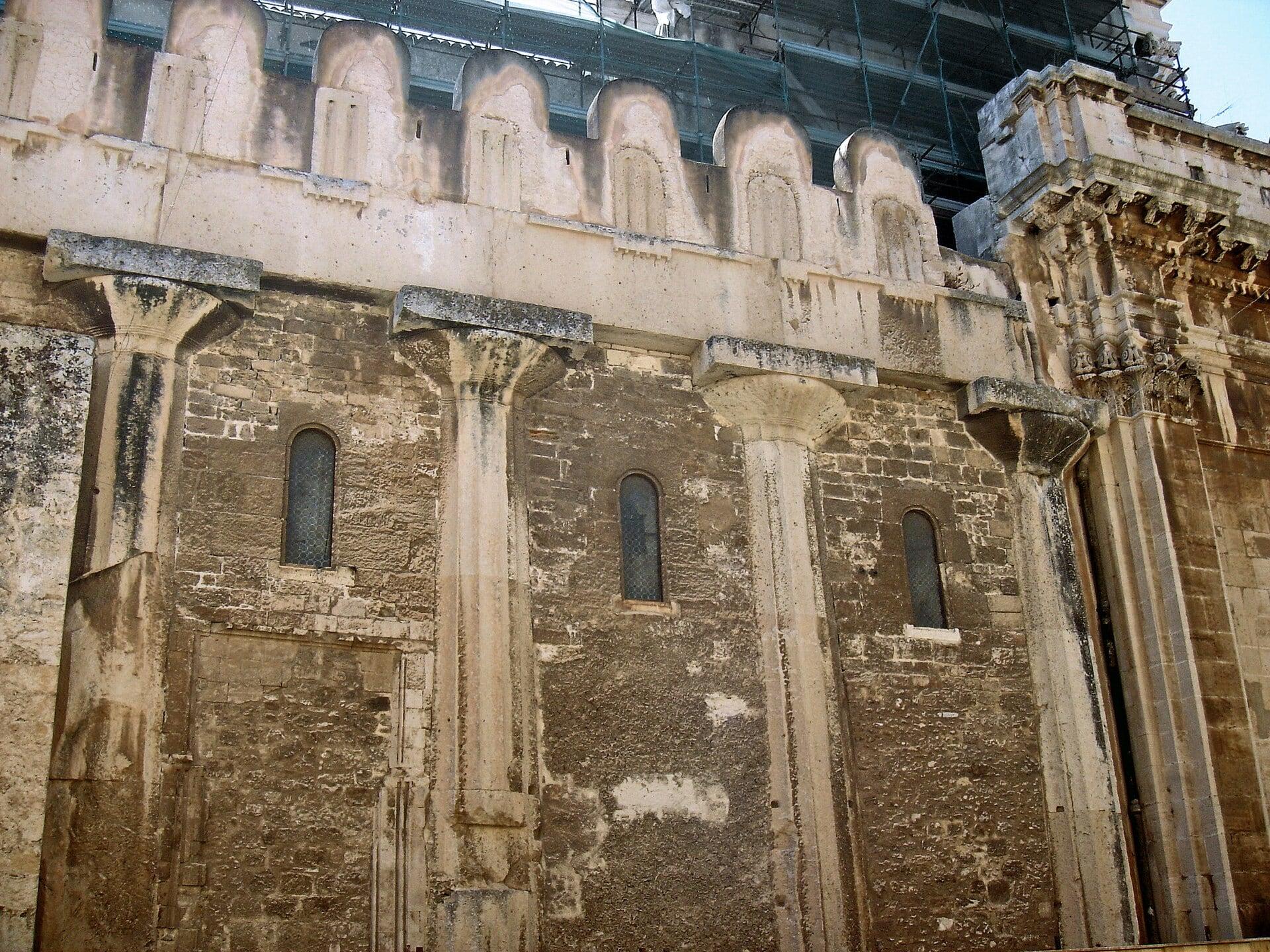
Now look up to the top of the bowl. The rows end short of the hilltop, and the line is ragged. The upper seats were built on fill rather than cut from bedrock, and in the sixteenth century, under the emperor Charles the Fifth, their blocks were taken down and carried off to fortify Ortigia, the island at the heart of old Syracuse. The stage building went the same way. Later still, mills fed by aqueduct water stood among the seats, from the sixteenth century until they were cleared by 1952.
So the shape you see has a simple rule. Where Hieron's builders cut into the hill, the theatre survives. Where they stacked stone on top, it left.
A theatre still in use
The bowl has its stage again every season. A festival of ancient drama began here on 16 April 1914 with Aeschylus's Agamemnon, and in spring and early summer a wooden seating structure normally covers the stone for the performances. Outside the season the bare rock is back, which is when the cutting is easiest to read.
The theatre is stop 6 of Neapolis Archaeological Park: A Theatre Cut from a Quarry Hill, a walk inside the ticketed park you can take at your own pace, skipping ahead to the theatre if you like. See all routes on the Syracuse page.
Sources
- Aretusapedia, Teatro greco di Siracusa: cavea about 138.6 metres across, 67 original rows, nine wedges, Hieron the Second's rebuilding after 238 BC and before 215 BC, the diazoma dedications including Heracles and the damaged Gelon, the upper rows and stage building removed under Charles the Fifth for Ortigia, the mills from 1576 cleared by 1952, the first festival performance of Agamemnon on 16 April 1914.
- Cicero, Against Verres 2.4, translated at attalus.org: Neapolis as the newest district of Syracuse with its great theatre on the highest point (section 119).
- Comune di Siracusa, Ara di Ierone: Hieron's altar in the same district and the sixteenth century reuse of Neapolis blocks for Ortigia's fortifications.
- Roamer's audited tour research (the city's monument guide, Mastelloni's work on the quarries): the eight stairways, the city's 238 to 215 BC dating, the four names the tour points to, the wedge-marking reading of the inscriptions, the earlier theatre known from Diodorus, the quarrying from the sixth century BC.
Ready to experience it?
Neapolis Archaeological Park: A Theatre Cut from a Quarry Hill
60 min · 0.9 km · easy
More from Syracuse
Explore more at your own pace.
Best Self-Guided Walking Tours in Syracuse (2026)
Neapolis Archaeological Park: How Syracuse Cut a City Out of a Quarry Hill
Ortigia: Reading the Island That Built on What Was Already There
Ear of Dionysius: The Syracuse Quarry Cave Whose Legend Has a Date
The Great Harbour of Syracuse: The Sea Battle an Army Watched From the Shore