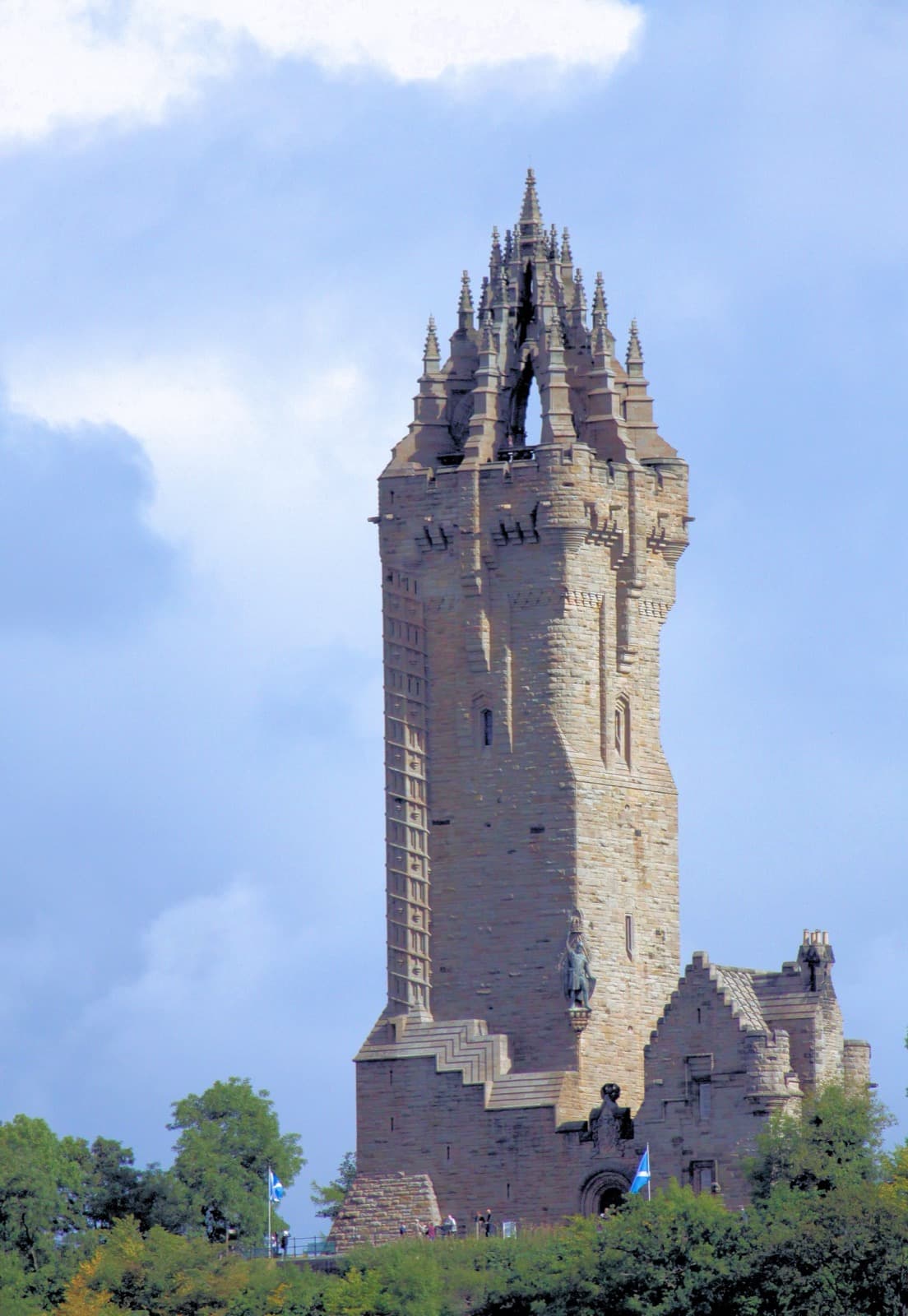
The National Wallace Monument on Abbey Craig is the clearest place in Stirling to watch how the Wars of Scottish Independence were actually won by geography, and how that record later hardened into legend. Climb the hill, look out over the River Forth toward the battlefields, and the whole shape of the war becomes legible: a war decided by rivers and crossings, told across a dispersed loop that reads Stirling Bridge and Bannockburn from the historical record rather than from the story the films tell. The tower is where the argument of the tour comes into focus, because it is both a monument to a thirteenth-century man and a monument to the nineteenth-century feeling that rediscovered him.
A tower that is half history, half myth-making
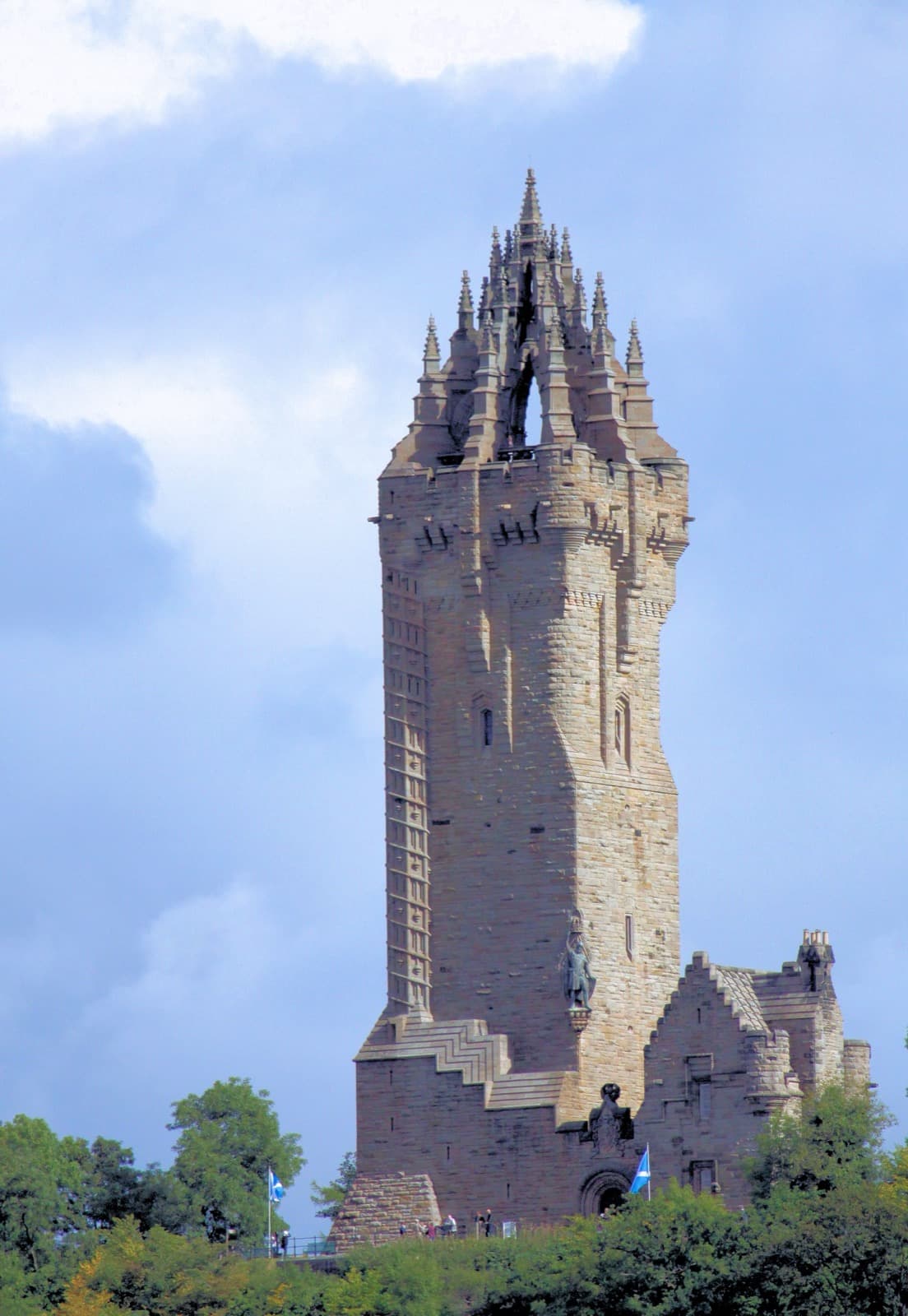
The monument rises sixty-seven metres above Abbey Craig. It is Victorian Gothic sandstone, designed by the architect John Thomas Rochead. Its foundation stone was laid in eighteen sixty-one, it opened in eighteen sixty-nine, and it cost about eighteen thousand pounds, raised largely by public subscription. That detail is worth pausing on. A tower paid for by ordinary people, penny by penny, is not just a memorial to William Wallace. It is a record of what the Victorian public wanted to believe about their own past, and about themselves.
By tradition, Wallace watched the English army from this craig before the battle of twelve ninety-seven. That is tradition, not documented fact, and the tour is careful to say so. The same honesty applies to the monument's most famous object. Inside, the so-called Wallace Sword is displayed, a great blade over one and a half metres long. Historians dispute that it ever belonged to Wallace. Doctor David Caldwell, a former president of the Society of Antiquaries of Scotland, said plainly that it had nothing to do with him. The sword's association with Wallace traces only to about eighteen oh three, and the blade itself appears to have been forged from more than one piece. The Victorians who built this tower wanted a relic, and a relic is what tradition gave them.
None of this drains the wonder from the real Wallace. It simply asks you to hold the symbol and the record apart, which is exactly the discipline the whole loop is built around. If you want to plan the wider route, the Stirling walking tours hub gathers the city's tours in one place.
The crossing the war was fought to hold
Hear a stop from this walk
The Battle of Bannockburn Centre: History Against the Legend
Below Abbey Craig, the loop begins at Stirling Old Bridge, and the first thing to understand there is that it is not the bridge of the battle. This stone crossing of four spans dates from about fifteen hundred and is a scheduled monument protected by Historic Environment Scotland. It replaced the earlier wooden bridges over the Forth, including the one on which the Battle of Stirling Bridge was fought. That wooden bridge lay roughly one hundred and eighty yards from where the stone one now stands.
For more than three hundred years, this was the lowest bridging point of the Forth. That single fact made it worth an army. On the eleventh of September, twelve ninety-seven, William Wallace and Andrew Moray held the Scottish side against an English army led by John de Warenne, the sixth Earl of Surrey, and Hugh de Cressingham, the treasurer. The English had to file across a narrow wooden bridge broad enough for only two horsemen abreast. The Scots waited. Once about half the English force had crossed, they attacked, trapping those men against a boggy loop of the river with no way back. It was the first major Scottish victory of the Wars of Independence. Cressingham was killed. Andrew Moray was mortally wounded and would die within weeks, which is easy to forget in a story that later belonged almost entirely to Wallace.
The quiet turn: an abbey and a buried king
Between the two battlefields sits the still point of the loop, Cambuskenneth Abbey, on a quiet loop of the Forth. King David the First founded it around eleven forty for Augustinian canons. Most of it is gone, dismantled after the Reformation, but one feature survives almost whole: a free-standing bell tower from the thirteenth century, a genuine rarity in Scotland, where such towers seldom stood apart from their church.
This quiet ruin also held a parliament. In thirteen twenty-six, nobles and clergy gathered here, swore an oath to King Robert the First, and confirmed the succession of his son, the future David the Second. There is a royal grave here too. Margaret of Denmark, queen of James the Third, died at Stirling Castle in fourteen eighty-six and was buried at the abbey. Her husband, King James the Third, was killed at the Battle of Sauchieburn in fourteen eighty-eight and brought here to lie beside her. Their tomb was restored in eighteen sixty-five with funding from Queen Victoria.
The field where Bruce broke an English army
South of the town lies Bannockburn, the climax of the loop. Over two days, on the twenty-third and twenty-fourth of June, thirteen fourteen, King Robert the First, whom we know as Robert the Bruce, defeated the much larger army of King Edward the Second of England. It was a decisive Scottish victory, part of a war that would end in thirteen twenty-eight with a treaty restoring Scotland's independence in law. One episode is well attested: on the first day, Bruce killed the English knight Henry de Bohun in single combat. Beyond that, casualty figures vary widely between sources and are genuinely contested.
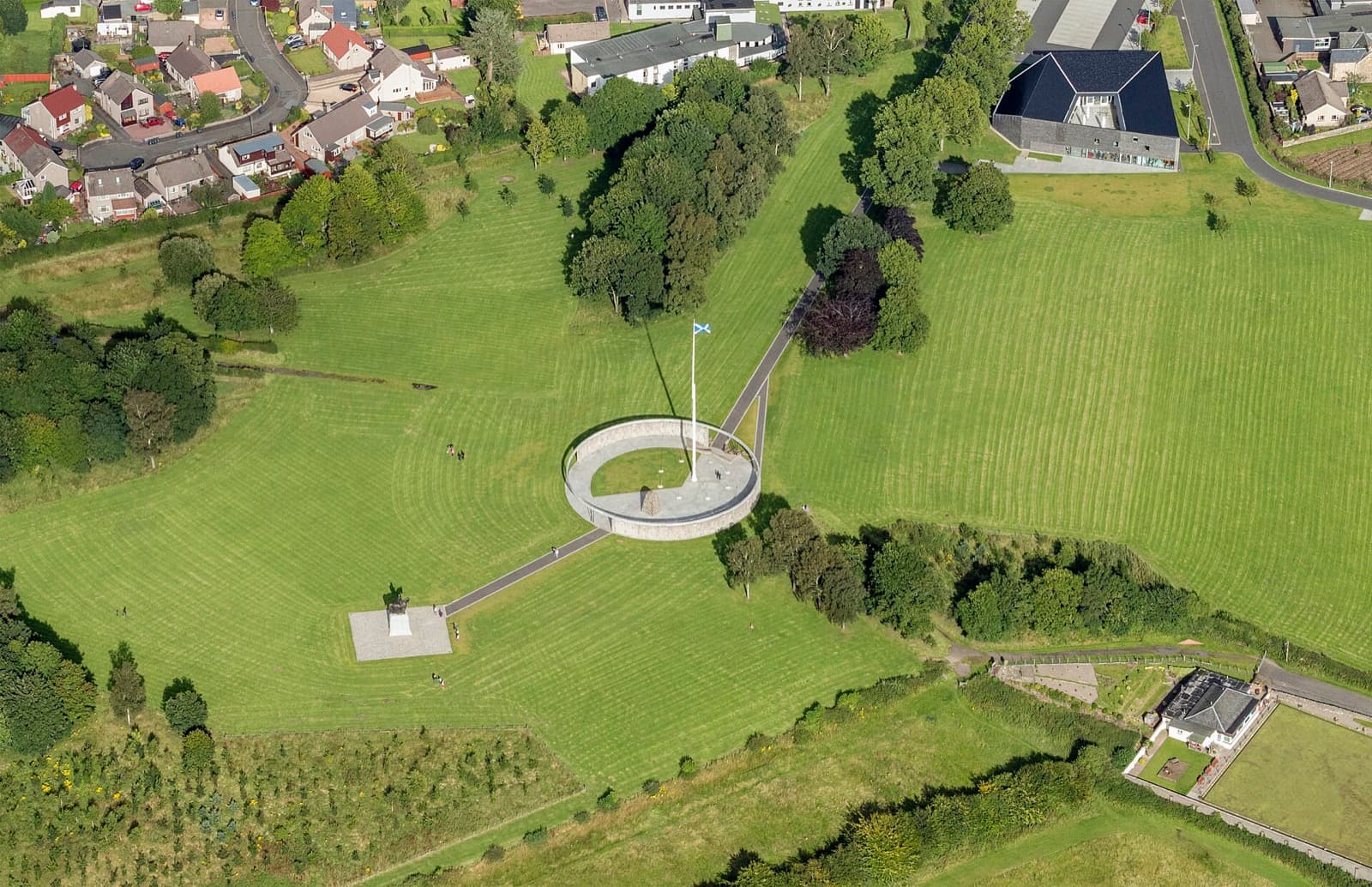
The monuments here are modern. The Rotunda, a circular concrete memorial, was raised in nineteen sixty-two. Beside it stands the bronze equestrian statue of Bruce by the sculptor Charles d'Orville Pilkington Jackson, unveiled in nineteen sixty-four for the six hundred and fiftieth anniversary. Its head was modelled on measurements taken from Bruce's own skull, found at Dunfermline Abbey in eighteen eighteen. The exact location and course of the battle remain genuinely uncertain, and the traditional Borestone site is only one candidate among several.
That uncertainty is why the loop closes at the National Trust for Scotland's Battle of Bannockburn visitor centre. The centre uses research and a digital recreation to present not only what is known but what is genuinely uncertain, and it sets the historical Bruce and Wallace apart from their popular film legend, above all the version in Braveheart. Access to the site, centre, shop and cafe is free; the timed indoor battle experience is a separate, pre-booked ticket, free for Trust members.
The reward of walking this ground yourself is that you leave knowing the difference between what happened here and the story the films tell. Start from the tower on Abbey Craig, then follow the Forth to the crossings and the field. You can see the full route and the rest of the city at Stirling.
Sources
- Wallace Monument, Wikipedia. Construction dates, architect, height, and cost of the Abbey Craig tower.
- "William Wallace sword 'did not belong to Wallace'," The Scotsman. Doctor David Caldwell's assessment of the disputed Wallace Sword.
- Stirling Old Bridge history, Historic Environment Scotland. Dating and scheduled-monument status of the surviving stone bridge.
- Cambuskenneth Abbey history, Historic Environment Scotland. Foundation, the parliament of thirteen twenty-six, and the royal tomb restored under Queen Victoria.
- Bannockburn commemorative monuments, National Trust for Scotland. The Rotunda, the Bruce equestrian statue, and the visitor centre's approach to the battle's uncertainty.
Ready to experience it?
Wallace & Bannockburn: The Wars of Independence
210 min · 12 km · easy
More from Stirling
Explore more at your own pace.
One Day in Stirling: A Walkable Castle-to-Battlefield Itinerary
Stirling Travel Guide: Days, Transport, Fees, and Safety
Stirling: The Rock That Held Scotland
Stirling Castle and the Walk Down a Royal Burgh
Bannockburn Battlefield and Monuments: The Field Where Bruce Broke an English Army