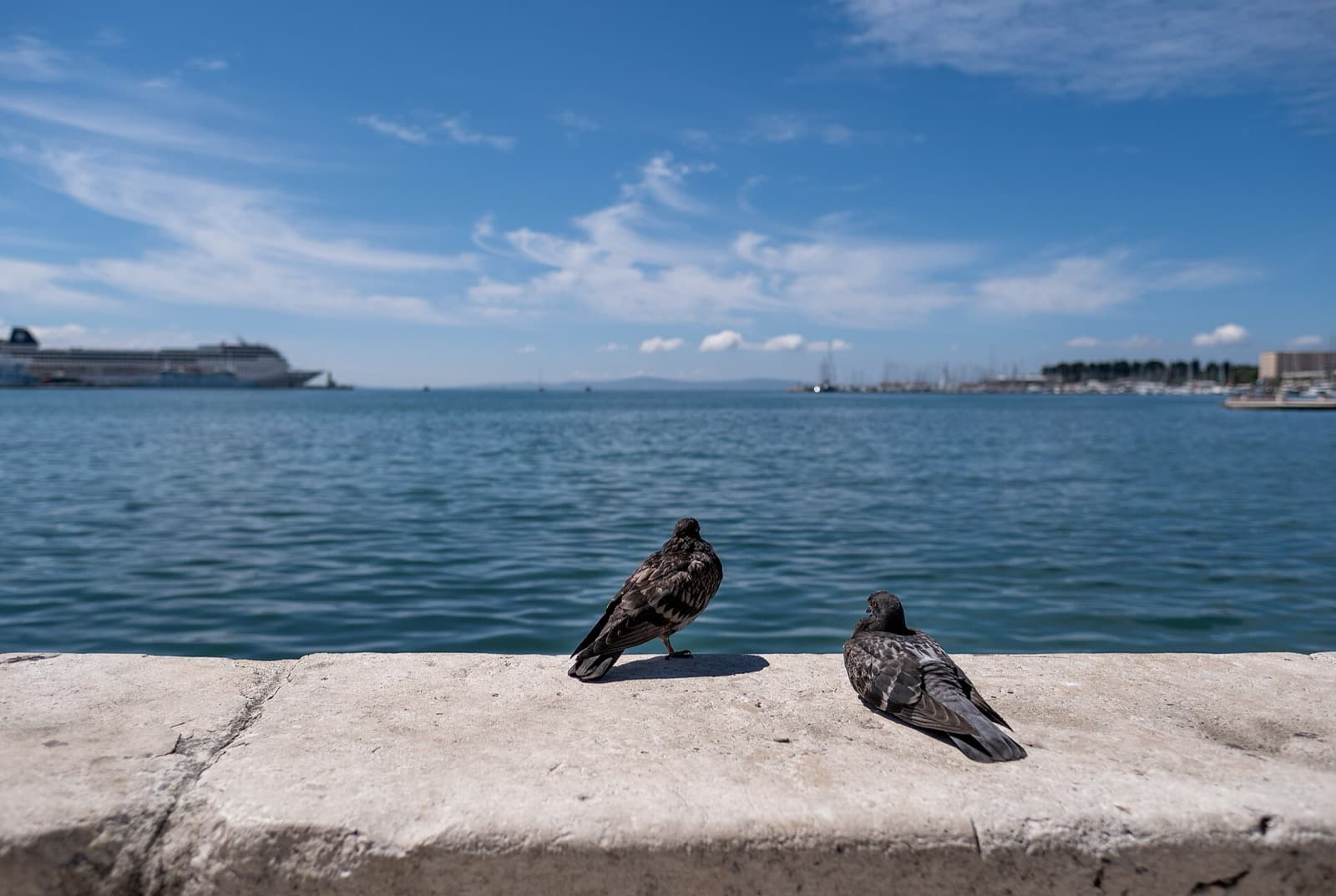
The Riva is not a monument you look at. It is a waterfront you join. Run your eye along the palm-lined marble promenade below Diocletian's Palace and you are looking at the social heart of Split, the place where, each evening, the whole city comes down to the water to walk. Understand that one thing, and you understand why a broad stone strip about two hundred and fifty metres long matters more to daily life in this Croatian city than almost anything behind it.
What you are actually standing on
Start with the geography, because it explains everything. The Riva runs along the southern, sea-facing wall of a Roman palace. That wall was once a true seawall. In the time of the emperor Diocletian, whose retirement palace this was, the water came right up to the southern facade, and boats could reach it directly. What you see now, the wide marble surface between that ancient wall and the harbor, is land the sea used to cover, pushed out and paved over the centuries. So on one side you have the back of an emperor's retirement home, roughly seventeen hundred years old, and on the other side the Adriatic. The Riva is the seam where those two things meet.
The word itself is plain. Riva simply means the shore, the waterfront. There is nothing grand in the name, and that fits. This is not the palace's ceremonial front. It is its working edge, the place where the sea business of the city happened, and where the life of the city still concentrates.
A promenade with a French accent
Hear a stop from this walk
The Southern Shore: Where Forest Meets the Sea
The Riva you walk today is much younger than the wall behind it. Its modern promenade form dates to the early nineteenth century, during French rule, in the years associated with Marshal Marmont, the French governor of these coastal provinces under the emperor Napoleon. That period, when Split sat inside the Napoleonic administration of the region, gave the waterfront its broad, deliberate, public shape. Before that, the shoreline had been a functional, crowded edge. The French turned it into something you could stroll.
It has been remodelled many times since, and the most recent redesign is worth knowing about because it shaped the surface under your feet right now. That project, completed in 2007 by the Croatian architecture studio 3LHD, rebuilt the promenade as a single integrated public space. The designers used a modular grid of concrete elements to organize everything, benches, lighting, planting, shade, echoing the ordered logic of the Roman palace beside it. The redesign was not universally loved when it opened, as changes to a beloved public space rarely are, but it did what it set out to do: it made the Riva work as one continuous room rather than a strip of leftover pavement.
That word, room, is not accidental.
The city's living room
People in Split call the Riva the city's living room, and once you have seen it at the right hour, the nickname stops sounding like a slogan. In the early evening the whole town comes down to walk it, slowly, over coffee, greeting one another, watching the light go soft on the water. Nobody is here to visit a specific attraction. They are here to be here. Children run between the palm trunks. Old friends claim the same café tables they have claimed for years. The pace is unhurried and social, and it belongs to residents as much as to visitors.
This is the honest reason to give the Riva your time. It is not that the marble is beautiful, though it is, or that the palace wall is old, though it is very old. It is that you are standing in the one place where the ordinary daily life of Split gathers itself into a single view. Most cities hide that life in living rooms and courtyards you never see. Split does its evening out loud, on the shore, in front of the sea.
How to stand here
Come in the late afternoon and let the light do the work. The Riva faces south over open water, so the sun stays with it late, and the marble picks up a warm glow as the day cools. Grab a coffee, find a spot along the edge, and simply watch for a while. Do not treat it as a checkpoint to photograph and leave. The whole point of the place is that it rewards lingering.
Practically, a few things help. There is very little shade along the promenade itself, so a hat and water matter in summer. The polished stone can be slippery, especially near the water, so watch your footing if it has rained. And remember that everything inland from here goes uphill. The Riva sits at sea level, at the known, bright, social front of the city, before the ground rises into the old fishermen's quarter and the green hill beyond.
That is the quiet argument the Riva makes. It is the edge you begin from. Once you have stood in it long enough to feel the rhythm of a Split evening, the natural instinct is to turn around and climb, away from the marble and the crowd, into the older and greener layers of the city that most visitors never reach.
Walk it, then leave it behind
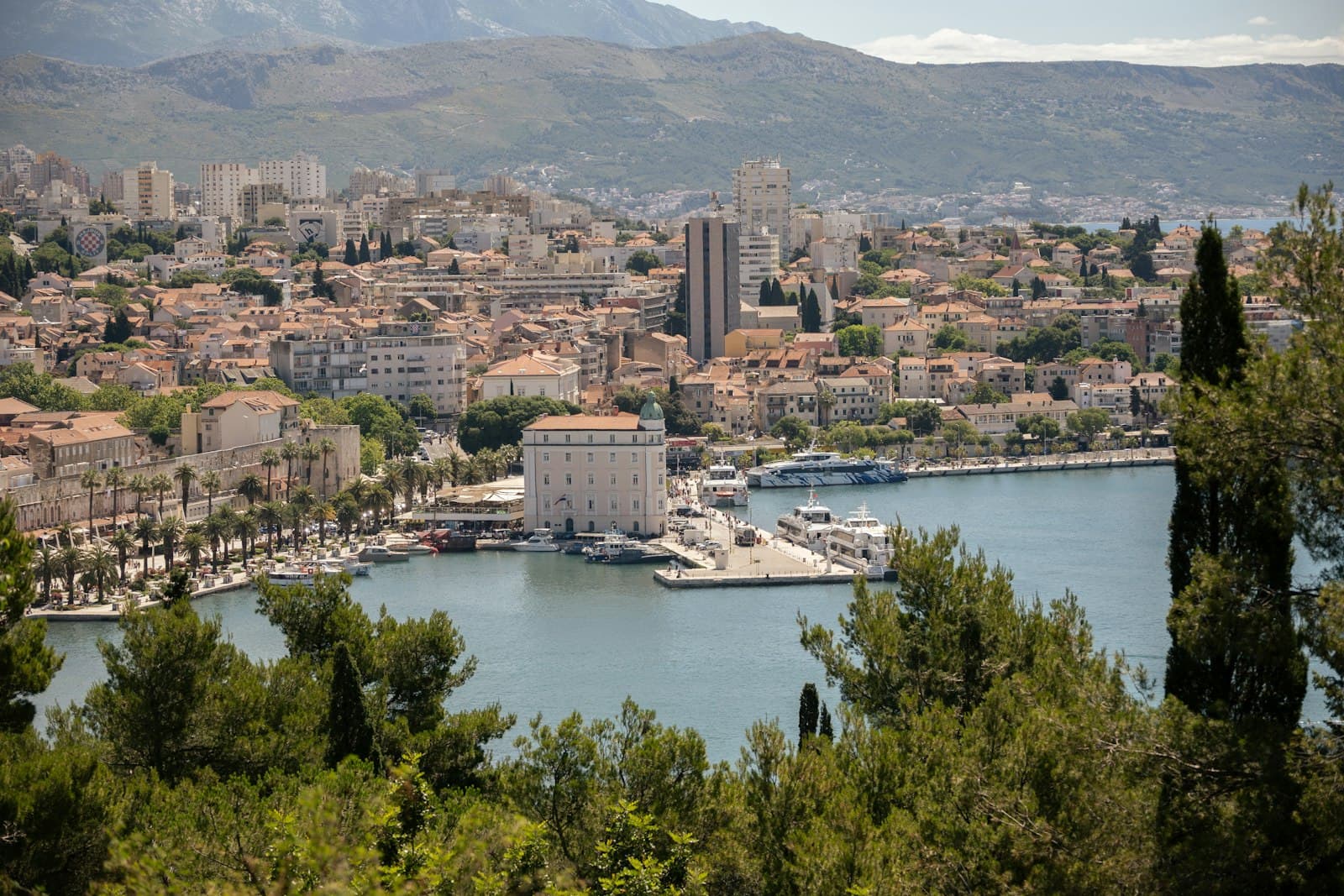
The Riva is the opening stop on our self-guided Split walking tours route through Varos and Marjan, a climbing walk that begins here at the water and rises through the fishermen's stone lanes to the forested summit of the hill the city calls its lungs. Standing on the promenade is the reason the rest of the walk works: you feel the bright, busy front of Split first, at sea level, so that when the town falls away above you into pine and quiet, you know exactly what you have left behind. The audio guide picks up right where you are standing, then carries you up the slope at your own pace, stop by skippable stop.
For the full route, the map, and the other stops that build on this one, see our guide to Split. Begin at the Riva. Let the evening gather. Then turn toward the hill.
Sources
- The Riva, Split Tourist Board (visitsplit.com): official description of the waterfront's palm-lined form, its shaping under French rule and Marshal Marmont, and its role as the city's living room and gathering place.
- Riva Split Waterfront, 3LHD (3lhd.com): architectural record of the 2005 to 2007 redesign, its modular concrete grid, and its relationship to Diocletian's Palace.
- Marjan, Split, Wikipedia: context on the hill above the waterfront and the wider geography the Riva route climbs into.
- Antonio Bajamonti, Wikipedia: background on nineteenth-century civic building in Split during the era that shaped the modern waterfront.
Ready to experience it?
Varos and Marjan Hill: The Fishermen's Hill
150 min · 6.4 km · challenging
More from Split
Explore more at your own pace.
One Day in Split: A Walkable Morning-to-Evening Itinerary
Split: The City That Moved Into an Emperor's Palace
Marjan Summit: Why Split's Green Hill Is the Walk That Turns Its Back on the Palace
The Cathedral of Saint Domnius: How a Persecutor's Tomb Became His Victim's Church
The Peristyle in Split: The Roman Court Where an Emperor Played God