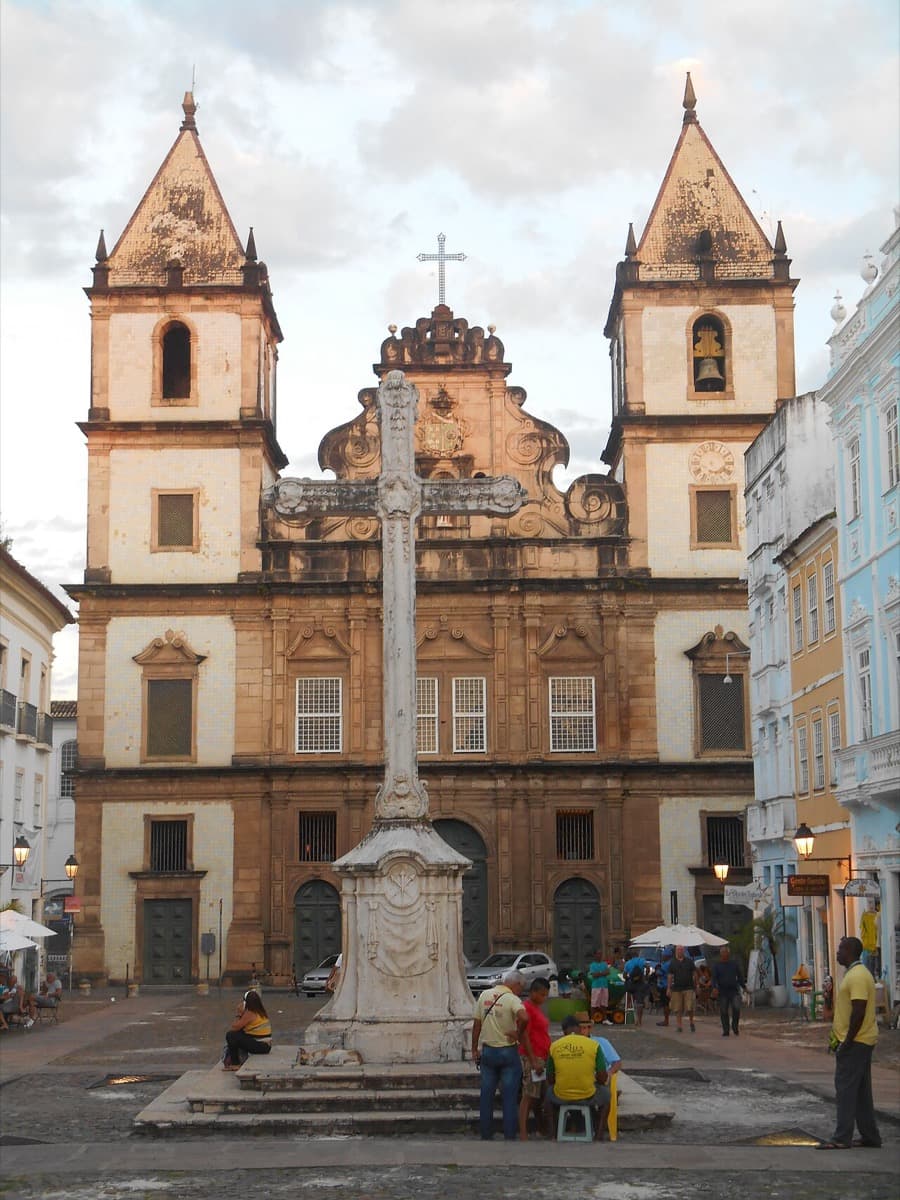
The Church and Convent of São Francisco in Salvador solves an engineering problem in two materials. Inside the church, nearly every surface is carved wood sheathed in gold leaf. Across the wider complex, roughly 55,000 imported Portuguese tiles cover the walls, the largest number in any church in Latin America. Both systems were carved, fitted, and assembled in large part by enslaved and freed Afro-Brazilian hands that this gold never enriched. Understanding how the building was made, and by whom, is more revealing than any single measurement of its wealth.
Two buildings, two schedules
São Francisco is not one structure but two joined efforts on different timelines. The current convent was begun in 1686. The church itself was built between 1708 and 1723, and its interior decoration continued for decades after the shell was closed, most of it finished by around 1755. That gap between construction and decoration matters. A masonry church can be raised in fifteen years. Filling it with gilded woodwork was a separate, slower campaign that outlasted the men who laid the walls.
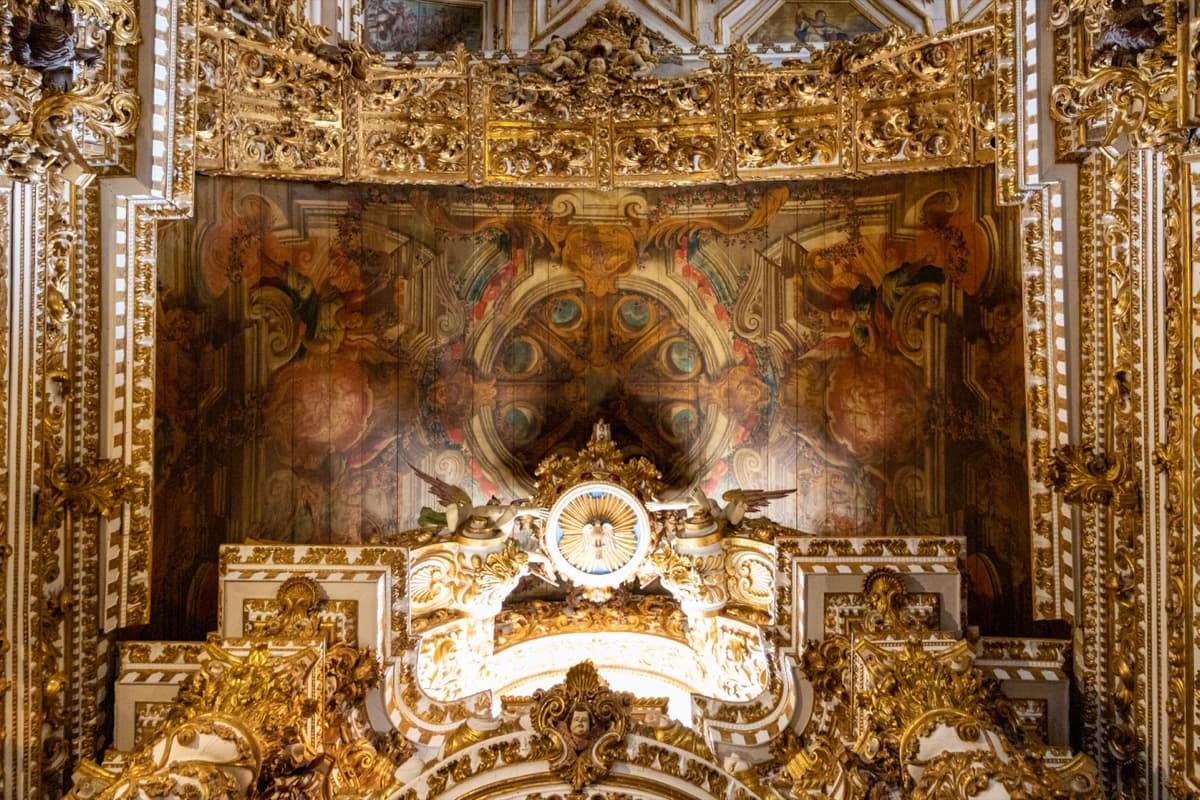
The interior technique is called talha dourada, gilded carving. The sequence is exacting: cedar and other tropical woods are carved into altarpieces, arches, and ceiling frames, then coated with a smooth base, then covered in gold leaf beaten so thin it is measured in fractions of a millimeter. You will hear a figure of about 850 kilograms of gold quoted for the whole interior. Treat it as a commonly repeated number rather than a proven one. The gilding was applied leaf by leaf over years, so no single weight was ever poured in place. The honest measurement is not the mass of the gold but the density of the coverage: there is almost no bare surface left to see.
The largest tile collection in Latin America
Hear a stop from this walk
Igreja e Convento de Sao Francisco: The Golden Climax
The second material system is ceramic. Across the church and convent there are around 55,000 azulejos, the blue-and-white Portuguese tiles, and that is the most of any church in Latin America. Roughly 35,000 of them line the cloister alone. They were manufactured in Portugal, arrived in Bahia between 1743 and 1746, and were fully installed by 1748. That means a shipment of tens of thousands of fired ceramic squares crossed the Atlantic, arrived intact enough to use, and was set in coordinated panels on the far side of the ocean.
The cloister tiles are not decoration for its own sake. Thirty-seven panels illustrate moral allegories drawn from the Roman poet Horace, adapted from an emblem book of engravings that circulated widely in Europe. A visitor walking the cloister is reading a printed philosophy book rendered at architectural scale, one panel at a time, in a language of ships, figures, and Latin mottoes. The painter José Joaquim da Rocha, a founder of the Bahian school of painting, later painted the entrance-hall ceiling in 1774. His work also appears in the lower city, on the ceiling of the Basilica of Nossa Senhora da Conceição da Praia beside the port, so a single hand connects the top of the hill to the water.
Who built it
The paradox is loudest here, and it is a question of labor, not just style. This is among the richest gilded interiors in all the Americas. The carving of the wood, the beating and laying of the gold leaf, the setting of tens of thousands of tiles, and the quarrying and hauling of stone were done in large part by enslaved and freed Afro-Brazilian people who were never enriched by the result. The archives that carefully recorded the cost of the gold and the names of some commissioning patrons kept far less about the workers whose hands did the assembly.
That pattern repeats one stop uphill. The Third Order church next door hides an equally telling story about how heritage survives. But São Francisco is where the accounting is starkest. Admire the brilliance, then ask, in the middle of all this light, who held the brush that laid the leaf and who fitted the tiles panel by panel. The building will not answer, and that silence is part of what it documents.
A structure under continuous care
Heritage on this scale is fragile. On February 5, 2025, a partial roof collapse at the church killed one person and injured several others, a reminder that a 300-year-old timber and masonry structure is a live conservation problem, not a finished object. Heritage reports afterward noted that the buildings had faced deterioration and termite damage for years. Brazil's national heritage institute, IPHAN, listed the church and convent in 1938, and the complex forms part of the UNESCO Historic Center of Salvador, inscribed in 1985. Continual restoration is the condition of its existence. The gold and tiles you see have been cleaned, re-secured, and repaired across generations, and that maintenance is itself a kind of engineering, invisible until something fails.
Seeing it in person
São Francisco sits on the Largo do Cruzeiro in the upper city, a short, steep walk from the Terreiro de Jesus and the cathedral. On our self-guided walking tour of Salvador's historic center, it is the golden climax of a descent that starts at the highest church and ends at the port on the Bay of All Saints, the same water through which the sugar, the gold, and the enslaved all passed. Give this stop more unhurried time than any other. Stand in the nave first, then walk the cloister slowly enough to read the tile panels. A modest entry fee covers the church, convent, and cloister, and flash photography is often forbidden near the gilded and painted surfaces, so look for posted signs.
If you want the fuller arc, the walk that includes São Francisco links six churches and the market at the water, tracing how the wealth accumulated uphill and where its human cost landed. You can find it and the rest of the city on our Salvador guide.
Sources
- Church and Convent of São Francisco, Salvador, Wikipedia. Construction dates, talha dourada, the 55,000 azulejo figure and 35,000 in the cloister, the tile arrival between 1743 and 1746 with installation completed in 1748, the 37 Horace panels, José Joaquim da Rocha's 1774 ceiling, the February 2025 roof collapse, and the 1938 IPHAN listing.
- IPHAN (Instituto do Patrimônio Histórico e Artístico Nacional). Heritage listing of the church and convent and restoration reporting on the cloister tiles.
- José Joaquim da Rocha, Wikipedia and Itaú Cultural encyclopedia. His role as founder of the Bahian school of painting and his ceiling for the Basilica of Nossa Senhora da Conceição da Praia.
- UNESCO World Heritage Centre, Historic Center of Salvador de Bahia. Inscription context for the 1985 World Heritage designation.
Brazil eSIM· 10% off with ROAMER10
Ready to experience it?
Pelourinho: Gold, Sugar, and the Gilded Baroque
90 min · 2.9 km · moderate
More from Salvador
Explore more at your own pace.
One Day in Salvador: A Walkable Old-City and Bay Itinerary (2026)
Salvador Travel Guide: How Many Days, Getting Around, When to Go, Is It Safe (2026)
Salvador: Brazil's First Capital and Its African Soul
What to Eat in Salvador: A Bahian Food Guide (2026)
Elevador Lacerda: The Public Elevator That Joins Salvador's Two Cities