The Aluminium Virgin of El Panecillo
The hill the Spanish called El Panecillo, the little bread loaf, rises directly south of Quito's colonial centre and has been a sacred site for far longer than the city has existed. The Inca who occupied the valley before the Spanish conquest called it Yavirac, and they had a temple of the sun on its summit. The Spanish destroyed the temple in the 1530s, used the stone to build the colonial city below, and left the hill bare for the next four hundred years. By the 1970s, the colonial centre had its UNESCO inscription on the way and the Panecillo was a worn, scrubby hilltop with a pedestrian crucifix on top, looked at from the streets below but rarely climbed.
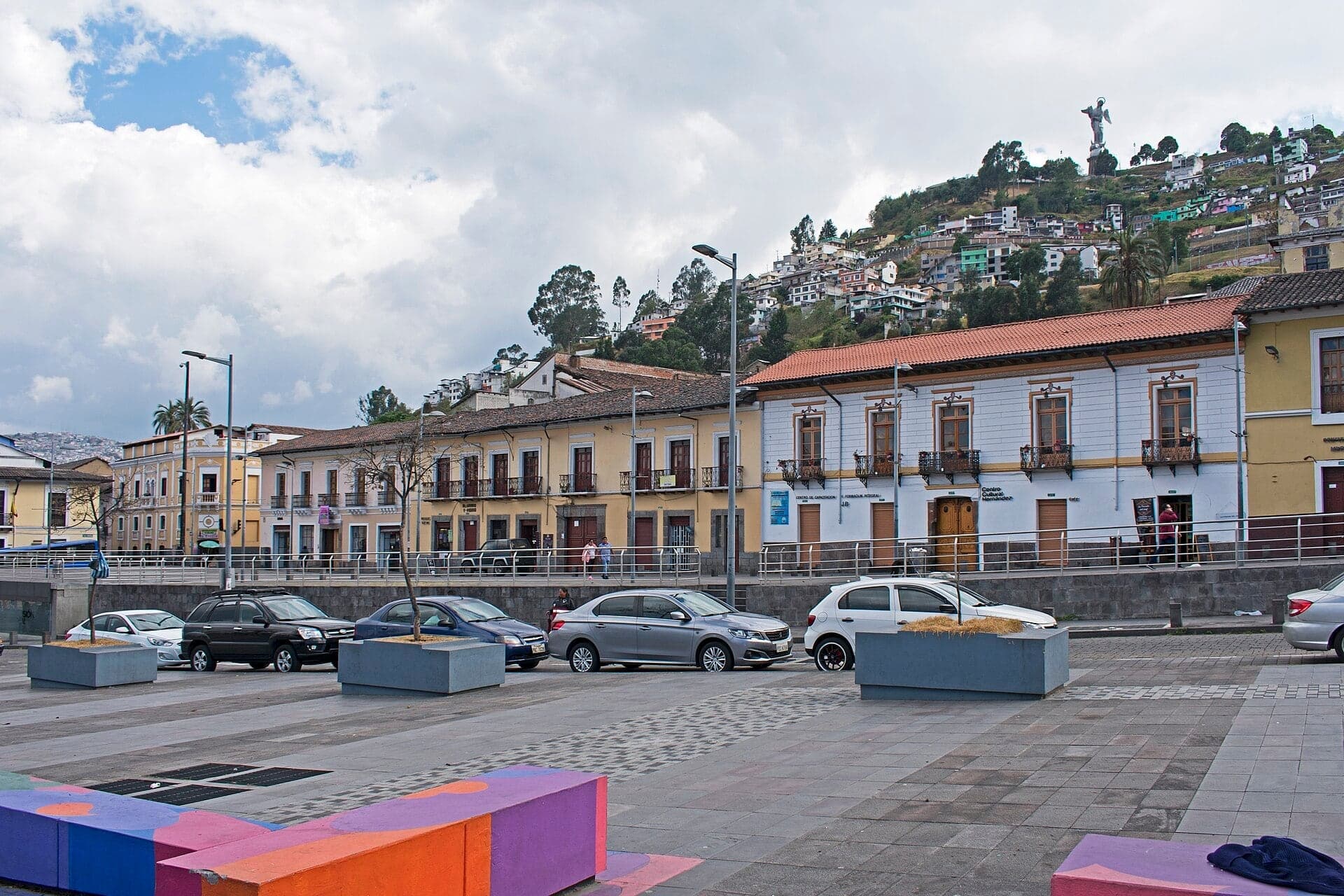
The Virgin who now stands there was finished in 1976. She is 41 metres tall on a 4 metre pedestal, which puts the crown of her head 45 metres above the summit and roughly 220 metres above Plaza Grande. She is made of about seven thousand cast aluminium pieces, bolted together over a steel skeleton. By scale, she is the largest aluminium sculpture in the world, and almost certainly the only monumental statue of the Virgin Mary cast in that material. The choice of aluminium is the first of three unusual decisions worth slowing down on.
Why aluminium
The sculptor was Agustín de la Herrán Matorras, a Spaniard born in 1916 and trained in Madrid. His original commission in the early 1970s was for a monumental Virgin that could be assembled cheaply, transported in pieces up a steep dirt road, and resist the wind and rain at the top of a Quito hill at 3,000 metres. Bronze, the traditional material for outdoor monumental sculpture, was too heavy and too expensive. Stone, the second choice, would have required millions of cubic metres of foundation work and would not have survived the seismicity. Cast aluminium, lighter by a factor of three than bronze and produced in moulds that could be hauled up the hill in pieces, solved every engineering constraint at once. The statue is, in that sense, a postwar industrial object dressed as a piece of devotional iconography. The pieces were cast in Madrid, shipped to Guayaquil in containers, trucked to Quito, and assembled on the hill by a team that included both Spanish foundrymen and local construction workers. The work took most of 1975 and was finished in March 1976.
Why she has wings
She is also unusual in her pose, and this is the second decision worth dwelling on. The Virgin of the Panecillo is a copy, at architectural scale, of a small wood-and-polychrome statue carved in 1734 by the Quito School sculptor Bernardo de Legarda. The original is about thirty centimetres tall and sits in a side chapel of the church of San Francisco, four blocks west of the Cathedral. Legarda's Virgin is unusual within Quito School iconography because she has wings, a feathered set of wings springing from her shoulders, and she stands on a globe with a serpent under her foot. The composition fuses two distinct Marian iconographies: the Virgin of the Immaculate Conception, who traditionally stands on a globe with a serpent, and the Woman of the Apocalypse from chapter twelve of the Book of Revelation, who has wings. Theologians have argued for three centuries whether Legarda intentionally combined the two; the consensus is that he did, and that the wings are the painter's most original contribution to colonial Marian art in the Americas.
What stands on the Panecillo, then, is a scale-up of an eighteenth-century carved Virgin with wings, transposed into mid-twentieth-century industrial aluminium. The original is small enough to sit inside a church. The copy is forty-one metres tall and dominates the skyline. The decision to use Legarda's Virgin specifically, rather than commissioning a new design, was made by the local cardinal who oversaw the project. He wanted the city's most beloved colonial sculpture, scaled to be seen from the centre's streets.
Why this side of the city
The third decision is geographic. Catholic monumental sculpture in colonial Spanish America almost always stands on a hill north or east of the city it watches over. The compass directions matter symbolically: east is the rising sun, north is the direction of the conqueror's homeland in the Andean cosmology adopted from indigenous traditions. The Panecillo is south. Why?
Two reasons. The Yavirac sun temple had stood on the hill before the Spanish arrived, which made the site already sacred in a way the conquest did not erase but only relabelled. And the city expanded historically to the north along the valley, which meant the Panecillo, originally on the colonial city's southern edge, became, by the time of the sculpture's commission in the 1970s, the only undeveloped high ground close enough to the historic centre to be visible from every plaza. The southern position is, in that sense, an accident of how the city grew, but the indigenous precedent of the site made the southern position symbolically loaded in a way the cardinal could justify.
What she looks out over
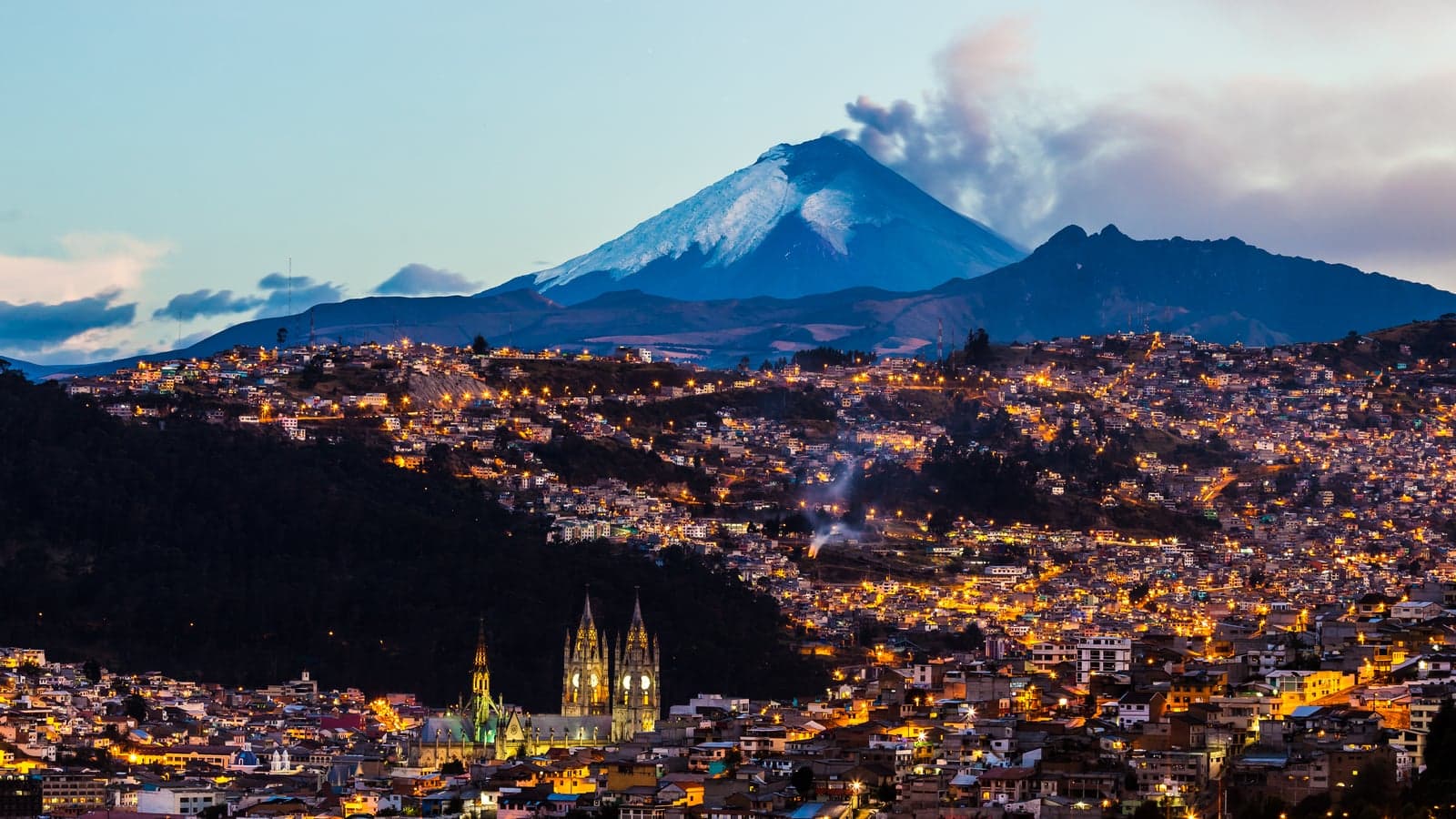
From the platform around the base of the Virgin, the viewer sees most of the answer to the question Quito's historic centre tour asks. The colonial city lies directly below, its grid of red tile roofs unbroken by any tall modern building, ending at the line where the modern city begins to climb the slopes of Pichincha to the north. To the east, the Machángara river gorge cuts a deep line through the valley. To the south, the modern city continues for another ten kilometres in a long ribbon of mid-rise apartments and industrial yards. From a single platform, the geographic constraint that preserved the colonial centre is visible in plan.
The Virgin has stood there for fifty years now. She has been re-painted twice, re-bolted once, illuminated since 1985, and visited, in roughly equal measure, by Catholic pilgrims, schoolchildren on field trips, and tourists with cameras. She is an aluminium copy of a colonial wood carving on the site of a pre-Columbian sun temple, paid for by a postwar Catholic hierarchy in a country that had just become an oil producer. She is the most concentrated symbol of Quito's layered history, hidden in plain sight forty-one metres above the city.
Explore Quito with Roamer
Take these audio tours to experience the stories mentioned in this guide