Quito lived for centuries inside its colonial old town. In the twentieth century it walked out. Families with money crossed El Ejido, the colonial city's old common land, and built a garden suburb of villas, castles and domed houses to the north. The middle of the century added the modern buildings of the Casa de la Cultura, and from the 1970s oil money brought the towers that replaced many of the villas. One suburb further on, La Floresta, kept its scale.
The La Mariscal and La Floresta: Quito Walks Out of Its Old Town walk follows that move in one line: ten stops and about 3.5 kilometres, roughly an hour and three quarters, from the Casa de la Cultura to the Plaza de la Floresta. Its one habit is worth borrowing: count the floors. They tell you which Quito you are looking at.
A house of culture after a lost war
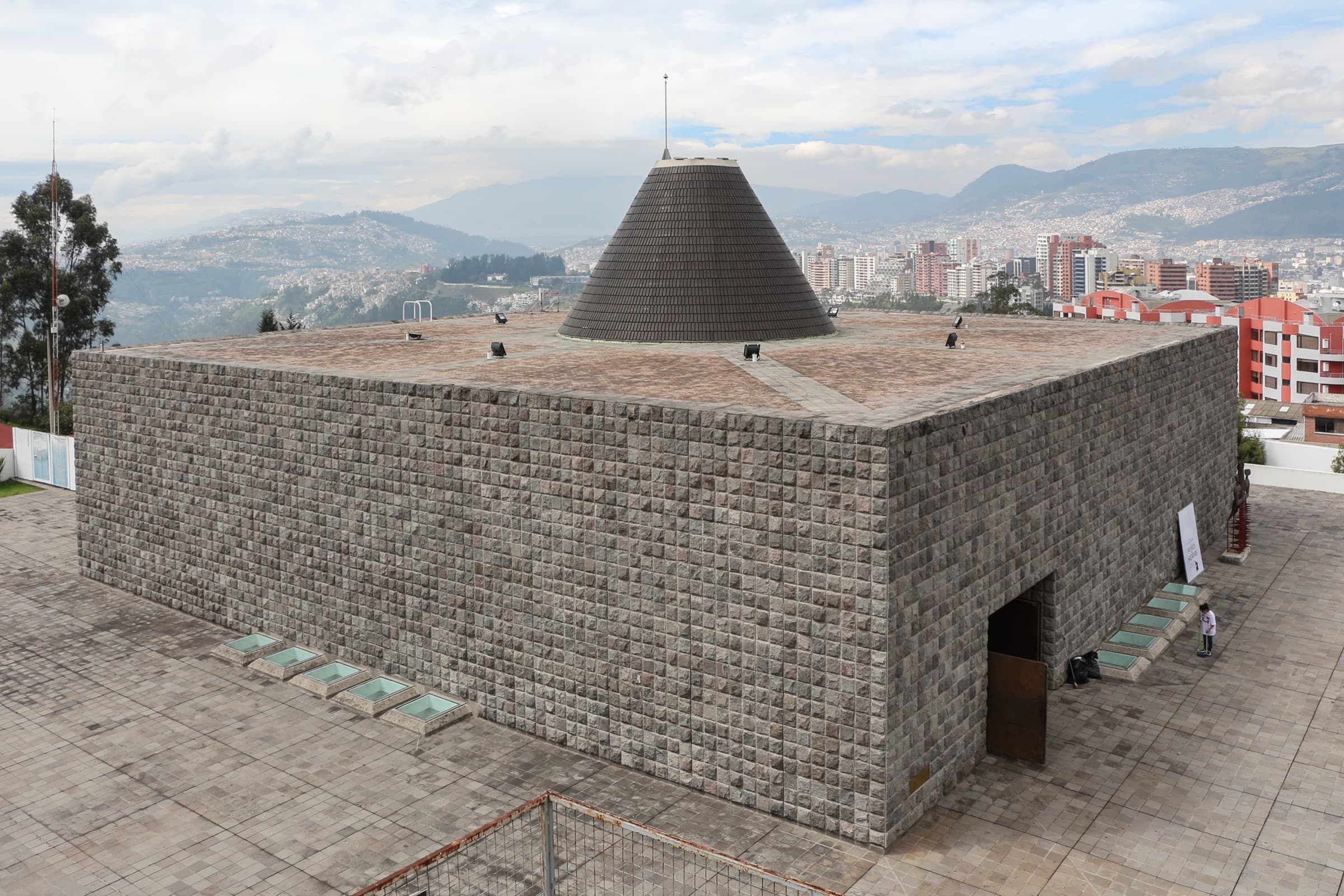
The walk starts at the Casa de la Cultura Ecuatoriana. Ecuador created it by decree on 9 August 1944, three years after its war with Peru, out of the writer Benjamín Carrión's idea that a small nation could be great in culture. The low first building, by Alfonso Calderón Moreno, went up in 1945 and 1946; the great main block behind it was designed from 1956 and built from 1975 to 1980. The national museum is still housed in the complex; a new building opposite Parque La Carolina is due to open at the end of 2028.
Across the road, the park of El Ejido is what survived of the colonial common land. It was laid out in 1922 for the centenary of the Battle of Pichincha, and painters show their work along it at weekends. The carved stone arch at the head of Avenida Amazonas was the garden gate of a private palace, La Circasiana, about a kilometre north, which the family later gave to the city.
The garden suburb
Hear a stop from this walk
Plaza de la Floresta: The Suburb That Kept Its Scale
La Mariscal was laid out from the 1920s, and was named Ciudadela Mariscal Sucre in 1924, after the general who won at Pichincha. Its craft market began on the pavements of Amazonas; in 2000 the city gave the traders their own site, and many of them come from Otavalo, whose own market town has a walk of its own, Plaza de los Ponchos: The Market That Keeps Moving.
On Calle Roca the builder Rubén Vinci put up a block of houses in the 1930s, and across the street La Coupole wears blue domes and minarets: the suburb at its most fanciful. Plaza Foch shows what happened next. From the 1980s many of the villas around it were rented out and became bars, hostels and agencies, and in February 2026 the city confined new bars to this zone. On Calle Juan Rodríguez the engineer Luis Egüez drew a street of matching houses for members of the state pension fund, the middle-class side of the suburb, under plane trees.
The hinge of the walk is the Castillo Larrea, a castle Vinci built from 1937 to 1939, now standing at the foot of a modern tower raised on its garden after a sale in 2013. Just before it, the walk passes the house the architect Karl Kohn, who left Prague for Quito in 1939, built for himself in straight lines. Both are private and seen from the street.
The suburb that kept its scale
Across Avenida 12 de Octubre, La Floresta was designed from 1917 on a former hacienda and filled in through the 1940s. Its streets are named after places in Spain. The independent cinema Ocho y Medio, named after Fellini's film, opened on the corner of Valladolid and Vizcaya in September 2001. Parque Vizcaya began as a design drawn up with the neighbours and shown at the UN's Habitat III conference in 2016, for the part of the city with the least green space per person. The walk ends at the round green of the Plaza de la Floresta. In 2021 the state declared 141 of the neighbourhood's properties national heritage.
Guayasamín, by taxi
The painter Oswaldo Guayasamín's foundation and the Capilla del Hombre are uphill from La Floresta, too far to walk on this route. Take a taxi from the end of the walk, and check hours and prices on their own site before you go. The Guayasamín Foundation piece has more on the painter.
Read the walk as a whole and it is one sentence: Quito left its old town for a garden suburb, the towers caught up with the garden suburb, and La Floresta, one avenue further, held on.
Ready to experience it?
La Mariscal and La Floresta: Quito Walks Out of Its Old Town
105 min · 3.5 km · easy
More from Quito
Explore more at your own pace.
Best Self-Guided Walking Tours in Quito (2026)
How Quito's Old Town Kept Its Shape: A Grid Laid on a Mountain
One Day in Quito: A Walkable Old-Town Itinerary (2026)
Quito Travel Guide: Altitude, How Many Days, Getting Around, Safety (2026)
What to Eat in Quito: An Ecuadorian Highland Food Guide (2026)