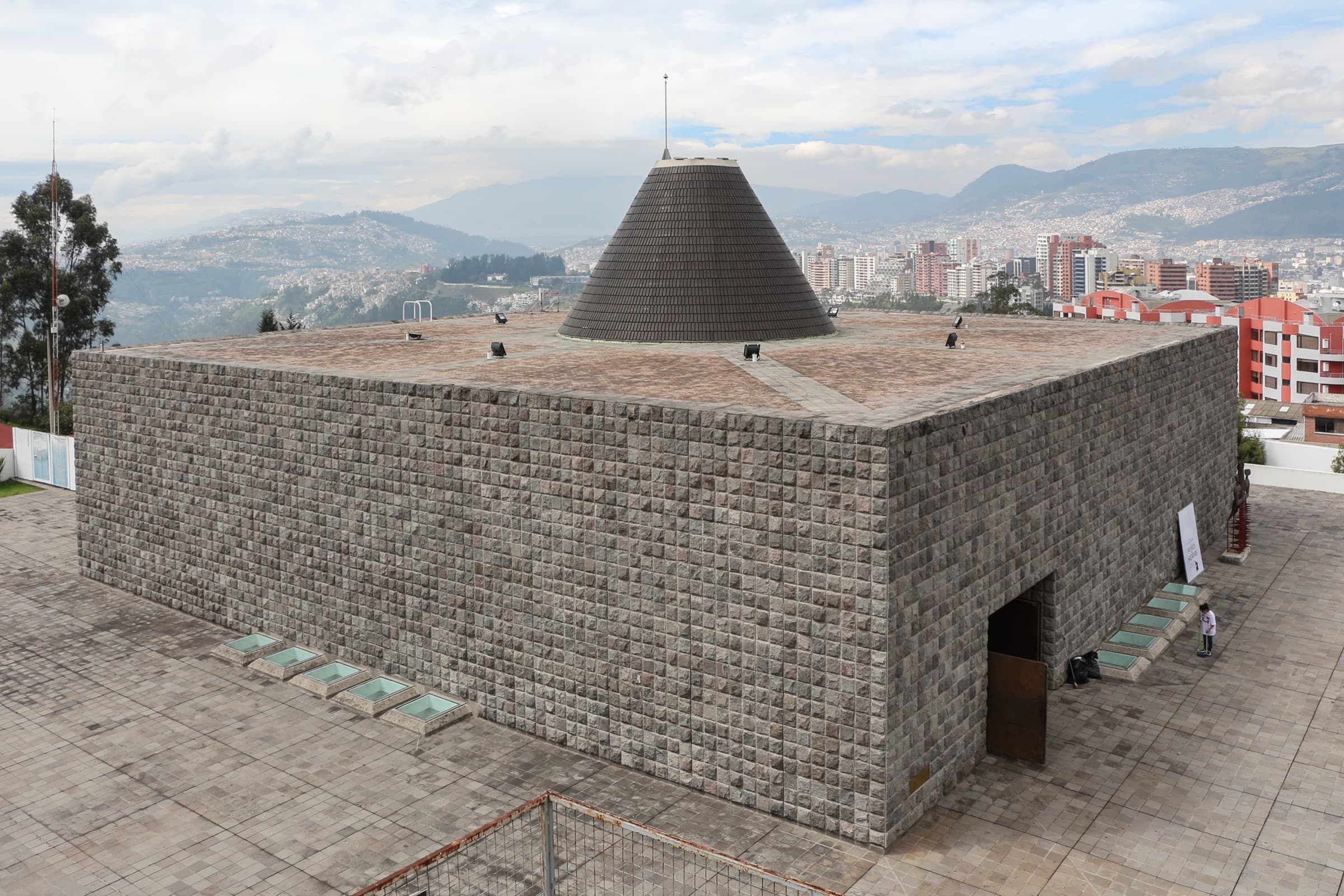
The neighbourhood is called Bellavista, and the road climbs steeply for about a kilometre out of La Floresta before it levels off at a long terrace cut into the slope. From the terrace, on a clear morning, you can see the entire valley of Quito laid out below: the colonial centre to the south, the modern city stretching north along the contour, the Pichincha massif behind. The view is the point. Oswaldo Guayasamín bought this land in the 1970s, designed two buildings for it, and spent the last twenty-five years of his life turning the site into a permanent home for his work and a memorial to the twentieth-century history he had spent his life painting.
Guayasamín was born in Quito in 1919. His early biography is the standard outline of a twentieth-century Latin American artist: enrolled at the School of Fine Arts in Quito at fourteen, expelled briefly for political activity, awarded his first prize in 1942, travelled through Mexico in 1943 where he met Diego Rivera and José Clemente Orozco, returned to Ecuador and began the cycle of paintings that would occupy him for the next fifty years. By 1955 he had been awarded the Grand Prize at the São Paulo Biennale. By the 1970s he was the most exhibited Latin American painter of his generation. He died in March 1999, having made about ten thousand paintings, drawings, and prints, almost all on a small set of recurring themes.
The work, in one sentence
The simplest description of Guayasamín's painting is that he spent his life rendering the indigenous and mestizo face of Latin America as a single, recurring expression of suffering, defiance, and grief, drawn in an angular figurative language that owed something to Picasso, something to the Mexican muralists, and something to colonial Quito School polychrome. He worked in three large cycles. The first, painted between 1946 and 1952, was called Huacayñán, the trail of tears, and traced the indigenous experience of the continent. The second, painted between roughly 1961 and 1990, was La Edad de la Ira, the age of anger, and responded to the wars, dictatorships, and political violence of the twentieth century. The third, which he was still working on when he died, was La Edad de la Ternura, the age of tenderness, and turned toward mothers and children. The work is not subtle. It is not meant to be. He once said that he painted with one tube of black and one tube of red, and the description, while not literally accurate, gets at the visual sensation.
The decision to build a foundation
Hear a stop from this walk
Plaza de la Floresta: The Suburb That Kept Its Scale
Most Latin American painters of Guayasamín's stature spent the second half of their careers abroad, or sold their major works to museums in Europe and North America. He did neither. Beginning in the late 1970s, with the support of the Ecuadorian state and a circle of wealthy patrons including Fidel Castro and President Carlos Andrés Pérez of Venezuela, he began building a complex in Quito that would hold the bulk of his life's work in one place and remain in Ecuador after his death. The first building was his studio and house, a low concrete-and-stone structure on the Bellavista terrace, designed in collaboration with architects to integrate sloped roofs, internal courtyards, and a personal art collection that included Quito School polychrome, pre-Columbian ceramics, and twentieth-century European painting. The second building, the one that has come to define the site, was the Capilla del Hombre.
La Capilla del Hombre
The Capilla del Hombre, the Chapel of Man, was designed by Guayasamín himself in collaboration with the architect Handel Guayasamín, his nephew. Construction began in 1995 and was substantially complete when the painter died in 1999. The building was inaugurated by Andrés Pastrana, the president of Colombia, and Fidel Castro in 2002. It is a square concrete and stone box, about thirty metres on a side, with an interior dome and a central rotunda. The dome has at its centre a single eternal flame, lit on the day of the inauguration, that commemorates the dead of the twentieth century's wars in Latin America. The walls of the rotunda hold three large murals: one on the indigenous experience of the conquest, one on the conditions of the contemporary worker, and one on the political prisoners of the dictatorships of the 1970s.
The chapel is the institutional argument of the foundation. Guayasamín wanted a building that did the same work in concrete and oil paint that a cathedral does in carved stone: a single space in which the viewer encounters the whole history the painter is committed to. The reference points are Diego Rivera's frescoes in the Palacio Nacional in Mexico City and José Clemente Orozco's murals at the Hospicio Cabañas in Guadalajara. Guayasamín, working forty years later and in a smaller country, wanted his version of that argument to live in Quito.
Getting here from the La Mariscal and La Floresta walk
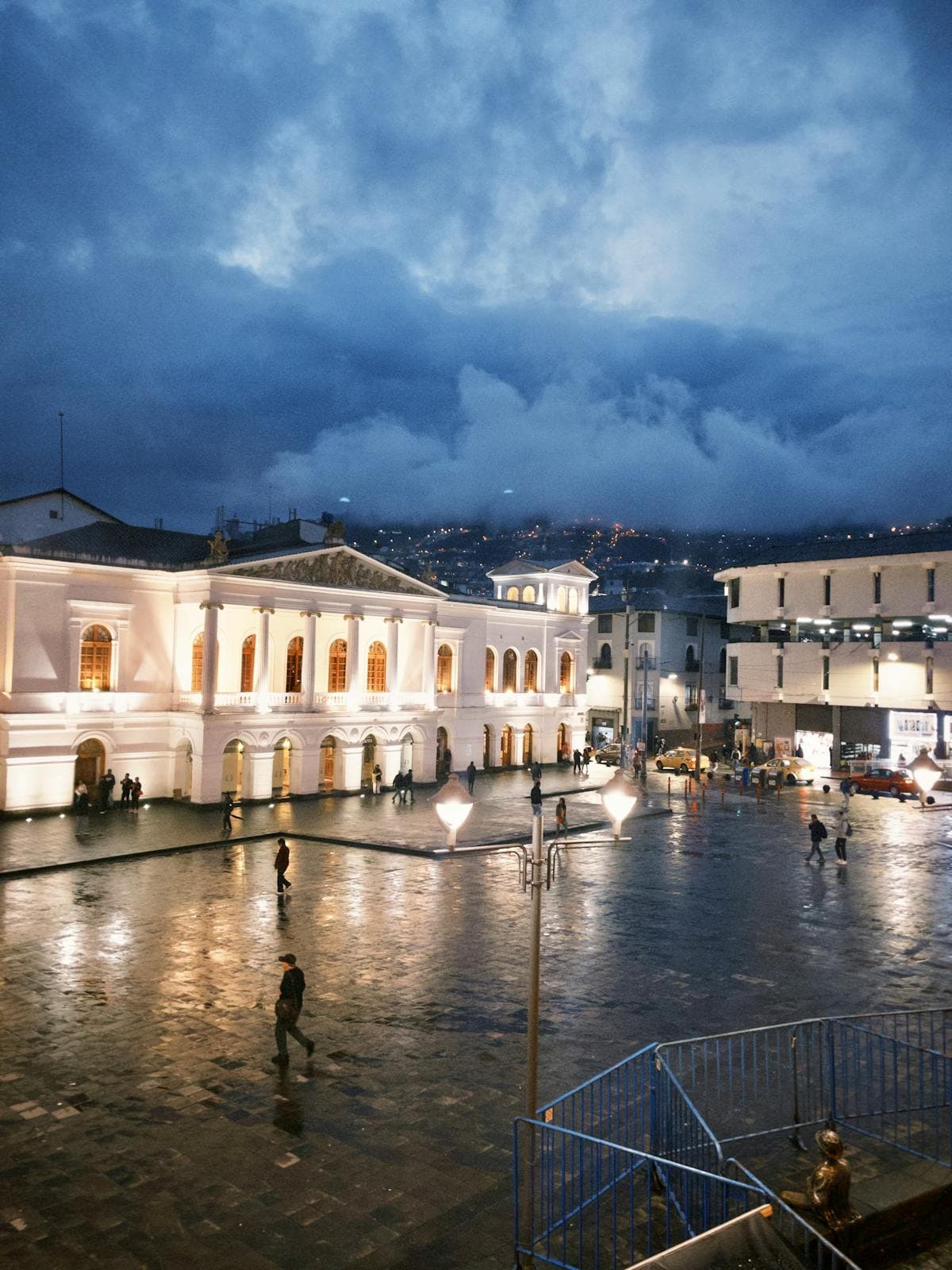
The La Mariscal and La Floresta: Quito Walks Out of Its Old Town walk runs ten stops from the Casa de la Cultura to the Plaza de la Floresta. The foundation and the Capilla del Hombre are uphill from there, too far to walk on that route: take a taxi from the end of the walk, and check hours and prices on the foundation's own site before you go. The walk itself is the city's twentieth-century story, from a 1920s garden suburb to the towers that replaced its villas; the foundation, on the hill above La Floresta, is the place where Quito's best-known modern painter built a permanent argument that Latin America's twentieth-century history could be told in oil paint without leaving home.
Walk the terrace, look down at the colonial centre and the modern city in the same field of view, and the foundation makes its claim. The art does not have to leave. The history does not have to be told from elsewhere. The chapel on the hill is the climax of an argument the painter spent his life building.
Ready to experience it?
La Mariscal and La Floresta: Quito Walks Out of Its Old Town
105 min · 3.5 km · easy
More from Quito
Explore more at your own pace.
Best Self-Guided Walking Tours in Quito (2026)
How Quito's Old Town Kept Its Shape: A Grid Laid on a Mountain
One Day in Quito: A Walkable Old-Town Itinerary (2026)
Quito Travel Guide: Altitude, How Many Days, Getting Around, Safety (2026)
What to Eat in Quito: An Ecuadorian Highland Food Guide (2026)