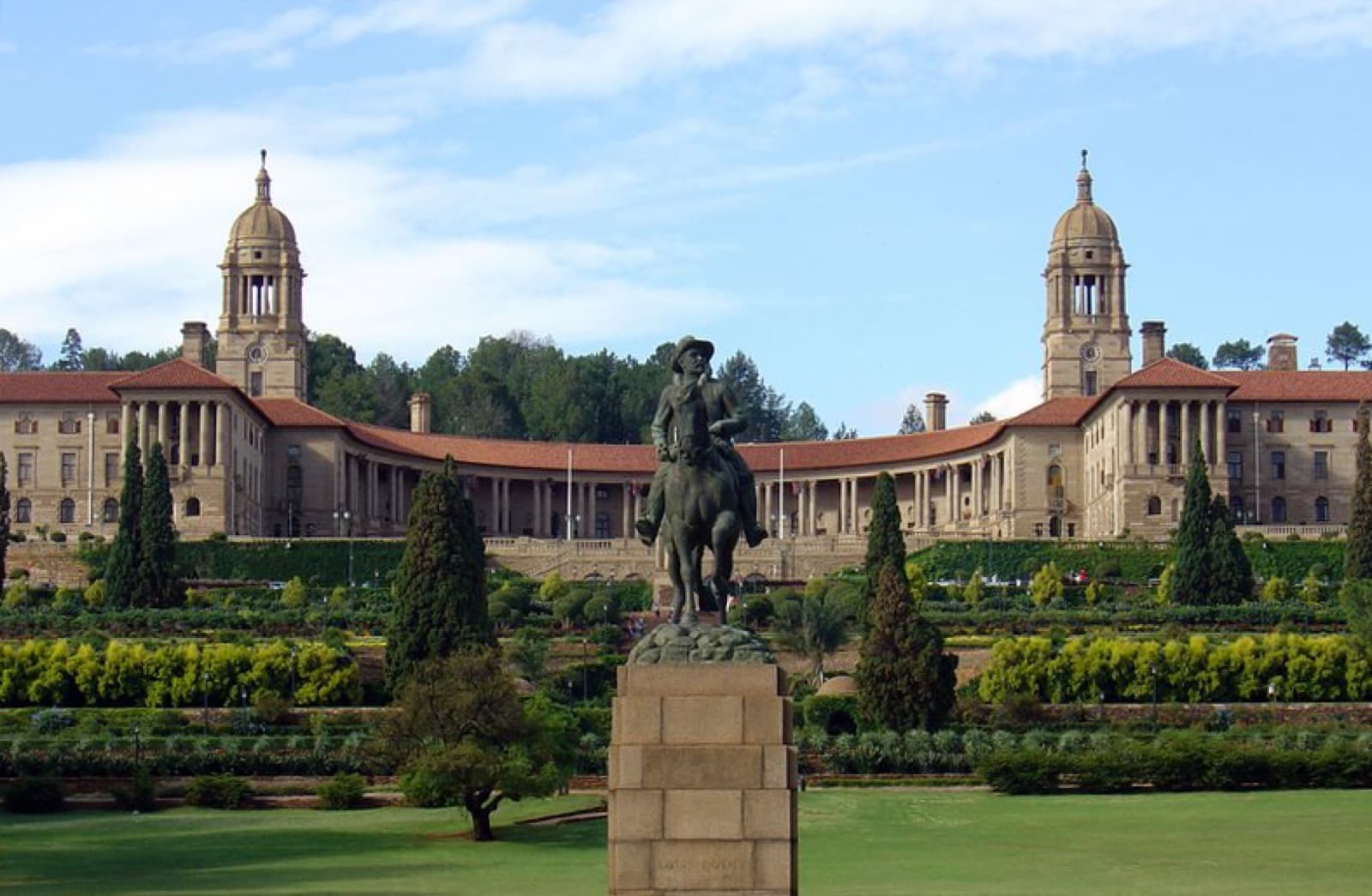
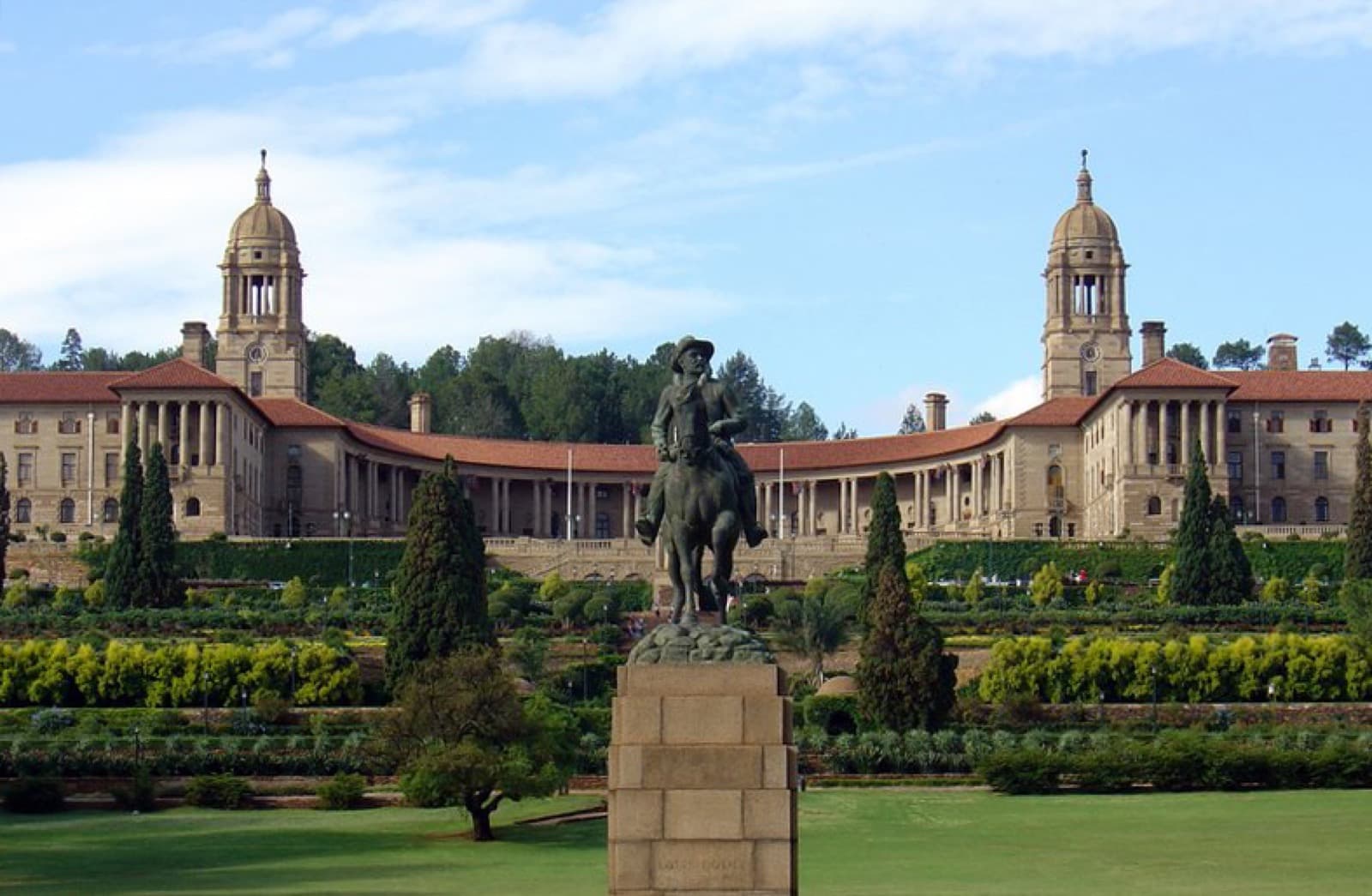
Sir Herbert Baker designed the two domed towers of Pretoria's Union Buildings to represent the two white language groups of a new country, the English and the Afrikaner, and he joined them with a curved colonnade meant to symbolise their union in the Union of South Africa of 1910. That is the message the architect built into stone above the hill of Meintjieskop, and it is the one fact worth carrying with you when you stand at the foot of the towers and look up. The building is beautiful and deliberate. It is also honest about a union that was, by law, a union of two peoples and not of all.
What Baker built, and when
Baker was commissioned in 1909, work on the hill began that year, and the buildings were completed in 1913. He worked in light sandstone, stretching the composition about 285 metres from end to end, in a neoclassical idiom carrying Italian Renaissance and Cape Dutch touches. The two towers do not sit alone. They anchor two great wings that reach out from the crown of the hill, and between them runs the curved colonnade that ties the whole plan together into a single sweeping gesture.
The gesture was not decorative. It was argument. In 1910 the four colonies of the region were joined into one country, the Union of South Africa, and the Union Buildings were raised to seal that joining and to house the government of the new state. When Baker set two towers side by side and bridged them with a colonnade, he was giving physical form to a political idea: two parties, formerly rivals, now bound into one whole. The building is the union it was built to celebrate, written large in sandstone on a hill above Pretoria.
The union the towers were built to mark
Hear a stop from this walk
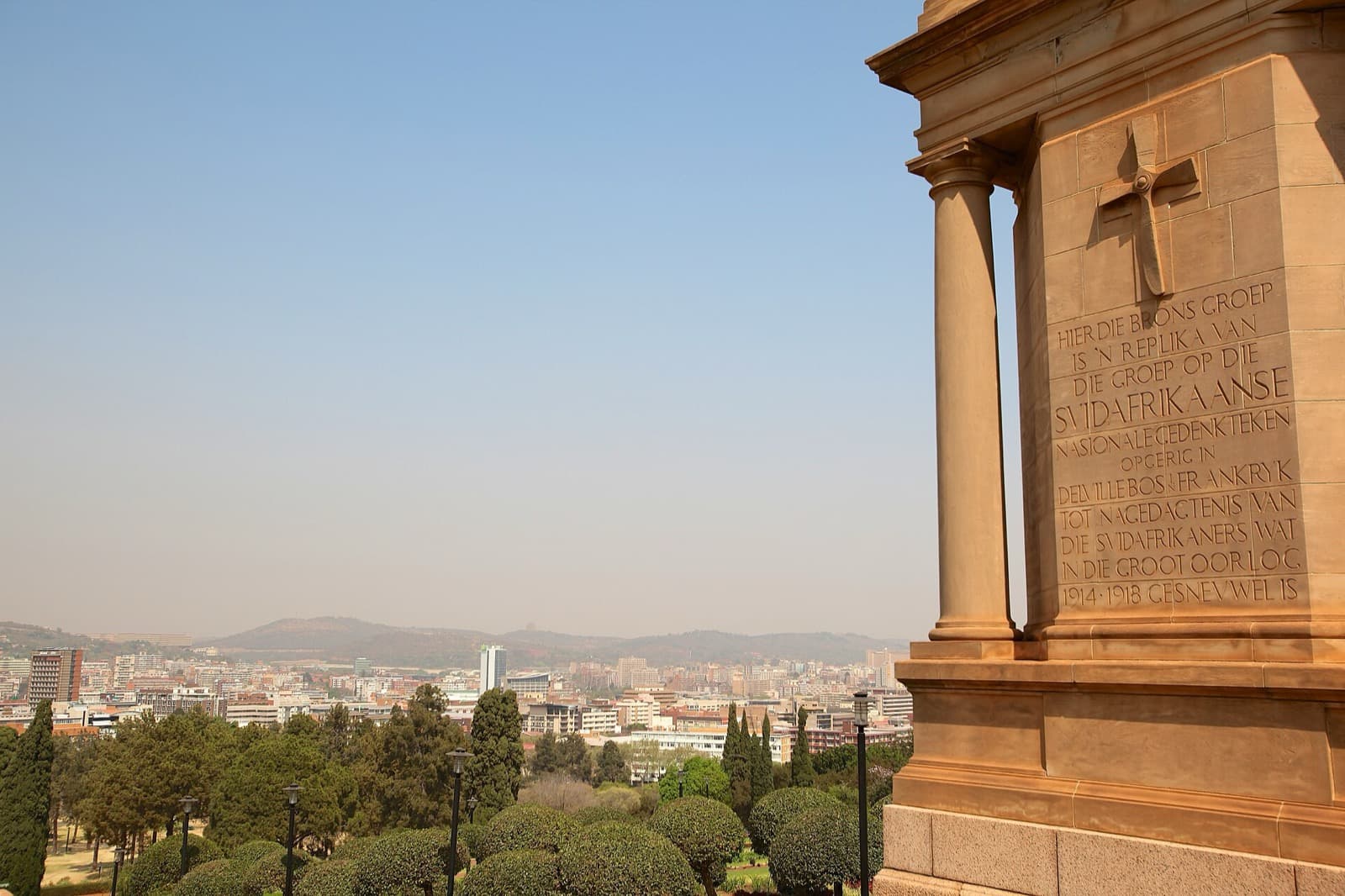
The Panorama: The Purple Capital Below the Seat of State
To read the towers honestly, you have to name the specific union they stand for. The two domed towers were meant to represent the two white language groups of the new country, the English and the Afrikaner, whose rivalry had run through the region's recent wars. The colonnade between them was the reconciliation: English tower and Afrikaner tower, joined.
That is where the building asks something of the visitor. The union these two towers were raised to celebrate was a union of white English and Afrikaner South Africa. By law, it excluded the black majority of the country. Two towers were built to stand for a partnership that then left most of the nation out. Standing below them, you are inside that tension: a graceful, carefully composed monument, raised to seal a partnership that was never designed to include everyone who lived here.
This is not a modern reinterpretation projected backward. It is what the design says. The symbolism of "two" is legible in the plan itself, and once you see that the "two" meant two white groups rather than the many peoples of the land, the colonnade reads differently. A bridge between two parties can also be a wall around them.
Baker's larger career, and this hill's place in it
Herbert Baker is often called the Union Buildings his masterpiece, and after this South African work he went on to help design the imperial architecture of New Delhi alongside Edwin Lutyens. That later commission places the Union Buildings in a wider story of empire building its seats of government in confident stone across the world. But this hill was Baker's great South African statement. New Delhi was a collaboration on someone else's capital. Meintjieskop was his own composition, from the terraced approach below to the towers at the summit, and it remains the clearest reading of what he thought a seat of state should look like.
What makes the towers worth a deliberate stop, rather than a glance, is that they still say plainly what they were built to say. Nothing has been carved off them. The English tower and the Afrikaner tower stand exactly as designed, and the colonnade still runs between them. The building did not change. The country did. That is the quiet drama of the place: an unaltered monument to one South Africa, now standing at the centre of another.
Standing in front of the towers
Give yourself a moment to take in the scale before you read the meaning into it. From the amphitheatre steps, the two towers frame the sky, and the roughly 285 metres of sandstone wing curve away on either side. Walk far enough back on the terraces to see both towers at once with the colonnade between them, because that is the composition Baker intended you to read as a single idea rather than as separate buildings.
Then hold the two thoughts together. This is a masterful piece of civic architecture, worth admiring on its own terms for its proportion, its material and its command of the hill. It is also a monument whose central symbol, the joining of two, deliberately drew a line around who counted as a partner in the new state. The building rewards both feelings at once, admiration and unease, and it does not ask you to resolve them. It only asks you to see clearly what the towers were built to celebrate, and to see just as clearly what they were built to leave out.
That double reading is the reason the Union Buildings are more than a handsome government office. The towers are a document. They record, in the permanence of stone, the exact shape of the union of 1910, and they let a visitor a century later measure the distance the country has travelled since.
Walk the hill
The twin towers are the third stop on a short walk up the terraced hill of Meintjieskop, from the lower gardens to the amphitheatre where South Africa took its democratic oath, past the Mandela statue and the war memorials, to the panorama over the capital. Roamer's self-guided audio tour lets you climb it at your own pace, with no group and no schedule, reading each stop in the order Baker meant the hill to be approached. Browse more Pretoria walking tours or start from the Pretoria city page and follow the Union Buildings route from the bottom of the green stair.
Sources
- South African History Online, "Union Buildings, Pretoria." History of the site, its construction, and the terraced grounds.
- Wikipedia, "Union Buildings." Architectural details, dimensions, and the symbolism of the twin towers and colonnade.
- Wikipedia, "Herbert Baker." Baker's career, his South African work, and his later collaboration with Edwin Lutyens in New Delhi.
- Roamer tour transcript, "Union Buildings: Herbert Baker's Amphitheatre of State." Fact-audited narration for the Twin Towers stop.
Ready to experience it?
Union Buildings: Herbert Baker's Amphitheatre of State
90 min · 1.6 km · moderate
More from Pretoria
Explore more at your own pace.
One Day in Pretoria: A Walkable Morning-to-Evening Itinerary
Pretoria Travel Guide: Days, Transport, Safety, and Budget
Pretoria's Square and Hill: How One City Holds Republic, Empire and Democracy
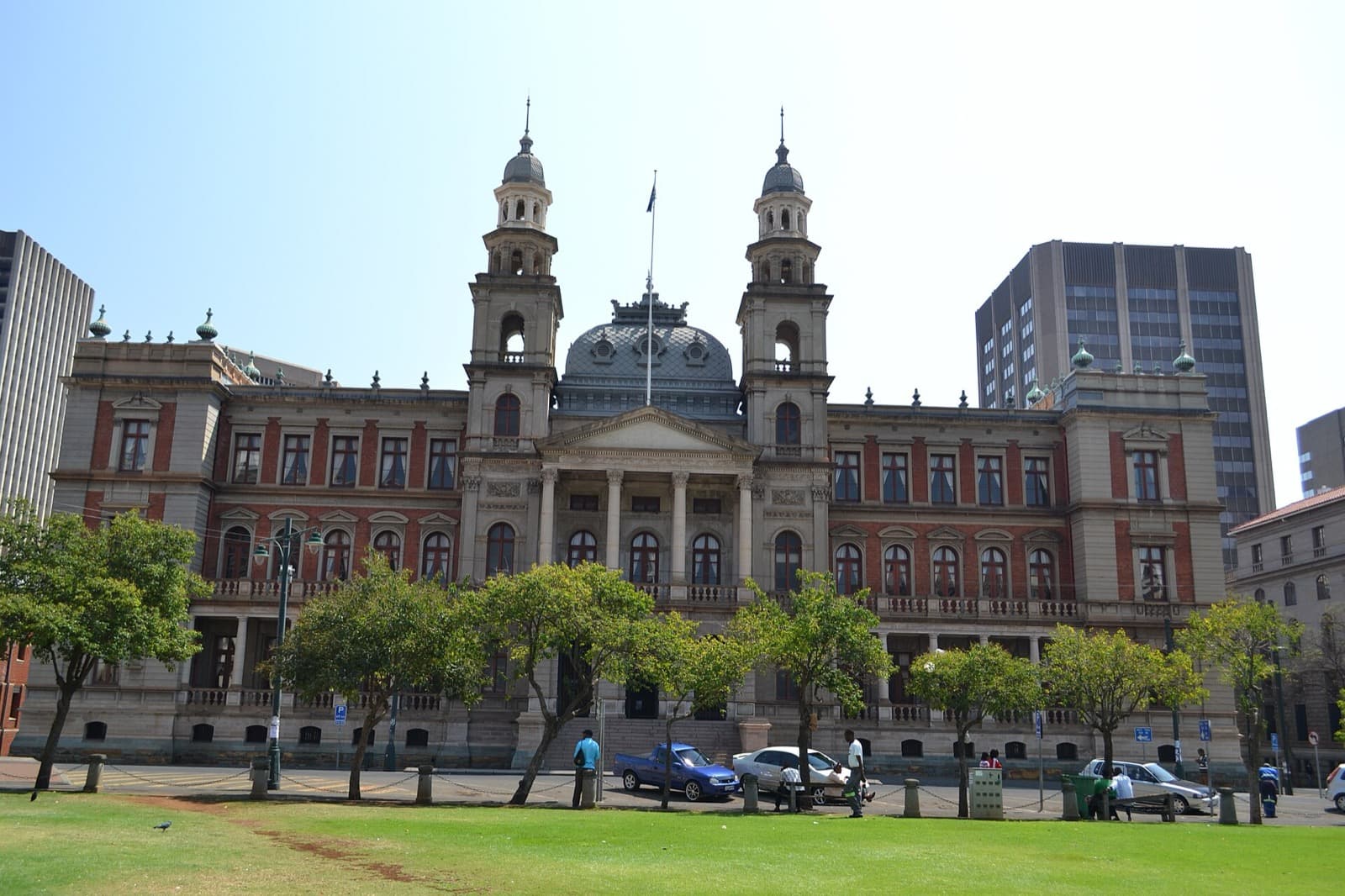
The Palace of Justice: Where Pretoria's Whole Century Fits in One Courtroom
The Union Buildings Amphitheatre: Where One South Africa Ended and Another Took the Oath