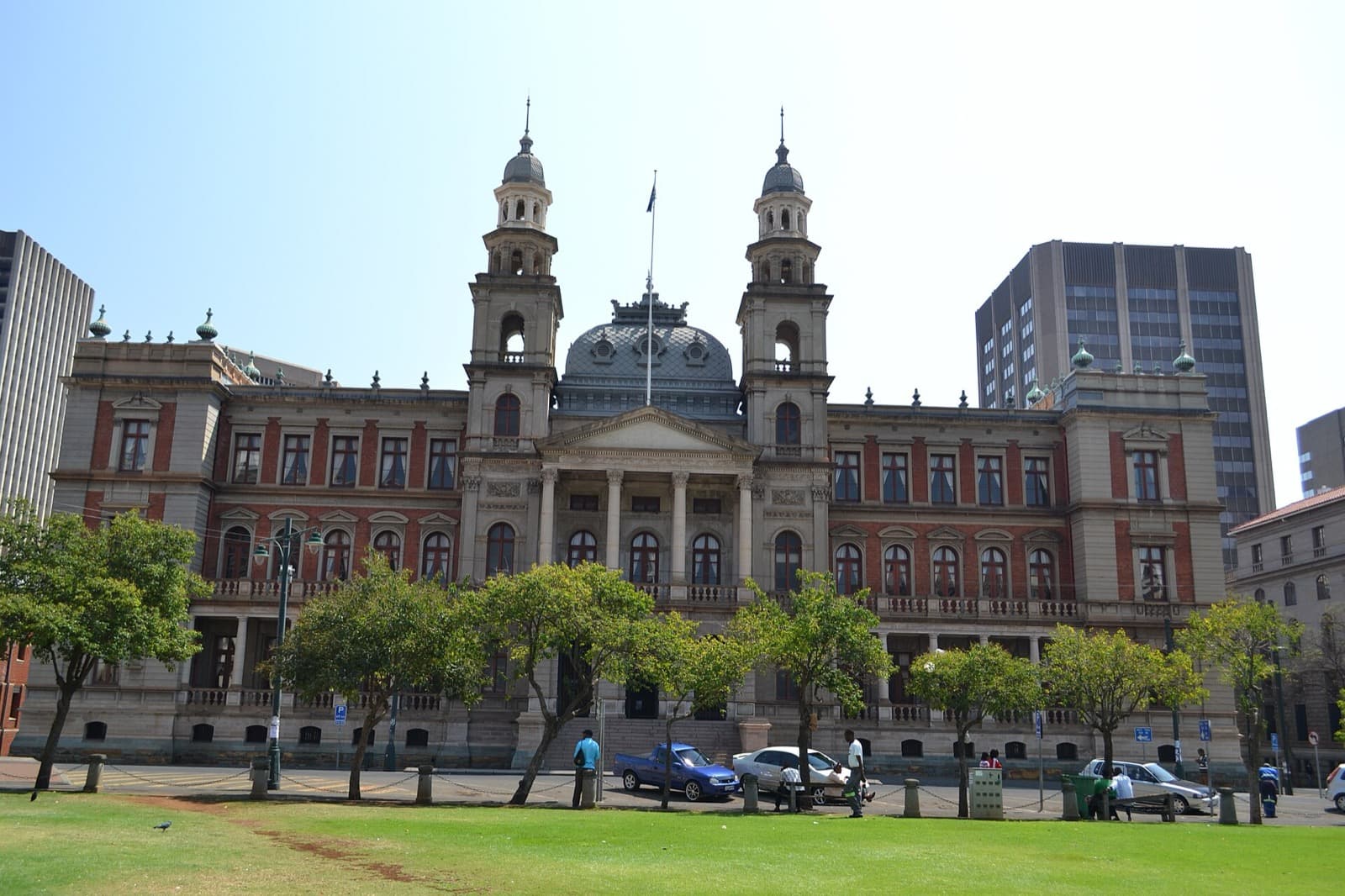
The Palace of Justice on Pretoria's Church Square is where empire, Boer republic, apartheid and democracy all become legible in one place, because the courtroom that sentenced Nelson Mandela to life imprisonment stands a few steps from the bronze statue of the president whose world that movement would eventually end. You can take in the whole argument of this walk from a single spot on the square's north side. A stone facade in front of you held the Rivonia Trial. Behind you, at the centre of the paving, Paul Kruger looks out over a country he could not have imagined. The distance between the two is short enough to cross in under a minute, and that short distance is the story.
One courthouse, two eras
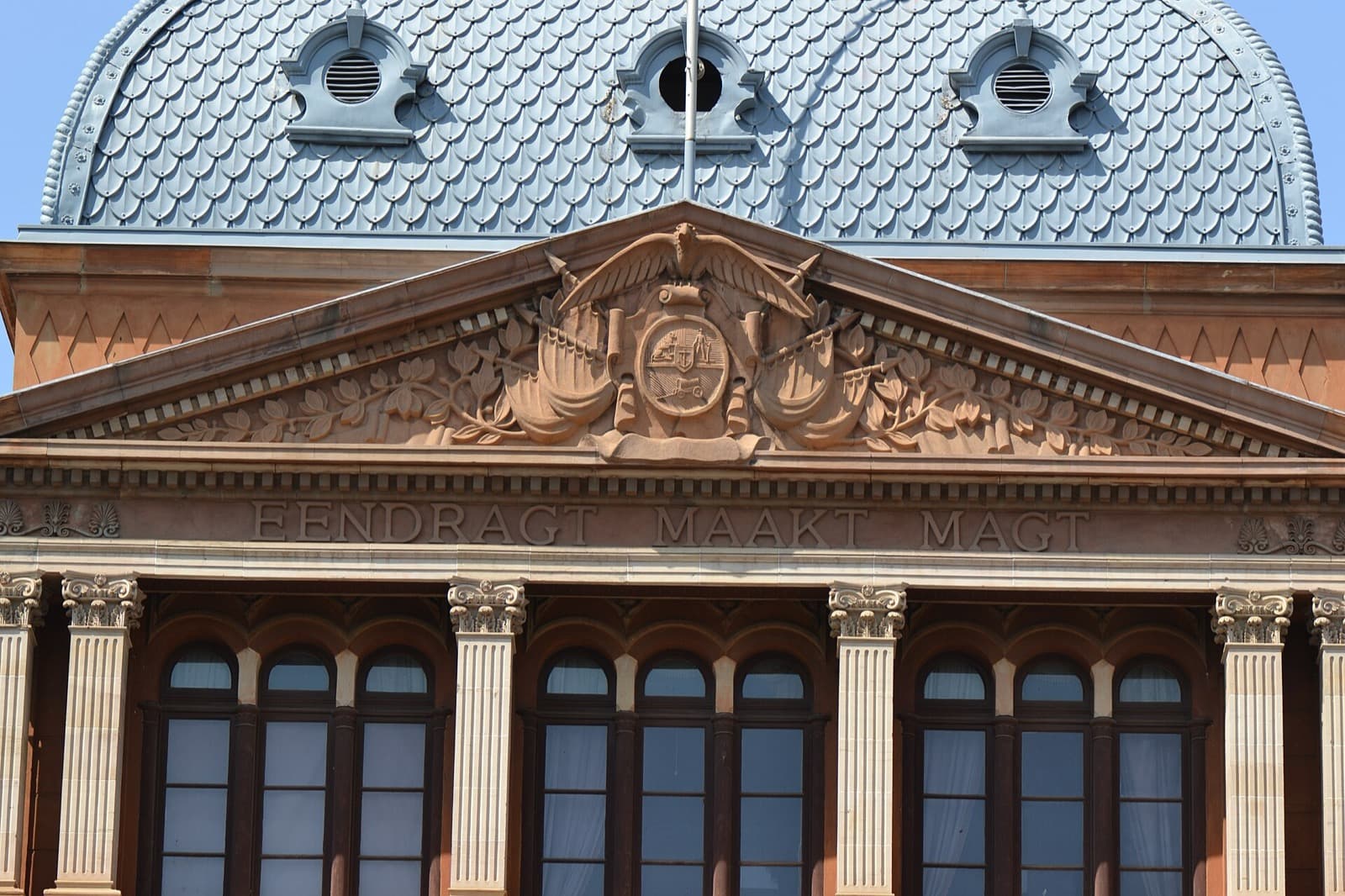
The building itself is a record of the first of those eras. It was designed by the Dutch architect Sytze Wierda, the same hand behind the Ou Raadsaal on the opposite side of the square, and President Paul Kruger laid its foundation stone on the eighth of June, eighteen ninety-seven. Its fittings were finished in the early nineteen hundreds. Before it ever heard a case, history had already redirected it: during the Second Boer War it briefly served as a hospital for British soldiers. Today it houses the Gauteng Division of the High Court of South Africa, still a working court more than a century after Kruger set its cornerstone.
That layering is the reason to stand here rather than glance and move on. A Boer president commissioned a hall of justice for his republic. The empire that defeated that republic used the unfinished building to treat its wounded. Then, decades later, the state that grew out of that empire and its own segregationist turn used the finished courtroom to try the men who would replace it. Four regimes, one wall.
The trial that draws people here
Hear a stop from this walk
The Kruger House Museum
From October nineteen sixty-three to June nineteen sixty-four, this building hosted the Rivonia Trial. In the dock stood Nelson Mandela, Walter Sisulu, Govan Mbeki, Ahmed Kathrada, Raymond Mhlaba, Denis Goldberg, Elias Motsoaledi, Andrew Mlangeni and others, charged in a case that could carry the death sentence. On the twentieth of April, nineteen sixty-four, Mandela rose and spoke from the dock for hours. He described the society he hoped for, a democratic and free society in which all persons lived together in harmony and with equal opportunities. It was an ideal, he said, for which he was prepared to die.
On the eleventh of June, nineteen sixty-four, Justice Quartus de Wet found the accused guilty, and on the twelfth of June he handed down life sentences to eight of them. Most were taken to Robben Island soon after, though Denis Goldberg was held in Pretoria. Read plainly, the state had won: the leadership of the movement went to prison, and the death penalty that hung over the trial had been avoided rather than sought by the bench. But the words spoken from that dock outlived the verdict, and the men sentenced here would, within a lifetime, govern the country. That reversal is why the Palace of Justice is the emotional centre of the walk, and why the Pretoria walking tours that pass through Church Square treat this one facade as the hinge of everything around it.
Why the whole square, not just the court
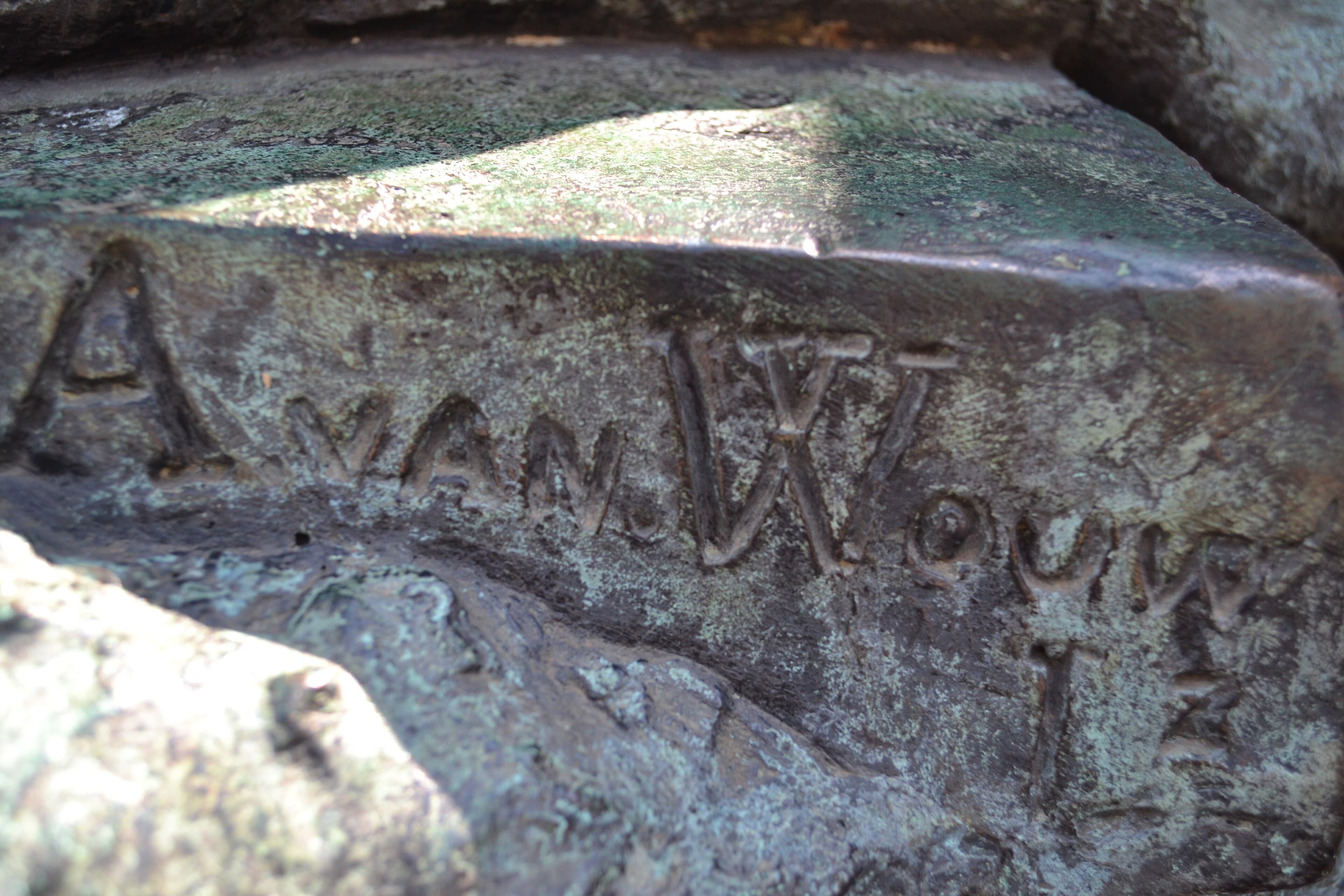
Stand at the courthouse and you can already see the rest of the argument. Turn around and Kruger is there in bronze, sculpted by Anton van Wouw and commissioned by the industrialist Sammy Marks, guarded on the lower plinth by four anonymous Boer citizen-soldiers. He was president of the South African Republic, the Boer state that governed the Transvaal, and his statue was finally unveiled on this square in nineteen fifty-four. On the south side stands the Ou Raadsaal, the parliament of that republic from eighteen ninety-one to nineteen oh two, whose crowning female figure of Liberty spoke for a state that thought of itself as free and self-governing while remaining closed to most of the people it ruled.
Around those anchors runs a nearly complete ring of turn-of-the-century buildings: the old General Post Office, Tudor Chambers, the Old Netherlands Bank, the Old Capitol Theatre, and on one corner Cafe Riche, built in nineteen oh five in the Art Nouveau style and often called one of the oldest cafes in Pretoria. Some of its window frames and doors are recorded as reused from the Gothic church that once stood at the square's centre. Very few civic squares anywhere kept their belle-epoque frame this intact, which means the setting of the Mandela trial survives almost exactly as it stood.
Two stops sit a short walk off the square and complete the arc. Melrose House, an ornate Victorian mansion to the south, is where the Treaty of Vereeniging was signed in its dining room on the thirty-first of May, nineteen oh two, ending the Anglo-Boer War and erasing the independent Boer republics. Kruger's own home to the west is the surprise: a plain single-storey house on WF Nkomo Street, private property because the republic gave its president no official residence, with a front stoep where he sat and received ordinary citizens. Between the courthouse, the treaty room and that modest porch, the century closes on itself.
Walking it
The full loop is six stops, about two hours over roughly four kilometres, most of it around the square with a longer street walk west to close. It moves at your own pace, with no group and no schedule, which suits a place that rewards standing still. Give stop three, the Palace of Justice, extra time. It is a working High Court, so read it from the outside; interior access is restricted. Weekday mornings are best, when office workers fill the square and the light is soft on the stone. Carry water and a hat for the open pavement, and some rand for the small entry fees at Melrose House and the Kruger Museum. To see the whole route and start the audio, open the tour from the Pretoria city page and begin at Church Square.
Sources
- South African History Online, "Rivonia Trial 1963-1964": timeline of the trial, the accused, and the June nineteen sixty-four sentencing.
- Wikipedia, "Palace of Justice, Pretoria": building history, Sytze Wierda design, Boer War hospital use, and current High Court function.
- Wikipedia, "Statue of Paul Kruger, Church Square": sculptor Anton van Wouw, commission by Sammy Marks, and the nineteen fifty-four unveiling.
- Wikipedia, "Treaty of Vereeniging": the thirty-first of May, nineteen oh two signing at Melrose House and the end of the Anglo-Boer War.
- Roamer tour transcript, "Church Square: The Heart of the Capital": fact-audited stop narration for Church Square, the Ou Raadsaal, the Palace of Justice, Melrose House and Kruger House.
Ready to experience it?
Church Square: The Heart of the Capital
120 min · 4 km · easy
More from Pretoria
Explore more at your own pace.
One Day in Pretoria: A Walkable Morning-to-Evening Itinerary
Pretoria Travel Guide: Days, Transport, Safety, and Budget
Pretoria's Square and Hill: How One City Holds Republic, Empire and Democracy
The Union Buildings Amphitheatre: Where One South Africa Ended and Another Took the Oath
Church Square and the Kruger Statue: How to Read Pretoria's Founding Ground