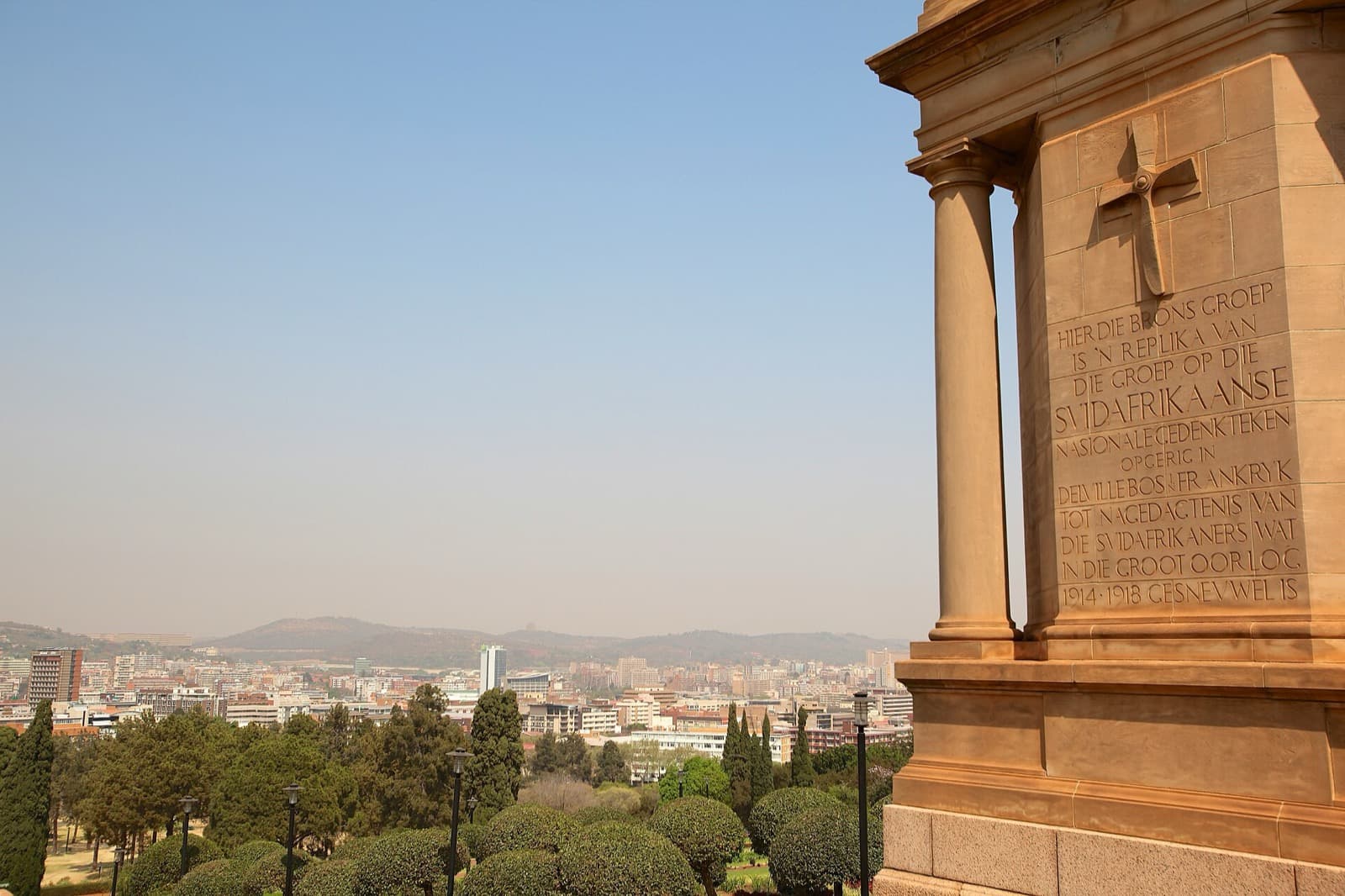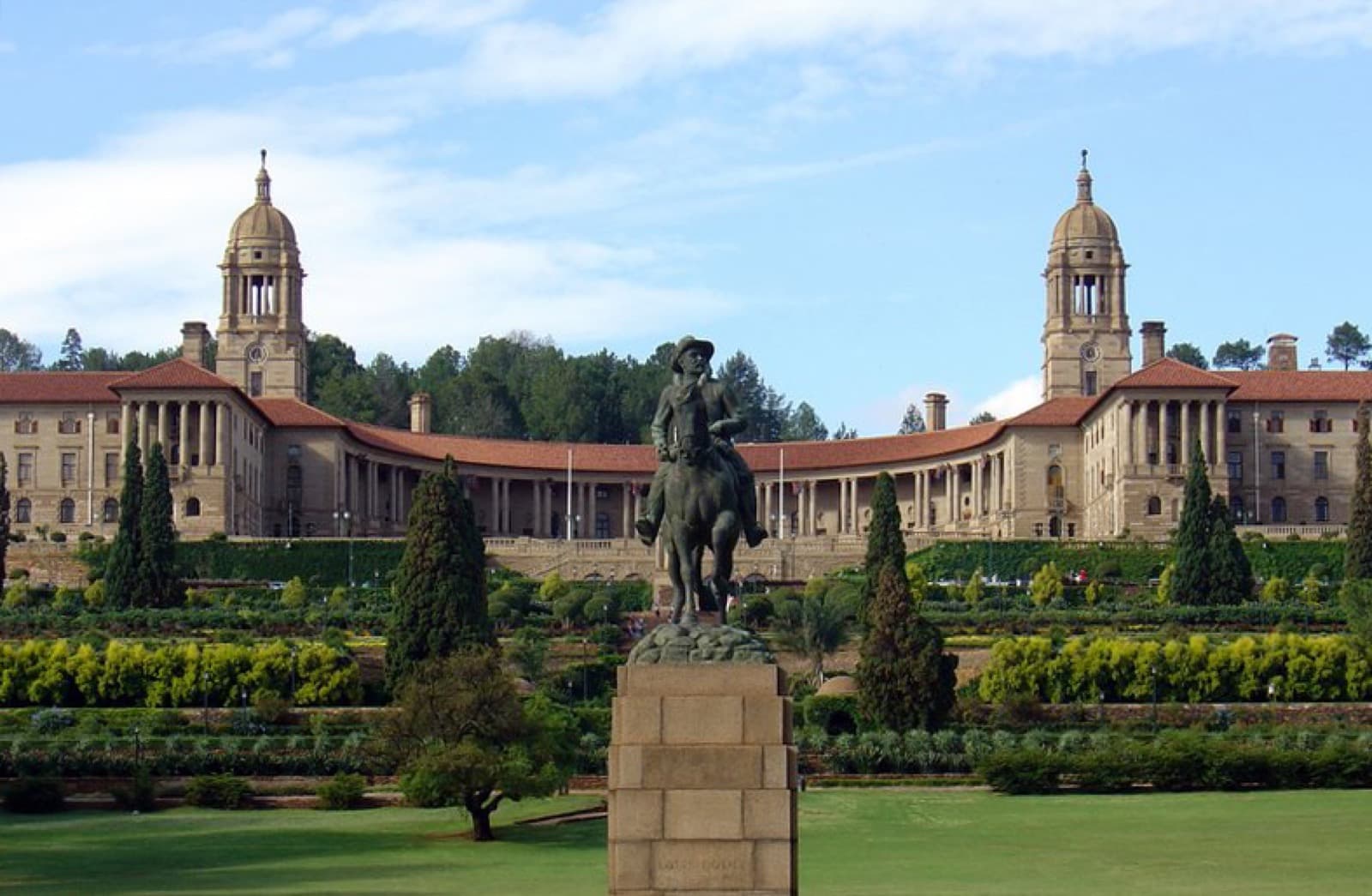
The semicircular amphitheatre at the Union Buildings in Pretoria is the one place where the whole story of the hill becomes visible in a single open court. It is a ceremonial space built for one South Africa that became the stage where a free country took the oath. On the tenth of May nineteen ninety-four, on these curved steps, Nelson Mandela was inaugurated as South Africa's first democratically elected president. The court had served the ceremonies of a state that, by law, excluded most of the country's people. Then it held the moment that ended that state. Stand in the amphitheatre and you are standing inside the tour's central argument, which is that a monument raised for one country can be rewritten by the country that grows beyond it.
A court cut from a quarry
The amphitheatre is the open ceremonial court set between the two great wings of the building, and it was built within a former quarry cut into the hill of Meintjieskop. The curved court seats about nine thousand people. That detail matters more than it first sounds. Sir Herbert Baker did not simply set a stage on flat ground. He worked with the scar the quarry had already left in the hillside and turned it into a place designed for large public ceremony. When you climb the terraced gardens from below, the amphitheatre is what you are climbing toward, and the ascent itself is part of the meaning. The gardens were laid out as a ceremonial approach to the seat of the state, so the walk up is not incidental to the drama at the top. It is the overture.
For decades the court did the work it was built to do, staging the ceremonies of a government that represented only part of the population it ruled. To understand why the nineteen ninety-four inauguration carries such weight, you have to hold the building's original purpose in view, and that is exactly what the full tour does at the twin towers just above the amphitheatre.
What the towers were built to say
Hear a stop from this walk
The Panorama: The Purple Capital Below the Seat of State
The two domed towers that crown the wings were designed by Herbert Baker to represent the two white language groups of the new country, the English and the Afrikaner. The curved colonnade that joins them was meant to symbolise their union, the joining of the former colonies into the Union of South Africa in nineteen ten. Construction ran from nineteen oh nine to nineteen thirteen, and the sandstone building stretches about two hundred and eighty-five metres from end to end. This is often called Baker's masterpiece, and he went on from it to help design the imperial architecture of New Delhi alongside Edwin Lutyens.
The honest reading is that the union these towers celebrate was a union of white English and Afrikaner South Africa, and by law it excluded the black majority. Two towers were raised to stand for a partnership that left most of the nation out. That is the tension the amphitheatre resolves. The same architecture built to seal an exclusive union became the frame for the inauguration that ended it. You cannot feel the full charge of Mandela taking the oath on these steps without first reading the message the building was constructed to carry, which is why the tour walks you through both.
Beginning and ending on the same steps
The amphitheatre holds two moments, and they sit at opposite ends of the same life. The first is the inauguration in nineteen ninety-four. The second is a return. When Nelson Mandela died in December of twenty thirteen, his body lay in state at the Union Buildings from the eleventh to the thirteenth of December, before he was buried at Qunu, the countryside where he was born, on the fifteenth. For three days people climbed this hill in long lines to stand where he had once been sworn in, and to say goodbye. The court that saw the beginning of the free country's story also held its most public farewell to the man most identified with it. That is a rare thing for any single space to carry, and it is why the tour treats the amphitheatre as its emotional core, a place to sit rather than to hurry through.
How the hill answers the question
The amphitheatre poses the question. The rest of the terraces answer it. On the lower terrace stands a bronze statue of Nelson Mandela, nine metres tall, weighing about three and a half tonnes, with a fingertip-to-fingertip span of about eight metres, sculpted by Andre Prinsloo and Ruhan Janse van Vuuren. It was unveiled on the sixteenth of December, twenty thirteen, the Day of Reconciliation and the day after his burial, and it stands on the spot where a monument to former Prime Minister J.B.M. Hertzog once stood before that figure was moved elsewhere on the grounds. The open-armed Mandela did not simply appear on empty ground. He replaced a figure of the old order.
The war memorials among the roses widen the frame further. One remembers the First South African Infantry Brigade at Delville Wood, near Longueval in France, where the brigade entered with about three thousand one hundred and fifty men in July nineteen sixteen and only around seven hundred and eighty walked out. Another marks the ninth of August nineteen fifty-six, when an estimated twenty thousand women marched to the Union Buildings against the pass laws, led by Lillian Ngoyi, Helen Joseph, Rahima Moosa and Sophia Williams-De Bruyn. From the upper terrace, the whole capital opens below, and in October Pretoria's jacaranda trees, numbering tens of thousands, turn the city purple. In twenty twenty-four the Union Buildings were inscribed by UNESCO as part of the Nelson Mandela legacy sites for human rights, liberation and reconciliation.
Walk it yourself
The grounds, gardens and amphitheatre are free and open to the public, though the building itself remains the working offices of the President and is not open to walk inside. Start at the lower terraces and climb, the way the gardens were designed to be approached, and give the amphitheatre and the Mandela statue the extra time they deserve. The self-guided audio walk carries the full arc across about six stops and roughly ninety minutes, at your own pace, with no group and no schedule. For more routes in the capital, see our guide to Pretoria walking tours, or start from the city page for Pretoria.
Sources
- South African History Online, "Union Buildings, Pretoria." Background on Meintjieskop, the terraced gardens, memorials and the site's history.
- Nelson Mandela Foundation, "Inauguration – The Presidential Years." Record of the tenth of May nineteen ninety-four inauguration at the amphitheatre.
- Wikipedia, "Union Buildings." Architecture, Herbert Baker, the twin towers, dimensions and the amphitheatre's quarry origin.
- Brand South Africa, "18 facts about the 9-metre Mandela statue." Details of the statue's scale, sculptors and unveiling.
- UNESCO World Heritage list, "Human Rights, Liberation and Reconciliation: Nelson Mandela Legacy Sites." The twenty twenty-four inscription.
Ready to experience it?
Union Buildings: Herbert Baker's Amphitheatre of State
90 min · 1.6 km · moderate
More from Pretoria
Explore more at your own pace.
One Day in Pretoria: A Walkable Morning-to-Evening Itinerary
Pretoria Travel Guide: Days, Transport, Safety, and Budget
Pretoria's Square and Hill: How One City Holds Republic, Empire and Democracy
The Palace of Justice: Where Pretoria's Whole Century Fits in One Courtroom
Church Square and the Kruger Statue: How to Read Pretoria's Founding Ground