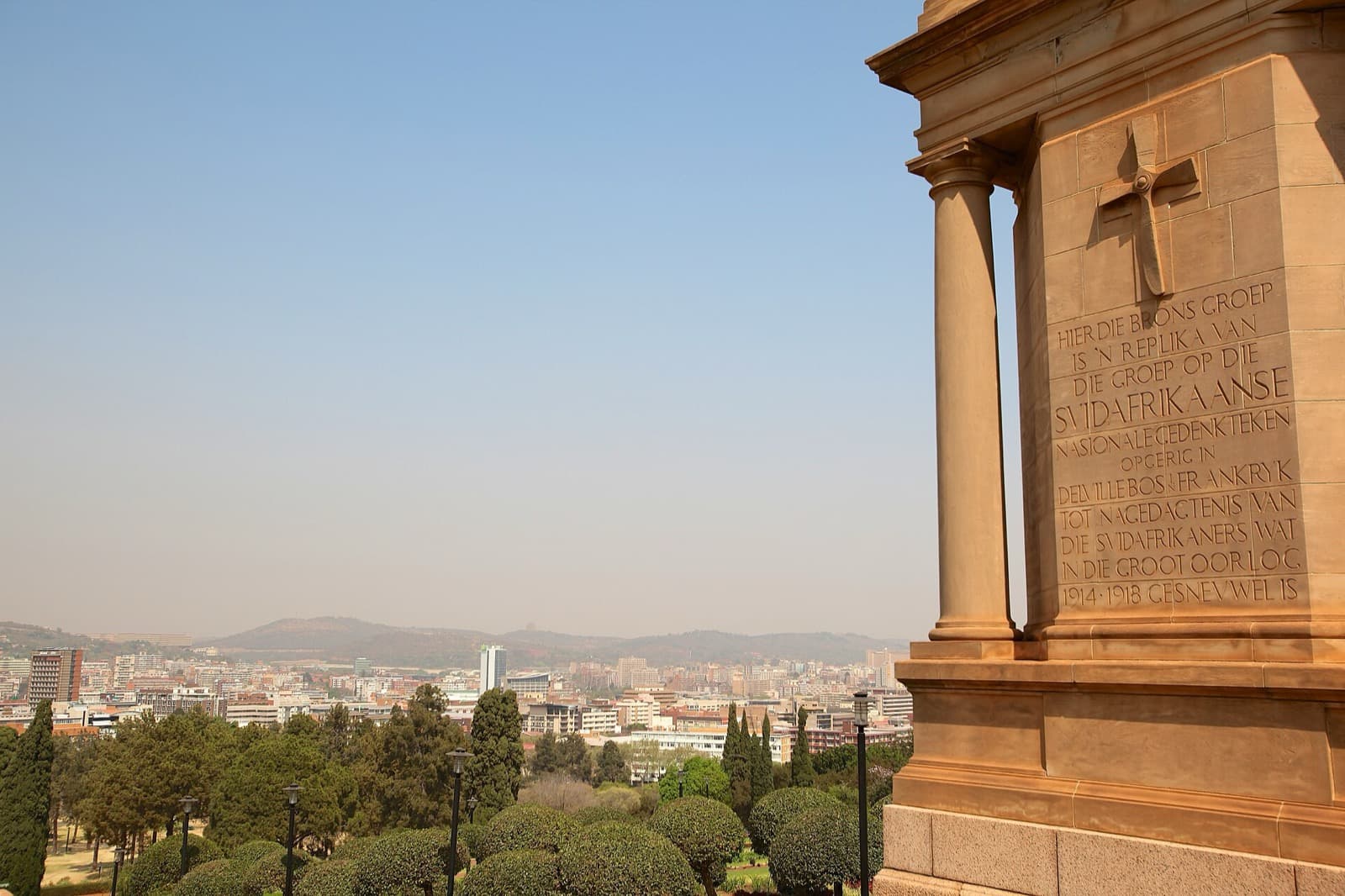
Church Square is the one paved hectare from which Pretoria grew, and the bronze figure of Boer president Paul Kruger at its centre, ringed by the buildings of a vanished republic, a conquering empire, an apartheid state and a democracy, lets you read the whole contested story of South Africa in a single open space. Most people cross it in a hurry, on their way to an office or a taxi. Stand still for ten minutes and the square starts to explain itself. That is the whole reason to come here first, and the one thing to understand before you look at anything else: this is not a monument surrounded by a city. It is a city organised around a monument, and the monument is arguing with everything built around it.
The square before the statue
The open space came first. Pretoria's founder, Marthinus Pretorius, set this ground aside as both marketplace and churchyard, and for years it was simply Market Square, Marktplein in the Dutch of the day. Church buildings stood at its centre from 1856, and from them the square took its lasting name: Church Square, Kerkplein. The first church burned. A Gothic replacement rose in the 1880s and was pulled down around 1905, and Kruger's own state funeral was held from that church shortly before it went. So the paved emptiness you are standing on is not an accident of planning. It is the negative space left by a church that no longer exists, kept open while the grand stone buildings crowded in around its edges.
That sequence matters because it tells you the square is older than almost everything on it. The banks, the post office, the courthouse and the parliament all arrived later, drawn to the space rather than the other way round.
Reading the bronze man
Hear a stop from this walk
The Kruger House Museum
At the centre stands Paul Kruger, president of the South African Republic, the Boer state that governed the Transvaal in the late nineteenth century. The figure is bronze and it is large: the Kruger figure rises about four and a half metres, and he stands top-hatted and heavy, looking out over the square with the settled authority of a man who believed his republic would last.
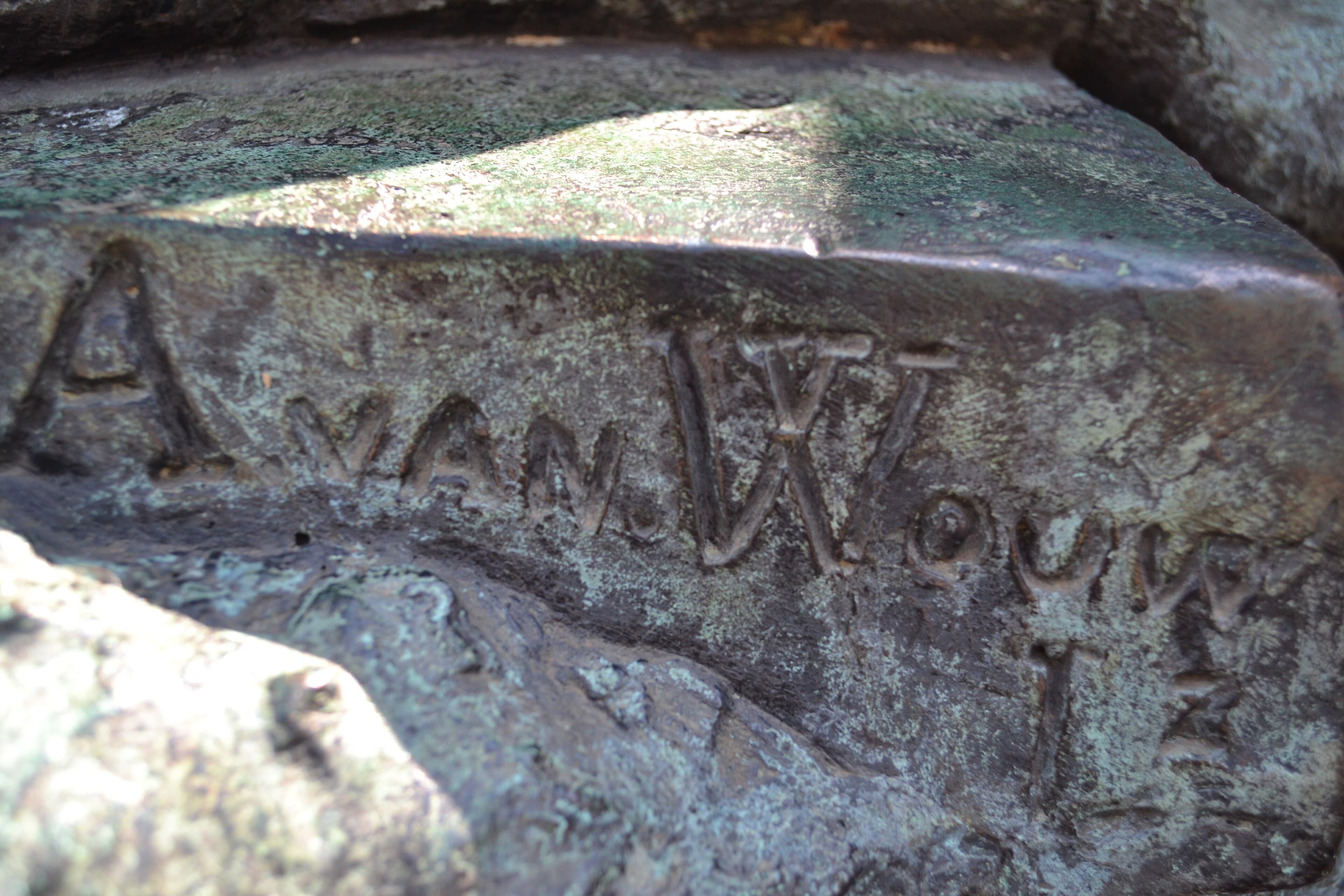
The statue was sculpted by Anton van Wouw, a Dutch-born artist often called the father of South African sculpture, and it was commissioned by the industrialist Sammy Marks, who put up the money for it in the 1890s. Look at the lower plinth and you will see Kruger is not alone. Four anonymous Boer citizen-soldiers keep watch at the corners, each a little over two metres tall. They are ordinary fighters, not statesmen, and their presence changes the meaning of the whole monument: this is not just a president on a pedestal but a republic that armed its farmers.
Those four soldiers have their own journey, and it is the detail most visitors never learn. They did not stay in Pretoria. Sammy Marks donated them to Lord Kitchener in 1902, at the close of the Second Boer War, and they crossed to England, where they were placed at the Royal Engineers barracks at Chatham. They came home only in 1921, after diplomatic negotiations, and were reunited with the Kruger figure at Pretoria Station a few years later, around his birth centenary in 1925. The whole monument moved several times, standing in a park and near the railway station, before it was finally assembled here on Church Square.
The date that changes the meaning
The most important thing to know about the statue is not who made it but when it arrived. The complete monument was unveiled on Church Square on 10 October 1954 by the prime minister of the day, Daniel Malan, whose National Party government had begun building the legal machinery of apartheid six years earlier.
Hold that in mind. The Boer president was cast in the 1890s, but he was placed at the exact centre of the capital in the 1950s, by the government that was then dividing the country by race. The statue is a nineteenth-century object put to twentieth-century political use, a claim staked in bronze about who the city belonged to. That is why the square cannot be read as neutral heritage. Kruger looks out over a country that would, within a lifetime, become something he could not have imagined, and the government that raised him here was the one working hardest to prevent that country from arriving.
The courthouse a few steps north
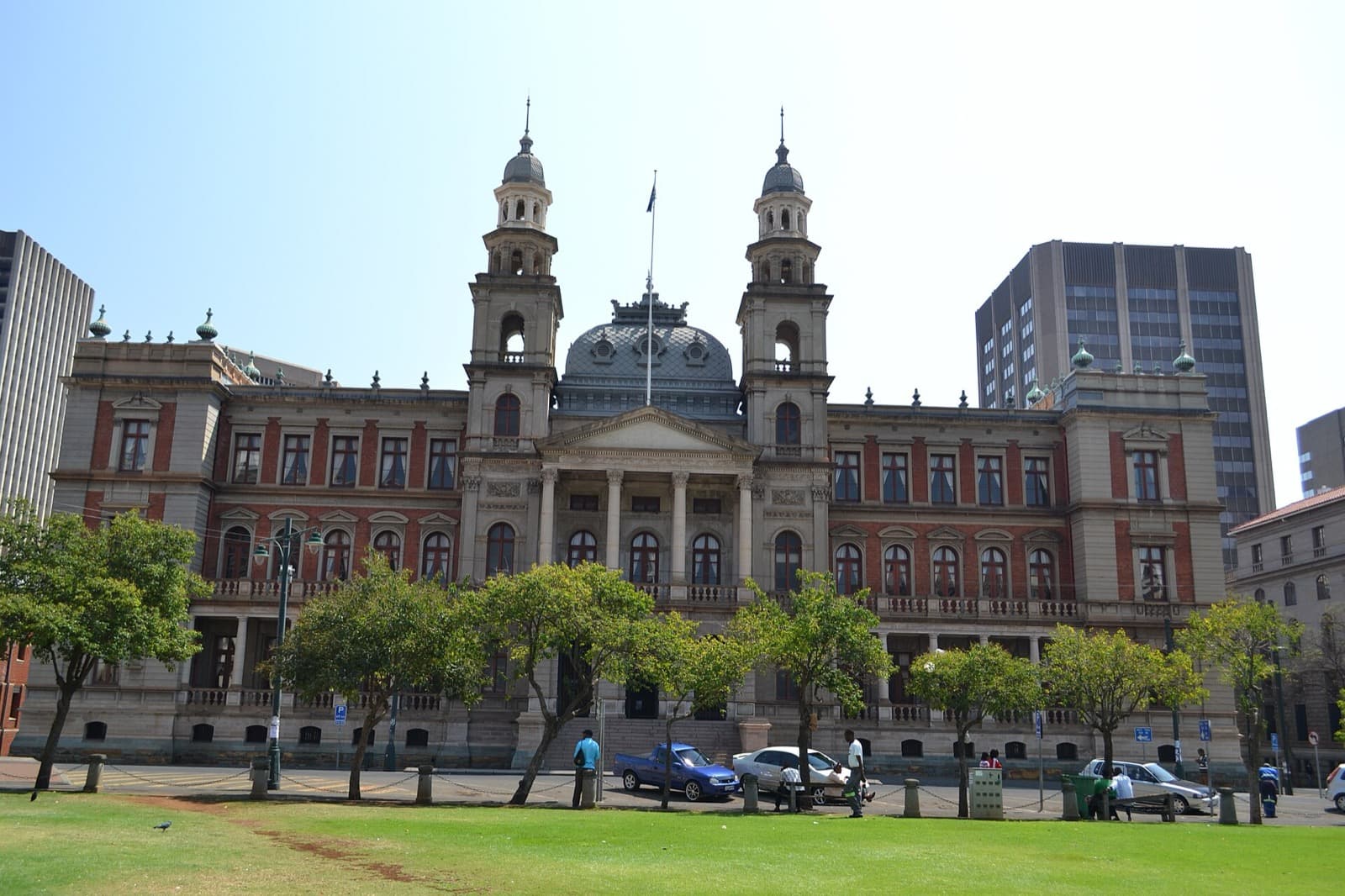
Everything the square means turns on one building on its north side. The Palace of Justice, a heavy stone courthouse, is where the Rivonia Trial was held from October 1963 to June 1964. In the dock stood Nelson Mandela, Walter Sisulu, Govan Mbeki, Ahmed Kathrada and others, facing charges that could carry the death sentence. On 20 April 1964, Mandela spoke from that dock for hours, describing a democratic and free society in which all persons lived together in harmony and with equal opportunities, an ideal, he said, for which he was prepared to die. On 12 June 1964, eight of the accused were sentenced to life imprisonment, and most were taken to Robben Island.
So the geography is the argument. The movement that would end Kruger's world was sent to prison a few steps from his statue, in a courtroom on the same square where Malan had planted him a decade before. Stand between the bronze president and the courthouse door and you are standing in the exact gap between the two South Africas, close enough to see both without turning your head.
What to do standing here
Give the statue a slow circle before you move. Read the four soldiers, not just the president, and remember they spent nearly two decades in England. Then turn to face the courthouse to the north and let the distance between the two sink in, because that short walk is the whole tour in miniature. The square is free and open at any hour, but weekday mornings are best, when the office workers give it life and the light is soft on the stone.
When you are ready to walk it properly, from the statue to the Ou Raadsaal, the Palace of Justice, and out to the house where the Anglo-Boer War was signed away, the Church Square audio tour takes you stop by stop at your own pace. You can browse the full set of Pretoria walking tours or start from the Pretoria city page. Either way, begin here, at the paved hectare where the whole story is still legible in one glance.
Sources
- South African History Online, "Dr D.F. Malan unveils the statue of Paul Kruger on Church Square, Pretoria." Confirms the 10 October 1954 unveiling and the unveiler's identity.
- Wikipedia, "Statue of Paul Kruger, Church Square." Sculptor, commission, dimensions, and the return of the four soldier figures.
- The Heritage Portal, "If only statues could speak: the four Boer statues Kitchener 'stole'." Detailed timeline of the soldiers' donation to Kitchener in 1902, their placement at Chatham, and their return in 1921.
- Wikipedia, "Church Square, Pretoria." Origins as Market Square, the church buildings, and the square's role as the city's civic core.
- South African History Online, "Rivonia Trial 1963-1964." The trial dates, defendants, and sentencing in the Palace of Justice.
Ready to experience it?
Church Square: The Heart of the Capital
120 min · 4 km · easy
More from Pretoria
Explore more at your own pace.
One Day in Pretoria: A Walkable Morning-to-Evening Itinerary
Pretoria Travel Guide: Days, Transport, Safety, and Budget
Pretoria's Square and Hill: How One City Holds Republic, Empire and Democracy
The Palace of Justice: Where Pretoria's Whole Century Fits in One Courtroom
The Union Buildings Amphitheatre: Where One South Africa Ended and Another Took the Oath