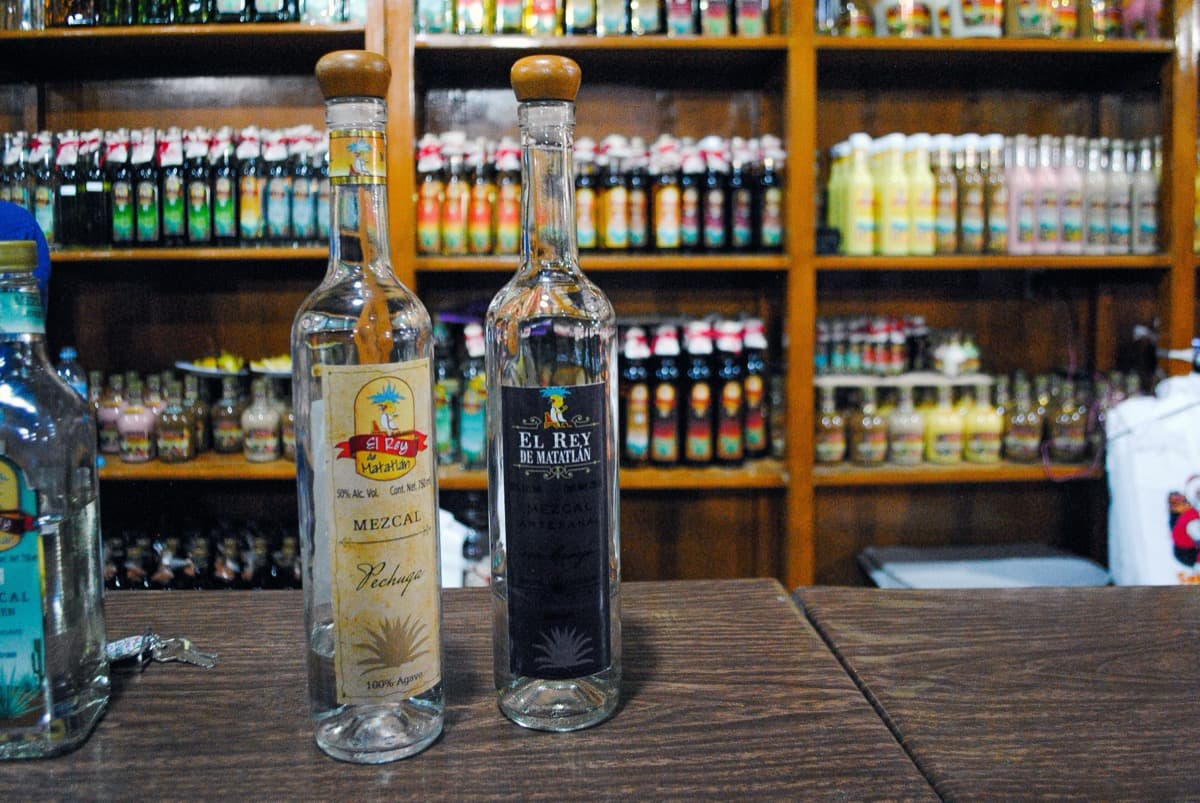
A mezcal flight in Oaxaca usually arrives in three or four small clay copitas on a wooden board. The pours are small. The glasses are unlabelled. The server tells you the agave variety and the producer village. You are expected to sip, not shoot. Let it sit in your mouth, breathe out through your nose, and only swallow once the smoke has cleared. The first sip will probably make your eyes water. The second sip will start to make sense. By the third, you will begin to taste what is actually in the glass.
What is in the glass is a compressed history of the valley. The technique that produced it is partly pre-Columbian and partly colonial. The agave plant was domesticated thousands of years before the Spanish arrived. The roasting and fermentation steps were already in use when the conquistadors landed. The distillation step is sixteenth-century, brought by either Spanish or Filipino contact. The final liquid is the product of all three eras working at once, and the reason the drink tastes the way it does is that every step has stayed close to its original form.
The agave
Agave is a slow plant. The most common variety used for mezcal, Agave angustifolia, locally called espadín, takes between seven and ten years to mature in the valley. The slower-growing wild varieties take longer. Tobalá (Agave potatorum) takes ten to fifteen years. Madrecuixe (Agave karwinskii) can take twelve. Tepextate (Agave marmorata) can take twenty-five. The plant flowers exactly once at the end of its life. The flowering stalk, the quiote, can rise five metres above the rosette. If the plant is left to flower, the sugars in its core run up the stalk and the heart becomes useless for mezcal. Producers cut the quiote before it emerges, which lets the sugars concentrate in the heart.
The heart, the piña, is the part that matters. It is the dense central core of the plant after the long fleshy leaves are sliced away. A mature espadín piña weighs roughly thirty to sixty kilograms. A mature tepextate piña can weigh over a hundred. The piña is composed largely of inulin, a fructose-based polymer that is bitter and indigestible in raw form. Roasting converts the inulin into fermentable sugars and adds the smoky flavour that defines the spirit.
The agave is genetically diverse in Oaxaca in a way it is not in tequila country. Tequila is, by law, made from a single agave species (Agave tequilana, the blue agave) grown on industrial plantations in Jalisco. Mezcal is made from any of more than thirty distinct agave species, most of them wild-harvested or grown in small mixed plots. The taste range is enormous. Espadín tends toward bright, citric, and balanced. Tobalá is floral and delicate. Tepextate is herbaceous and minty. Arroqueño is dense and earthy. The varietal distinction in the glass is not a marketing claim. It is the consequence of the plant's biochemistry, the soil, the climate, and the producer's choice of when to harvest.
The roast
Hear a stop from this walk
Mezcal Tasting Experience
The first step that defines mezcal as mezcal is the underground roast. A producer digs a conical pit about three metres across and two deep in the ground beside the palenque (the production yard). The pit is lined with stones. A fire of local hardwood (often encino, the Mexican oak) is built at the bottom and burned down to a thick coal bed. The stones are heated until they glow. The piñas are stacked on top of the coals, covered with a layer of agave fibre and earth, and left to roast for three to five days.
The roast does two things at once. It converts the inulin in the agave hearts into simple sugars (fructose, glucose) that can be fermented. And it deposits a layer of smoke compounds (phenols, guaiacols, syringols) onto the surface of the agave fibres. The smoke is not added later. It is fixed into the agave at this stage and is impossible to remove. The intensity of the smoke depends on the wood used, the moisture in the pit, and the size of the load. A small pit using dry encino produces a moderately smoky mezcal. A larger pit using mixed greener wood produces a much more intensely smoky one.
Tequila does not use this step. The agave for tequila is steamed in stainless steel autoclaves. The result is a spirit with no smoke character at all. The fact that mezcal tastes smoky and tequila does not is entirely a matter of the roast.
The fermentation
After roasting, the agave hearts are pulled out of the pit and crushed. In the most traditional palenques, the crushing is done by a stone wheel called a tahona, pulled in a circle by a mule or a horse. In smaller operations the crushing is done by hand with wooden mallets. In larger operations a mechanised shredder is used. The crushed agave (the bagazo) is moved into open wooden fermentation vats, mixed with water, and left to ferment.
The fermentation is wild. No commercial yeast is added. The microbial population that does the work, a mix of Saccharomyces cerevisiae, various non-Saccharomyces yeasts, and lactic acid bacteria, lives in the palenque. It comes from the bagazo of previous batches, from the wood of the vats, from the air, and from the producer's hands. Each palenque has a slightly different microbiome. The fermentation takes anywhere from four to fifteen days depending on the weather and the producer's preference. It is finished when the mixture stops bubbling.
The fermentation gives mezcal much of its complexity. Wild yeast populations produce a wider range of flavour compounds than the single-strain commercial yeasts used in industrial spirits. The lactic acid bacteria contribute a tangy character. The result, before distillation, is a slightly sour, low-alcohol wash that already tastes of the agave and the smoke.
The distillation
The distillation step is the one that may have been brought from outside. The pre-Columbian peoples of the valley fermented agave into pulque, a milky low-alcohol beverage that they had drunk ceremonially for at least two thousand years. They probably also produced some unrecorded ferments from cooked agave. But there is no firm archaeological evidence of distillation in Mesoamerica before the conquest. The first definite distilled spirits in the region appear in the sixteenth century. The transmission route is contested. The traditional view is that Spanish missionaries introduced European copper alembic stills. A more recent view, supported by work by the anthropologist Daniel Zizumbo-Villarreal, is that the Manila galleon trade brought Filipino-style clay stills across the Pacific to the west coast of Mexico in the late 1500s, and that mezcal distillation developed by combining the local pre-Columbian fermentation with the imported still design.
Both still types are still in use in Oaxaca. Most commercial mezcal is distilled twice in small copper alembics. The producer separates the head (the first volatile fraction), the heart (the drinkable middle), and the tail. The tail is added to the next batch. Mezcal labelled "ancestral" must be distilled in clay stills heated over wood fires. Mezcal labelled "artesanal" can use copper but must use wood-fired direct heat. Mezcal labelled simply "mezcal" can use steam-heated stainless steel. The legal categories were codified in 1994 by the Consejo Regulador del Mezcal, the regulatory body that controls the denomination of origin.
What you are tasting
A flight of three mezcales typically pairs an espadín with a wild variety and a blend. The espadín establishes the producer's baseline style. The wild variety shows what the local agave biodiversity offers. The blend or aged version demonstrates the range. The server may pour the espadín first as a control.
Pay attention to four things on each sip. The smoke (intensity, type, sweet or harsh). The agave character (vegetal, mineral, floral, fruity). The body (oily and full versus thin and bright). The finish (clean and short versus persistent and warming).
The mezcal in front of you is the end of a chain that runs from a plant the Zapotec domesticated thousands of years ago, through a roasting technique that pre-dates the Spanish, through a wild fermentation that depends on a microbiome unique to its palenque, through a still design borrowed from across the Pacific in the late 1500s, and into a regulated denomination of origin established in 1994. The drink is the entire history of the valley reduced to one liquid.
That is the right way to think about it as you sip. Not as a curiosity, not as a tougher cousin of tequila, but as the most concentrated demonstration on the tour of what cultural continuity actually looks like when nobody bothered to interrupt it.
Mexico eSIM· 10% off with ROAMER10
Ready to experience it?
Oaxaca: Markets, Mezcal & The Indigenous Continuity
150 min · 3.5 km · easy
More from Oaxaca
Explore more at your own pace.
Best Self-Guided Walking Tours in Oaxaca (2026)
Oaxaca Travel Guide: How Many Days, Getting Around, When to Go (2026)
One Day in Oaxaca: A Walkable Historic-Center Itinerary (2026)
What to Eat in Oaxaca: A Food Guide (2026)
Markets, Mezcal, and the Continuity the Spanish Never Broke