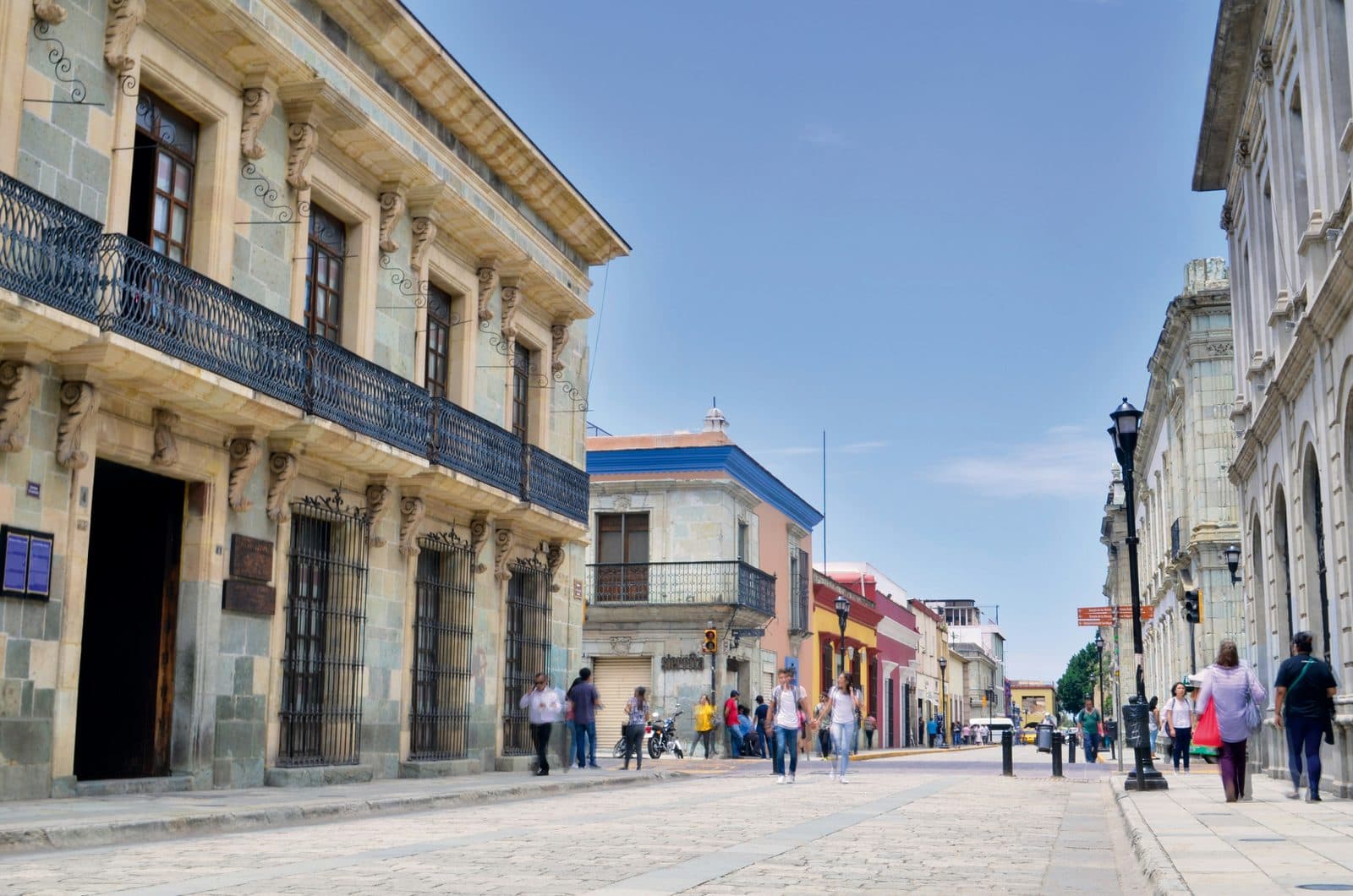
The Historic Center tour walks a counter-clockwise loop of about 3.2 km through the centre of Oaxaca, twelve stops, roughly 110 minutes at an unhurried pace, finishing about a hundred metres from where it started. It is short for the amount of ground it covers because the centre is small and the loop weaves rather than running a straight spine.
The thesis is worth holding before you start, because it replaces one you have probably read elsewhere. Oaxaca almost never knocked anything down. It changed what things were for. A Dominican convent becomes houses, shops, a hotel, mechanics' workshops and a car park, and then a cultural centre. An army drill yard becomes a botanical garden. A bookbinder's house becomes a national shrine to the servant boy who lived in it. So the question the walk asks is not who was here first. It is who gets to decide what a building is for, and how many times that answer has changed.
The tour introduces the two people you keep meeting before the first stop, so you know them when they come back. Benito Juárez, a Zapotec boy who walked into this city from a mountain village at twelve, worked as a servant and became president, and whose laws took church property into public hands. And Francisco Toledo, a Zapotec painter who made his money in art and spent it here. One changed these buildings with the law. The other did it with his own money.
The premise the walk removes first
A story told often about this city is that the Spanish arrived at a Zapotec plaza and simply built beside what was already there, layer next to layer, nothing displaced. The documents do not support it, and the tour opens by saying so.
What stood on the site of the Zócalo was not a Zapotec plaza. The national institute of anthropology records that in 1486 the Mexica ruler Ahuizotl posted a garrison on this low hill of huaje trees and named it Huaxyácac, and it is explicit about the purpose: to control and watch the Zapotecs. The Zapotec capital was Monte Albán, about eight kilometres west, and it had been abandoned for centuries by then. The Spanish grid was traced fresh in 1529, outward from the square, by a surveyor who had already gridded Mexico City.
What happened to the people who were living here is also on the record rather than open to interpretation. Viceroy Mendoza's memorial of 1544, held in the Archivo General de Indias, describes the mexica, zapoteca and mixteco inhabitants of Huaxyácac as displaced to other areas of the city and replaced with Spaniards.
The tidy inverse fails too. It would be neat to close the walk by saying the indigenous half of the city eventually won it back, and the tour refuses that at Stop 7 for a documented reason: the Reform Laws that gutted Santo Domingo were Benito Juárez's own, and Juárez was a Zapotec boy from a mountain village of a few dozen families. In the memoir he wrote for his children he says the priesthood was effectively the only career open to the poor and most especially to the indigenous class, and that he felt an instinctive repugnance for it. There is no clean side to be on. What there is instead is a long argument about use.
Reassignment, stop by stop
Hear a stop from this walk
Santo Domingo: A Church, a Barracks, and a Garden in the Drill Yard
Stop 1, the Zócalo. The walk starts beside the kiosko, the roofed bandstand in the middle of the square, because this stop is about that one patch of ground. Four decisions, each made by whoever had just taken power: a marble fountain of 1739, pulled out in 1857 for a bandstand; the bandstand removed in 1885 for a bronze Benito Juárez facing the government palace with his back to the cathedral; Juárez ordered out to his mountain village in 1894; and a new bandstand built in the hole in 1901, which is the one you start beside.
Stop 2, the Centro Cultural San Pablo and the Museo Textil. The clearest single case on the walk, heard inside the Antiguo Callejón de San Pablo, the narrow garden lane that is the only piece of the convent you can walk through. San Pablo was the first Dominican house in Oaxaca, dated 1528 by the Harp Helú foundation and the Juan de Córdova research library, and 1529 by the cultural centre and the museum themselves. Friars preached inside it in Mixtec, Zapotec and Nahuatl. The Instituto de Ciencias y Artes moved in in 1834 and Juárez taught canon law in the building. His Reform Laws nationalised the convent in 1860, and it was sold to private buyers to pay the Institute's teaching salaries. By 2006 the first Dominican convent in Oaxaca was houses, shops, a hotel, mechanics' workshops and a car park. A private foundation reassembled it into the cultural centre and the textile museum. The textile museum's door, on the street at the bottom of the lane, belongs to Casa Antelo, an eighteenth-century mansion built on cochineal money on the convent's former orchard.
Stop 3, the Teatro Macedonio Alcalá. Heard at the theatre's domed corner at Armenta y López, because the street along its front is too narrow to stand back from. A private joint-stock venture, named the Teatro-Casino Luis Mier y Terán for a soldier and former governor, taken off its shareholders by Decree number 7 of 21 November 1906, which authorised the state to acquire the land, the half-built structure and every asset, and bound it to finish the work within two years for no less than 140,000 pesos. Town councils were asked to move idle funds out of the public pawnshop to help pay for it. The theatre opened on 5 September 1909 with Verdi's Aida, became the Jesús Carranza in the revolutionary years, and took its present name by the 1930s from a composer who had died in 1869, forty years before the doors opened.
Stop 4, MACCO. The house locals call the Casa de Cortés, which is not his and could not have been: the documentary study of the city's colonial houses dates the building after him and places his actual residence on the ground where the market now stands, which held a pre-Hispanic market in the same space. Four grand houses in the centre copied a carved shell onto the lintel where a coat of arms belonged, and the study's conclusion is that all four were emulating the conqueror's magnificence. The contemporary art museum inside opened in 1992, closed during the pandemic, and reopened on 19 July 2024 under a different name, the Museo de Arte Contemporáneo y de las Culturas Oaxaqueñas, because the association that had run it still owns the old one. Calling it MACO in 2026 is out of date.
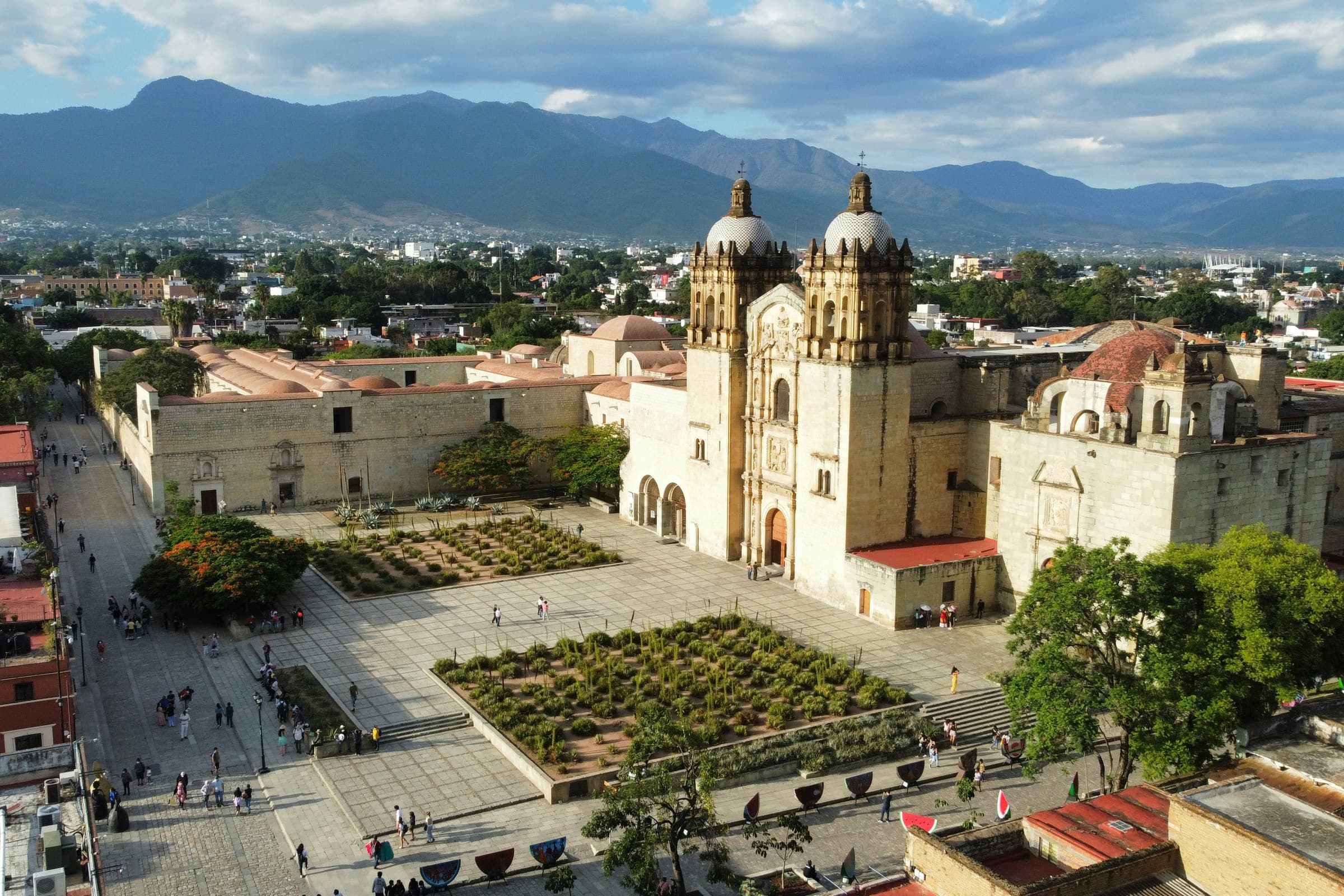
Stop 6, Santo Domingo. The longest reassignment sequence in the city, heard in the church's open forecourt, and the tour narrates the Museo de las Culturas and the botanical garden here rather than as separate stops. The gilding of the barrel vault and the high choir is dated and attributed: 1659, by an unnamed master from Puebla. The order was suppressed in 1859 and the complex became a barracks from 1862; the temple stayed shut to worship from 1866 to 1902 by one official account and from 1860 to 1901 by another; its fourteen altarpieces were looted around 1869 and the altars and choir stalls were lost completely; the Dominicans did not recover the parish until 1938. The stucco family tree of the Dominican order over the entrance was made by seventeenth-century friars and finished around 1901 by Bishop Gillow's restorers, who added Christ the Redeemer and the Virgin. And the sequence people usually get backwards: the museum was recognised in the building on 20 December 1972, while the army stayed until the early 1990s. They shared it for about twenty years.
Stop 8, the Casa de Juárez. It was never his house. It belonged to Antonio Salanueva, a lay bookbinder, and Juárez lived in it as his servant and apprentice. The state bought it in 1906, the centenary of his birth, and it has been a museum since the 1930s. Servant's quarters to national shrine, by government purchase, a century after the fact.
Stop 10, the Basílica de la Soledad. The counterexample that proves the rule, and it proves it twice over. Construction began in 1682 and the works were finished in 1689, and in the three and a half centuries since, the church has been a church without interruption. It was not raised to a basilica until 17 July 1959. The convent physically attached to it went nuns, poorhouse from 1874, trade school, reform school, teacher-training college, and since 20 August 1992 the city hall, which you can see from the terrace about thirty metres away. Six reassignments and one shared wall.
Stop 11, San Felipe Neri. The same pattern through one man's wedding. Juárez married Margarita Maza on 31 July 1843; his own memoir gives the date but not the church, which the federal history institute supplies. The house of spiritual exercises next door was finished in 1842, one year before the wedding, and the disestablishment of 1856 took it. It became a charitable society's headquarters, then a charity hospital, then another hospital, which occupies it still. The church kept its function. The annexe did not.
Stop 12, the cathedral. The building most often described as unfinished, and it is not. The national institute of anthropology says its proportions are those proper to a seismic zone, with no tall towers and no large domes, which is exactly why the facade is the element that has to carry everything. It is the third church on the site. The present one was begun in 1702, damaged by an earthquake in 1714 before it was finished, rebuilt from 1724 and consecrated in 1733.
Toledo as the modern decider
For four centuries on these streets the answer to who decides was a viceroy, a bishop, a governor or an army. For the last forty years, on this particular corridor, it has mostly been one painter. The loop walks his institutions out of chronological order, so it helps to have the order: the graphic arts institute IAGO in 1988, the contemporary art museum in 1992, the civic group Pro-OAX and the botanical garden campaign in 1993, the Francisco de Burgoa rare book library in 1994, and the photography centre in 1996.
Stop 7, IAGO, is where it started. Francisco Toledo was born in Juchitán on the isthmus in 1940 and was Zapotec. He founded the institute in 1988 in the house he was living in, filled it with an art library of nearly sixty thousand volumes on open shelves, including Rufino Tamayo's own library, and in 2015 he donated the building to the national fine arts institute, four years before he died on 5 September 2019. The building faces the boundary wall of the old Dominican orchard across the street, which is the argument in one glance.
Stop 5, the Centro Fotográfico Manuel Álvarez Bravo, is two colonial houses rather than a purpose-built museum. Toledo founded it on 17 September 1996 and named it for a photographer who was standing in the room at the opening. It holds around eighteen thousand photographs, more than four thousand books, and a sound archive of more than three thousand recordings.
The botanical garden, narrated at Stop 6, is the sharpest case. That ground was the convent's orchard and then the army's drill yard with barracks and sports courts. When the military finally went, the proposal on the table was a private hotel with parking. Toledo, Pro-OAX and a group of artists and citizens won the argument, and the garden records its own beginning in one sentence: in July 1998 they planted the first plant. Its gate is a separate gate about two hundred metres east of the church, at Reforma and Constitución, and it can only be visited on a guided tour. You do not get in through the museum.
The two things that actually did come down
The walk is honest about its own exceptions, and they sharpen the argument rather than break it. Two buildings in this centre were genuinely demolished, and neither demolition was the conquest's work. Antelo pulled down an adobe house between 1764 and 1771 to build the mansion the textile museum now occupies. And in 1862 the city demolished a house beside it to cut Calle Fiallo through the block. A merchant and a liberal council, three centuries apart.
Stop 9 is a painter's gift, not a painter's purchase
Stop 9 is the Museo Rufino Tamayo, heard from the pavement across the street from the house, and it is the other half of the painters' answer. Rufino Tamayo was born in Oaxaca in 1899 to a Zapotec family and died in 1991. The house is eighteenth century, and it had already been reassigned before he got it: until 1971 it held government offices and the state's general archive, the paperwork of Oaxaca filed in a colonial house. The state then gave it to Tamayo, he had it restored, and the museum he founded with his wife Olga opened on 29 January 1974.
What they put inside is the point. Over about twenty years Tamayo collected more than a thousand pieces made by the cultures of ancient Mexico and chose them for their beauty, so they are shown as art, not as archaeology, in five rooms each painted a colour from his own palette. A painter decided what those objects were for, just as Toledo decided what his houses were for, and a state archive became a painter's gift to his city. The museum is open, 90 pesos, and closed on Tuesdays.
The print workshops are still on the route. You walk past them on the way to Stop 9, in ordinary colonial townhouses behind ordinary doors, and there the decision about what a building is for is still being made: workshops take a house for a few years, collectives form and split, and no institution owns any of it yet. Two weeks after his museum opened, Tamayo founded a workshop in the city that teaches printmaking, so the tradition you pass and the museum you stop at are closer relatives than they look.
How to use the walk
Do not read the route as a chronology, because it is not one. Read it as twelve answers to the same question, given by twelve different kinds of authority: a Mexica garrison commander, a viceregal surveyor, a Dominican provincial, a cochineal merchant, a liberal government with a nationalisation law, an army quartermaster, a state decree, a private foundation, a painter with money, a painter with a collection, and, in the print workshops you pass on the way to the Tamayo, nobody in particular yet.
The loop closes about a hundred metres from where it opened, which is the point. This city has been rearranging the same few blocks for five centuries without clearing them.
For the building the walk spends longest on, read Santo Domingo de Guzmán: How a Cochineal Boom Built the Gilded Church. To route a full day around the walk, use the one day in Oaxaca itinerary, or browse all Oaxaca tours.
Mexico eSIM· 10% off with ROAMER10
Ready to experience it?
Historic Center: The City That Kept Reassigning Itself
110 min · 3.2 km · moderate
More from Oaxaca
Explore more at your own pace.
Best Self-Guided Walking Tours in Oaxaca (2026)
Oaxaca Travel Guide: How Many Days, Getting Around, When to Go (2026)
One Day in Oaxaca: A Walkable Historic-Center Itinerary (2026)
What to Eat in Oaxaca: A Food Guide (2026)
Markets, Mezcal, and the Continuity the Spanish Never Broke