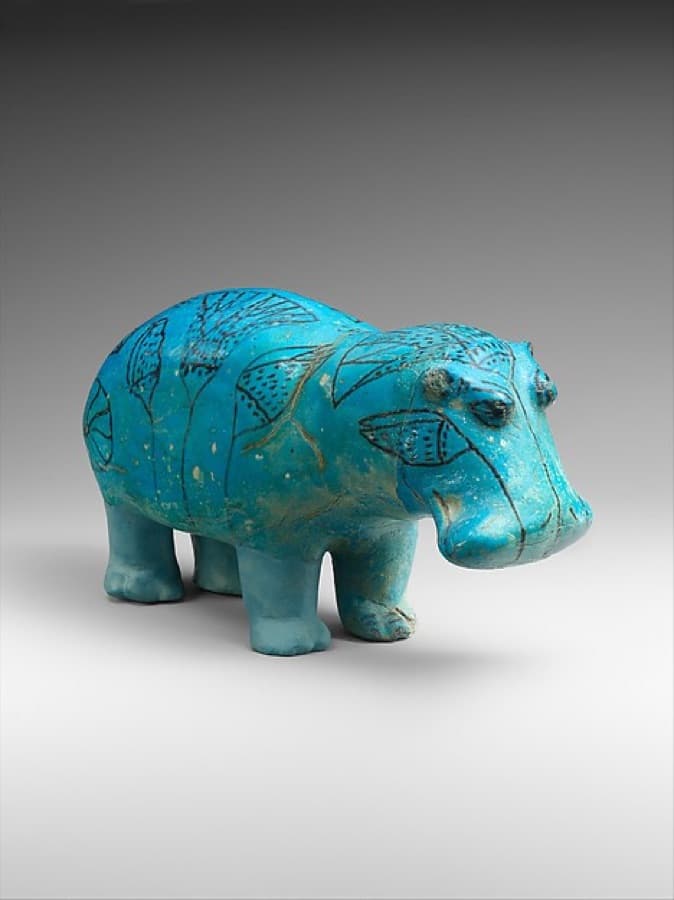
William the hippo is on Floor 1 of The Met Fifth Avenue, in Gallery 111, the Middle Kingdom gallery of the Egyptian wing, as of October 2026. He is a faience figure about twenty centimetres long, made in Dynasty 12, about 1961 to 1878 BCE, and found in 1910 in a burial at Meir in Middle Egypt. His name comes from a 1931 story in the British magazine Punch.
William, the little blue hippo, is on Floor 1 of The Metropolitan Museum of Art, in Gallery 111, the room of the Egyptian wing given to the Middle Kingdom. That is where the museum's open data placed him on 22 October 2026. He is small, about twenty centimetres long, so look for a bright blue animal among the kings and jewels.
What he is made of
William is faience, a glazed ceramic made from crushed quartz. Before the blue glaze went on, someone painted lotus flowers and buds on his body, so that he seems to stand among the plants of a river marsh. The lotus closes at dusk and opens at dawn, and for that reason it carried an idea of new life.
A charming figure of a dangerous animal
Hear a stop from this walk
African Burial Ground: The Ground Under the City
To Egyptians the hippopotamus was no pet. It was among the most dangerous animals they knew, able to overturn a small boat. William was one of a pair placed in a burial shaft of a steward named Senbi at Meir, in Middle Egypt, in Dynasty 12, about 1961 to 1878 BCE.
Look at his legs
Only his front left leg is original. The other three were probably broken off on purpose in antiquity, so that the animal could not hurt the man he was buried with, and they have since been restored.
Where the name came from
He was found in 1910, in the Khashaba excavations at Meir, and given to the museum in 1917 by Edward S. Harkness. The name came later. In 1931 the British humour magazine Punch printed a story about a family who kept a colour print of the hippo and treated it as an oracle. The nickname William comes from that story. The museum reprinted the story in its Bulletin the same year, and the name has stayed with him ever since.
What else is in Gallery 111
The Middle Kingdom, nearly four thousand years ago, was an age of strong kings and fine craft, and the room shows both. A sphinx of Senwosret III has a lion's body and a king's careworn face, with heavy eyelids and a downturned mouth; scholars still argue about what that face was meant to say. The jewellery of Princess Sithathoryunet includes a pendant about eight centimetres wide set with about three hundred and seventy cut stones, found in 1914 in a niche of her tomb that ancient robbers had missed. And there is an ebony game board with pins shaped like hounds and jackals, found by Howard Carter and the Earl of Carnarvon in 1910.
How this fits the Roamer guide
William is a stop on "The Met in an Hour", and he leads "Small Wonders", the route of eleven small pieces for a close look, in Roamer's independent audio guide to The Met. Open Gallery 111 and play its story, or start a route: The Met guide. For the rest of the museum, wing by wing, read what to see at The Met.
Cover image: The Met's Open Access program (CC0).
Ready to experience it?
Lower Manhattan: Wall Street to the World Trade Center
110 min · 3.5 km · easy
More from New York
Explore more at your own pace.
MoMA: What to See, Floor by Floor, and Where the Famous Paintings Hang

Monet's Water Lilies at MoMA: The Room, the Fire and the Pond
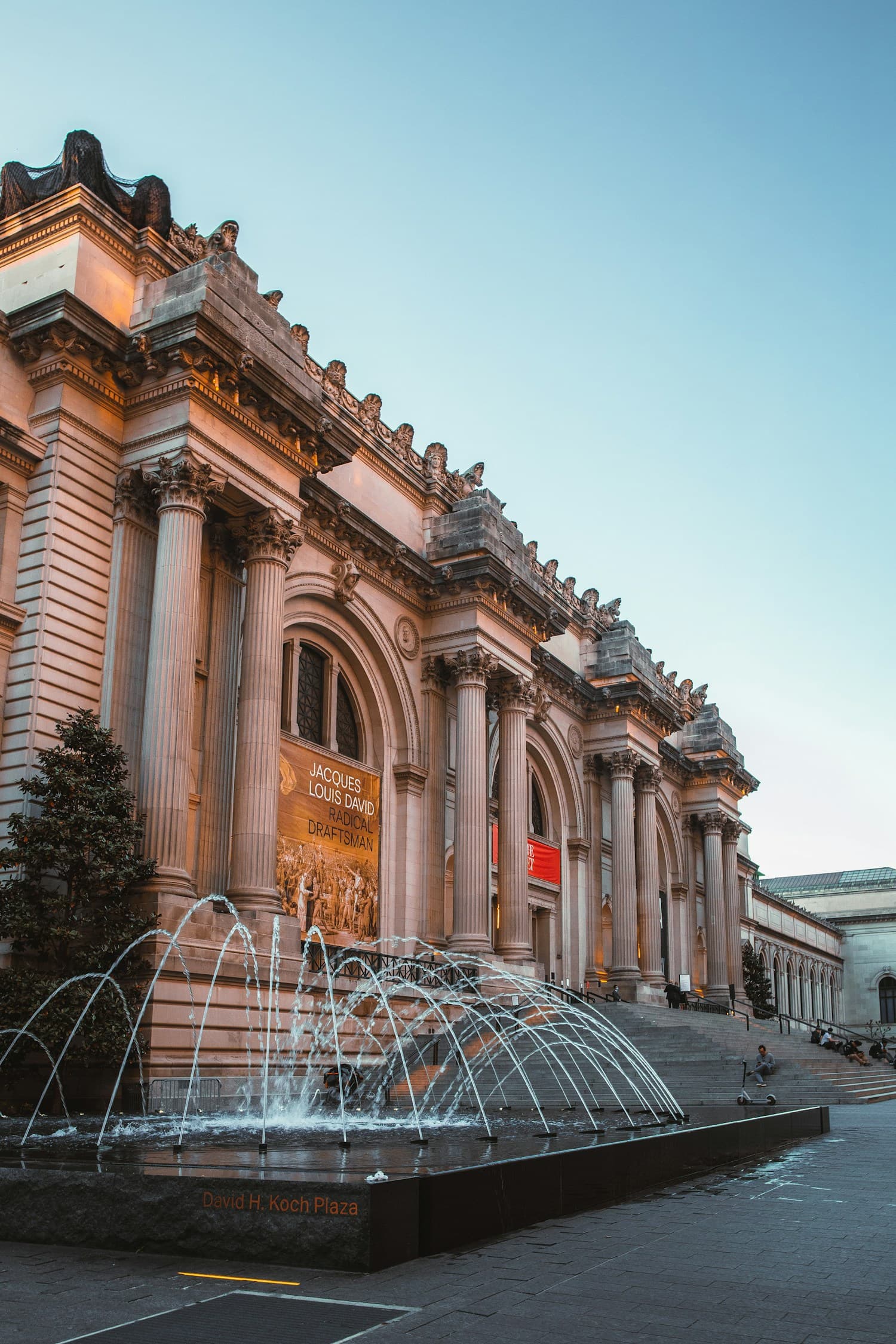
The Met: What to See, Wing by Wing, and Where the Famous Works Are
The Starry Night at MoMA: Where It Hangs and What to Look For
The Temple of Dendur at The Met: Where It Is and What to Look For