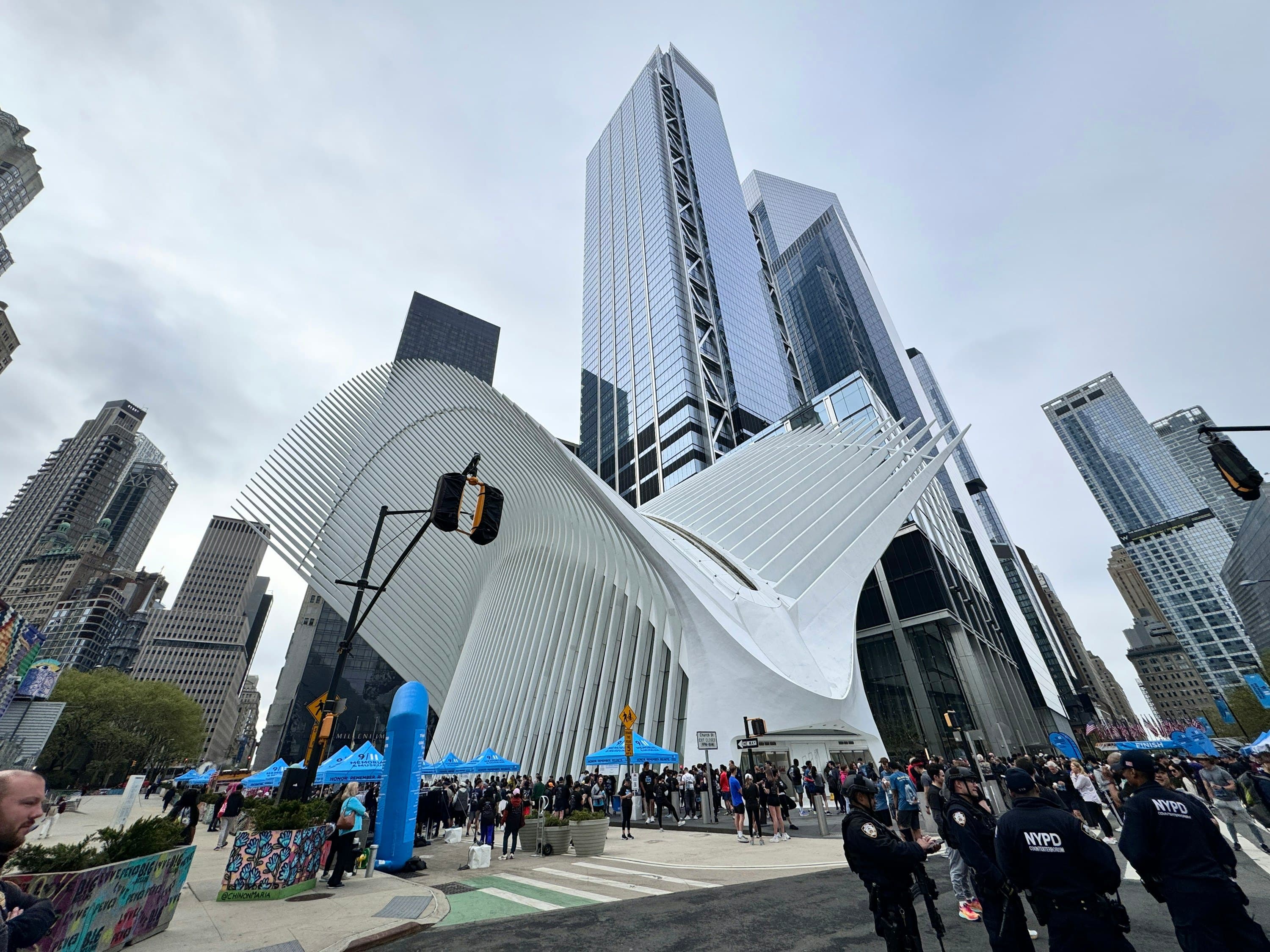
Lower Manhattan: Wall Street to the World Trade Center
110 min · 3.5 km · easy
New York's food is immigrant food, perfected and made cheap. The three things the city is most famous for eating, the pizza slice, the bagel, and the pastrami sandwich, all arrived in someone's suitcase from somewhere else, then got refined by generations of people cooking for a fast, crowded, hungry city. Eating your way through New York is really reading its immigration history one bite at a time.
Here is what to eat, why it matters, and where the real versions come from. Almost all of it is cheap, which is the point.
The pizza slice
Start here, because it is the most New York thing you can eat. A proper slice is a large, thin, foldable wedge cut from an 18-inch pie, crisp along the outer edge and soft enough underneath the toppings to fold in half lengthwise. You fold it so you can eat a big floppy slice one-handed while walking, which is exactly how a city in a hurry wants its food.
That fold is not a New York invention. It comes from Naples, where folding a slice to eat on the go, "pizza al portafoglio," predates the New York version. New York-style pizza itself descends directly from Neapolitan pizza: the first pizzeria in the United States, Lombardi's, was opened in 1905 in Little Italy by Gennaro Lombardi, an immigrant pizzaiolo from Naples.
The other essential New York pizza fact is the dollar slice. Cheap plain cheese slices became a citywide staple, popularized by shops like 99 Cent Fresh Pizza in the early 2000s and 2 Bros. Pizza during the 2008 recession. The dollar-ish slice is the great equalizer: grab, fold, eat, keep moving. It is also the cheapest good meal in the city.
You will pass slice shops all over downtown, including on our Greenwich Village walking tour, where the low-rise streets are dense with them.
The bagel
Hear a stop from this walk
African Burial Ground: The Ground Under the City
The second thing to eat is a proper New York bagel, and the word that matters is boiled. A real New York bagel is boiled in water before baking. That step gelatinizes the starches on the surface and gives the bagel its signature firm, glossy crust and dense, chewy interior, the opposite of the soft bread-roll versions sold elsewhere. Many old-school shops still hand-roll the dough by hand.
Bagels arrived with Jewish immigrants from Poland and Ukraine in the late 1800s, sold from pushcarts on the Lower East Side as cheap, filling food before the first dedicated bagel bakeries opened in the early 1900s. New Yorkers will swear the local water is the secret. Bakers are more honest about it: the water plays a minor role, and the boiling and hand-rolling are what actually make the bagel.
Order it the classic way, a plain or everything bagel with cream cheese, or go for lox, the cured salmon that pairs with it. It is a breakfast that costs a few dollars and is unmistakably New York.
The deli: pastrami and corned beef on rye
The third classic is the Jewish deli sandwich: pastrami or corned beef, piled high on rye with mustard. This is Lower East Side food, born of the same wave of Eastern European Jewish immigration that gave the city its bagels.
The most famous example is Katz's Delicatessen, established in 1888 on the Lower East Side, still at the corner of Houston and Ludlow Streets, and still hand-carving pastrami that many consider the best in New York. It serves something on the order of 15,000 pounds of pastrami a week. It is touristy, it is not cheap by slice-and-bagel standards, and it is worth it once, both for the sandwich and for the room, which has barely changed in a century.
The Lower East Side is not on any of our routes, but it is a short subway ride from the end of our Lower Manhattan walking tour, which starts at Castle Clinton, where some eight million immigrants landed before Ellis Island. The neighborhood's history of arrival and reinvention is exactly what makes the food make sense.
Eating by neighborhood
Beyond the three classics, New York's real edge is depth: entire cuisines living in their own neighborhoods, cooked for the communities that brought them, and priced accordingly.
- Chinatown for dumplings, hand-pulled noodles, and roast meats, some of the best cheap eating in the city.
- The Lower East Side for Jewish deli, pickles, and the layered food history of the old immigrant quarter.
- Little Italy and the old Italian streets for the Neapolitan roots of that pizza slice.
- Food halls, scattered across the city, which pack many kitchens under one roof and are an easy way to graze several cuisines in one stop.
Wandering these neighborhoods on foot is the best way to eat well and cheaply, which is one more reason New York rewards walking. Our one day in New York itinerary builds meals into the route, and the New York travel guide covers how to get between the food neighborhoods on a flat 3-dollar subway ride.
Eat as you walk
The best way to eat New York is on foot, slice in hand, with somewhere to be. Every Roamer walking tour is self-guided and GPS-triggered, so you can pause at a bakery, grab a bagel, and pick the narration back up when you are ready. Browse the full list of New York walking tours and start any one for free in the Roamer app.
Frequently asked questions
- What food is New York famous for?
- Pizza by the slice, bagels, and pastrami or corned beef on rye from a Jewish deli are the three classics. All three are immigrant foods that New York made its own: the folded slice descends from Naples, the boiled bagel from Eastern European Jewish bakers, the pastrami sandwich from the Lower East Side. Beyond those, New York's real strength is depth, with world-class Chinese, Italian, and dozens of other cuisines in their own neighborhoods.
- What is a New York pizza slice and why do people fold it?
- A New York slice is a large, thin, foldable wedge cut from an 18-inch pie, crisp at the edge and pliable under the toppings. People fold it lengthwise because it lets you eat a big floppy slice one-handed while walking, and because that is how it was done in Naples, where folding a slice to eat on the go predates the New York version. The city's dollar-slice shops made the fold-and-walk slice a cheap daily staple.
- What makes a New York bagel different?
- The boiling. A true New York bagel is boiled in water before it is baked, which gelatinizes the surface starches and gives it a firm, glossy crust with a dense, chewy interior. Many old-school shops still hand-roll them. The local water is often credited, but bakers agree the boiling and hand-rolling matter far more than the water.
- Where do you eat like a local in New York on a budget?
- The cheapest authentic eats are the slice shops, the bagel counters, the delis, and the immigrant neighborhoods: Chinatown for dumplings and noodles, the Lower East Side for Jewish deli, and the food halls scattered across the city. A dollar-ish slice, a bagel, or a shared plate in Chinatown all deliver a real New York meal for a few dollars.
Ready to experience it?
Lower Manhattan: Wall Street to the World Trade Center
110 min · 3.5 km · easy
More from New York
Explore more at your own pace.

Best Self-Guided Walking Tours in New York (2026)
New York Travel Guide: How Many Days, Getting Around, When to Go
One Day in New York: A Walkable Itinerary That Actually Works
MoMA: What to See, Floor by Floor, and Where the Famous Paintings Hang

Monet's Water Lilies at MoMA: The Room, the Fire and the Pond