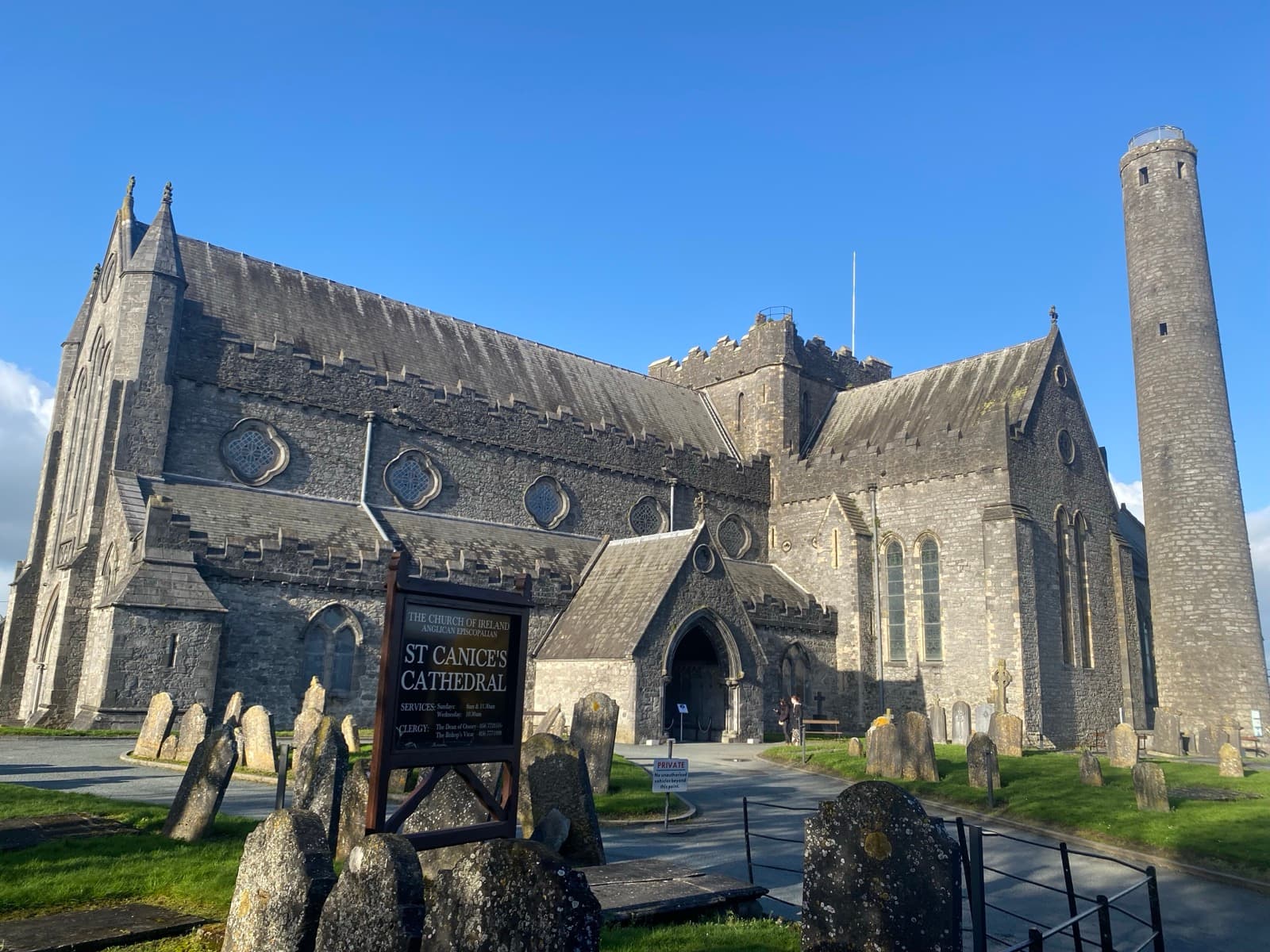
St Canice's Cathedral and its round tower stand on the hilltop where a sixth-century monastery gave Kilkenny its name, and that origin is the one thing to understand while looking up at them. Everything else in the city, the castle by the river, the merchant houses, the charters, the friars, came later. This hill came first. The Irish name of Kilkenny is Cill Chainnigh, which means simply the church of Canice, and the church of Canice is the building in front of you. Read the city backward from here and it makes sense: a saint's monastery on high ground, a settlement gathering below it, and a thousand years of Ireland growing outward from that seed.
The saint who named the city
Canice lived from roughly 515 to 600, one of the monastic founders of early Christian Ireland. He established the monastery on this hilltop in the sixth century, and the settlement that grew around it took its name from his church. There is a quiet completeness to that. A modern city of shops and streets and a busy castle still carries, in its name, the memory of a single monk who chose this rise of ground. When you say Kilkenny, you are saying the church of Canice, whether you know it or not.
The monastery itself is long gone. Early Irish monastic buildings were modest, often timber, and rarely survived the centuries. What survives from that first age is the tower.
The oldest thing in Kilkenny
Hear a stop from this walk
Saint Canice's Cathedral and the Round Tower: The Thousand-Year Church That Named the City
Beside the cathedral stands a round tower, about thirty metres high, dated to around the ninth century. It is the oldest standing structure in the entire city. Older than the cathedral. Older than the Butler castle. Older than every wall and lane and slip you might have crossed to get here. When it was raised, the Anglo-Normans who built the castle and laid out the medieval town were still four hundred years in the future.
Round towers are Ireland's own contribution to medieval architecture, tall tapering cylinders attached to monastic sites, built between the ninth and twelfth centuries. This one narrows as it climbs, from about four and a half metres in diameter at the base to a little over three metres near the top. Their exact purpose is debated. They served as bell towers and as landmarks visible for miles, and their high doorways and internal ladders made them refuges in trouble, though the popular image of monks hiding from Vikings is more legend than settled fact. What is certain here is the endurance: this shaft of stone has stood on this hill for more than a thousand years while everything around it was built, burned, rebuilt, and renamed.
The tower can still be climbed, up one hundred and twenty-one steps and a series of internal ladders across seven levels. It is one of only a small number of round towers in Ireland that visitors can still ascend to the top. Another is at Kildare, beside St Brigid's Cathedral, and a third stands on Devenish Island in County Fermanagh. If you make the climb here, the reward is the medieval town read from above: the castle, the High Street spine, the cathedral roof at your feet, the countryside beyond.
A cathedral built, broken, and rebuilt
The cathedral you see is younger than the tower but old by any other measure. This Church of Ireland cathedral was built roughly between 1202 and 1285, a great Gothic church raised over more than eighty years on the site of Canice's monastery. It is a solid, early Gothic building, more austere than soaring, and it holds one of Ireland's finest collections of medieval funerary monuments, the carved tombs of the families who ran the medieval city.
The cathedral's long life has included two documented catastrophes worth knowing as you stand before it. In 1332 the central tower of the cathedral collapsed, an event the cathedral's own history ties to the notorious witchcraft trial of Dame Alice Kyteler, one of the earliest such cases in Ireland. The tower was much taller then, and when it fell it came down into the choir and side chapels, substantially demolishing them. Then, in 1650, Oliver Cromwell's forces captured Kilkenny and wrought extensive devastation on the cathedral. It was left abandoned and roofless for twelve years before restoration began. The building has been damaged and repaired across seven centuries, which is part of why it repays a slow look: much of what you see is medieval fabric that survived, patched and carried forward by each generation that refused to let the church of Canice fall.
What to understand standing in front of it
If you take one idea away from this hilltop, let it be sequence. The tower is the ninth century. The cathedral is the thirteenth. The name Cill Chainnigh reaches back to the sixth. And the whole living city below, everything with a Kilkenny address, is the outward growth of what began on this ground. Most cities forget their origins. Kilkenny wears its origin in its name and keeps its oldest stone standing in plain sight. That is the rare thing here, and it is free to see. The cathedral and the tower climb each charge a small entry fee of a few euro, but the churchyard, the tower's silhouette, and the sense of a thousand years compressed into a single view cost nothing at all.
Come in the morning if you can, before the coach groups reach the hill, and try to arrive outside service times so you can move quietly through the nave. This is an active place of worship, so keep your voice low. Give the tombs their due, read a few of the carved faces, and if the ladders are open and you have the legs for them, climb.
Walk the whole mile to it
St Canice's is the final stop and the origin point of the Kilkenny Medieval Mile, the self-guided walking tour that reads the city end to end, from the Butler castle on the river Nore up the hill to this cathedral. Arriving here on foot, after the castle, the old town hall, the Tudor merchant houses, the citizens' church, and the friars' abbey, is what makes the hilltop land. You feel the arc close: you have walked through a thousand years of the city and finished at the sixth-century church that started it. To plan the route and read every stop along the way, see our guide to Kilkenny walking tours, or browse everything on offer in Kilkenny. Then walk the mile at your own pace, and let the tower be your finish.
Sources
- St Canice's Cathedral, official history page. Documents the 1332 central tower collapse into the choir and side chapels, tied to the Alice Kyteler witchcraft trial, Cromwell's 1650 devastation, and the twelve roofless years.
- St Canice's Cathedral, "Round Towers of Ireland: Why St Canice's is So Special." Confirms the ninth-century tower as one of the very few climbable round towers in Ireland, reached by 121 steps and internal ladders.
- Wikipedia, "St Canice's Cathedral." Overview of the thirteenth-century Gothic cathedral, its 1202 to 1285 build dates, the thirty-metre ninth-century round tower, and the climbable round towers at Kildare and Devenish.
- Tuatha.ie, St Canice's Cathedral and Round Tower visitor guide. Source for the tower's height and its taper from about four and a half metres to a little over three metres across seven floors.
- Roamer tour transcript, "The Medieval Mile: Castle to Cathedral" (fact-audited). Primary source for Canice's dates, the Cill Chainnigh naming, and the tour's stop sequence.
Ready to experience it?
The Medieval Mile: Castle to Cathedral
120 min · 2.3 km · moderate
More from Kilkenny
Explore more at your own pace.
Kilkenny Travel Guide: Days, Transport, Best Time, Safety, and Budget
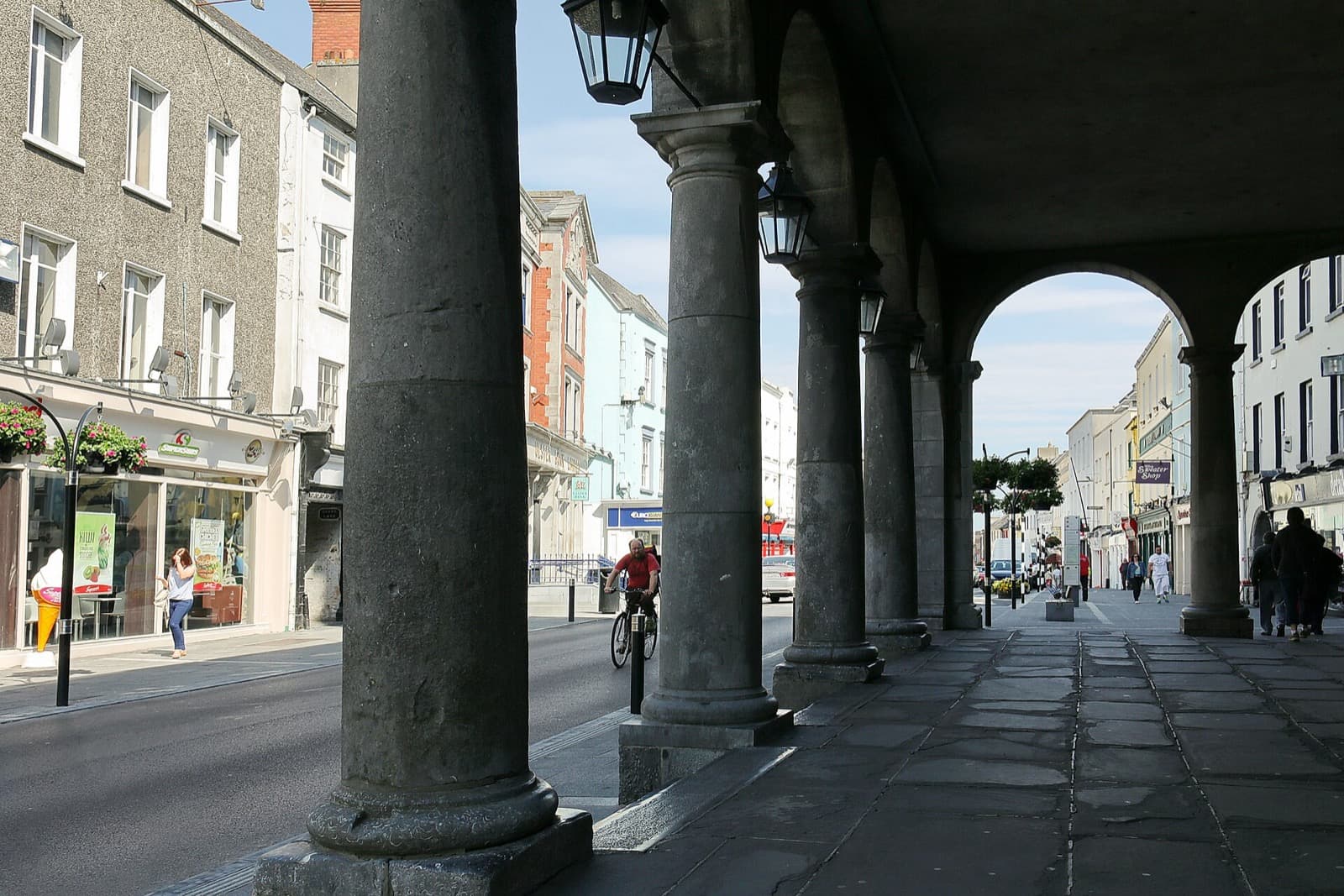
One Day in Kilkenny: A Walkable Medieval Mile, Morning to Evening
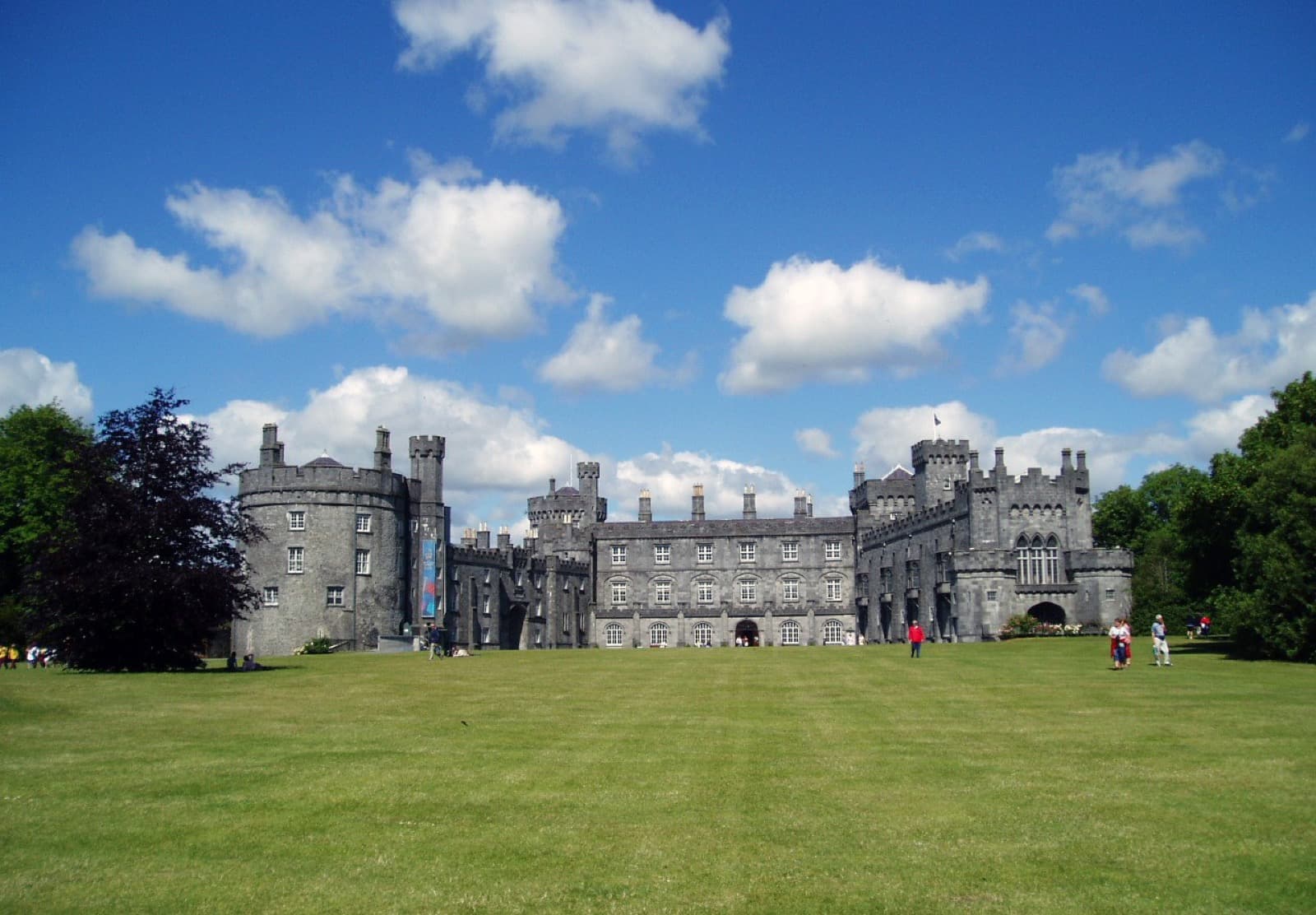
Kilkenny: Ireland's Medieval Capital in a Single Mile
Kilkenny Castle and the Medieval Mile: One River Crossing, One Family, Six Hundred Years
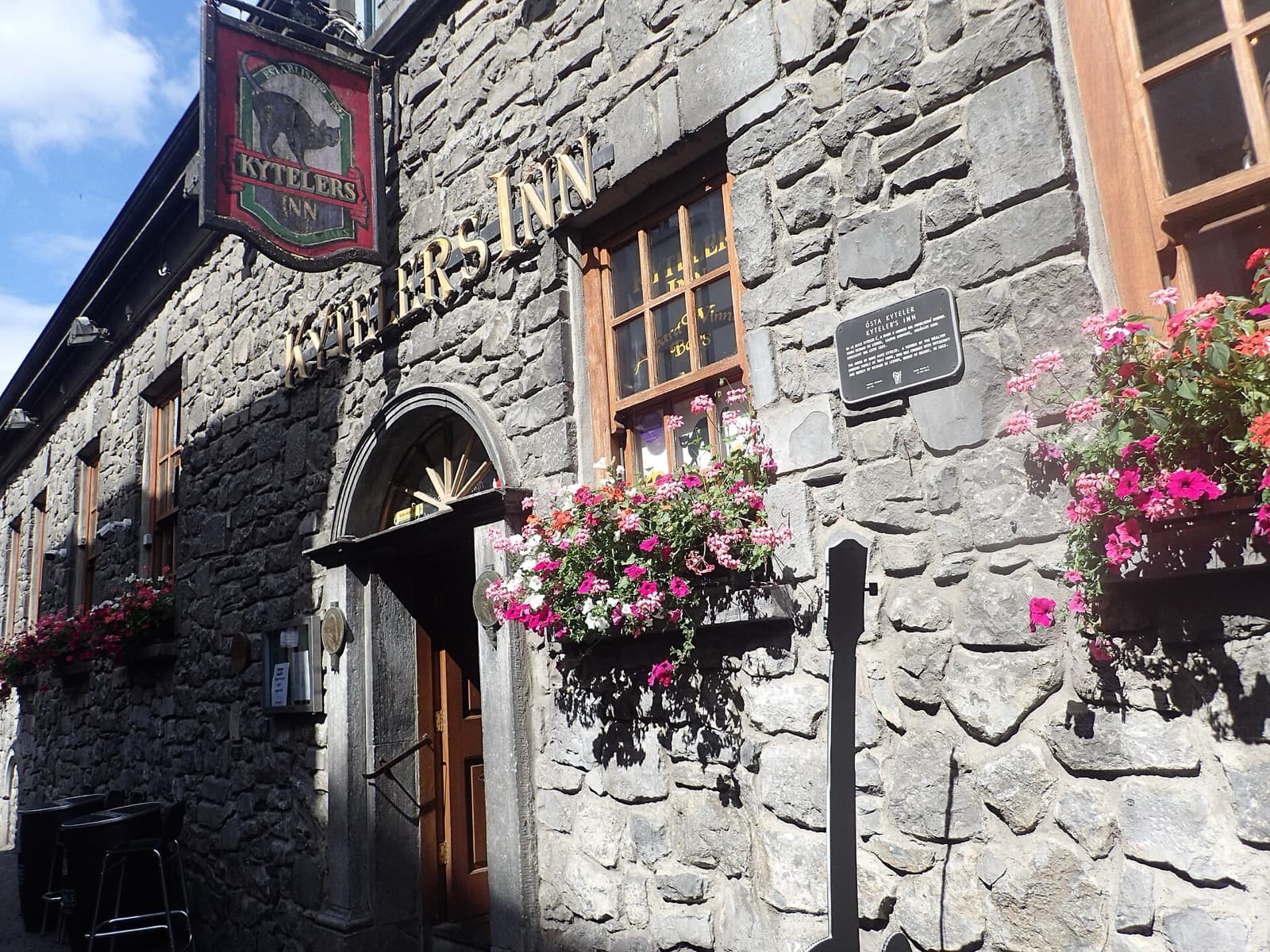
Kyteler's Inn and the Servant Who Burned in Kilkenny's Place