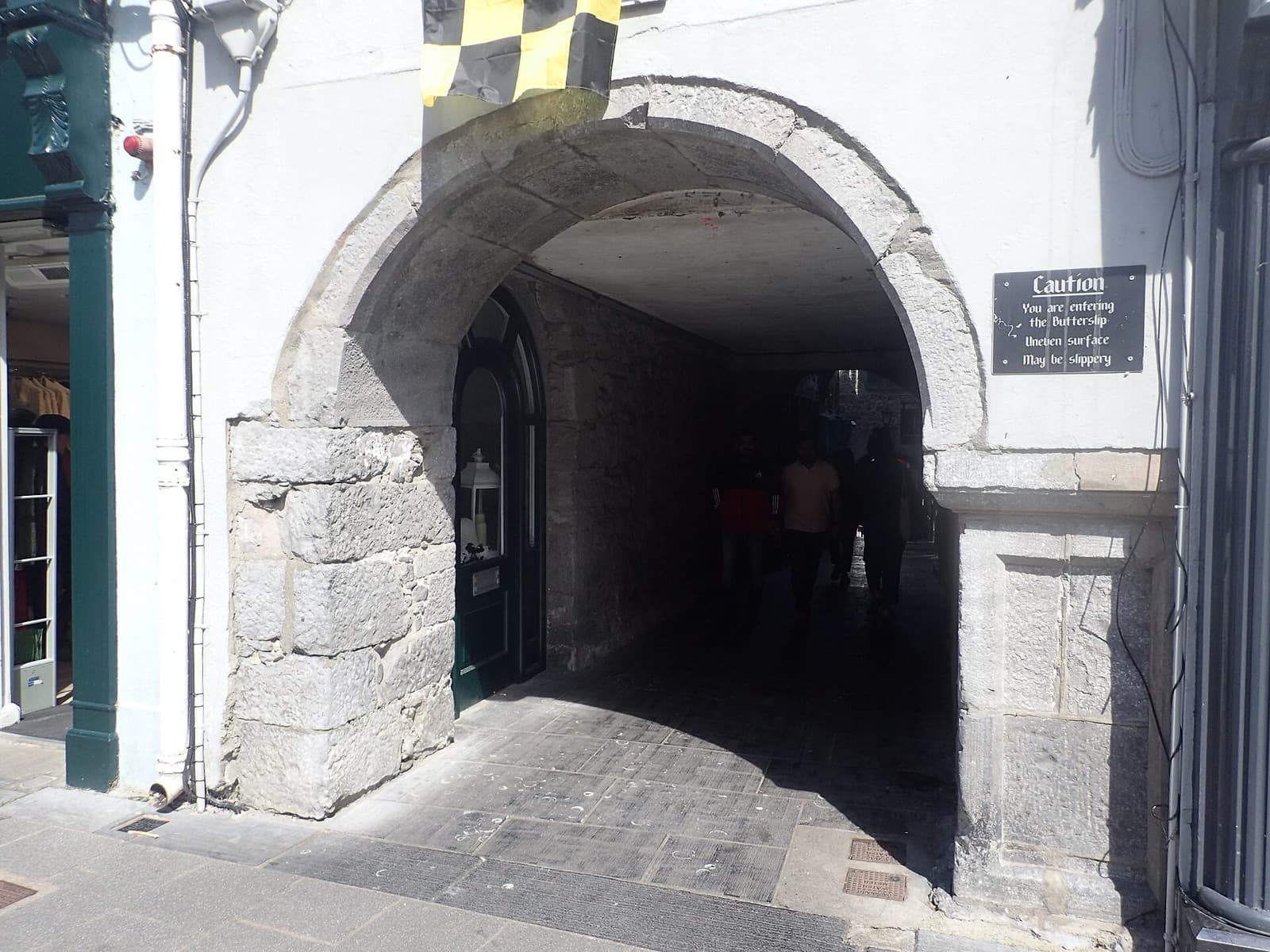
The Butter Slip, built in 1616, is the best-known of the narrow stepped passages that Kilkenny locals call slips, and standing at its mouth tells you more about the working city than the postcard Medieval Mile ever will. It is a dark lane that ducks under two connected houses and runs between High Street and Saint Kieran's Street, and its name is exactly what it sounds like. On market days the butter vendors sold their wares here, in the cool shade of the passage, out of a sun that would have spoiled their goods. That is the whole plain fact of the place, and it is a better story than any invented legend.
What a slip actually is
To read the Butter Slip properly, you have to understand what it belongs to. In Kilkenny, a slip is the local name for a narrow medieval passage, and the city is threaded with them. They are the hidden grain of the medieval town: the tight service lanes that run between the grander parallel main streets, carrying traders, servants, and the poor about their daily business. The city you see on a tourist map has two or three broad ceremonial streets climbing the hill from Kilkenny Castle to Saint Canice's Cathedral. Between and beneath those streets ran the real circulation system of a merchant town, and the slips are what survive of it.
The Butter Slip is the most photographed and the best known of them all, but it is not a museum piece. It remains a public right of way, a working shortcut that people still use to cut between one street and the next. It links High Street with Saint Kieran's Street, which was once called Low Lane, a name that quietly records the social geography of the old town: the high street above, the low lane below, and a stepped passage joining them in the shade.
The one thing to understand standing in front of it
Hear a stop from this walk
The Butter Slip: Down the Lane of the Butter Sellers
Here is the detail worth carrying with you. The slip was named for commerce, not ceremony. Butter is a perishable good, and in the centuries before refrigeration a butter seller's entire livelihood depended on keeping the product cool through a market day. The shaded stone passage did that work. It was, in the plainest sense, a piece of practical infrastructure: a place cool enough to trade in butter without losing it to the sun. When you stand in the arch and feel the temperature drop a few degrees, you are feeling the exact reason the vendors chose this spot.
That is why the Butter Slip is the right place to begin reading the other Kilkenny. The marquee mile above is about castle and cathedral, about power and worship. The slip is about a woman selling butter and needing shade. Both are true, and the second is easier to forget because nobody built a monument to it. The passage itself is the monument, and it has kept the name of the trade for more than four hundred years.
Take the legend with a grain of salt
There is a story, repeated in guidebooks, that a merchant named Nicholas Langton had the slip paved. It is a pleasant tale, and you will hear it told with confidence. It belongs to guidebook tradition rather than to the documentary record, so it is best held as a nice story rather than a settled fact. The honest version of the Butter Slip does not need the embellishment. What is certain is enough: a dated medieval passage of 1616, a trade that gave it its name, and a stepped lane that has carried foot traffic between two streets ever since. The Buildings of Ireland heritage register records the slip on Saint Kieran's Street, and the plain facts hold up on their own without the merchant's flourish.
This restraint matters more than it might seem, because Kilkenny attracts the kind of tourism copy that reaches for drama. The next stop along this walk, the site linked to Dame Alice Kyteler, is one that most guidebooks get badly wrong, dressing a real judicial killing as a ghost-tour thrill. Beginning at the Butter Slip, a place with a modest and verifiable story, sets the honest tone for everything that follows. You learn to trust the plain fact over the flourish.
Walking the slip
The Butter Slip is stone-stepped, and it can be slick after rain, so it rewards shoes with good grip and a little care on the stairs. It is free, a public laneway with no gate and no charge, and there is no group waiting at the top of the steps to move you along. That is the point of walking it slowly. Stand in the cool of the arch, look at how the medieval city closes in around you, and notice that the passage is doing today exactly what it was built to do: carry people quietly between two busier streets.
From here the rest of the walk opens out. The slips set the tone, and the story climbs from a burned servant to a merchant's almshouse, from a Norman keep turned county jail to a brewing friary by the river, and finally to the few years when this river town was the effective capital of Catholic Ireland. Each of those stops belongs to the same underlife the Butter Slip introduces: the working, suffering, ordinary city that ran alongside the ceremonial one.
If you want to read the whole of that other Kilkenny in order, the Butter Slip is stop one on a self-guided audio walk that threads the slips, the lanes, and the riverbank at your own pace. You can browse the full set of Kilkenny walking tours or start from the Kilkenny city page and walk the slips route whenever you arrive. Stand in the arch first, feel the shade the butter sellers relied on, and then carry on when you are ready.
Sources
- Buildings of Ireland (National Inventory of Architectural Heritage): the Butter Slip, Saint Kieran's Street, Kilkenny. Heritage register entry documenting the passage and its listing.
- Roamer tour "Kilkenny Slips: The Witch, the Ale, and the Confederation": fact-audited narration for the Butter Slip and the wider slips route.
- Kilkenny Medieval Mile heritage materials: context on the city's parallel main streets and the network of medieval slips that connect them.
- Local guidebook tradition: the popular Nicholas Langton paving story, cited here as tradition rather than documented fact.
Ready to experience it?
Kilkenny Slips: The Witch, the Ale, and the Confederation
100 min · 1.9 km · moderate
More from Kilkenny
Explore more at your own pace.
Kilkenny Travel Guide: Days, Transport, Best Time, Safety, and Budget
One Day in Kilkenny: A Walkable Medieval Mile, Morning to Evening
Kilkenny: Ireland's Medieval Capital in a Single Mile
Kilkenny Castle and the Medieval Mile: One River Crossing, One Family, Six Hundred Years
Kyteler's Inn and the Servant Who Burned in Kilkenny's Place