Sunda Kelapa is the harbour that explains the entire city built south of it. Stand at the edge of the working quay in Jakarta's Old Town and you are looking at the reason the pastel plaza, the old City Hall, the colonial courthouse, and the last Dutch drawbridge exist at all. Every power that came to this stretch of the Java coast came for this water: the Sunda Kingdom, the Portuguese, the Demak Sultanate, and finally the Dutch East India Company. The offices and cells inland were built to administer what moved across this quay. This is a spice harbour older than the empire that seized it, and it is still loaded by hand today.
A port before the Dutch, before Batavia, before the name Jakarta
The harbour was the main port of the Sunda Kingdom from roughly the thirteenth to the sixteenth centuries. It ran on the international spice trade, especially pepper, dealing with European buyers alongside other Indonesian ports of the era such as Aceh and Makassar. It was not a fishing village that grew into something. It was already a functioning maritime trade hub, connected up the Ciliwung River to an inland capital, when the first Europeans arrived to negotiate for access.
That access is worth tracing as a sequence, because it makes clear that Sunda Kelapa was the prize and everyone knew it. In 1522 the Portuguese secured an agreement with the Sunda Kingdom for a foothold at the port. Five years later, on the twenty-second of June, 1527, a commander named Fatahillah, acting for the Demak Sultanate, captured the port and renamed it Jayakarta. That single date carries an outsized weight in the city: it is celebrated today as Jakarta's official anniversary. The name Jayakarta is the root of the modern word Jakarta itself. So the city's birthday and its name both come from the conquest of this harbour, not from anything the Dutch later built inland.
The Dutch came for the same reason and took it more violently. In 1619 Jan Pieterszoon Coen, governor-general of the Dutch East India Company, seized the port and established Batavia over the ruins of Jayakarta. Everything the walk covers, the head office with cells in its cellars, the arcades where clerks kept the ledgers, the courthouse that handed down colonial justice, was raised on the strength of this quay. The harbour was the point. The company town was the paperwork.
What "hand-loaded" actually means when you see it
Hear a stop from this walk
Taman Fatahillah: The Front Office of an Empire
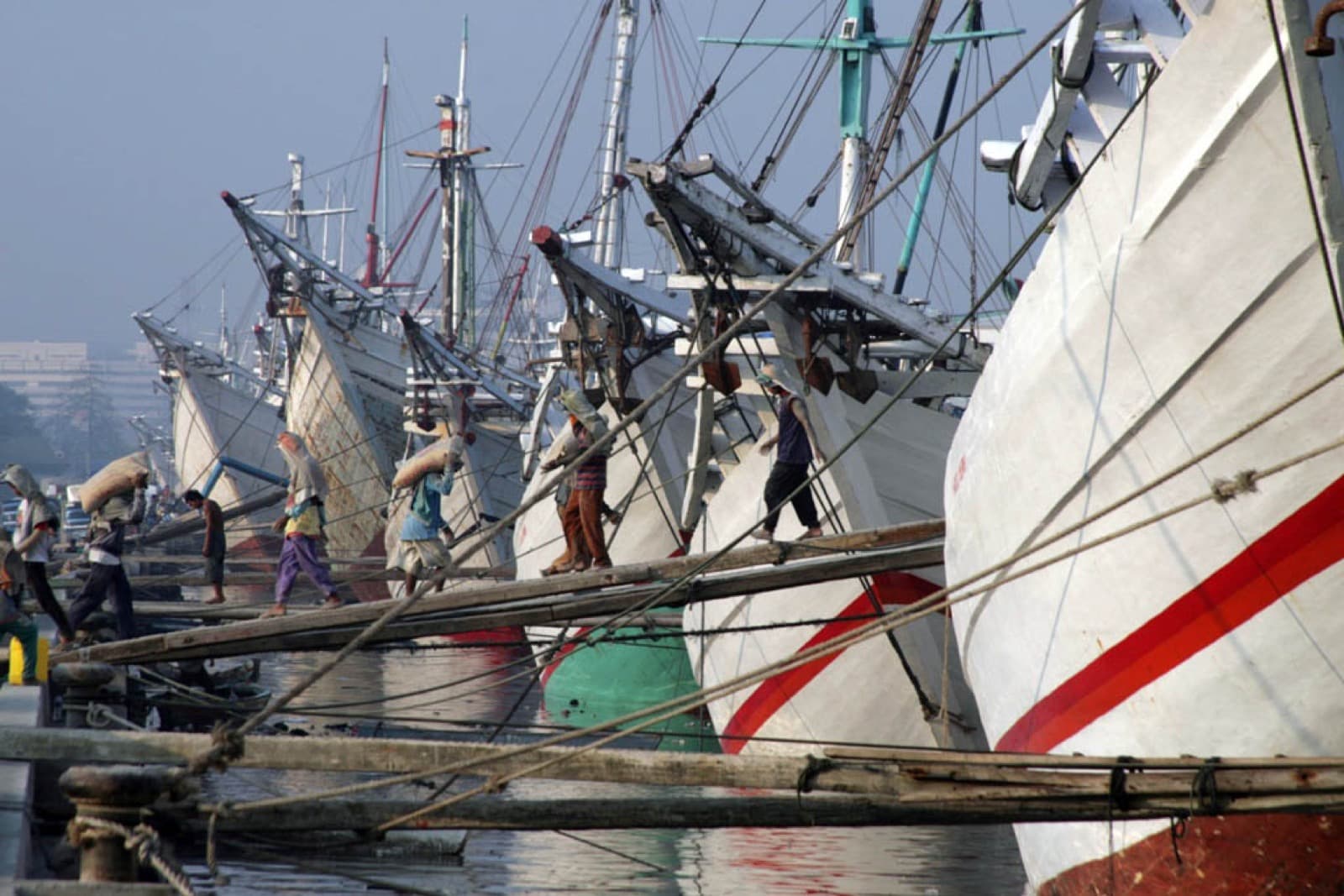
The most striking thing about Sunda Kelapa is not that it is old. It is that it still works, and it works by a method that looks almost unchanged. The harbour handles the pinisi, traditional two-masted wooden sailing schooners tied to the shipbuilding tradition of Makassar in South Sulawesi. These are working freighters, not museum pieces. They carry cargo between Indonesia's islands, and they are still loaded and unloaded largely by hand: sack by sack, plank by plank, along narrow gangplanks between the deck and the quay.
The craft behind these ships carries a distinction worth knowing before you stand in front of one. In 2017, UNESCO inscribed "Pinisi, art of boatbuilding in South Sulawesi" on its Representative List of the Intangible Cultural Heritage of Humanity. What that recognizes is the boatbuilding tradition itself. Sulawesi's shipwrights build hull-first, assembling a shell of planks and only later inserting the internal frames, a reversal of the Western frame-first technique, with proportions carried in the memory of master builders rather than drawn on paper. The vessels working this harbour are the living end of that tradition. When you watch a crew walk cargo up a plank, you are watching a maritime economy that predates the containerized port a short distance east and still finds enough work to keep sailing.
Why the harbour is the last stop, not the first
By 1885 the newer Tanjung Priok port had opened a short distance east, built for steamships and, eventually, containers. That is where Jakarta's heavy sea trade went, and where most of it still is. The old harbour could have become irrelevant. Instead, after Indonesian independence, it took back the name Sunda Kelapa, reclaiming the identity it carried centuries before the Dutch renamed the town. The name is a deliberate honoring of its role as the cradle of Jakarta.
This is why walking the tour to the harbour last, rather than starting there, changes what the whole route means. Along the way the Jakarta walking tours route through the Old Town reads as a study of power on land: a corporation's front office, its bookkeeping arcades, the grave of the man who razed Jayakarta, a courthouse, a drawbridge over a canal that no longer carries trade. Each of those places is inland. Each was built to manage something. When you finally reach Sunda Kelapa, the object all that management existed to control is right in front of you, on the water, and it turns out to be older than any of it. The pastel square is the administration. The harbour is the thing being administered.
Standing at the quay: the one thing to understand
If you take away a single idea here, make it this: the trade at the root of the pretty square is not a historical abstraction you have to imagine. It is physically present, ongoing, and unglamorous. The pepper and spices that drew the Sunda Kingdom's partners, the Portuguese, Fatahillah, and Coen are gone from these particular decks, but the logic that made this a port, deep enough water reached by a working channel, close to inter-island routes, is exactly what still keeps the pinisi coming in. The empire that built the offices inland has been gone for generations. The harbour is still here, still loading by hand, still doing the thing every conqueror wanted it for.
There is a practical note that matters at this stop. Sunda Kelapa is a live working port, not a viewing platform. Loading ropes, gangplanks, forklifts, and slippery quaysides are all in use, and crews are handling cargo by hand as you watch. A small entry fee of a few thousand rupiah is usually collected. Give the working crews room, keep your footing near the edge, and let the scene do its work. The reward for reaching the far end of the walk is seeing the answer to the question the whole Old Town poses without ever quite saying it out loud: what was all of this for. It was for this water.
To walk the full route, from the front office of the empire out to this hand-loaded harbour, start with the Kota Tua tour in Jakarta and take it at your own pace.
Sources
- Sunda Kelapa, Wikipedia. Port history under the Sunda Kingdom from the thirteenth to sixteenth centuries, the pepper trade alongside Aceh and Makassar, the 1522 Portuguese agreement, Fatahillah's 1527 capture, Coen's 1619 seizure, the 1885 opening of Tanjung Priok, and the post-independence return of the name.
- "Sunda Kelapa Harbour: Its Past and Present," Sunda Kelapa Heritage. First-hand account of the working harbour and its hand-loaded pinisi schooners.
- "Pinisi, art of boatbuilding in South Sulawesi," UNESCO Intangible Cultural Heritage list (inscribed 2017). Source for the 2017 inscription of the boatbuilding tradition.
- "Sunda Kelapa and the Birth of Jakarta," NOW! Jakarta. Context on the harbour as the origin point of the city and the 22 June 1527 anniversary date.
- Fatahillah Square, Wikipedia. Corroborates the 22 June 1527 date as Jakarta's official anniversary and the pre-Dutch history of the port.
Ready to experience it?
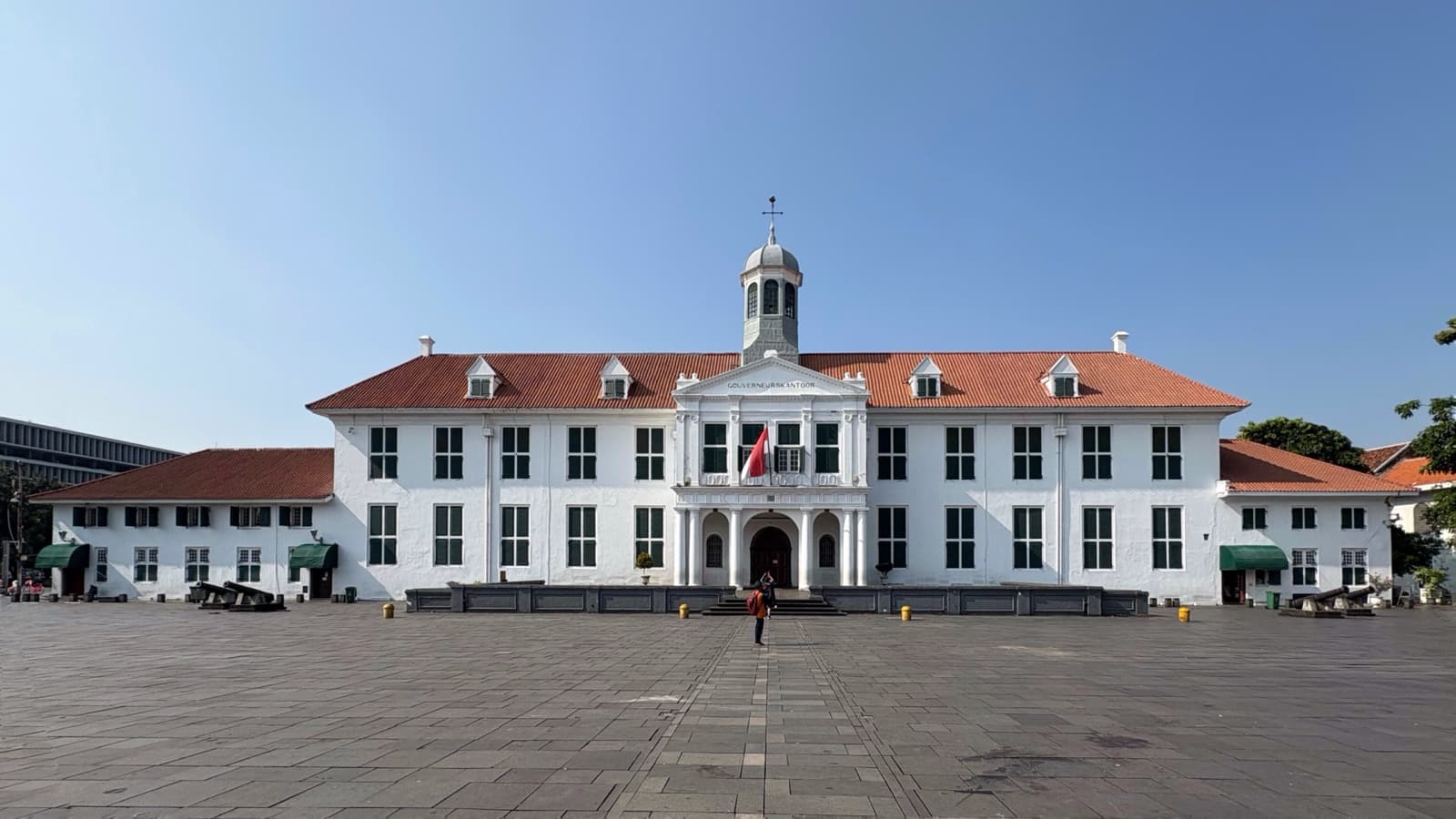
Kota Tua: The Company Town That Ran an Empire
90 min · 3.4 km · easy
More from Jakarta
Explore more at your own pace.
Jakarta Travel Guide: Days, Transport, Weather, Safety, Budget
One Day in Jakarta: A Walkable Morning-to-Evening Itinerary
Company Town and Square of Freedom: Reading Jakarta on Foot
The Istiqlal Mosque: A Mosque Named Freedom, Designed by a Christian
The Stadhuis of Batavia: Why Jakarta's Prettiest Square Was a Corporation's Head Office