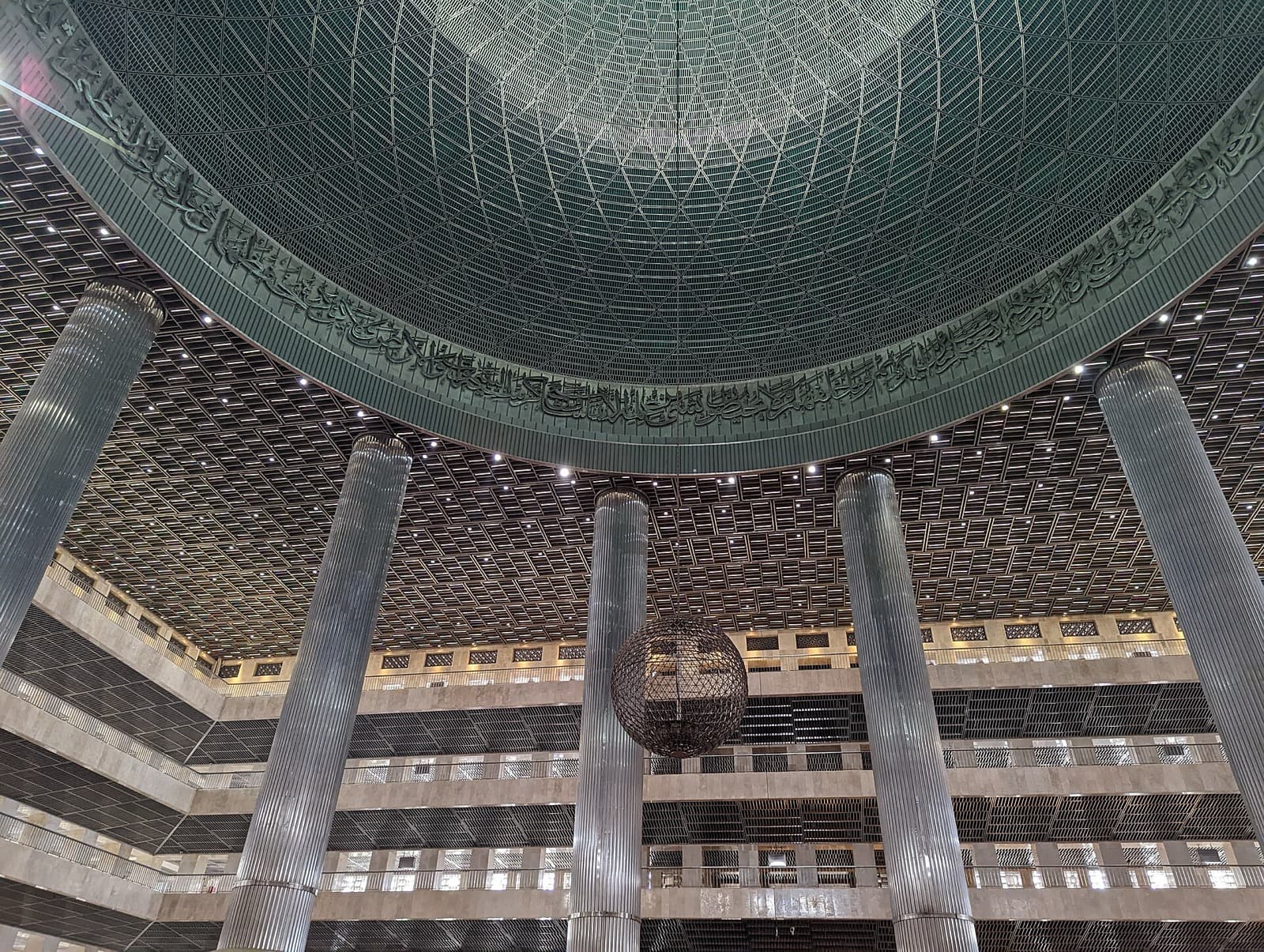
The Istiqlal Mosque in Jakarta is named for independence, it was designed by a Protestant Christian, and it was placed on purpose to face a Catholic cathedral across a single street. Those three facts sit on top of one another at one address, and once you see them together they read the whole square around them. This is the largest mosque in Southeast Asia, with room for about two hundred thousand worshippers, and it stands just off the northeast corner of Merdeka Square, the vast former Dutch parade ground that a colony turned into the stage for a republic. The mosque is stop five on the self-guided walk across that square, and it is the point where the tour's quiet argument becomes impossible to miss.
What the name is doing
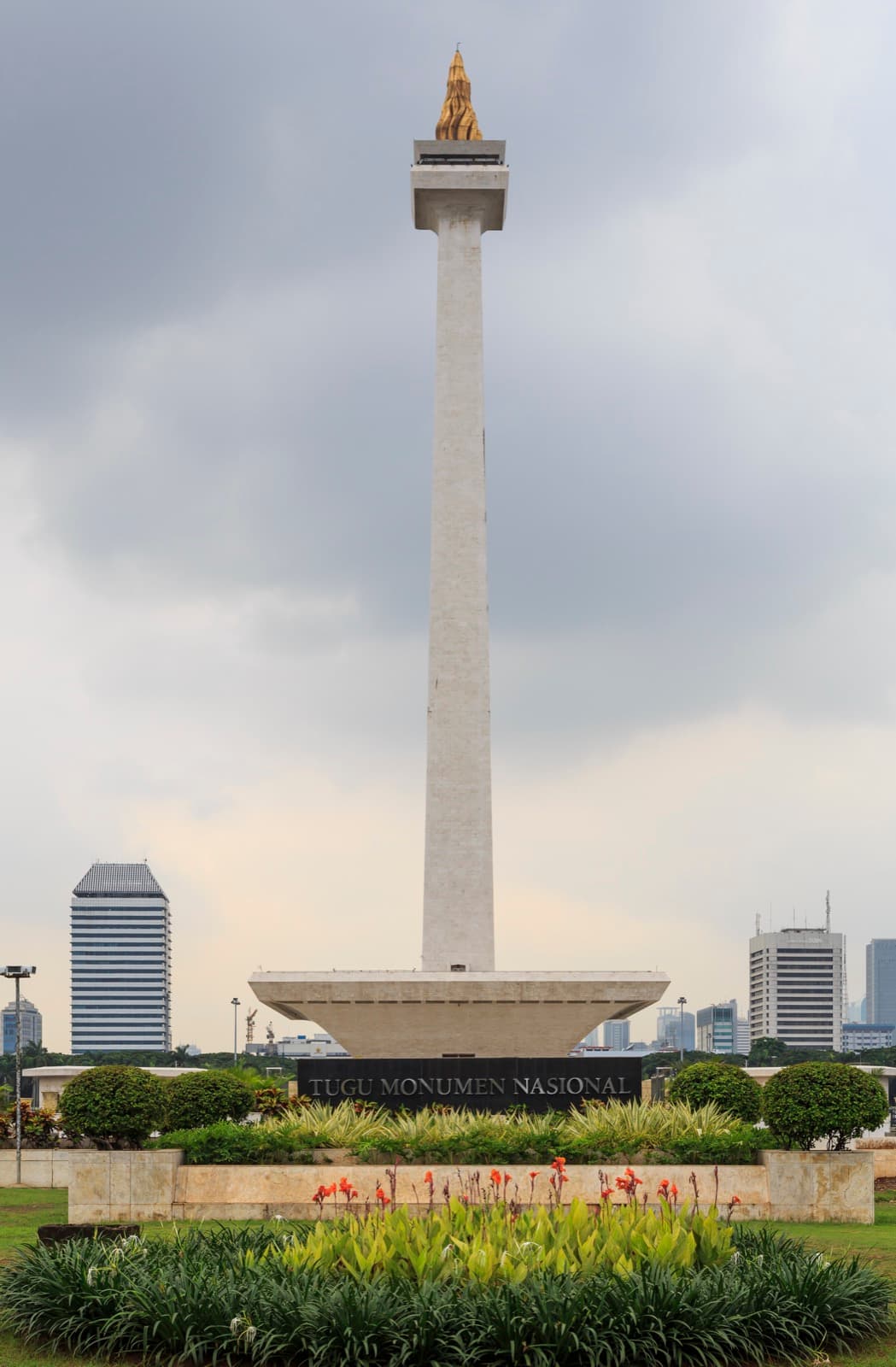
Istiqlal means Independence in Arabic. The mosque was built to commemorate the independence of Indonesia, and its foundation stone was laid by President Sukarno on the twenty-fourth of August in nineteen sixty-one. After roughly seventeen years of construction it was inaugurated on the twenty-second of February in nineteen seventy-eight. That timeline matters, because it puts the mosque in the same building season as the National Monument at the center of the square, whose construction Sukarno launched a week earlier, on the seventeenth of August nineteen sixty-one. A young nation was writing its founding ideas into stone across the same ground at the same time: a gilded flame at the middle of an old colonial field, and a house of worship at its edge, both carrying the word freedom in one form or another.
Naming a mosque Independence is not a neutral act. The Dutch built this whole quarter to display an empire. The square itself began as the Koningsplein, the King's Square, a military parade ground at the center of Batavia, the Dutch East Indies capital founded in sixteen nineteen. In nineteen forty-nine Sukarno renamed the parade ground Medan Merdeka, Independence Square. The mosque, going up a decade later, takes that same word and makes it Arabic. The ground says freedom, the flame at its center says freedom, and the mosque at its edge says freedom again in a second language. The repetition is the point.
The detail that ties the mosque to everything else
Hear a stop from this walk
The Jakarta Cathedral: The Church That Faces the Mosque
Here is the fact that reorganizes the entire walk once you know it. The architect of the Istiqlal Mosque was Friedrich Silaban, the same man who shaped the National Monument you passed at the center of the square. Silaban was a Protestant Christian, the son of a Lutheran pastor. A Christian designed the largest mosque in the region.
That is not a piece of trivia. It is the argument. A country that had just declared itself out from under a colonial power chose, for its grandest new mosque, an architect from a religious minority, and then set that mosque directly opposite the Catholic cathedral to symbolize coexistence. The placement was deliberate. Sukarno himself insisted the national mosque be built beside the Jakarta Cathedral, so that two rival faiths stand looking at each other rather than turning away. Once you have registered that Silaban was Christian, you cannot un-see it in the building. The mosque named for independence, in the newly independent nation, was drawn by a member of the faith worshiping across the road.
The everyday version of the same idea
The grand statement is written in the placement of the two buildings. There is also a small, daily version of it, and the Vatican's own news service has recorded it. On the great Christian holy days, at Christmas and at Easter midnight Mass, Christians use the mosque's parking lot. The courtesy is returned to Muslims at Eid, when the cathedral's parking serves the mosque's overflow crowds. Two congregations lend each other their car parks on their holiest days, a cooperation that has run for more than thirty years. It is an ordinary logistical arrangement, and it is exactly the coexistence the square was built to declare, worn down to the scale of where you leave your motorbike.
If you can time your visit for the days around a major Muslim or Christian holy day, you can watch the shared-parking custom happen, though those are also the most crowded days. Standing between the two, with the mosque named for freedom on one side and the cathedral built to face it on the other, is the clearest single reading of what this whole place is trying to say.
Visiting the mosque with respect
Non-Muslim visitors are welcomed at Istiqlal through a separate visitor entrance, the gate that faces the cathedral. Register at the information desk, where volunteers offer a free guided tour of about twenty minutes. Dress modestly, covering shoulders and knees. Robes are provided free at the entrance for anyone whose clothing does not meet the code, and women may be asked to wear a headscarf. You remove your shoes before the prayer hall. Plan the visit outside prayer times, because the mosque closes to visitors during the five daily prayers and especially the Friday midday Jumah prayer, when the guided tours pause entirely. Treat the people around you as worshipers at prayer, not as scenery for a photograph. The cathedral across the street is an active Catholic church and asks the same quiet respect: keep your voice low if a service is underway.
Why the mosque makes you want the whole walk
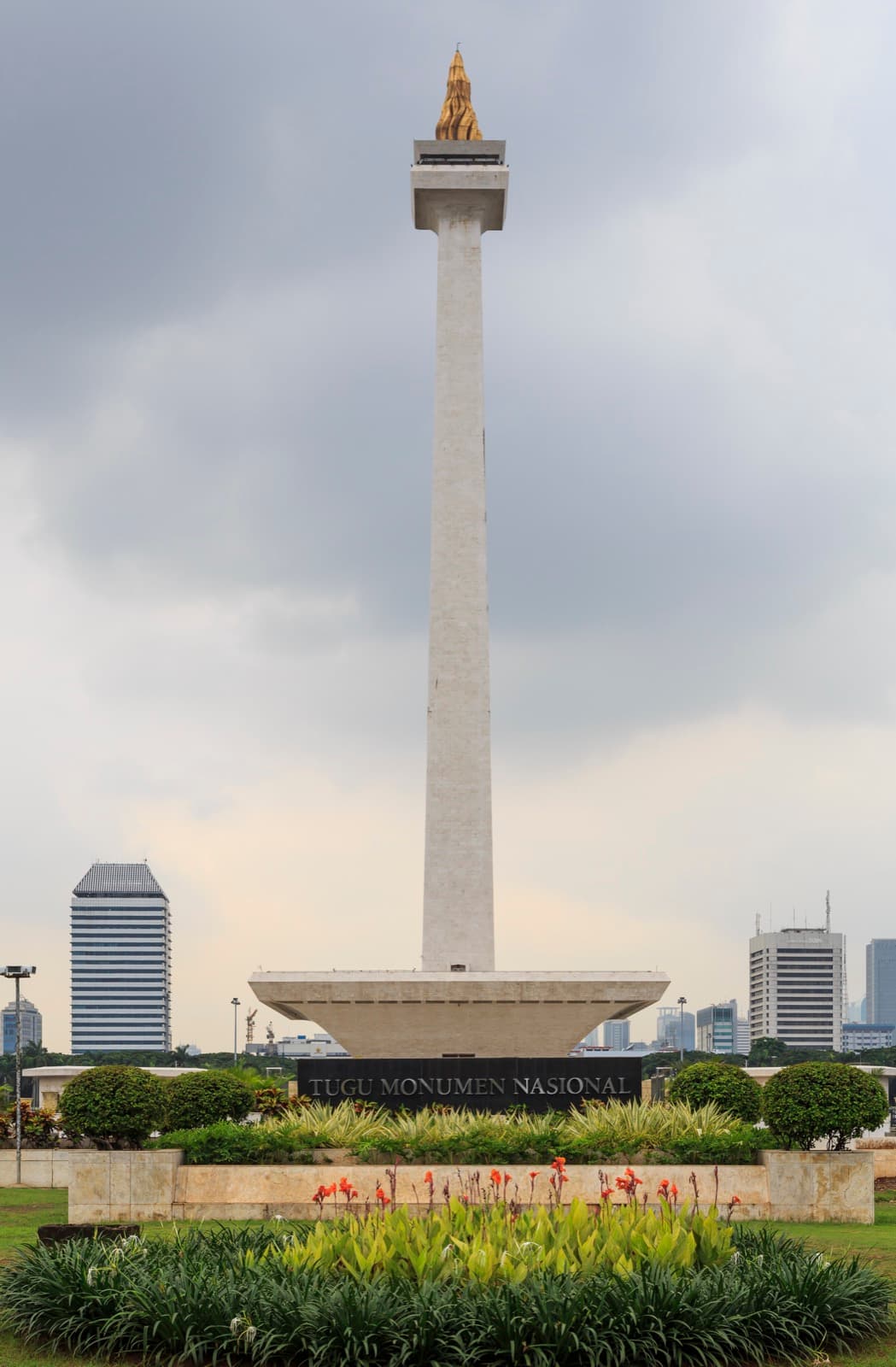
The mosque is powerful on its own, but its full meaning only lands if you have crossed the square to reach it. That crossing is the tour. It begins at the colonial edge, the old Koningsplein where colonial troops once paraded, then moves to Monas, the one hundred and thirty-two meter National Monument crowned by a flame sheathed in gold that the monument's records call the burning spirit of struggle of the Indonesian people. From there it reaches Istana Merdeka, the mansion built between eighteen seventy-three and eighteen seventy-nine for the Dutch governor-general and renamed the Freedom Palace on the twenty-eighth of December nineteen forty-nine, when it became the president's house without a single wall being rebuilt. Every stop is the same move: the same stone, a completely overturned meaning. The mosque, designed by a Christian and facing a cathedral, is that move at its boldest.
You can plan the full route and see the other stops through the Jakarta walking tours guide, and the tour itself lives on the Jakarta city page. Come early, ideally between seven and nine in the morning, before the tropical sun turns the open ground hard and shadeless, carry water and a hat, and give yourself the whole crossing. The mosque is the answer the walk is building toward, and it reads best after you have felt the size of the square that surrounds it.
Sources
- Istiqlal Mosque, Jakarta (Wikipedia). Foundation date, inauguration, capacity, architect Friedrich Silaban as the son of a Lutheran pastor, and Sukarno insisting it be built near the cathedral to symbolize religious harmony.
- National Monument, Indonesia (Wikipedia). Monas at one hundred and thirty-two meters, construction begun on the seventeenth of August nineteen sixty-one under Sukarno, its gold-leaf flame, and Friedrich Silaban as one of its designers.
- Merdeka Palace (Wikipedia). Construction between eighteen seventy-three and eighteen seventy-nine as the Dutch governor-general's residence and the renaming to Istana Merdeka on the twenty-eighth of December nineteen forty-nine.
- Merdeka Square, Jakarta (Wikipedia). The former Koningsplein parade ground, its scale, and Sukarno's renaming to Medan Merdeka in nineteen forty-nine.
- "Jakarta Cathedral, Istiqlal Mosque: Symbols of religious tolerance" (Vatican News). The shared-parking custom between the two congregations at Christmas, Easter, and Eid.
Ready to experience it?
Merdeka Square: From Colony to Republic
125 min · 6.4 km · moderate
More from Jakarta
Explore more at your own pace.
Jakarta Travel Guide: Days, Transport, Weather, Safety, Budget
One Day in Jakarta: A Walkable Morning-to-Evening Itinerary
Company Town and Square of Freedom: Reading Jakarta on Foot
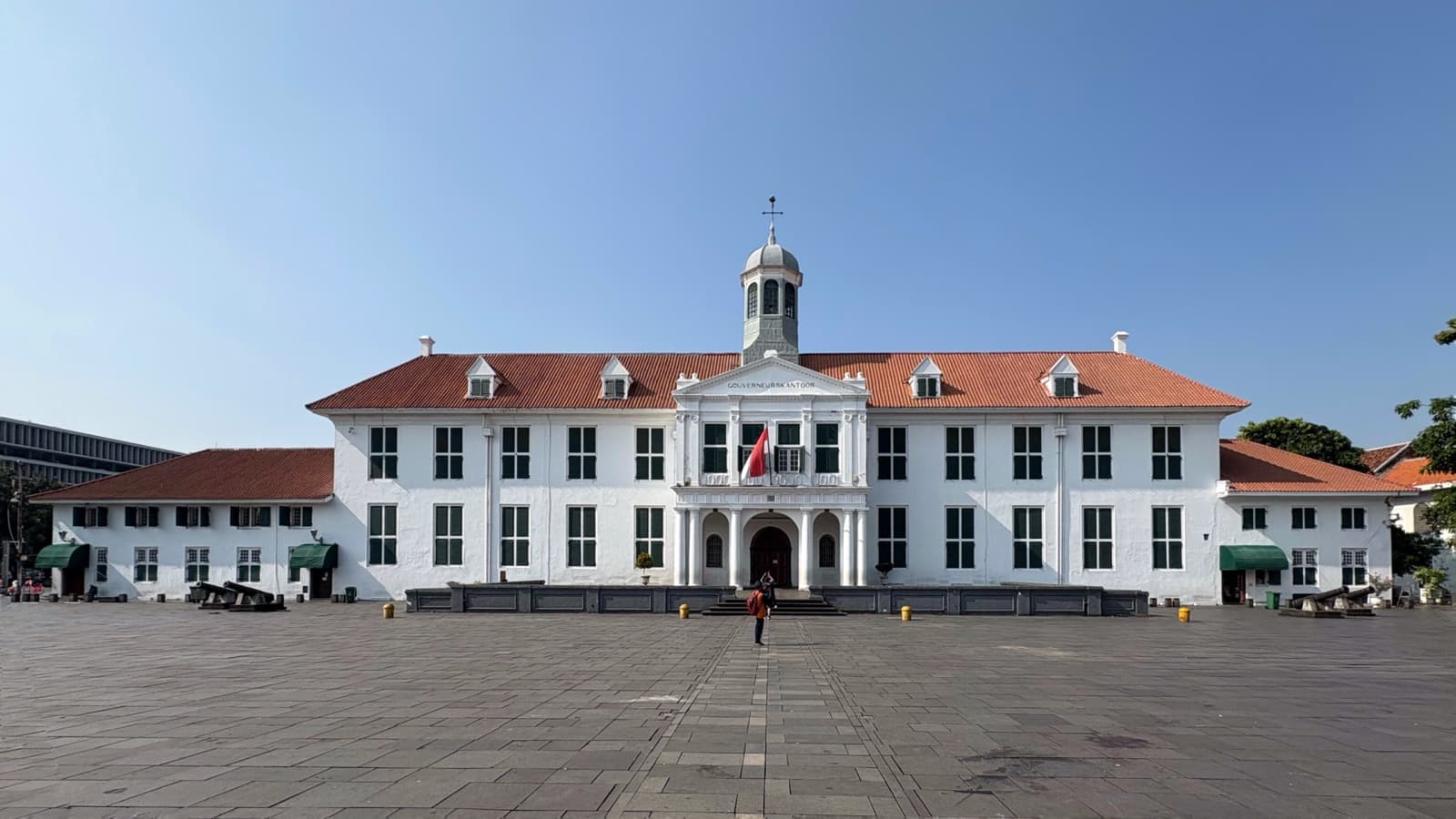
The Stadhuis of Batavia: Why Jakarta's Prettiest Square Was a Corporation's Head Office
Monas: Why Indonesia Planted a Golden Flame at the Center of a Colonial Parade Ground