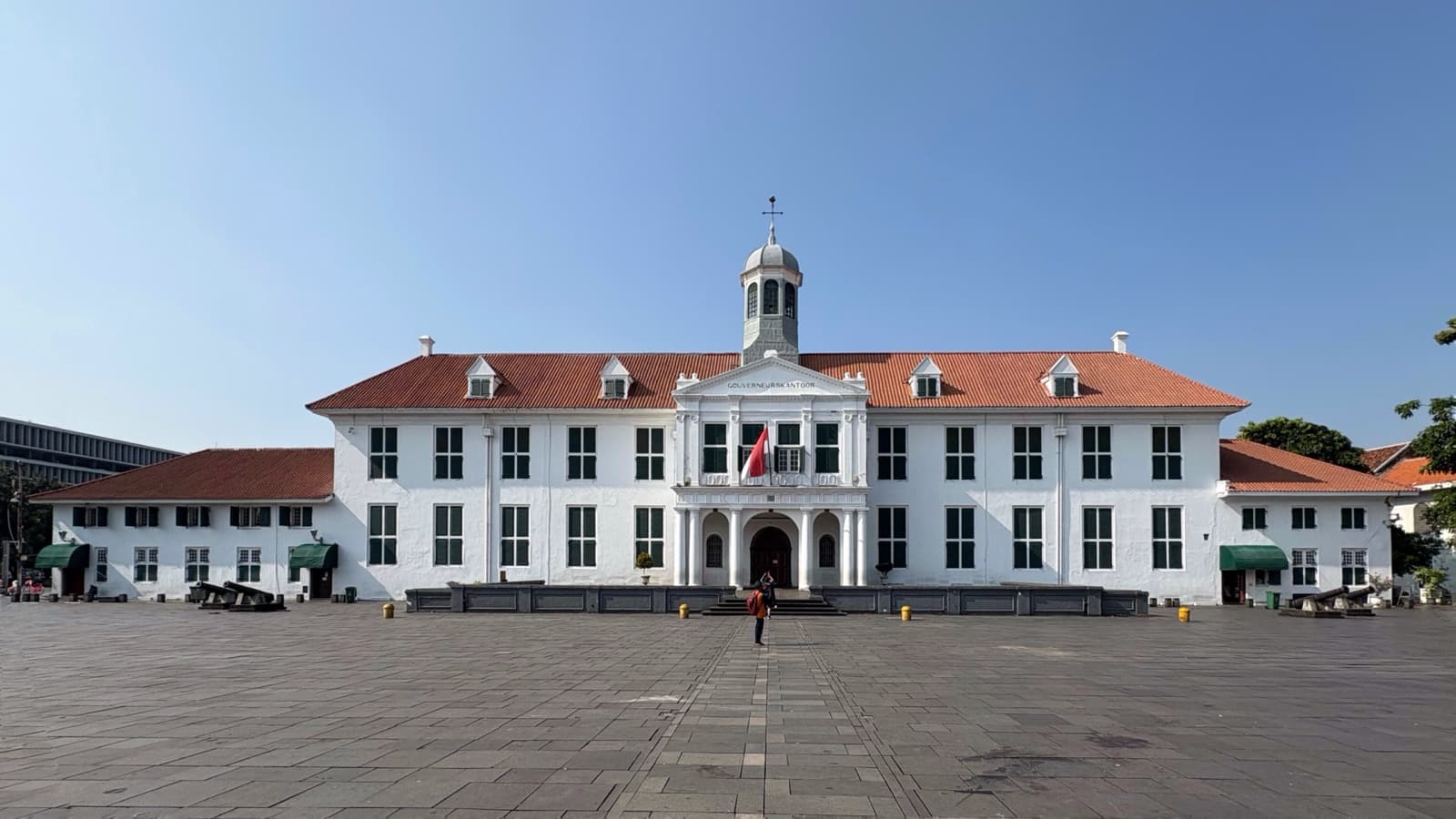
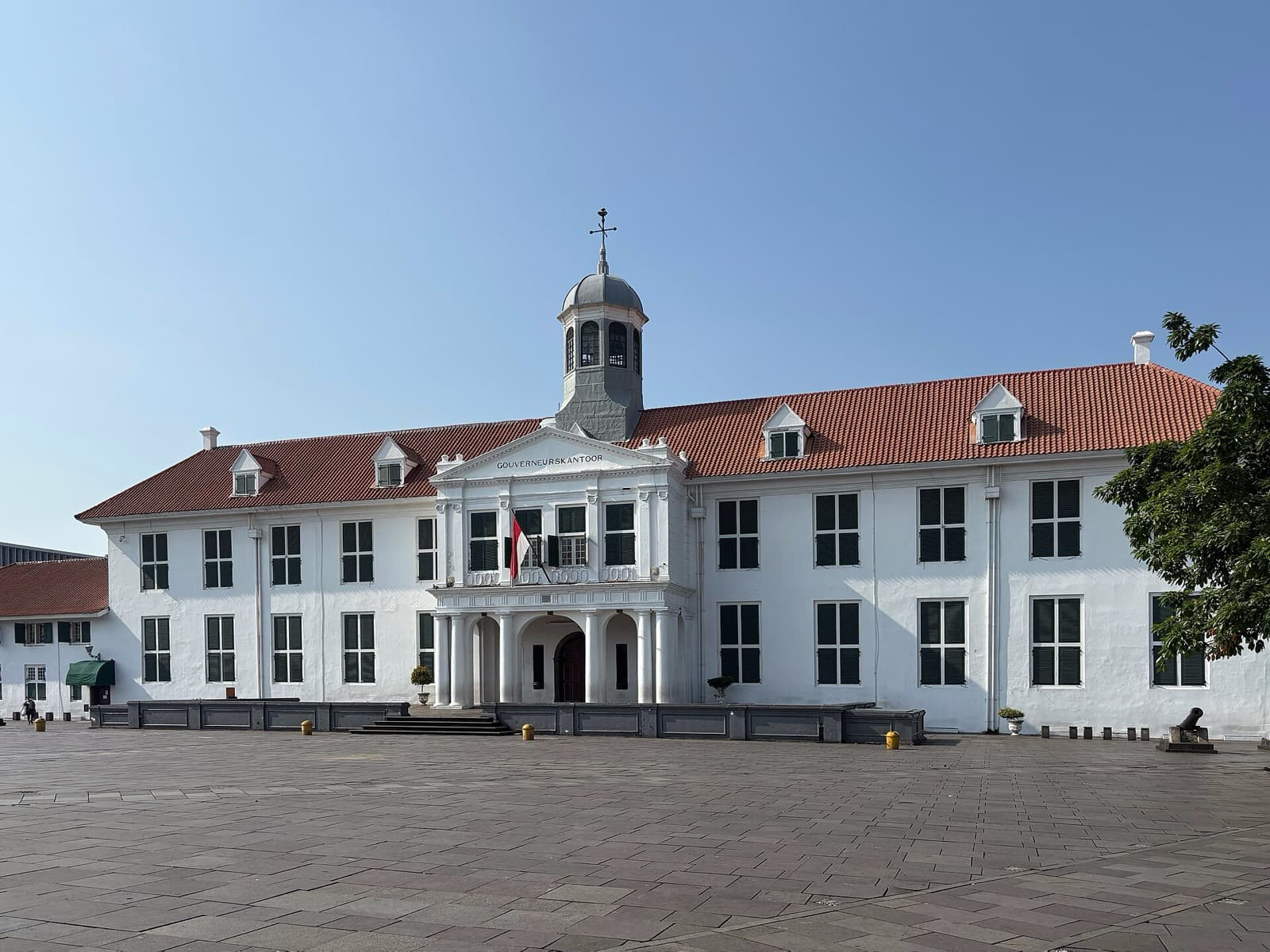
The Jakarta History Museum, the old Stadhuis of Batavia, sits on the south side of a charming pastel square, and it is the reason to read that charm carefully. This handsome building was the administrative headquarters of the Dutch East India Company, the corporation that governed a spice empire from these rooms. Beneath its front portico were cells that held prisoners into the middle of the nineteenth century. If you want to understand Kota Tua, Jakarta's Old Town, start with this building, because everything else on the square arranges itself around it.
A Company That Governed Like a State
The present structure was completed in seventeen ten, on a site whose first city hall had been finalized in sixteen twenty-seven. When the seventeen ten renovation was complete, Governor General Abraham van Riebeeck inaugurated it as the seat of the Dutch East India Company, known by its Dutch initials as the V O C. This is worth pausing on. The Company was not a government in the ordinary sense. It was a chartered corporation, a trading enterprise with shareholders, and yet from these rooms it signed the orders that moved pepper and nutmeg across oceans and governed the colonial city around it. Trade, administration, and punishment ran out of one building. That fusion is the whole argument of the tour, and the Stadhuis is where it becomes concrete rather than abstract.
Then there is what lay beneath. The dungeons under the front portico served as prison cells, and they functioned until eighteen forty-six. Among the people held here was Prince Diponegoro, the Javanese leader of the Java War, imprisoned in the cellars in eighteen thirty before he was banished to Manado in North Sulawesi. Stand at the pastel facade and hold that plainly: the same graceful front the tourists photograph today is the one those prisoners never got to admire. The building's role as a city hall ended in nineteen thirteen, after the Company had gone bankrupt and the Dutch colonial government took over. It was formally declared a museum on the thirtieth of March, nineteen seventy-four, closed for conservation in twenty eleven, and reopened in twenty fifteen with Dutch government support.
The Square Reads Differently Once You Know the Center
Hear a stop from this walk
Taman Fatahillah: The Front Office of an Empire
Once the Stadhuis is fixed in your mind as a head office with cells, the rest of Taman Fatahillah stops looking like a pleasant plaza and starts looking like a company town. The square was once called Stadhuisplein, the city hall square, and only took the name Taman Fatahillah after independence, honoring the commander who captured this port for the Demak Sultanate on the twenty-second of June, fifteen twenty-seven, long before the Dutch arrived. That date is Jakarta's official anniversary, fixed by the city in nineteen fifty-six. A quick correction worth carrying: you may hear the Old Town called a World Heritage Site, but it is not. It was placed on UNESCO's tentative list in twenty fifteen and never inscribed.
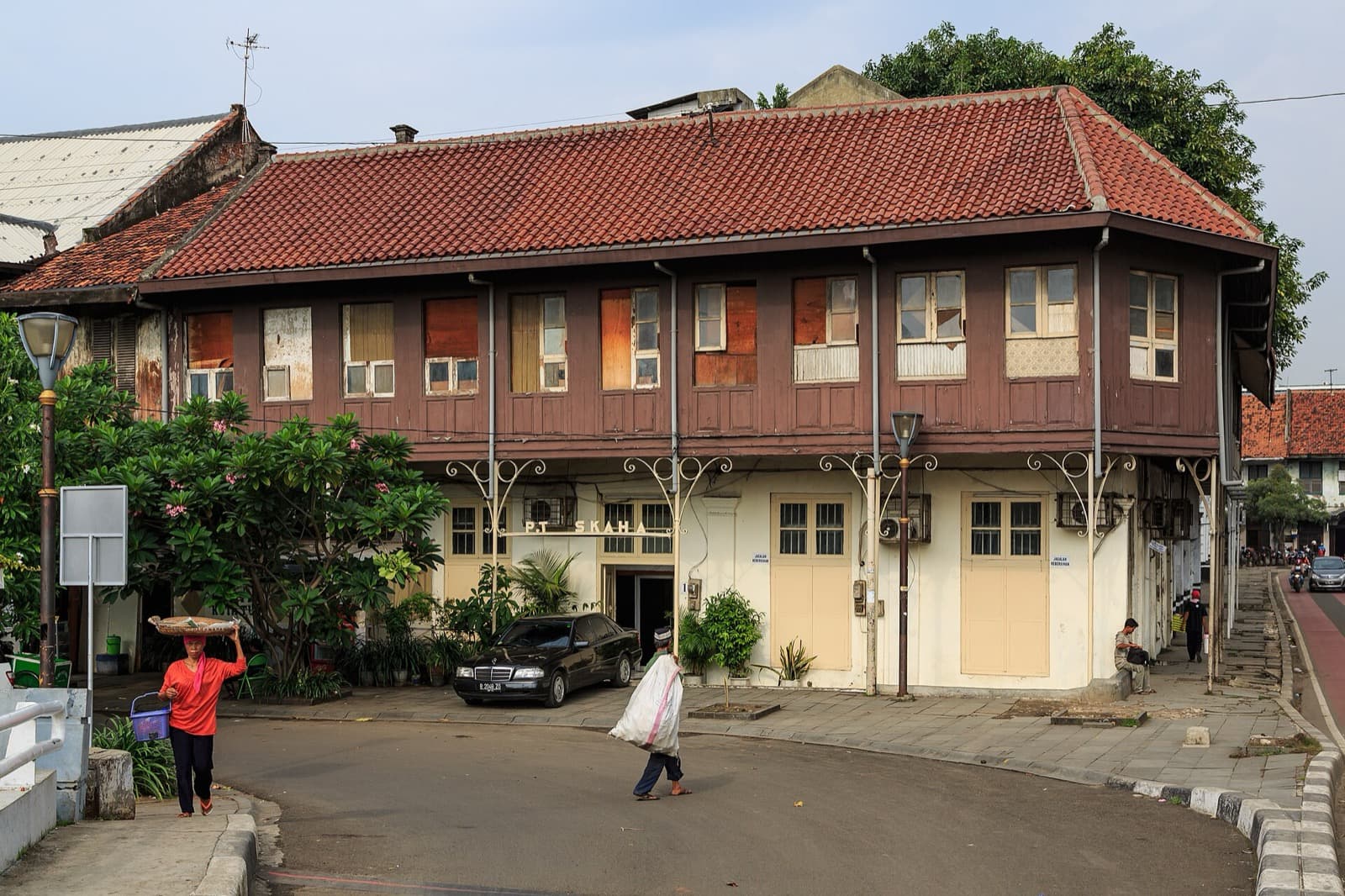
The buildings around the plaza fill in the machinery. The arcaded facades, including the structure now known as Cafe Batavia, framed the daily commerce of the Company: the bookkeepers, factors, and clerks who kept its ledgers. An empire runs on paperwork, and this is where the paperwork lived. Cafe Batavia is the second-oldest building on the square after the old City Hall, and a Javanese teakwood staircase leads up to its grand upper salon with its shuttered gallery windows over the plaza. This was never only Dutch. Batavia grew distinctive cross-cultural communities, including Mardijker, Indies, and Chinese Peranakan cultures, all of whom shaped the trade.
Punishment, Conquest, and the Reason for the City
The tour's harder turns sit on either side of the Stadhuis, and the museum makes them legible. On the west side, the Wayang Museum, devoted to Javanese shadow-puppet theatre, stands on a former churchyard that was the funeral site of Jan Pieterszoon Coen. Coen, the Company's governor-general, seized this town in sixteen nineteen and founded Batavia over the ruins of Jayakarta; the city was renamed Batavia in sixteen twenty-one. He died in Batavia on the twenty-first of September, sixteen twenty-nine. He is remembered as the Butcher of Banda for the sixteen twenty-one massacre in the Banda Islands, in which about two thousand eight hundred inhabitants were killed and roughly one thousand seven hundred enslaved. Of some fifteen thousand original inhabitants, only about one thousand survived. A puppet museum now stands over that grave.
On the east side, the Museum of Fine Arts and Ceramics occupies the former Court of Justice, the Raad van Justitie, completed on the twelfth of January, eighteen seventy, as the highest court of justice in the colony. Draw the line back to the cellars: authority signed in the Stadhuis, judgment delivered in this courthouse, punishment carried out below. The Company's power ran on both ends of the square. That courthouse was later inaugurated as the museum by President Soeharto on the twentieth of August, nineteen seventy-six.
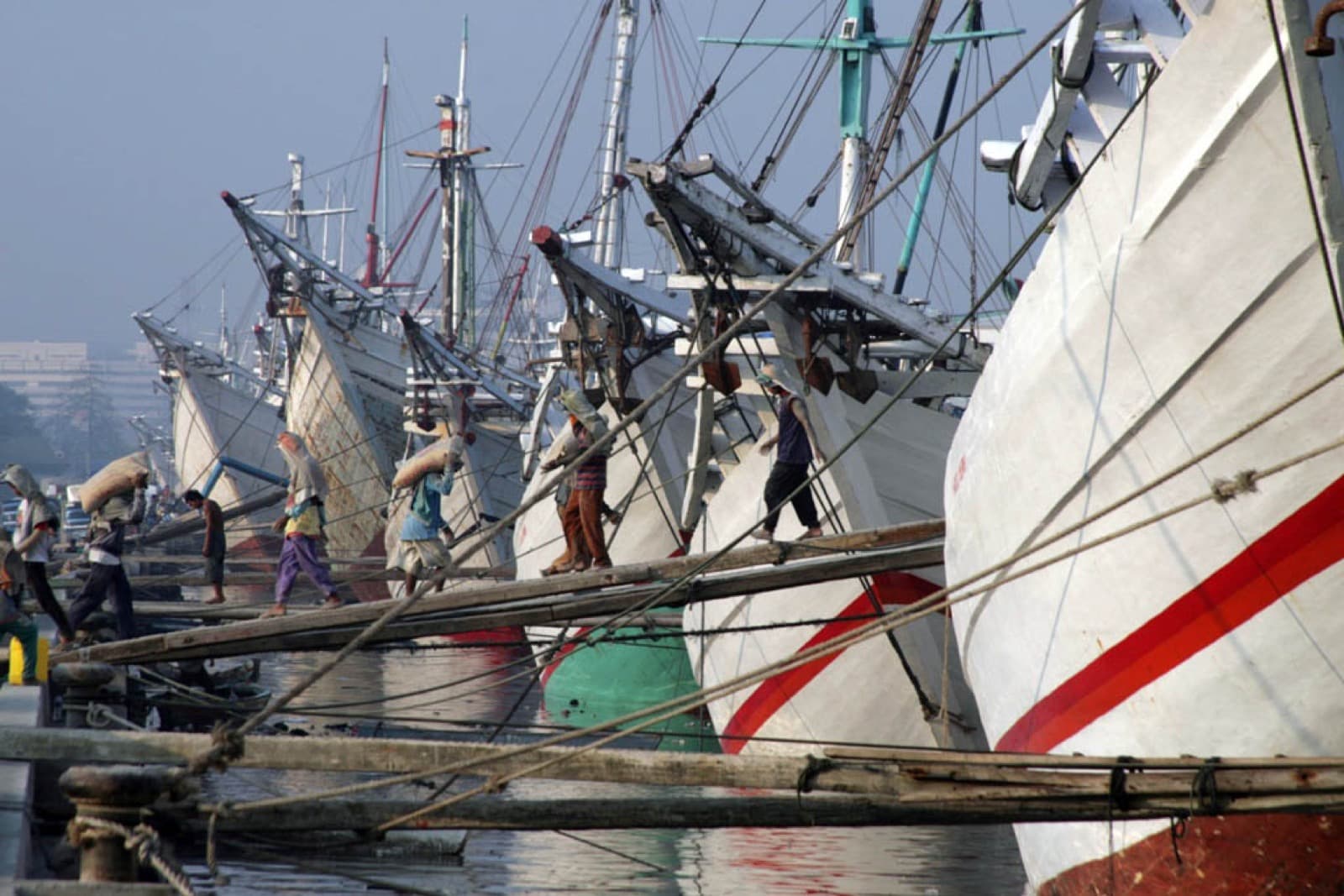
Two stops close the walk by explaining the geography. The Kota Intan drawbridge, built in sixteen twenty-eight, is the oldest bridge in Indonesia and the only surviving seventeenth-century Dutch drawbridge, crossing the Kali Besar, a remnant of a planned canal city that had Venice of the East ambitions. And the harbour of Sunda Kelapa, about a kilometre north, is why any of it exists. It was the main port of the Sunda Kingdom from the thirteenth to the sixteenth centuries, thriving on the spice trade, especially pepper, long before the Dutch. Every power that came here, the Portuguese who secured an agreement with the Sunda Kingdom in fifteen twenty-two, Fatahillah in fifteen twenty-seven, Coen in sixteen nineteen, came for this water. It still handles the pinisi, traditional two-masted wooden schooners loaded largely by hand.
Walk It in the Right Order
The Stadhuis rewards a slow, self-guided pace, because its meaning depends on what you notice: the cellar door, the site history from sixteen twenty-seven, the fact that a corporation signed orders here. Reach the square early, before the midday heat and the costumed photo-touts thicken, and you can linger at the museum before tracing the story outward to the harbour. The full route runs roughly three and a half kilometres over about ninety minutes and seven stops. For more context on the city, see our guide to Jakarta walking tours, or browse everything on the Jakarta page. The audio walk carries you from this head office to the water that was the whole point, at whatever clock is yours.
Sources
- Jakarta History Museum, Wikipedia: completion of the Stadhuis in seventeen ten, the sixteen twenty-seven first city hall, its role as V O C headquarters under van Riebeeck, the cellar prison cells to eighteen forty-six, the Diponegoro imprisonment, and the nineteen seventy-four museum declaration.
- Fatahillah Square, Wikipedia: the square's naming history from Stadhuisplein to Taman Fatahillah and the surrounding museum buildings.
- Jan Pieterszoon Coen, Wikipedia: Coen's founding of Batavia in sixteen nineteen, the sixteen twenty-one renaming, his death in sixteen twenty-nine, and the Banda Islands massacre casualty figures.
- Sunda Kelapa, Wikipedia: the harbour's role as the Sunda Kingdom's spice port from the thirteenth to the sixteenth centuries, the fifteen twenty-two Portuguese agreement, and the pinisi still working today.
- Kota Intan Bridge, Wikipedia: the sixteen twenty-eight drawbridge on the Kali Besar as the oldest bridge in Indonesia.
Ready to experience it?
Kota Tua: The Company Town That Ran an Empire
90 min · 3.4 km · easy
More from Jakarta
Explore more at your own pace.
Jakarta Travel Guide: Days, Transport, Weather, Safety, Budget
One Day in Jakarta: A Walkable Morning-to-Evening Itinerary
Company Town and Square of Freedom: Reading Jakarta on Foot
The Istiqlal Mosque: A Mosque Named Freedom, Designed by a Christian
Monas: Why Indonesia Planted a Golden Flame at the Center of a Colonial Parade Ground