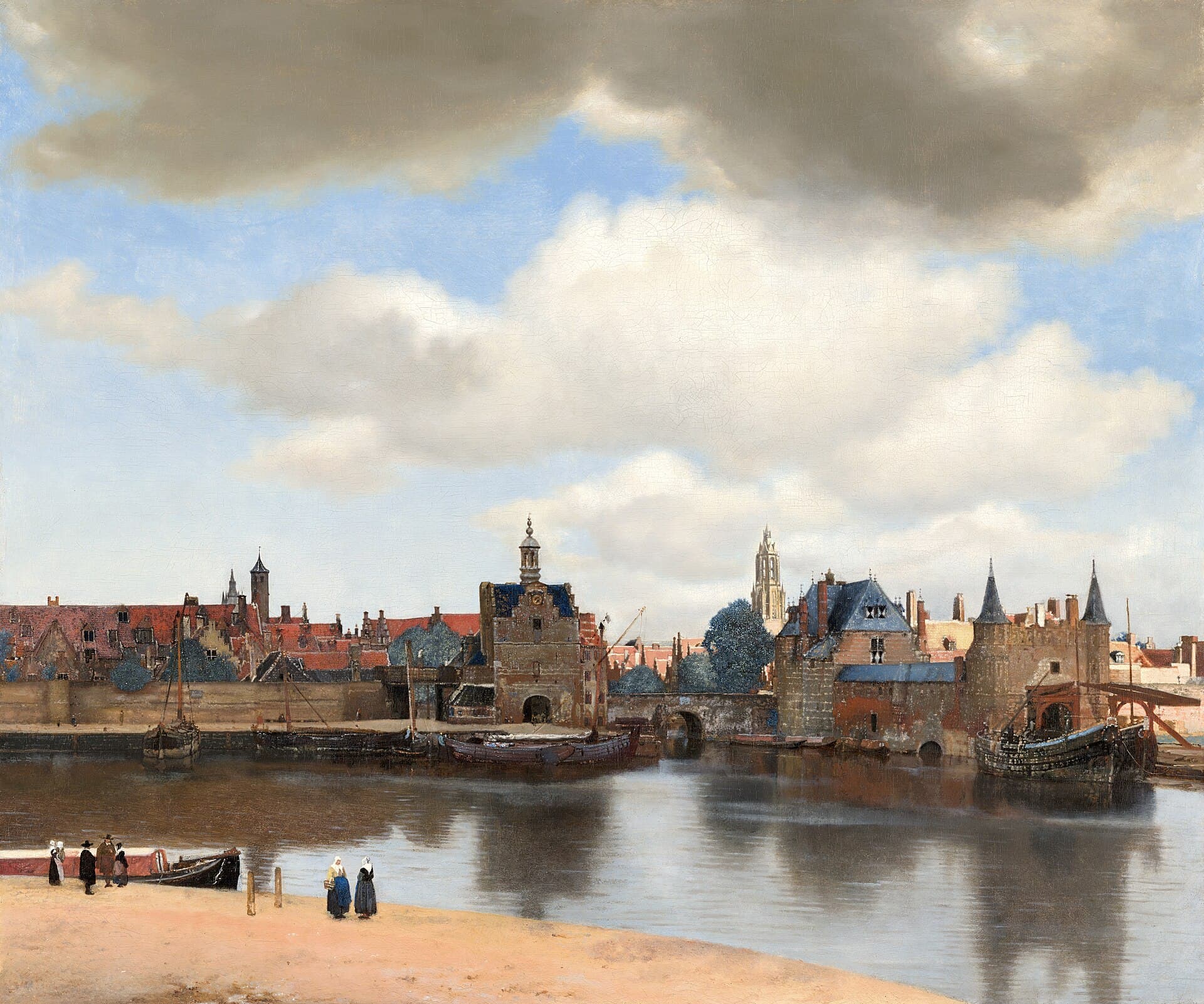
On the Hooikade quay, Johannes Vermeer stepped outside. Almost everything else he painted was a quiet indoor scene, a woman at a window, a wall dissolving into brightness. But around sixteen sixty to sixteen sixty-one he turned and painted his own city, looking north across a calm harbour pool called the Kolk, a widening of the river Schie. The result was his View of Delft, and from this same quay the church towers still line up over the rooftops almost exactly as he set them down. The painting is not here. That gap, the intact town and the absent canvas, is the paradox the entire walk is built around, and the Hooikade is the clearest place to feel it.
Start with what Dutch words are telling you. Kade means quay, and kolk means harbour pool. Vermeer stood or sat at the edge of this water and recorded the towers, the gates, the moored boats, and the shifting weather of Delft under a broken sky. Look north today and the two towers he painted are still there: the leaning Oude Kerk and the tall spire of the Nieuwe Kerk, rising over the same roofline. A marker stands on the quay to note the painter's vantage. There is an honest complication here, and it is worth carrying. The exact spot is debated among scholars. The angle in the painting looks down slightly on the water, which suggests Vermeer worked from an upper floor of a house near the quay rather than at ground level. Researchers have narrowed the location by comparing the canvas to old topographical records, but no single window is certain. What is certain is the view itself, which is why standing here works: the geography is the part that survived intact.
The painting that lives somewhere else
The View of Delft now hangs in the Mauritshuis in The Hague, only a short train ride away. It measures roughly ninety-six by one hundred and fifteen centimetres, a little under a metre tall and a little over a metre wide, which is smaller than most people expect from a picture with this reputation. That reputation is not modern hype. When the French writer Marcel Proust saw it in The Hague in nineteen oh two, he called it, in his own words, the most beautiful painting in the world. It is also a rarity within Vermeer's own output. He left perhaps three dozen paintings, and this is one of only two known cityscapes among them, the other being the close-up street scene now called The Little Street. Everything else looks inward. Here, once, he looked at his whole town at once.
So you can stand on the quay where the artist worked, see the exact skyline he rendered, and still not see the painting. That is not an accident of this one stop. It is the condition of the entire tour. A practical tip repays the effort: bring your phone or a small print of the View of Delft to the Hooikade and hold it up against the real horizon. The church towers still register almost perfectly against the rooftops, and the small act of aligning them turns a distant masterpiece back into a place you are actually standing in.
Reading the rest of the walk from here
Hear a stop from this walk
Hooikade: The View of Delft Viewpoint
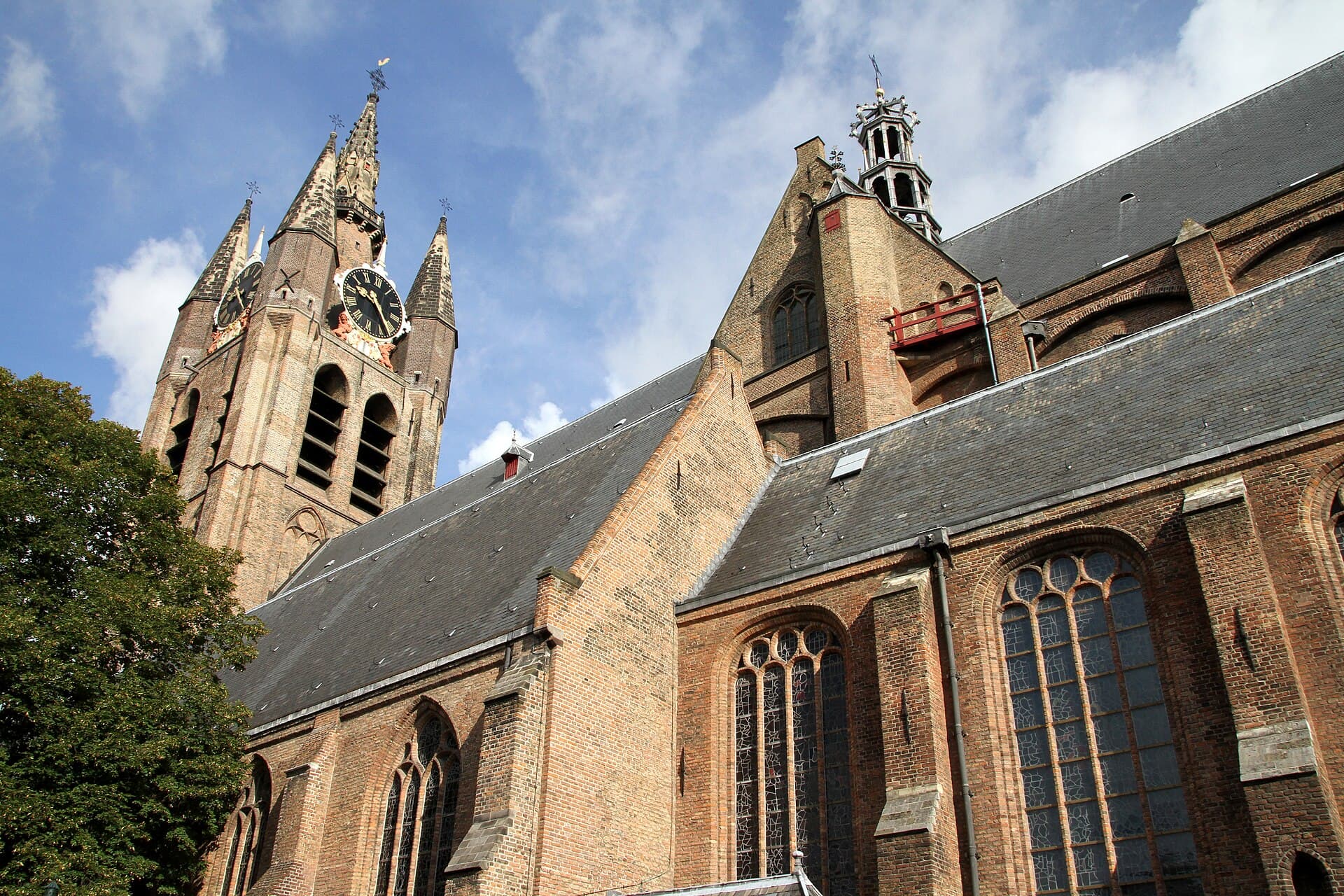
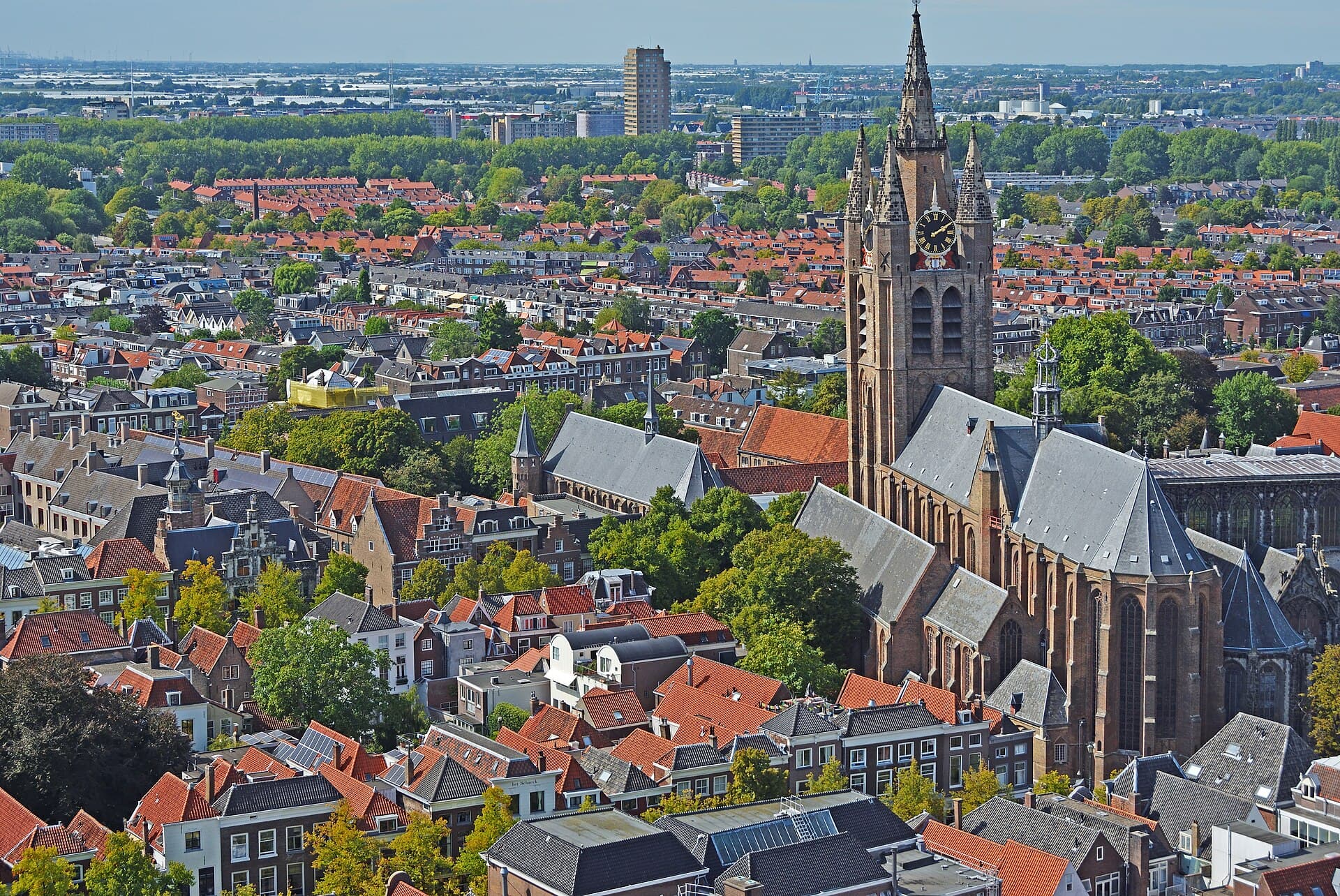
Everything the earlier stops set up resolves at this water. The walk begins on the Markt, the market square where Vermeer was baptized in the Nieuwe Kerk on the thirty-first of October, sixteen thirty-two, and where his father ran a large inn called Mechelen whose front door looked clear across the square. From there the route reaches the Oude Kerk, the Old Church whose brick tower tilts roughly two metres off vertical because the marshy ground could not hold its foundations. Vermeer was buried inside on the fifteenth of December, sixteen seventy-five, the day he died at forty-three, in a family crypt, his widow left in debt. That same church holds Antonie van Leeuwenhoek, the microscopist who first observed a world of tiny living things, along with the naval commanders Piet Hein and Maarten Tromp.
The tour's central absence is named a block north of the square, at the Vermeer Centrum Delft on the Voldersgracht. It sits on the site of the old Guild of Saint Luke, the body that governed the painters, potters, glassmakers, and booksellers of the town, and which Vermeer joined as a master painter in sixteen fifty-three. The facade was reconstructed there in two thousand six. Inside, and this is the honest thing to know before you pay, there is not one original Vermeer. What the centre shows are full-size reproductions of every known work, arranged in order, because his paintings scattered after his death and passed through an Amsterdam auction in sixteen ninety-six. They now hang in the Mauritshuis, the Rijksmuseum, the Frick Collection in New York, and elsewhere. His city kept the story. The world kept the paintings.
Between the museum and the Hooikade, the walk slows at the Oude Delft, said to be the oldest canal in town, dug in the eleventh century to drain the peat marsh. The town's name comes from the Dutch verb delven, to dig, so Delft is literally a place that was dug. Stand at the water and watch the cool, even northern light double the sky on the still surface. That reflected daylight is the raw material behind what art historians call the Delft school of painting, the strand of Dutch Golden Age art that turned toward domestic interiors, courtyards, and city streets instead of grand historical scenes. Vermeer's glow did not fall from the sky. It rose from canals like this one, and it comes to a head in the View of Delft, where the whole town sits on the same reflecting water.
The loop closes back on the Markt with the rediscovery. Vermeer was largely forgotten for two centuries until the French critic Theophile Thore-Burger, who first saw View of Delft in The Hague in eighteen forty-two, published a catalogue of the artist in eighteen sixty-six and reignited interest that has never faded. He over-credited Vermeer badly, and scholars have since narrowed the accepted corpus to about thirty-four works. The Hooikade is where that whole arc becomes physical. You are looking at the exact scene that pulled a forgotten painter back into the light.
If you want the walk in full, start from the Delft walking tours hub or the city page for Delft, then set out for the Markt and follow the route south to this quay. Plan on about ninety minutes over roughly two and a half kilometres, and give the water more time than you think you need.
Sources
- Johannes Vermeer, View of Delft, Mauritshuis collection page. Confirms the painting's home, dimensions, and dating.
- View of Delft, Wikipedia. Background on the cityscape, its vantage debate, and the Kolk harbour.
- Essential Vermeer, scholarly site on Vermeer's Delft. Detail on the Mechelen inn, the guild, and biography.
- Vermeer Centrum Delft, official site. Confirms the reproduction-only display and the reconstructed guild facade.
- Oude Kerk (Delft), Wikipedia. The tower's tilt, founding, and Vermeer's burial.
Ready to experience it?
Vermeer's Delft: The Painter of Impossible Light
85 min · 2.4 km · easy
More from Delft
Explore more at your own pace.
The Small Town That Made Big History: Delft's Light, Its Martyr, and Its Blue
Royal Delft and the Real Story Behind Delft Blue
The Prinsenhof in Delft: Where a Single Shot Founded a Nation
Nieuwe Kerk, Delft: The Church That Turned a Rebel Into a Dynasty
The Oostpoort: Reading Delft's Last City Gate