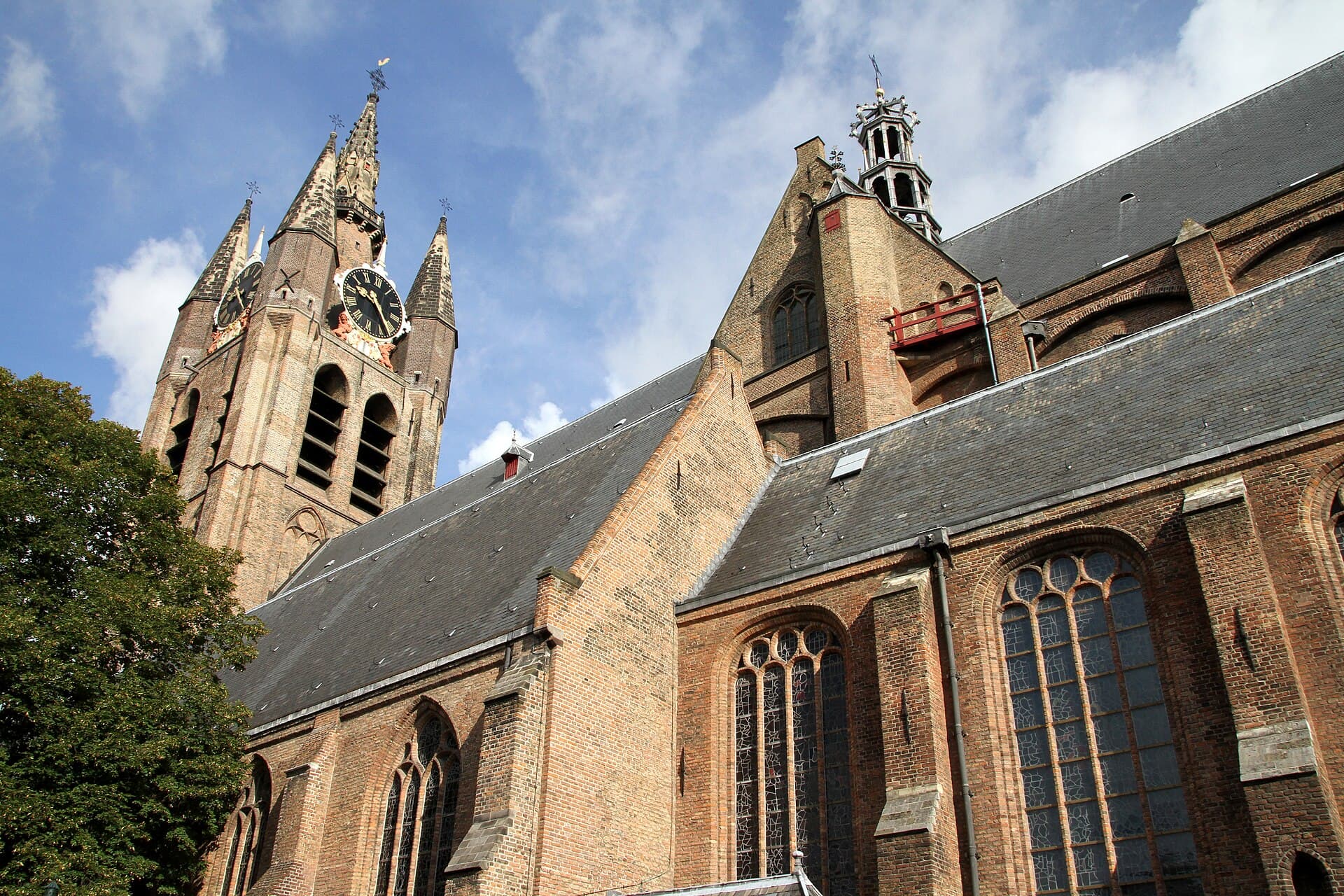
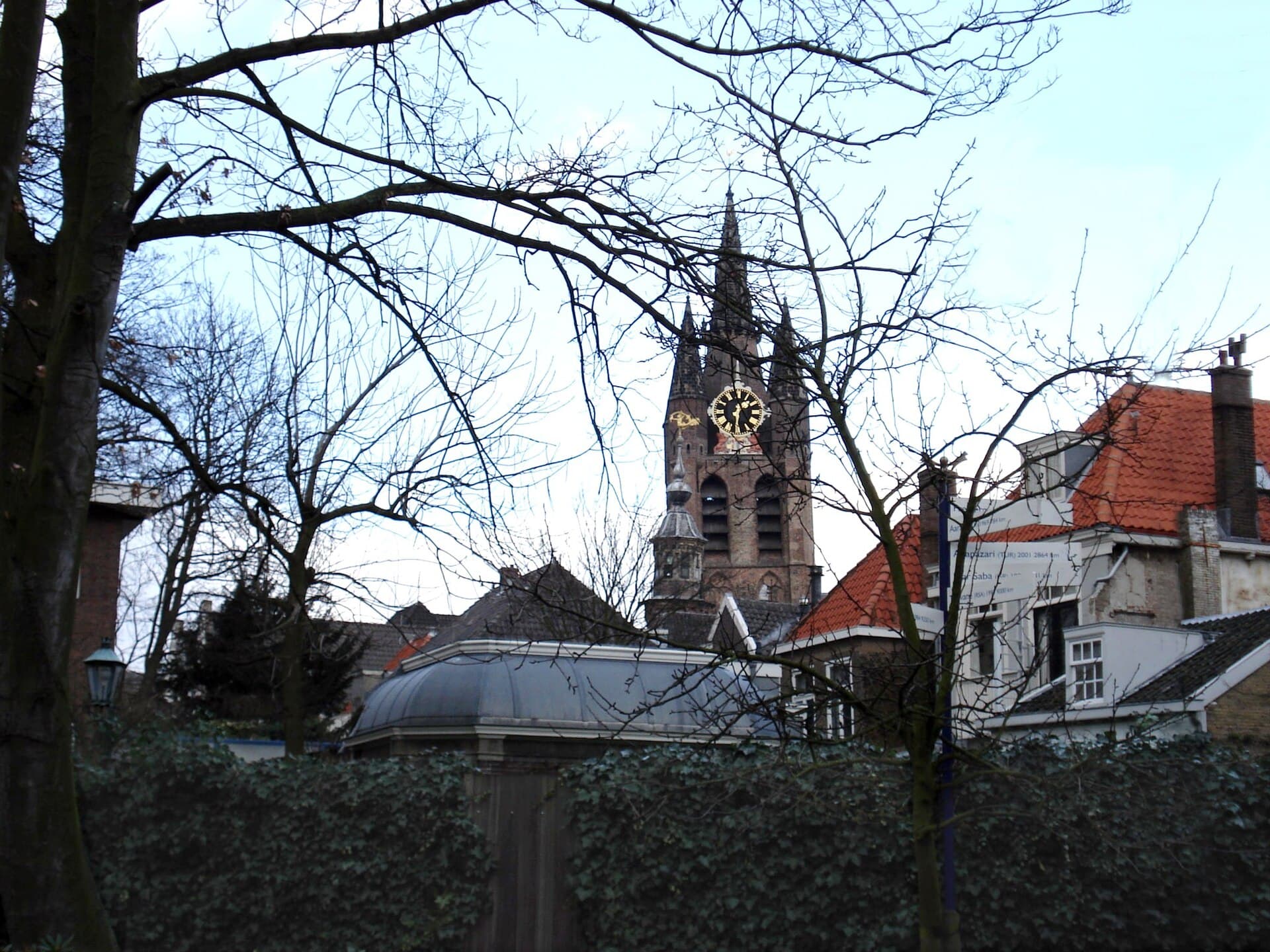
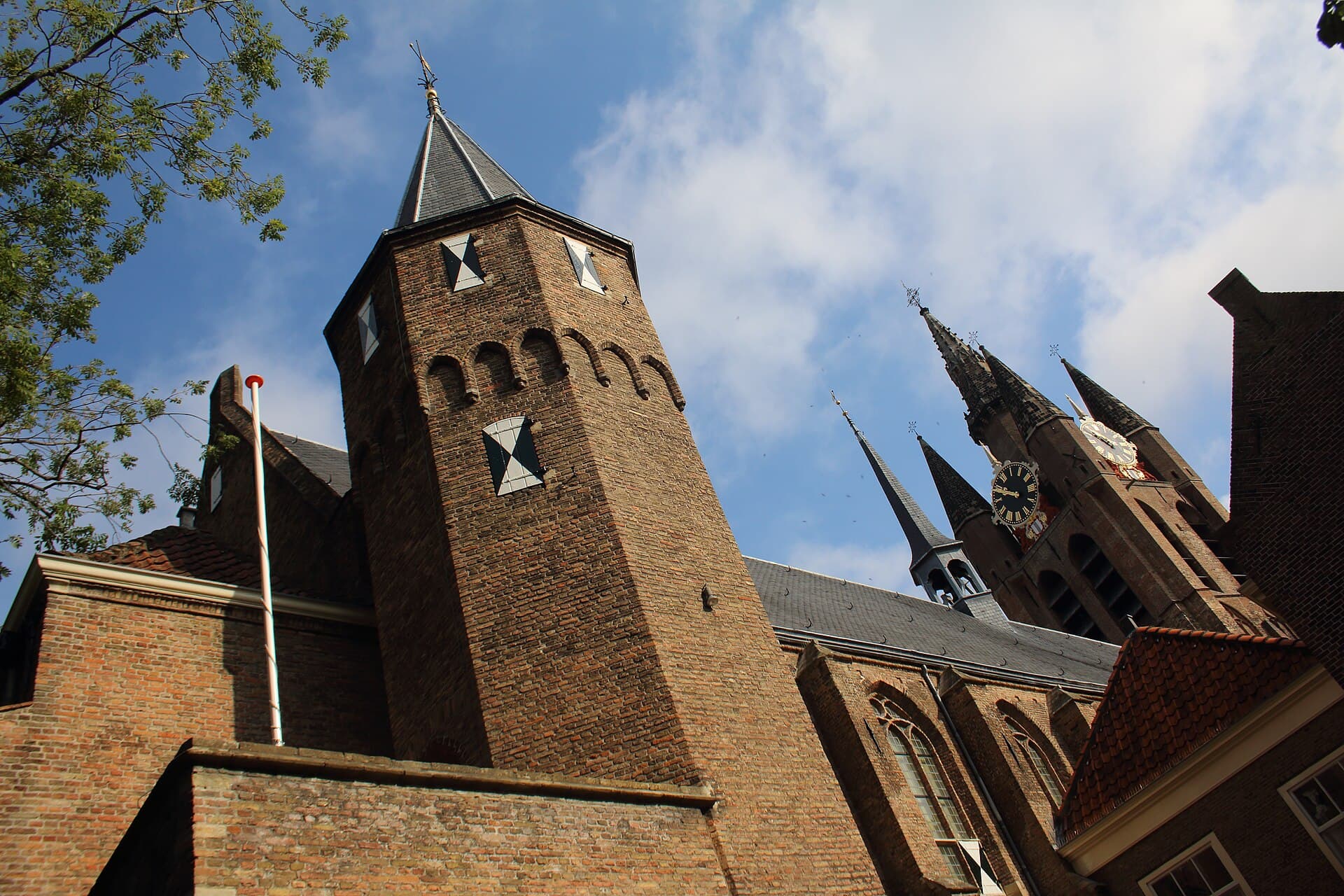
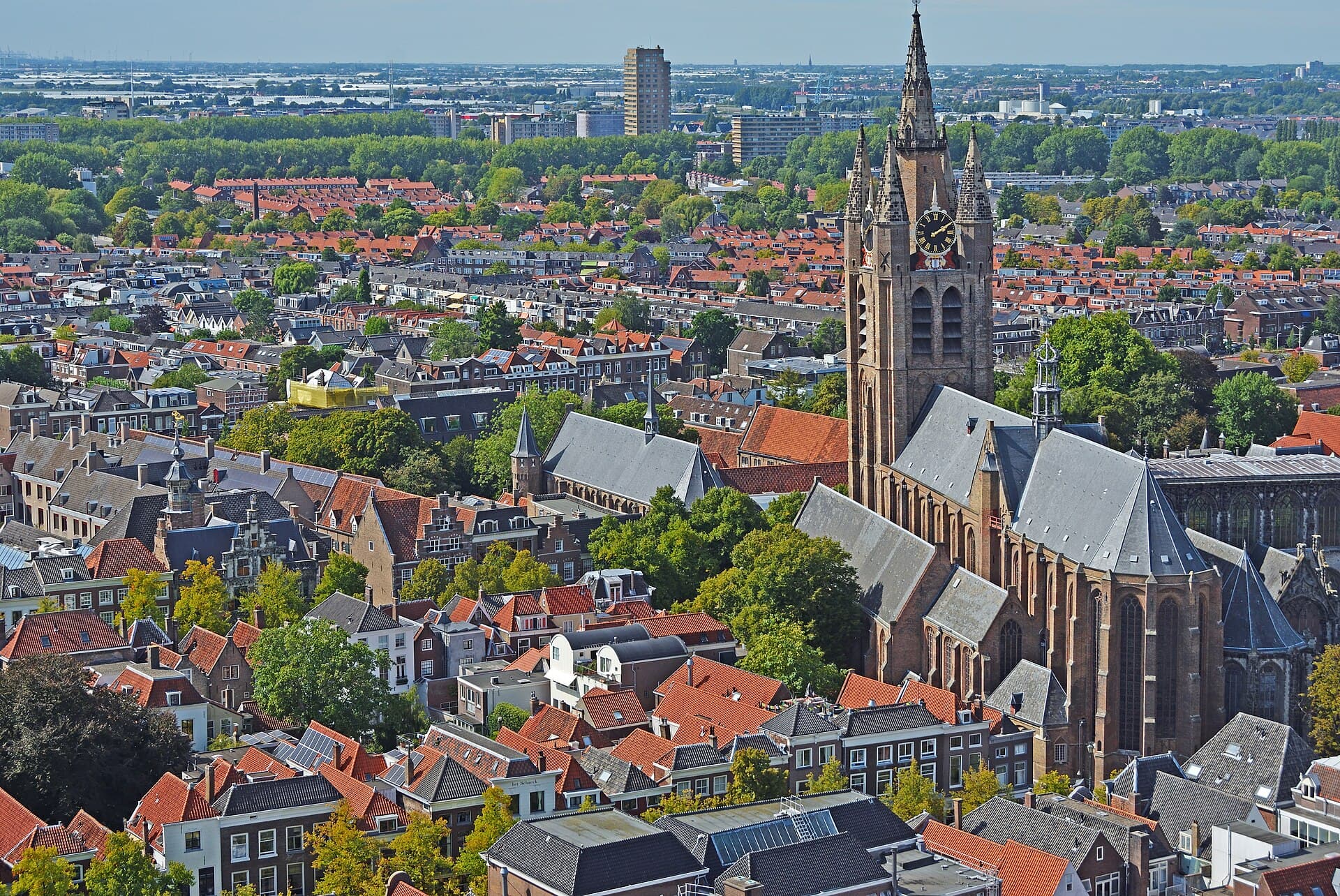
Delft's Oude Kerk leans. Its brick tower rises about seventy-five metres above the canal and tilts roughly two metres from vertical, and inside its walls, in a family crypt, lies Johannes Vermeer, one of the steadiest painters who ever worked. That pairing is the whole reason to stop in front of this church. A tower that cannot stand straight guards the grave of an artist whose paintings are the quietest, most exactly balanced things in Dutch art. Standing here, you are looking at both at once: the wobble in the stone and the calm in the man.
A church that started tilting during construction
The Oude Kerk, the Old Church, was founded in the year twelve forty-six, first as Saint Bartholomew's and later rededicated to Saint Hippolytus. Its tower was added in the early thirteen hundreds, and it began to lean almost immediately. The cause is Delft's ground. The town sits on soft, peaty, waterlogged soil, and the foundations were never sunk deep enough to hold the weight of a tall brick tower. So the tower settled unevenly and pulled off true.
Look closely at the top and you will see the builders' response to their own problem. Only the four small turrets at the very peak are truly upright. As the tower rose and the medieval masons realized it was going out of plumb, they corrected the upper stages, setting the crowning turrets vertical even as the great mass below them leaned. The result is a structure that documents its own struggle. The lower tower confesses the mistake; the turrets confess the correction. You are reading a thirteenth and fourteenth century engineering diary written in brick, and it is still leaning about two metres from the vertical today.
That lean is easy to dismiss as a curiosity, the kind of thing you photograph and move on from. But it is worth pausing on, because it is the physical signature of Delft itself. This is a town whose name comes from the Dutch verb delven, to dig. Delft was cut out of a marsh, drained by canals, built on ground that never wanted to hold anything heavy. The leaning tower is not a flaw in an otherwise solid place. It is the honest expression of what it means to build a city on water and peat.
The grave under the tower
Hear a stop from this walk
Hooikade: The View of Delft Viewpoint
Now the reason a visitor should really stand here. Johannes Vermeer was buried inside this church on the fifteenth of December, sixteen seventy-five, the very day he died, at the age of forty-three. He went into a family crypt in the northern part of the church. There was no procession worthy of note, no crowd, no sense that anything historic had happened. His widow was left in debt, with no money even for a tombstone. A remarkable painter was laid quietly into the floor of a leaning church in a small town, and the world simply went on without pausing.
That absence of ceremony is the point. For roughly two centuries after this burial, Vermeer was largely forgotten outside Delft. The grave sat here the whole time, unmarked as a place of pilgrimage, while the paintings drifted through auctions and private collections and, in some cases, were sold under other painters' names. The man who painted daylight better than almost anyone lay in near-total silence beneath a tower that itself could not keep a straight line. When you stand in front of the Oude Kerk, you are standing over the low point of one of the strangest reputations in art: a genius filed away and half-lost, right here, for two hundred years.
The company he keeps
Vermeer is not the only extraordinary person entombed in this church, and the others sharpen the picture of the world he came from. Antonie van Leeuwenhoek, the pioneering microscopist who first observed micro-organisms through lenses he ground by his own hand, is buried here too; he died in seventeen twenty-three. The two men were near-contemporaries in the same small town, one training a new kind of attention on the invisibly small, the other training an equally new kind of attention on the fall of light in a room. Delft, in their lifetimes, was a place where people learned to look very hard at ordinary things.
The naval heroes Piet Hein and Maarten Tromp lie in the Oude Kerk as well, and so does the painter Hendrick Cornelisz van Vliet, who specialized in painting the interiors of churches exactly like this one. In all, roughly four hundred people are entombed within these walls. The building is less a monument to any single person than a dense archive of a whole society: its admirals, its scientists, its artists, packed into the floor of a church that keeps quietly sliding off vertical.
The one thing to understand standing here
If you take a single idea away from this stop, let it be the contrast. The Oude Kerk is a building that visibly failed to stay upright, and it holds the remains of a man whose art is a study in near-perfect equilibrium: a woman poised at a window, a wall dissolving softly into brightness, a whole room held in stillness. Vermeer's Delft was not a grand or triumphant place. It was marshy, modest, and prone to settling. The steadiness in his paintings did not come from a steady world. He made it, canvas by canvas, out of a town that could barely hold its own tower straight.
To go inside, you can usually buy a combined ticket for the Oude Kerk and the nearby Nieuwe Kerk for around ten euros. The two towers are the twin anchors of Vermeer's whole story, the church where he was baptized and the church where he was buried, facing each other across the small centre of his life. The Oude Kerk is stop two on the self-guided delft-vermeer walking tour, which threads his baptism square, his grave, the guild he joined, the canals whose light shaped his eye, and the harbour quay where he painted his one radiant view of the city.
This stop is where the paradox of the whole walk becomes physical. Vermeer is here, under a leaning tower, in a town that kept his story but lost his paintings to the wider world. See the tower, find the grave, and then keep walking. For the full six-stop route and the other Delft themes, browse the city's Delft walking tours and let the audio carry the rest.
Sources
- Oude Kerk (Delft), Wikipedia: founding in twelve forty-six as Saint Bartholomew's, later rededicated to Saint Hippolytus, the seventy-five metre brick tower added between thirteen twenty-five and thirteen fifty and leaning about two metres, the corrected upper turrets, and the roughly four hundred people buried inside including Vermeer, van Leeuwenhoek, Piet Hein, Maarten Tromp, and Hendrick Cornelisz van Vliet.
- Vermeer's Delft: The Oude and Nieuwe Kerk, Essential Vermeer: the two churches in Vermeer's biography, his burial in the Oude Kerk, and that there was no money for a tombstone when he died.
- Johannes Vermeer, Wikipedia: his death on the fifteenth of December, sixteen seventy-five at age forty-three, his burial in the Oude Kerk, and his widow Catharina Bolnes left in debt.
- Antonie van Leeuwenhoek, Wikipedia: the Delft microscopist who first observed micro-organisms and his interment in the Oude Kerk, died seventeen twenty-three.
- Prices and times, Oude en Nieuwe Kerk Delft (official site): the current combined adult admission for both churches.
Ready to experience it?
Vermeer's Delft: The Painter of Impossible Light
85 min · 2.4 km · easy
More from Delft
Explore more at your own pace.
Delft Travel Guide: Days, Transport, Safety, and Costs
The Small Town That Made Big History: Delft's Light, Its Martyr, and Its Blue
Royal Delft and the Real Story Behind Delft Blue
The Prinsenhof in Delft: Where a Single Shot Founded a Nation
Nieuwe Kerk, Delft: The Church That Turned a Rebel Into a Dynasty