Historic Center: French Faces on Colonial Houses
85 min · 2 km · easy
The historic-centre walk runs ten stops and about two kilometres across Cuenca's old grid, from the Plaza de San Sebastián on its western edge along Calle Simón Bolívar to Parque Calderón and on to San Alfonso, in about eighty-five minutes. It is flat, but the city sits about two and a half kilometres up, so take it slowly on your first day. The tour tells you what each building is. This piece is the longer view of the idea that holds the stops together.
A grid laid out beside the Inca city, not on it
Cuenca was founded on 12 April 1557. Unlike Quito and Cusco, it was not built on top of an earlier city. The UNESCO nomination file says the Spanish town was placed in a free area, in spite of the Inca city of Tomebamba, whose principal centre lay about two kilometres away, and the ICOMOS evaluation calls it a green-field site. The remains of Tomebamba lie along the river to the east, at Pumapungo, the last stop of the El Barranco walk, not this one.
The grid had a main plaza and, at its western and eastern ends, two smaller ones, San Sebastián and San Blas, each about half the size of the main square, around which the Cañari were settled on the edge of the town. The walk starts at the western one.
A bullfight in 1739
Hear a stop from this walk
San Alfonso and the Banco del Azuay: Hats Into a Bank
Plaza de San Sebastián is where the French Geodesic Mission lost its surgeon. On 29 August 1739 Jean Seniergues was attacked in a riot at a bullfight in this square, and he died on 2 September, four days later, according to the trial record edited by the Universidad de Cuenca. Across the street stands a long, low building put up in 1876 as a house of temperance for alcoholics, its design attributed to the Redemptorist lay brother Juan Bautista Stiehle. It has been the municipal Museum of Modern Art since 1981. Stiehle comes back twice more on the walk.
Hats paid for the fronts
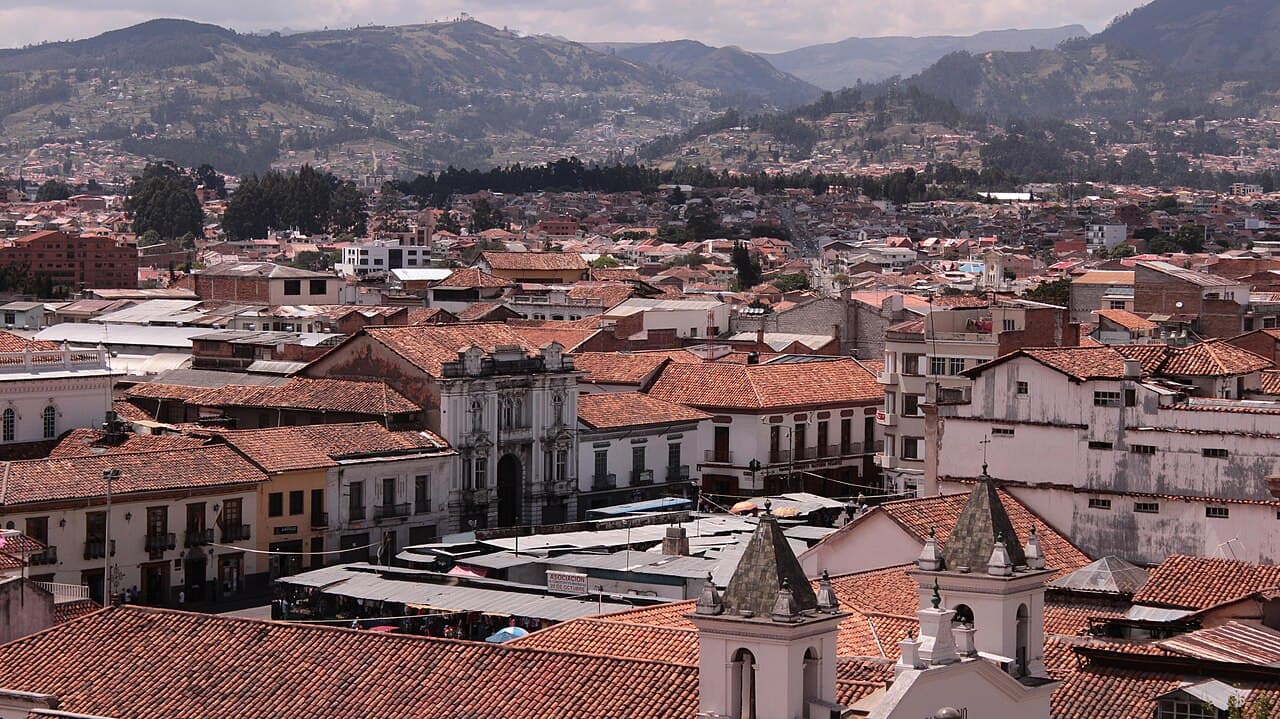
Calle Simón Bolívar carries the walk's main idea. The 1998 UNESCO nomination sums up the republican boom in one line: Cuenca exports hats and imports culture. Money from toquilla straw hats, sold abroad as Panama hats, and from cinchona bark, the source of quinine, paid for new street fronts in brick, dressed with pilasters, cornices, mansards and balustrades of French inspiration. The nomination says the changes were made mostly on the epidermis, the outer walls, while the courtyards behind were kept, and that postcards and magazines served as patterns for local self-taught master builders. Casa del Coco, built in 1890 by Florencia Astudillo, is one of these houses. At the corner of General Torres, the third stop, stands the house of Dr Benigno Polo, a pioneer of the hat export trade, shown today as the Casa de las Cruces for the two crosses on its roof. Its salon had embossed brass ceilings brought from France, an interior rather than something you see from the street.
Churches with new faces
The nomination lists Santo Domingo, San Francisco and San Sebastián among the churches whose plain colonial fronts gave way to classical ones from the end of the nineteenth century. Santo Domingo is the third church on its lot, built new in the early 1900s; the earthquake of 18 March 2023 cracked its towers, so the walk looks at them from the small plaza outside. At the Plaza de las Flores the flower sellers work in front of El Carmen, a Carmelite convent founded in 1679 whose first nuns arrived from Quito in 1682. Across the street rise the blue domes of the New Cathedral, and the nomination itself describes the flower sellers' courtyard as framed by it. At San Francisco a gilded colonial altarpiece of the mid-eighteenth century survived inside a church that was replaced in the early twentieth century.
The towers that stopped short
Parque Calderón is the old main plaza of the 1557 grid. Its eight araucarias, Norfolk Island pines, were bought in Lima and planted in 1875 by Luis Cordero Crespo, later president of Ecuador; the story that Chile donated them does not hold up. The New Cathedral facing the park was begun in 1885 under Stiehle, who directed the work until his death in 1899. It was consecrated in 1967 without its towers, which were left off because the building was judged unable to carry their weight, and declared finished in 1975. The twelve entrance columns with apostle capitals were carved in local marble from Tarqui by the sculptor Eloy Campos over thirty-two years. The cathedral reopened to worshippers in February 2026 after interior restoration, with parts still closed then, so check at the door.
A tower in the survey
El Sagrario, the Old Cathedral, stands where the colony's first main church stood, and a 1998 dig found an earlier hermitage underneath. The French mission used one of its towers as a fixed point in its survey of the meridian. According to the city's tourism foundation that tower came down in the late nineteenth century and the present front replaced it. The church houses a museum of religious art and an eighteenth-century organ.
Two convents that kept their skin, and a bank
The nomination names El Carmen and the Conceptas as convents that resisted the republican changes and kept their colonial scale. Las Conceptas, founded on 13 June 1599, fills a whole block behind high whitewashed adobe walls. The cloistered nuns sell their preparations through a torno, a turntable that passes goods and money without either side seeing the other, as they have since 1922, and Expreso credits them with inventing agua de pitimas, a herbal tonic. The walk ends at San Alfonso, Stiehle's church, dedicated in 1888, with nearly ninety stained-glass windows by Louis Victor Gesta of Toulouse, and across the street at the former Banco del Azuay, built from 1922 to 1926 and now municipal offices.
What the walk adds up to
Seen together, the stops make one argument: Cuenca kept its colonial plan and its courtyards and changed its face. The faces tell you who had money and when. Two convents show you what the town looked like before the change, and a cathedral without towers shows you where ambition met the limits of the building. For the river, the Panama hat museum and the Inca site at Pumapungo, walk the El Barranco tour next.
Ready to experience it?
Historic Center: French Faces on Colonial Houses
85 min · 2 km · easy
More from Cuenca
Explore more at your own pace.
Best Self-Guided Walking Tours in Cuenca (2026)
Cuenca Travel Guide: How Many Days, Altitude, Getting Around, Safety (2026)
One Day in Cuenca: A Walkable UNESCO Itinerary (2026)
Why Cuenca Calls Itself the Athens of Ecuador
What to Eat in Cuenca: A Food Guide (2026)