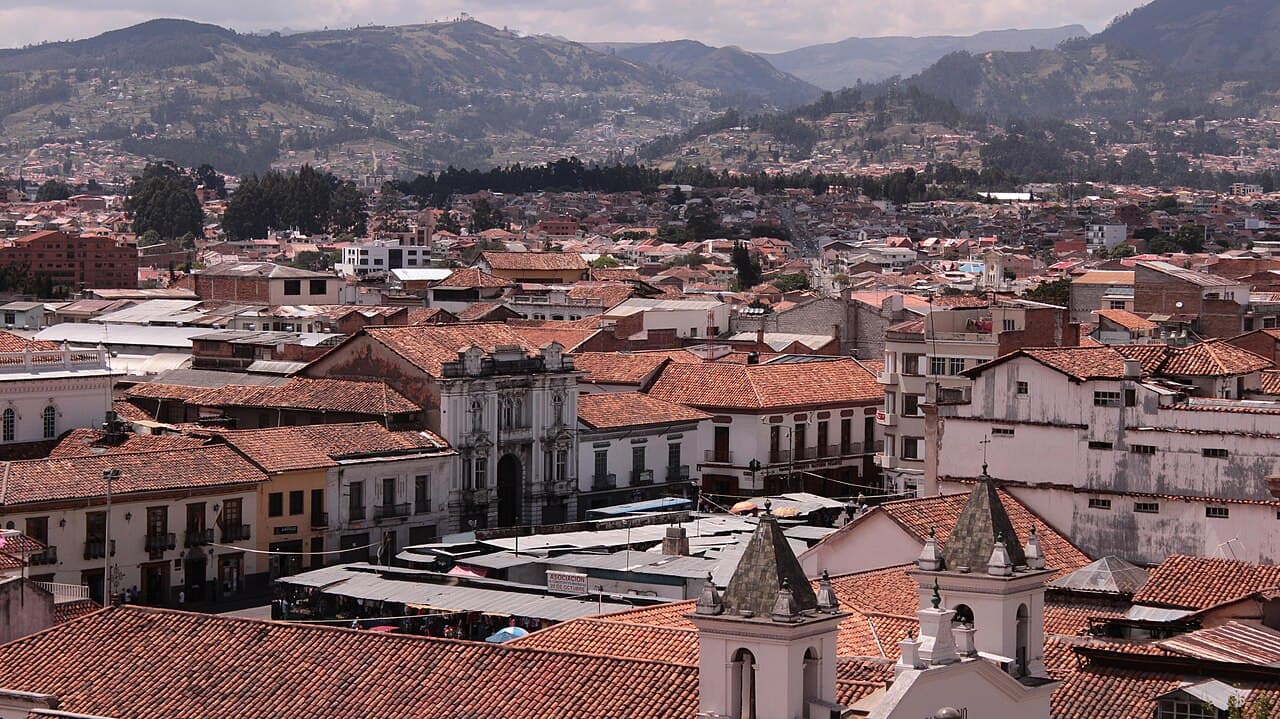
Walk Cuenca's colonial grid from Plaza de San Sebastián along Calle Simón Bolívar's republican fronts to the flower market, the blue domes, both cathedrals, the Conceptas convent and San Alfonso.
Start · Plaza de San Sebastián: The Bullfight of 1739
DirectionsStops
- 1
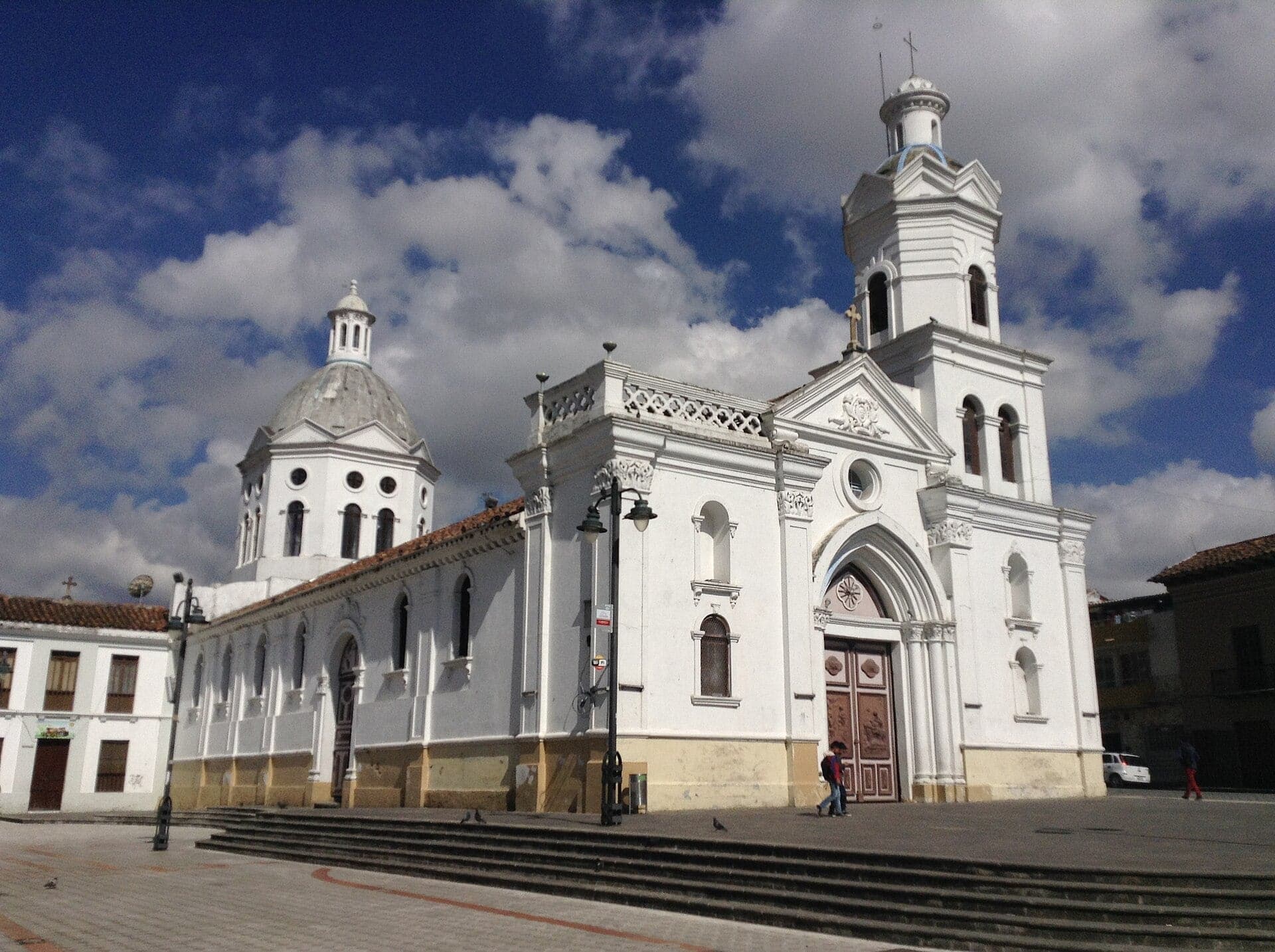
Plaza de San Sebastián: The Bullfight of 1739
Where the colonial grid begins. A white church, a former house of temperance and the riot that wounded a French surgeon in 1739.
- 2
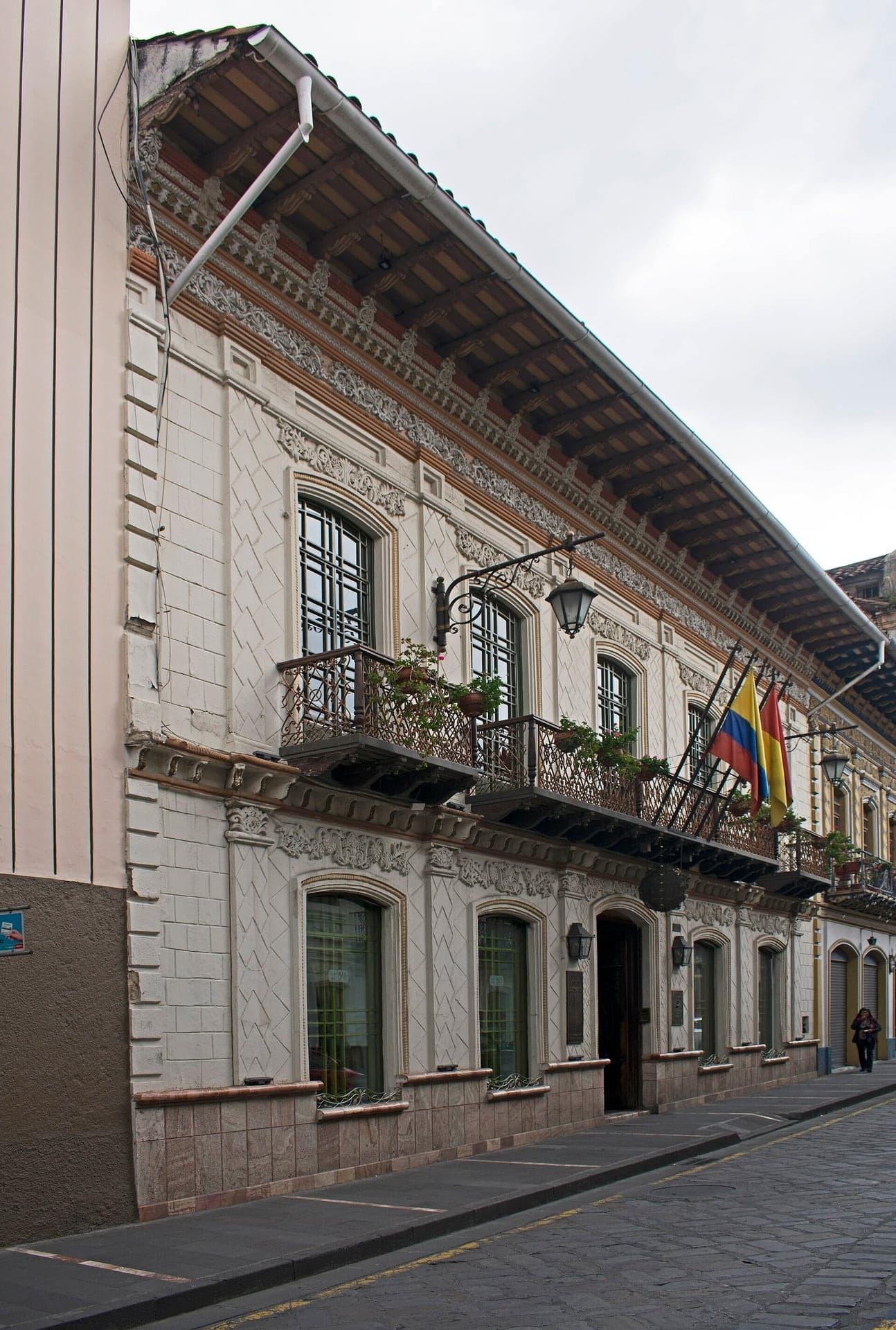
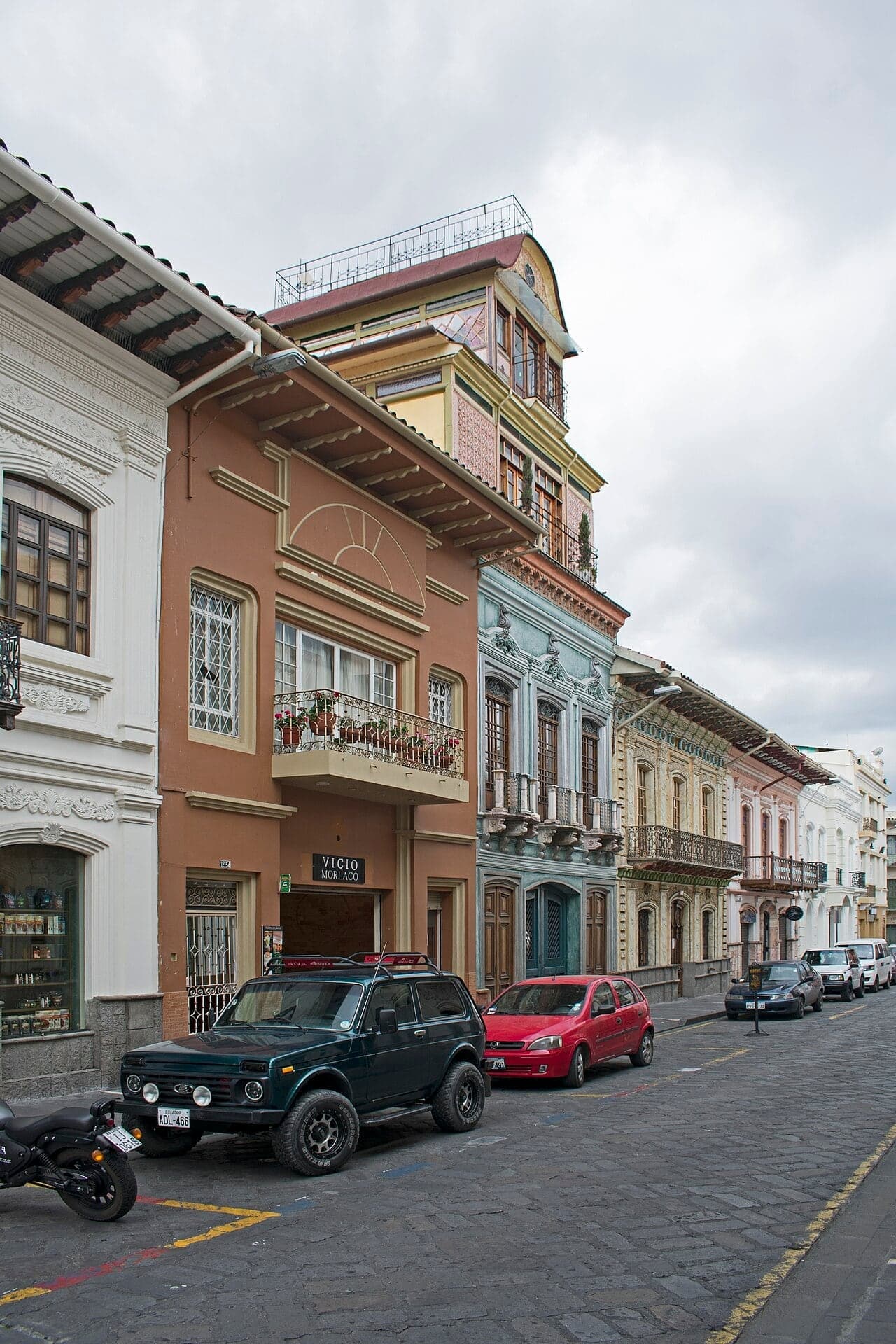
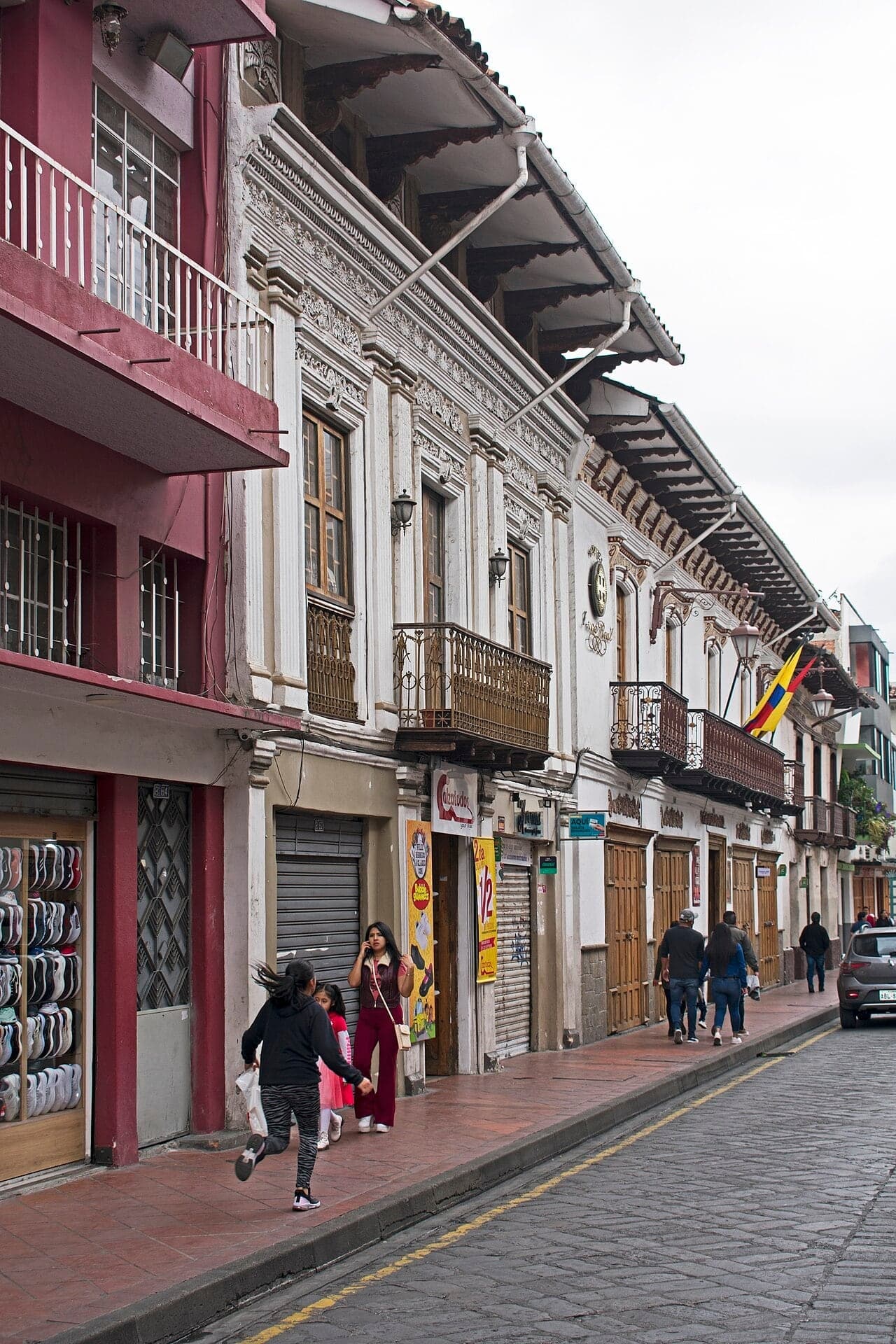
Calle Simón Bolívar: French Fronts, Colonial Houses
French fronts on colonial houses. Stucco, iron balconies and carved eaves dress houses that still keep their old courtyards.
- 3
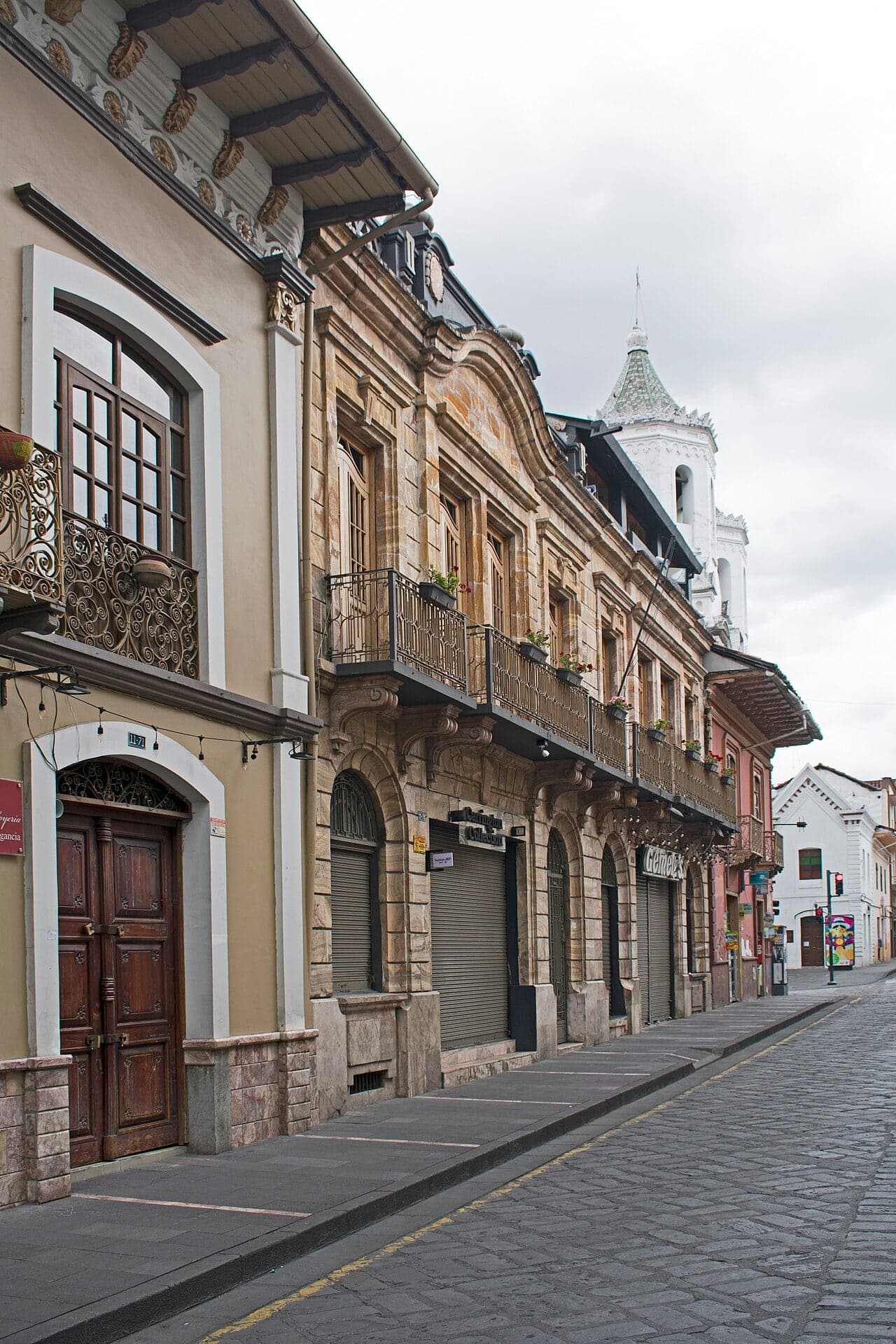
The Hat Exporter's House: Straw Into Brass
A hat exporter's corner house. A Cuenca doctor's house, paid for by the trade in toquilla straw hats the world calls Panama hats.
- 4
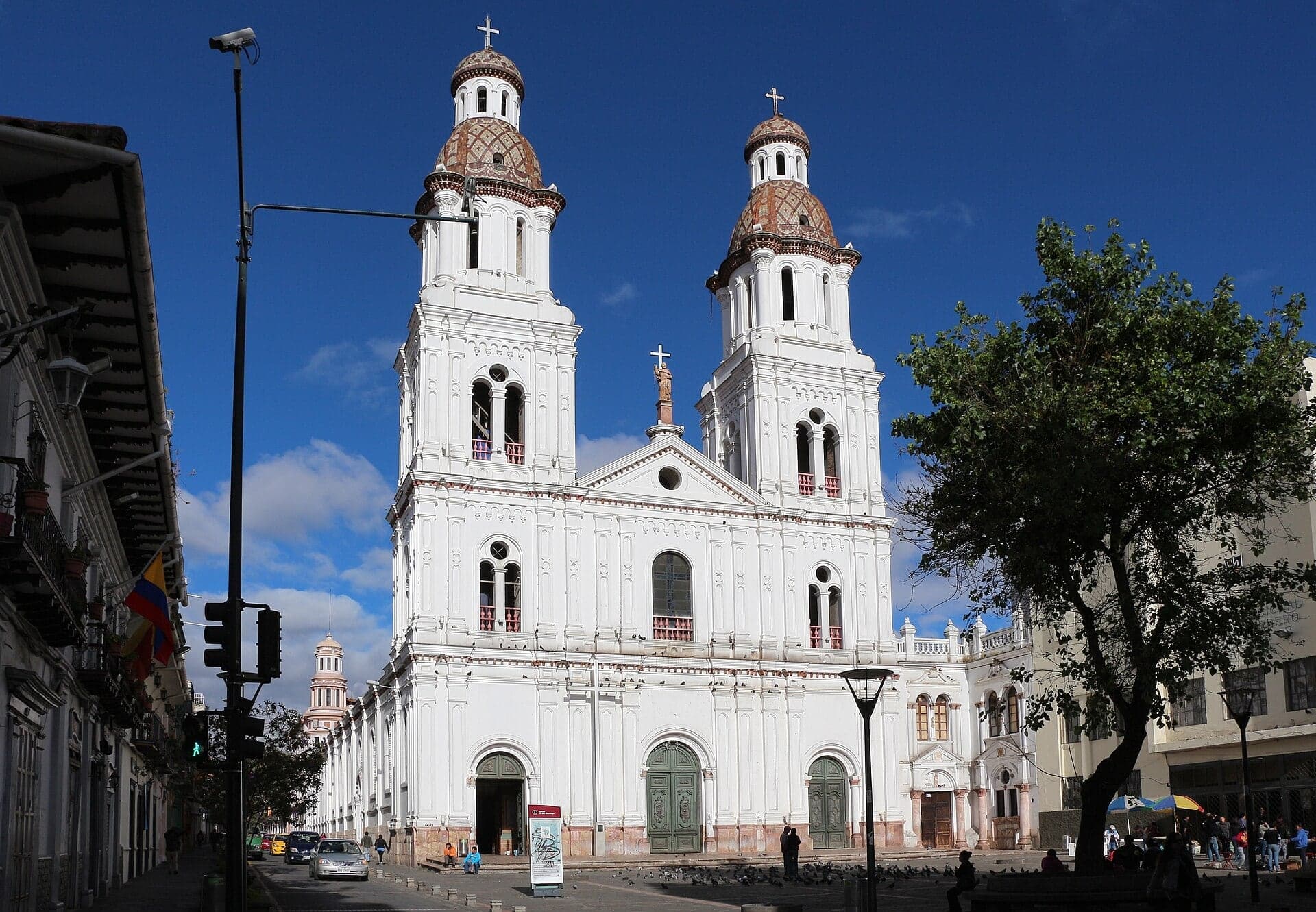
Santo Domingo: A New Front on an Old Lot
Twin brick towers over a plaza. A Dominican lot from the town's founding, with a church rebuilt in the early twentieth century.
- 5
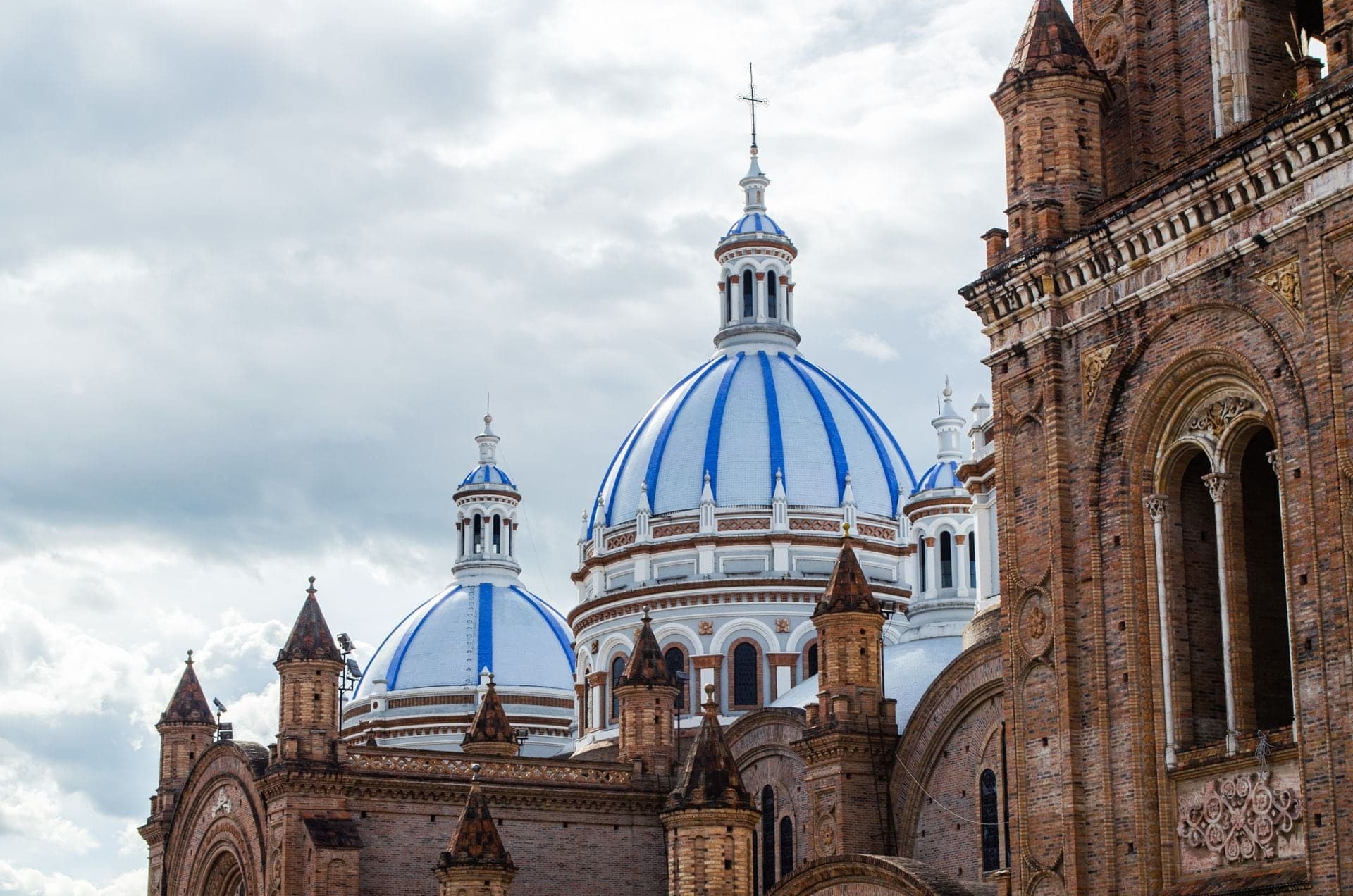
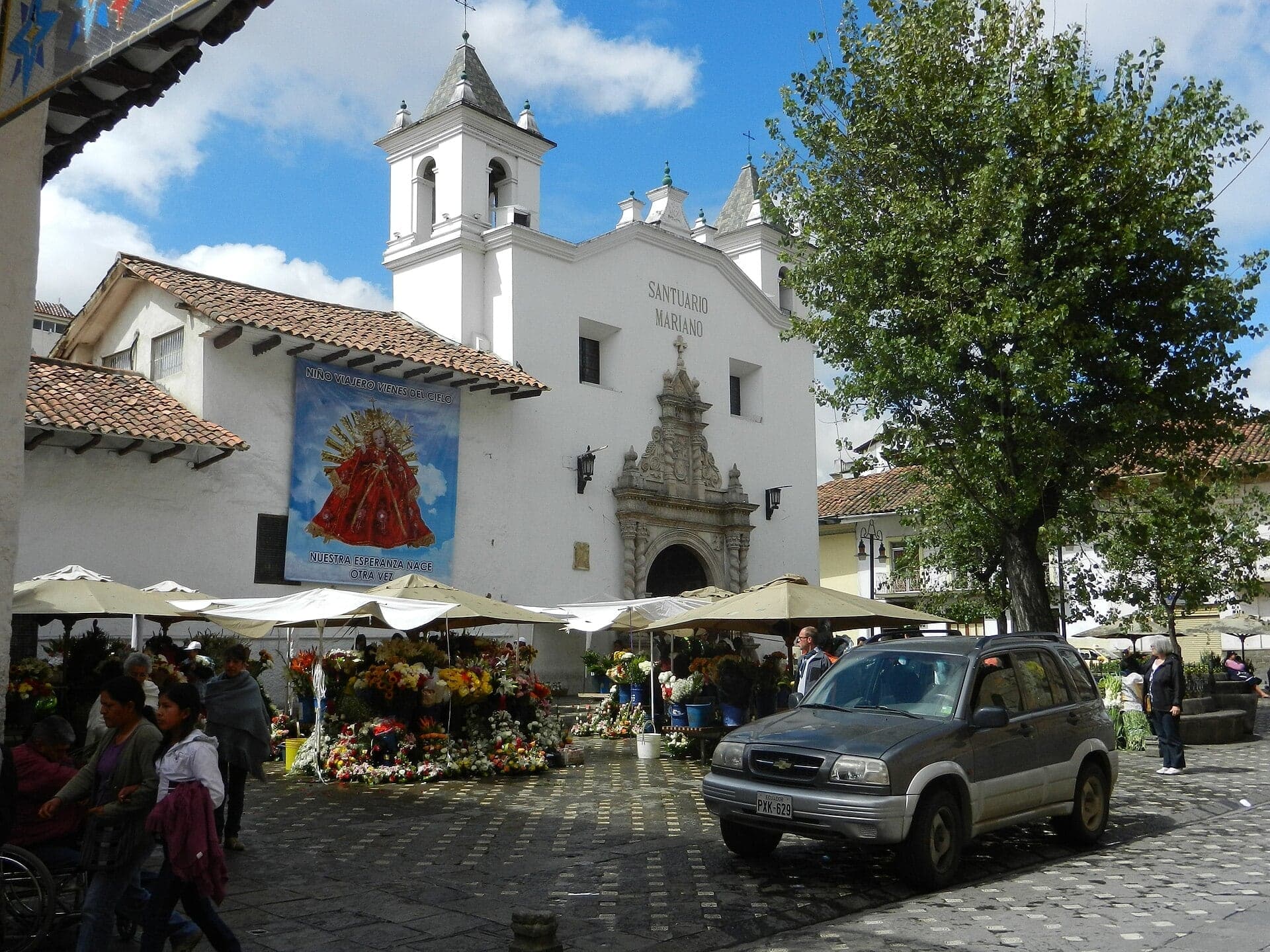
Plaza de las Flores: The Convent and the Blue Domes
Flower stalls and blue domes. El Carmen kept its colonial face; across the street rise the New Cathedral's tiled domes.
- 6
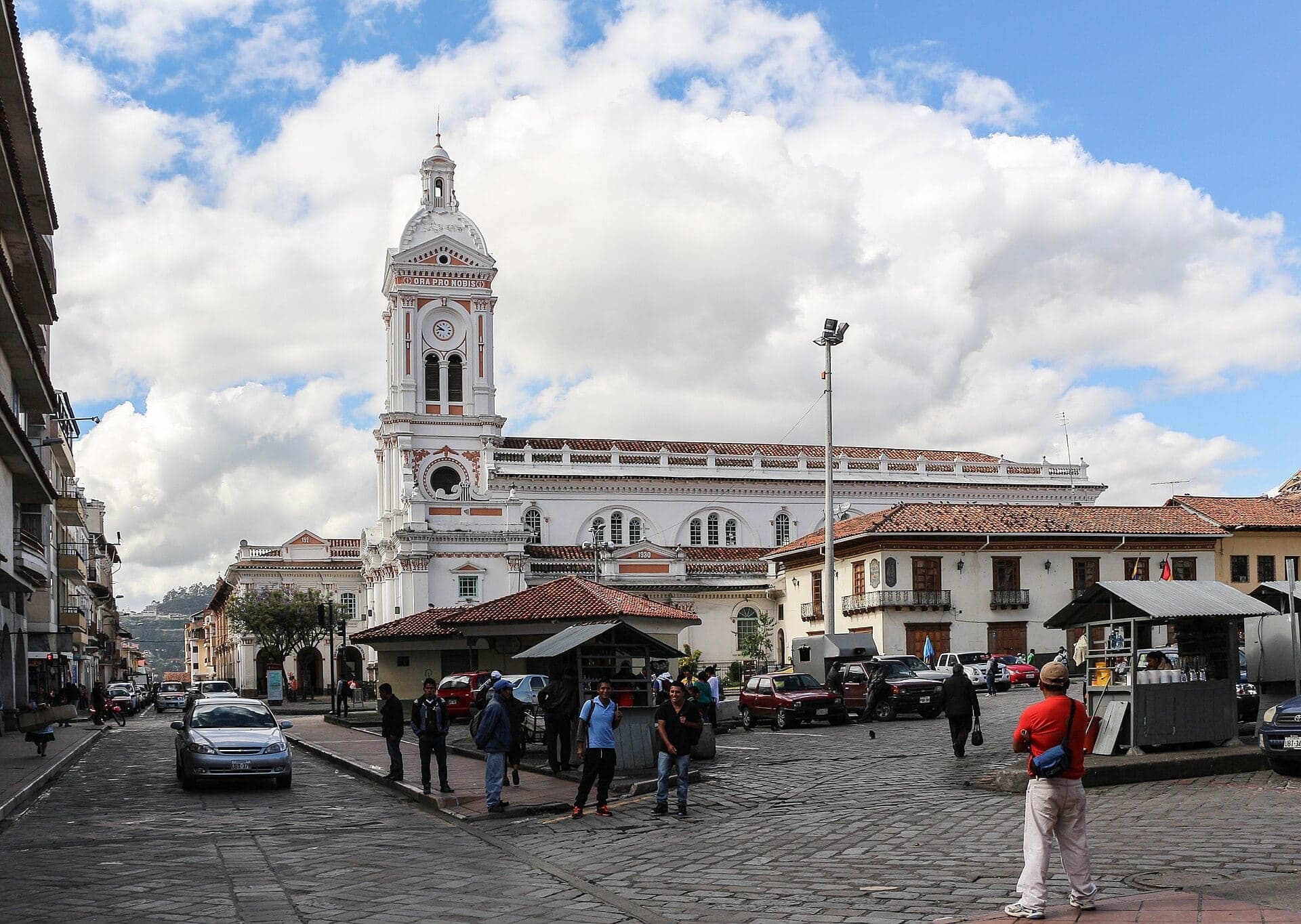
Plaza de San Francisco: The Gold That Stayed Inside
An open plaza before San Francisco. A church rebuilt in the twentieth century that kept its gilded colonial altarpiece, and textile traders from Otavalo.
- 7
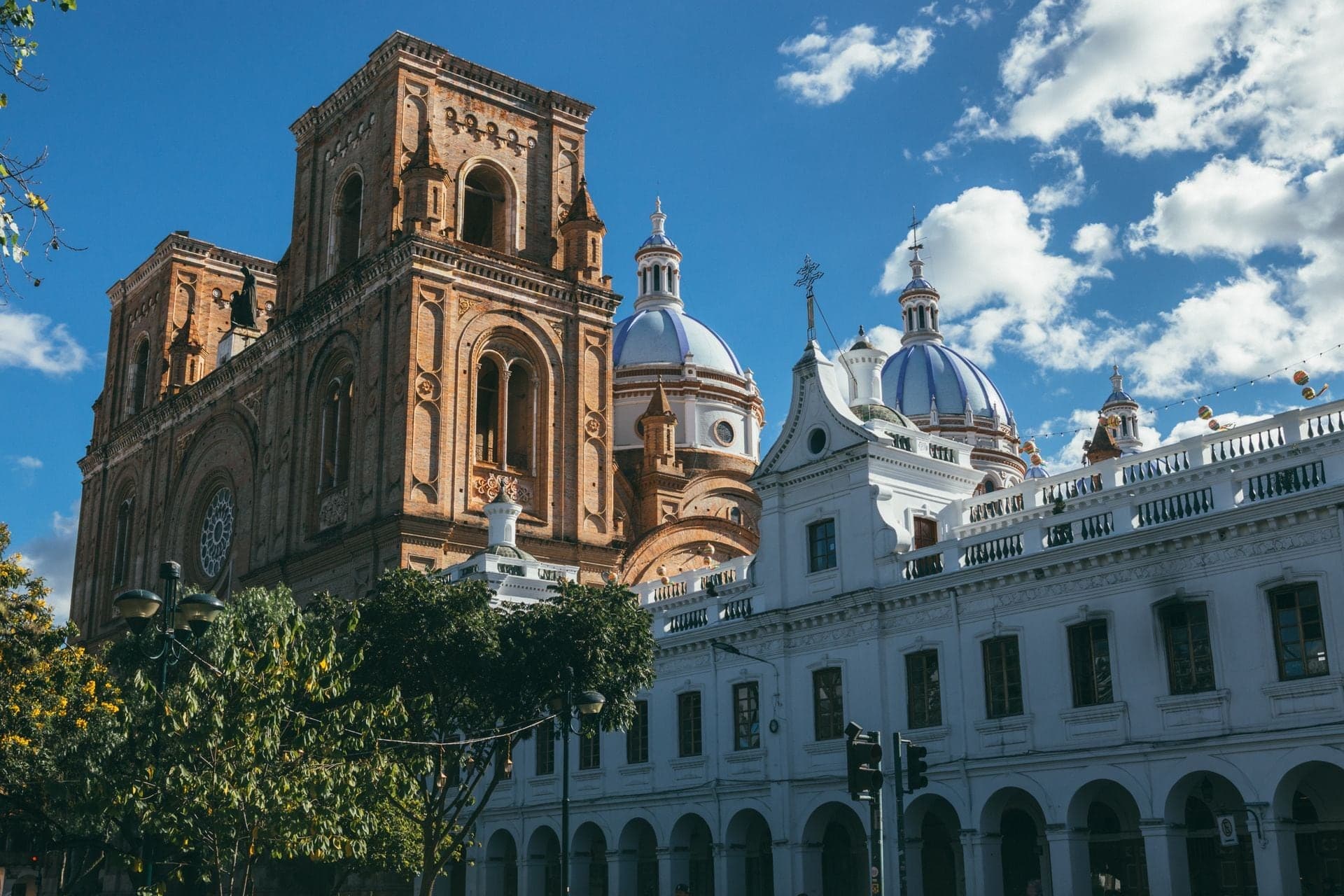
Parque Calderón: The Towers That Stopped Short
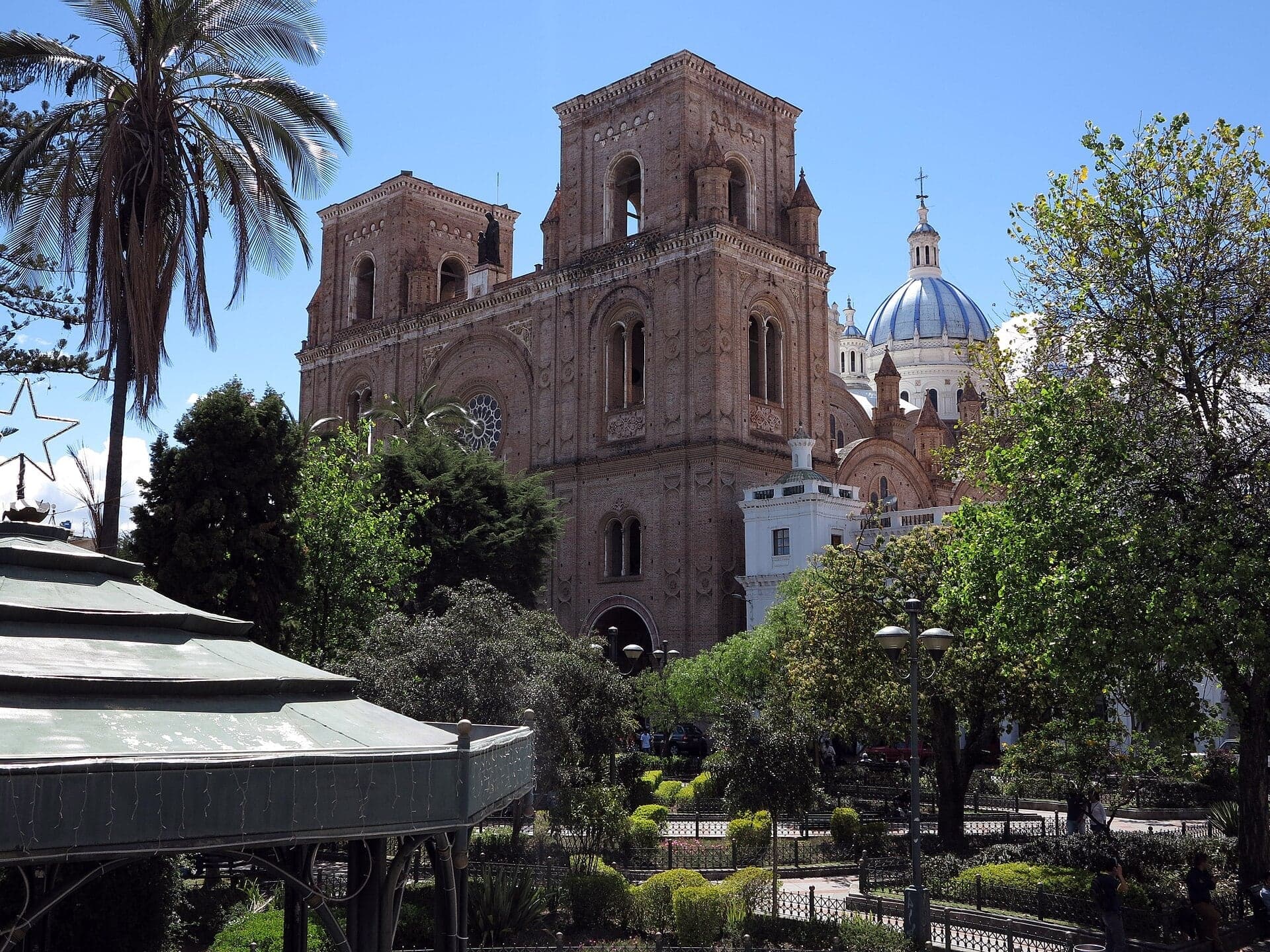
The main square and New Cathedral. Begun in 1885, consecrated in 1967 without its full towers, declared finished in 1975.
- 8
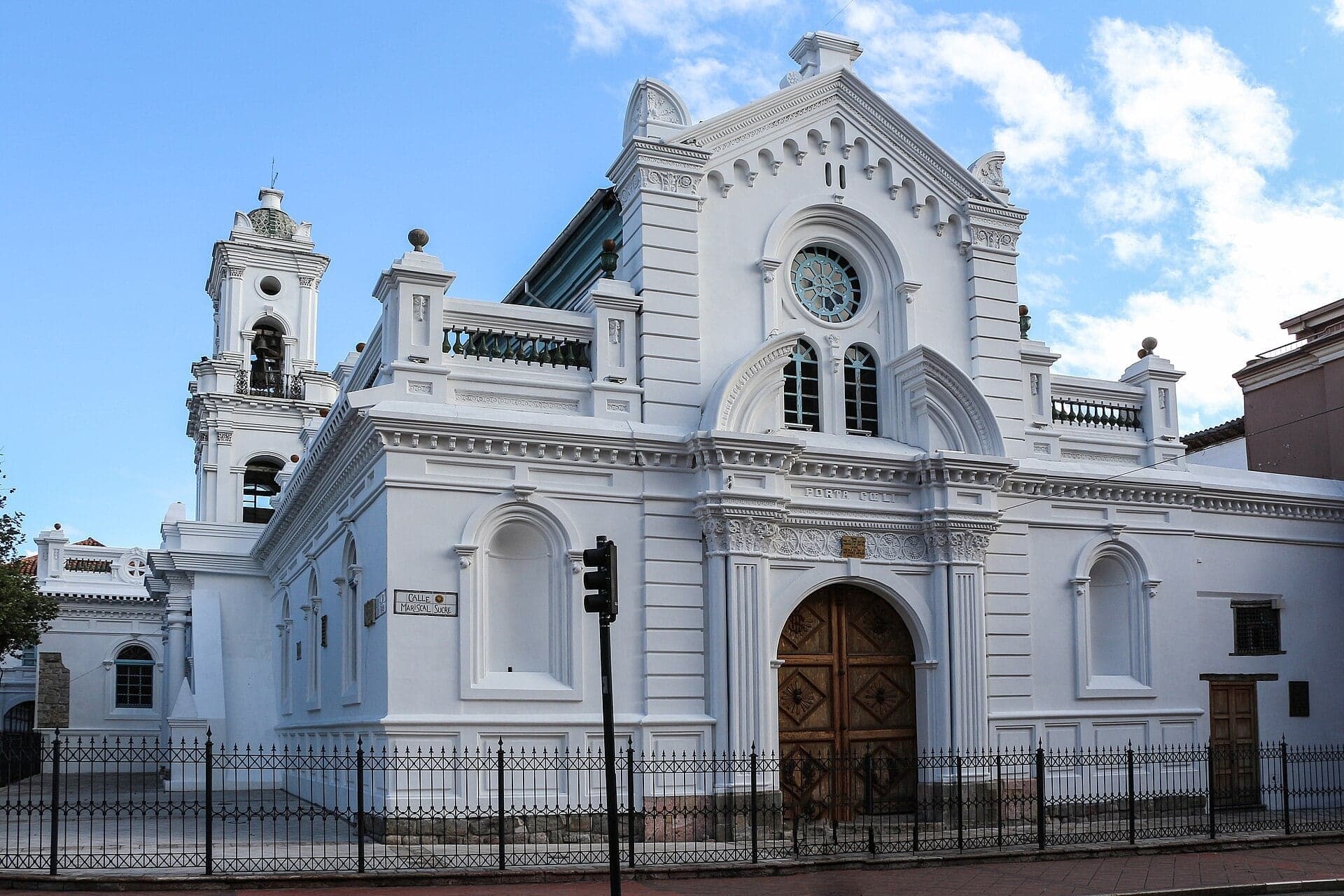
El Sagrario: The Old Cathedral and the French Survey
The Old Cathedral on the square. Built where the town's first main church stood, it gave the French survey of 1739 a fixed point.
- 9
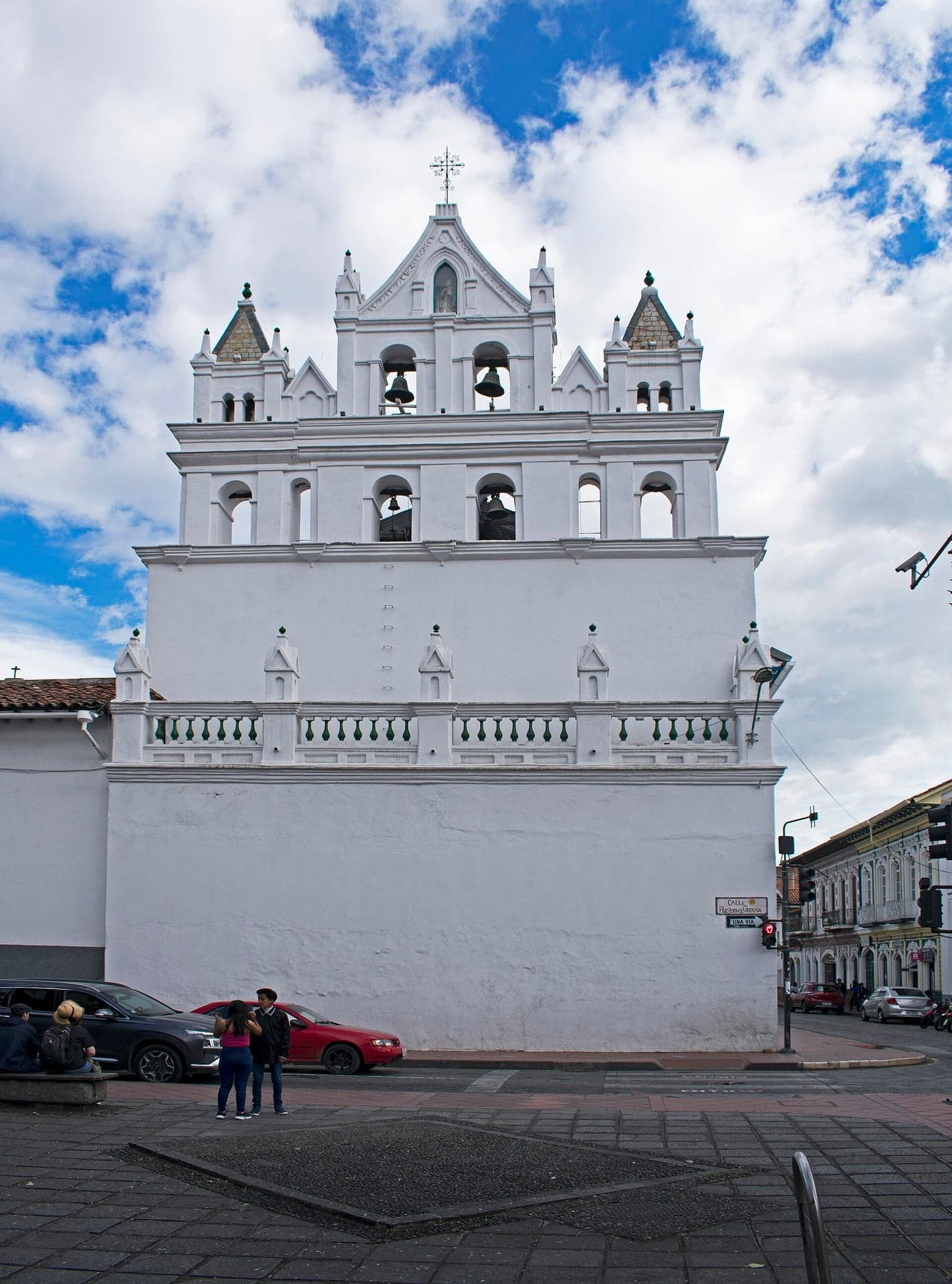
Las Conceptas: The Walls That Kept Their Skin
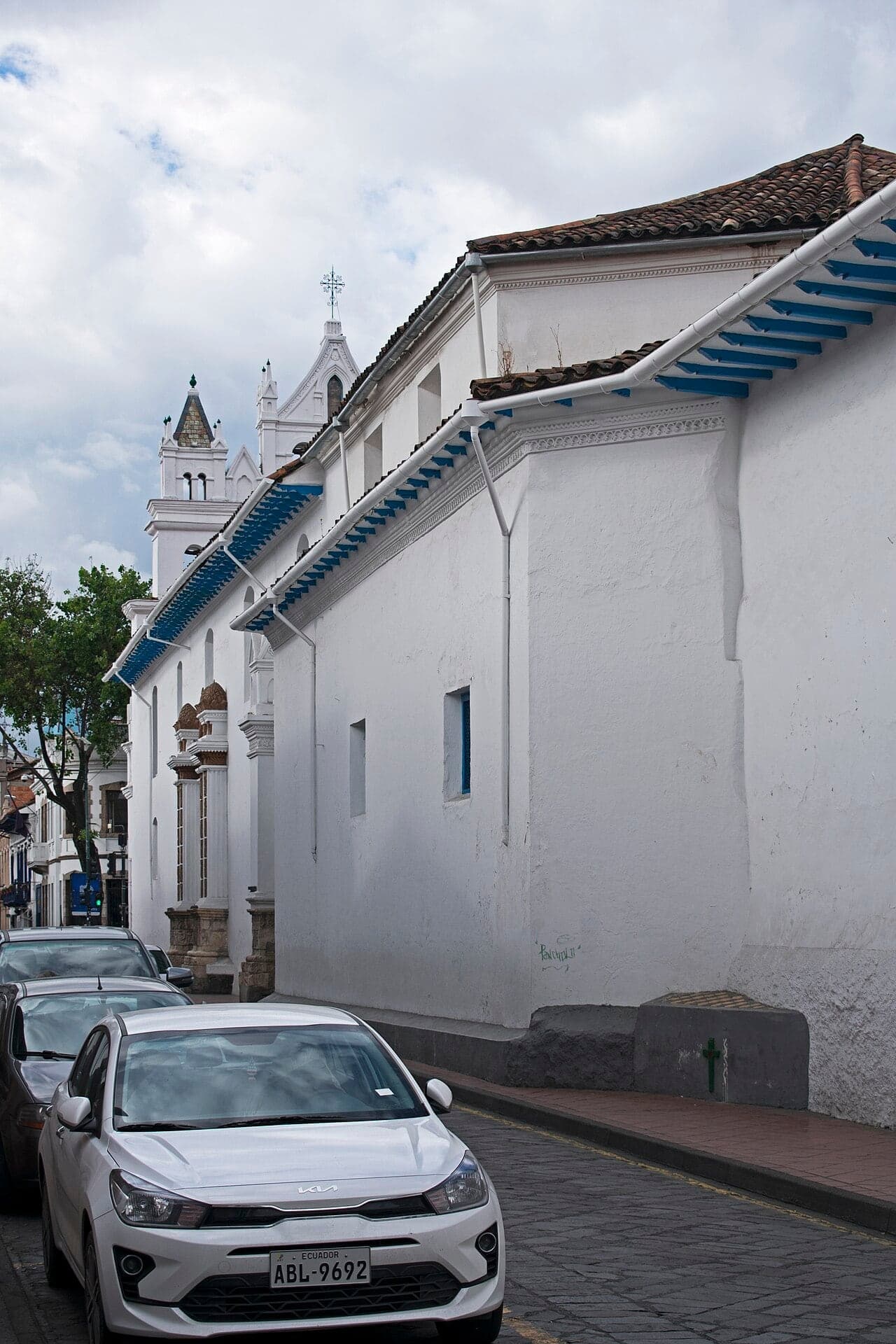
Convent walls that never changed. The blank whitewashed walls of the Conceptas convent. Founded in 1599, it kept its colonial skin, and its nuns still sell through a turntable in the wall.
- 10
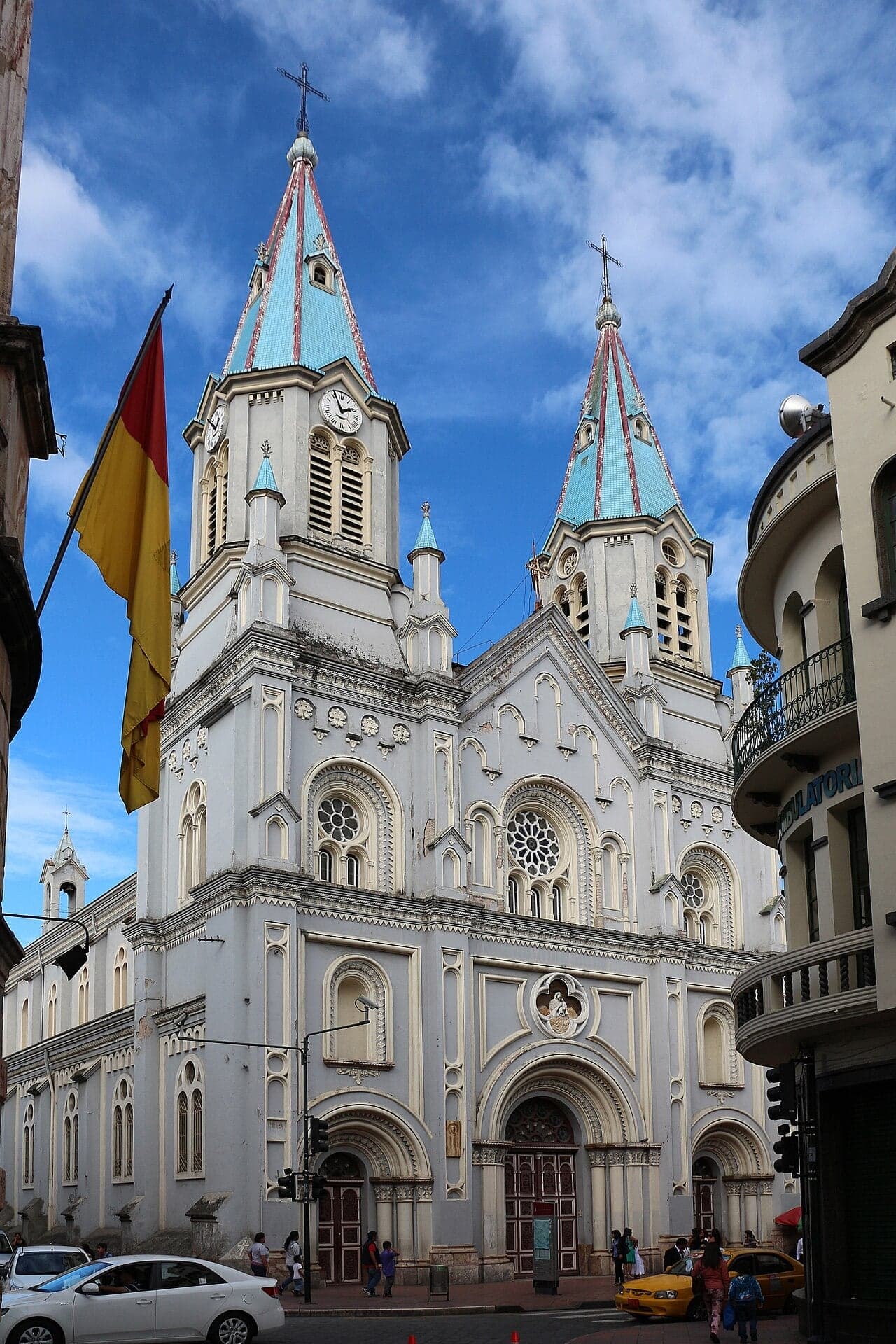
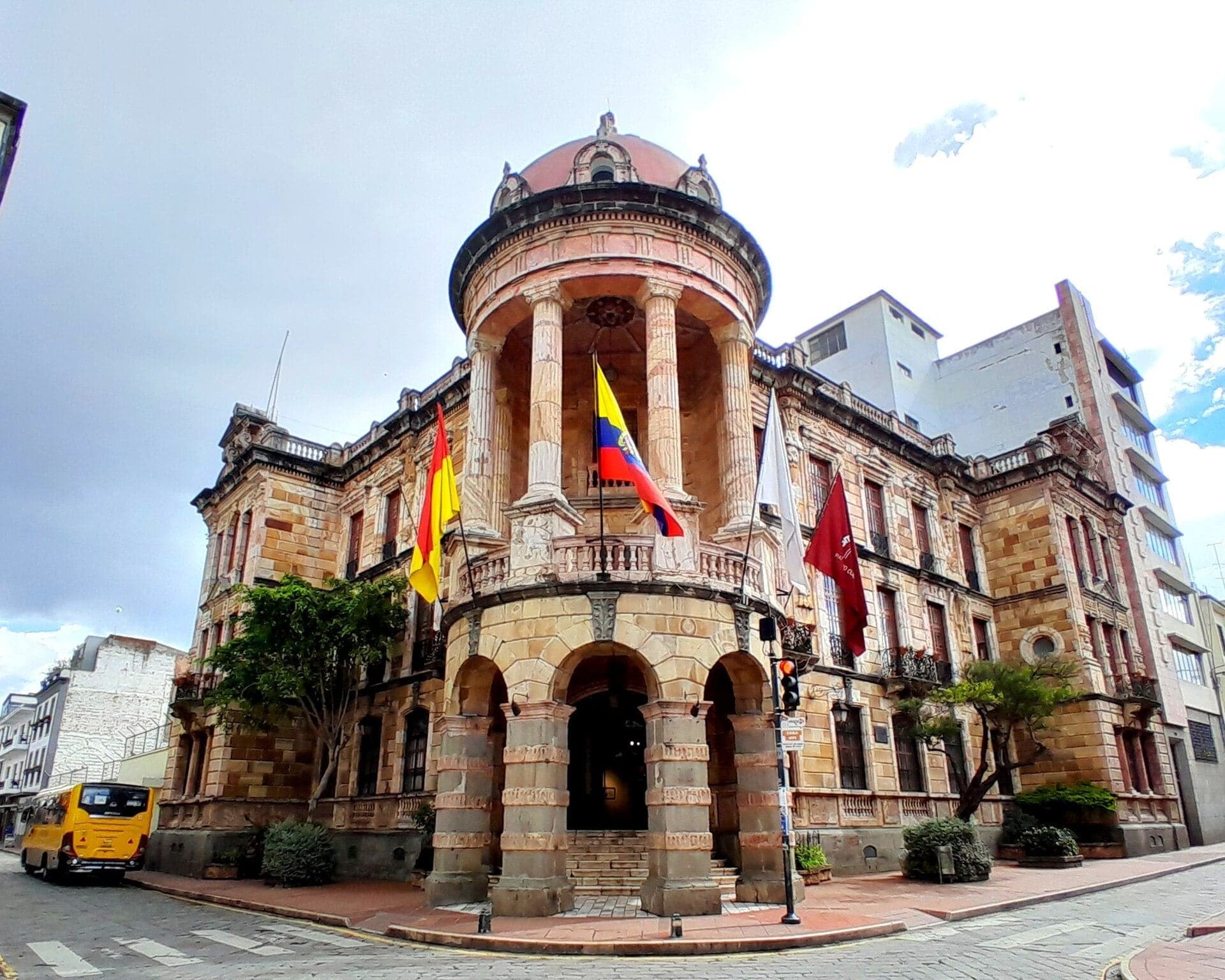
San Alfonso and the Banco del Azuay: Hats Into a Bank
A church and a bank of hats. San Alfonso's twin towers face the former Banco del Azuay, now the city's offices.
Details
Best Time to Visit
Monday to Saturday, in the morning: the flower market is busiest early, church interiors close at lunch and for services, and the Conceptas museum is closed on Sundays. Expect crowds and some closures on 9 October (national holiday) and around 3 November, Cuenca's independence day.
Pro Tips
- •Getting to the start: take a taxi to Parque de San Sebastián (Coronel Talbot and Simón Bolívar), or the tram (Tranvía de los Cuatro Ríos) to stop 11s Coronel Talbot, about 200 m from the plaza. The fare is USD 0.35 a ride, half price for students, seniors and people with disabilities, paid with a tram card; cards went back on sale on 20 August 2026 after a three-month shortage. Checked 5 October 2026.
- •The walk ends at San Alfonso, 150 m from Parque Calderón; the nearest tram stop is 13s Luis Cordero, about 110 m away. Checked 5 October 2026.
- •The Municipal Museum of Modern Art in the old House of Temperance, at stop 1, is free. Published 2026 hours differ between sources (one gives 09:00 to 16:45), so check at the door. Checked 5 October 2026.
- •Museo de las Conceptas (stop 9, entrance on Hermano Miguel 6-33): USD 4 general, USD 2 reduced, Monday to Saturday 10:00 to 17:00, closed Sundays and Good Friday. Checked 5 October 2026.
- •Museum of the Old Cathedral (stop 8): USD 2.50 adults, published 2026 hours Monday to Saturday 09:00 to 12:30 and 14:00 to 17:30, Sunday 09:30 to 13:30. Not reconfirmed for October. Checked 5 October 2026.
- •The New Cathedral's terrace climb and crypt are run as guided visits by the Archdiocese's tourism office; slots were listed in January 2026 but the current price and schedule were not confirmed: ask at the cathedral. Checked 5 October 2026.
- •Agua de pitimas, the nuns' herbal tonic, is sold at a shop beside El Carmen at the flower market and by the Conceptas through their turntable.
- •With more time, Simón Bolívar runs straight on east from the last stop to Plaza de San Blas, the old town's other Indigenous parish plaza, about 500 m away.
Safety & Precautions
- •Calle Simón Bolívar has narrow pavements and steady one-way traffic: keep to the pavement and cross at the corners.
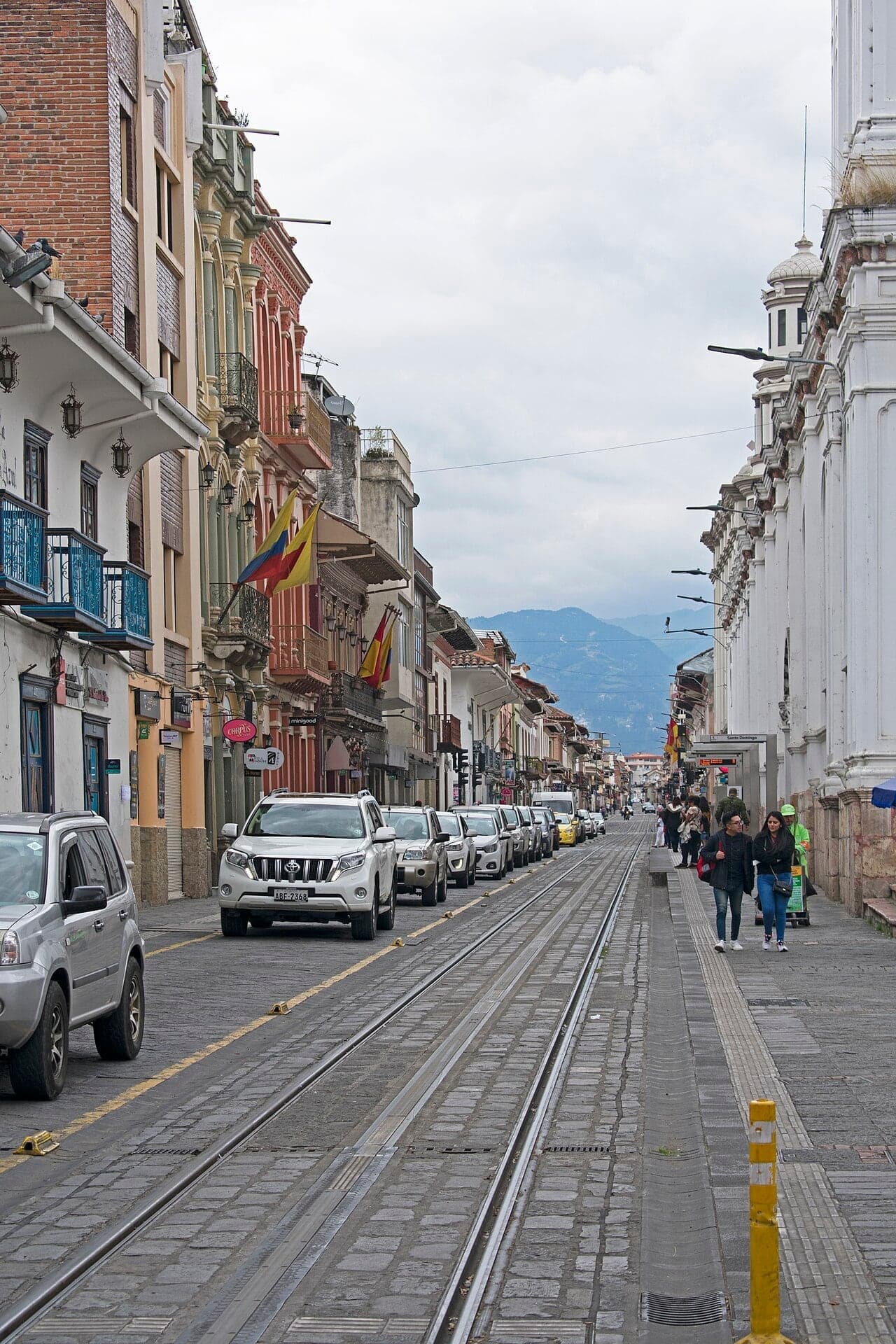
- •The tram runs along Gran Colombia: the route crosses it twice, both times at the lights, at General Torres and at Padre Aguirre.
- •Entering Parque Calderón from Benigno Malo, the crossing is mid-block with no signal, over two lanes of one-way traffic: look both ways.
- •Plaza de San Francisco and the flower market are busy: keep bags in front of you.
- •The New Cathedral: interior restoration of its domes and vaults began in August 2025; it reopened to worshippers on 18 February 2026 with about three quarters of the building in use, and completion was expected in mid-2026. No later report was found, so parts may still be closed. Checked 5 October 2026.
- •Santo Domingo's towers were cracked by the earthquake of 18 March 2023 and in 2024 the church was rated for caution; view it from the plaza.
- •Churches open at service times and close at lunch. During mass, stay at the back or come back later.
- •Cuenca sits about 2,550 m above sea level. The walk is flat, but take it slowly on your first day and carry water and sun protection.
Travel advisory: Exercise Increased Caution (Level 2).
Gallery
Read the walk
The full story of Historic Center: French Faces on Colonial Houses, in words. Prefer to listen? Play it narrated, from home or on location.
Introduction
Cuenca, in the southern Andes of Ecuador, wears French faces on a Spanish town. Its grid was laid out in fifteen fifty-seven on open ground near the ruins of an Inca city, and filled with adobe houses built round courtyards. Then, from the late nineteenth century, money poured in from two exports: straw hats, the ones the world calls Panama hats, and the bark of the cinchona tree, the source of quinine. With that money the city redressed its streets. The file that made Cuenca a UNESCO World Heritage Site puts it in one line: Cuenca exports hats and imports culture.
This walk reads that change one front at a time. Over ten stops and about two kilometres, a mile and a quarter, it runs from the Plaza de San Sebastián on the old town's western edge, along Calle Simón Bolívar, through the flower market and the main square, to two convents and a bank. Allow about eighty-five minutes. The streets are flat, but the city sits about two and a half kilometres up, so take it slowly if you arrived today.
Three names come back along the way. Jean Seniergues was a French surgeon whose expedition came to measure the Earth. Benigno Polo was a doctor who became one of the city's early hat exporters. And Juan Bautista Stiehle was a German lay brother whose churches still shape the skyline.
Watch the fronts, and wonder what is behind them.
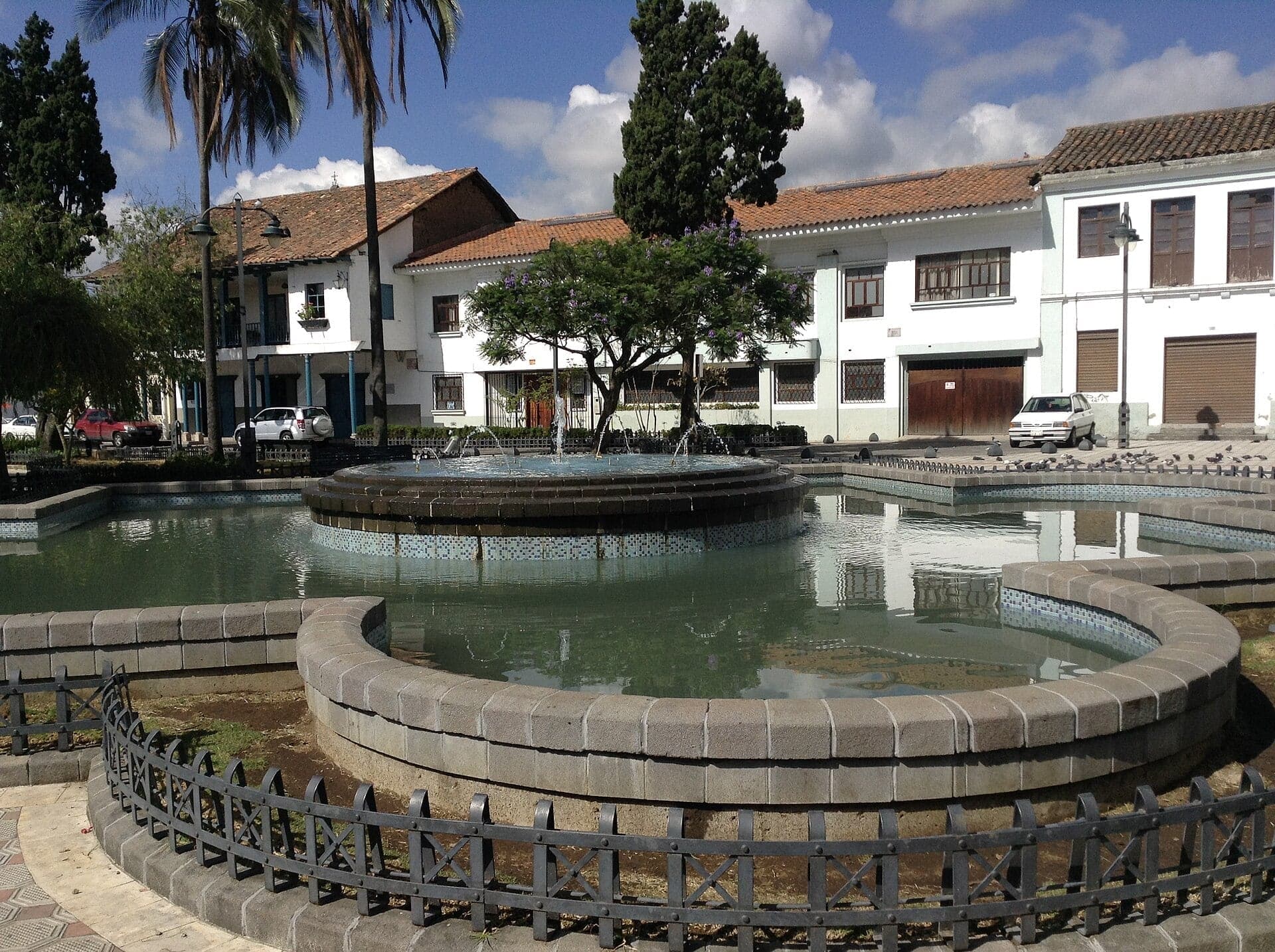
1. Plaza de San Sebastián: The Bullfight of 1739
Welcome to the Plaza de San Sebastián, at the western edge of old Cuenca. Walk on into the park and stop near the fountain.
The Spanish town had a main square and two smaller plazas at its ends: this one in the west, San Blas in the east. Around them, on the edge of town, Indigenous Cañari families were settled.
Look first at the church closing the plaza at one end. Like many churches here, it was rebuilt from the end of the nineteenth century, and a plain colonial face gave way to a grander classical one. Keep that idea, a new face on an old building.
At the other end, across the street, stands a long, low front. It went up in eighteen seventy-six as a house of temperance, a home for alcoholics, and its design is attributed to Juan Bautista Stiehle, the German lay brother. It was later a prison, and since nineteen eighty-one it has been the city's modern art museum.
In seventeen thirty-nine a French expedition was in these mountains, measuring the true shape of the Earth. On the twenty-ninth of August there was a bullfight here. The expedition's surgeon, Jean Seniergues, had quarreled with a local man over money that man owed a young woman whose engagement he had broken. As he came down from his box, a crowd shouted: long live the king, death to bad government, death to the French. He was cornered, disarmed and wounded, and died four days later, on the second of September, in the house where he hid. The case dragged on for years.
One of the expedition's leaders also wrote about a tree of these mountains, the cinchona, whose bark gives quinine. Remember that bark.
As you walk on, look up: some old houses in this part of town carry crosses on their roofs.
Follow the route along Calle Simón Bolívar. Next, a street of new faces.
2. Calle Simón Bolívar: French Fronts, Colonial Houses
Walk on along Bolívar and stop on the pavement in front of the hotel, with the row of houses across the street.
This is Calle Simón Bolívar, the long street through the old grid. Read the fronts across from you: two and three stories in white and pastel stucco, flat pilasters running up the walls, molded frames round the windows, balconies of iron and turned wood, and deep eaves resting on carved wooden brackets. At first glance, this could pass for a town in France.
Look again. Behind most of these fronts is a colonial house of adobe, narrow at the street and deep behind it, closed to the pavement and open to its own courtyards. When the money from straw hats and that cinchona bark arrived in the late nineteenth century, owners mostly did not knock those houses down. They gave them a new skin. The city's UNESCO nomination file lists the borrowings: pilasters, friezes and cornices of stucco, attics, mansard roofs and balustrades, all from French architecture. The changes, it says, were mostly made on the skin, and the courtyards were kept. A cheaper way to get the look was to work from postcards and magazines, and the work was done by local master builders, self-made architects risen from the working class.
So read each front, then picture the courtyard behind it.
Behind you, a few doors back across the street, is the Casa del Coco. It was built in eighteen ninety by a woman the city's tourism foundation calls the wealthiest in Cuenca at the time. She put a chapel on the upper floor of her second courtyard, so she could go to mass without leaving home. Later a new owner turned it into a shopping arcade named after his own nickname, Coco.
Follow the route on along Bolívar, on this same pavement. Next, the house of a hat exporter.
3. The Hat Exporter's House: Straw Into Brass
Walk on along Bolívar and stop at the corner of General Torres, where you can see the houses on the corners across the street.
On this crossroads stands the house of Benigno Polo, the doctor and hat exporter named at the start of the walk. He became a pioneer in exporting hats woven from toquilla straw. The world calls them Panama hats, and the city's UNESCO file explains the curious name: they were widely worn during the building of the Panama Canal. From the late nineteenth century, for some seventy years, these hats, with the cinchona bark from the first stop, paid for the fronts on this street. Weaving them is now on UNESCO's list of the intangible heritage of humanity.
Here is where the money went. Inside, the main salon had ceilings of embossed brass, brought from France, and an imported grand piano. None of that shows from the pavement. What shows is the front, dressed for the street. Remember the line from the nomination file: Cuenca exports hats and imports culture. This house is the sentence in one building.
The house has a nickname too. It is known as the Casa de las Cruces, the House of the Crosses, for the two crosses on its roof, like those on old roofs near San Sebastián. Look up at the corner roofs across the street and see if you can find them.
Just past the far corner of General Torres, on this side of the street, beyond the corner hotel, stands an elegant neoclassical building from the nineteen thirties, now the provincial education office.
Follow the route. You cross Gran Colombia, where the tram runs, at the lights. Next, the twin towers of Santo Domingo.
4. Santo Domingo: A New Front on an Old Lot
Walk on to the small plaza in front of Santo Domingo and stop at its corner, with the church's twin brick towers in view. The Dominicans were here from the start. A local study of the founding records says two lots near the main church were set aside for their church and…
Full narration for this stop unlocks with the tour.
5. Plaza de las Flores: The Convent and the Blue Domes
Walk on down the pedestrian street into the flower market and stop among the stalls. Beside them stands a small church, its whitewashed front set with a carved stone portal. This is El Carmen de la Asunción, the church of a convent of Carmelite nuns. Its first four nuns came…
Full narration for this stop unlocks with the tour.
6. Plaza de San Francisco: The Gold That Stayed Inside
Walk on to the corner of the open plaza and stop, with the church of San Francisco across the street. The Franciscans, like the Dominicans at Santo Domingo, opened a plaza in front of their house. Their church is another new face. Church and convent were both replaced, and the…
Full narration for this stop unlocks with the tour.
7. Parque Calderón: The Towers That Stopped Short
Walk on into the park and stop. Then turn round to face the cathedral. This is Parque Calderón, the old main square at the head of the grid. Government, courts and both cathedrals face it. Among the trees are eight araucarias, Norfolk Island pines, planted in eighteen…
Full narration for this stop unlocks with the tour.
8. El Sagrario: The Old Cathedral and the French Survey
Walk on through the park to its corner and stop, with the Old Cathedral just across the street. Today it is a museum of religious art, ticketed and worth it; the details are on this stop's card. This is El Sagrario, the Old Cathedral. It stands where the town's first main…
Full narration for this stop unlocks with the tour.
9. Las Conceptas: The Walls That Kept Their Skin
Walk on to the corner of the small plaza and stop. Turn to face the long whitewashed walls across Córdova, with almost no windows in them. Part of this convent is a museum, ticketed and worth it; the details are on this stop's card, and its door is round the corner on Hermano…
Full narration for this stop unlocks with the tour.
10. San Alfonso and the Banco del Azuay: Hats Into a Bank
Walk on to the corner of Bolívar and stop there. Across Bolívar rises a church with twin neo-Gothic towers. Across the other street stands a grand front that was once a bank. The church is San Alfonso, and it brings back Juan Bautista Stiehle, the German lay brother of the New…
Full narration for this stop unlocks with the tour.
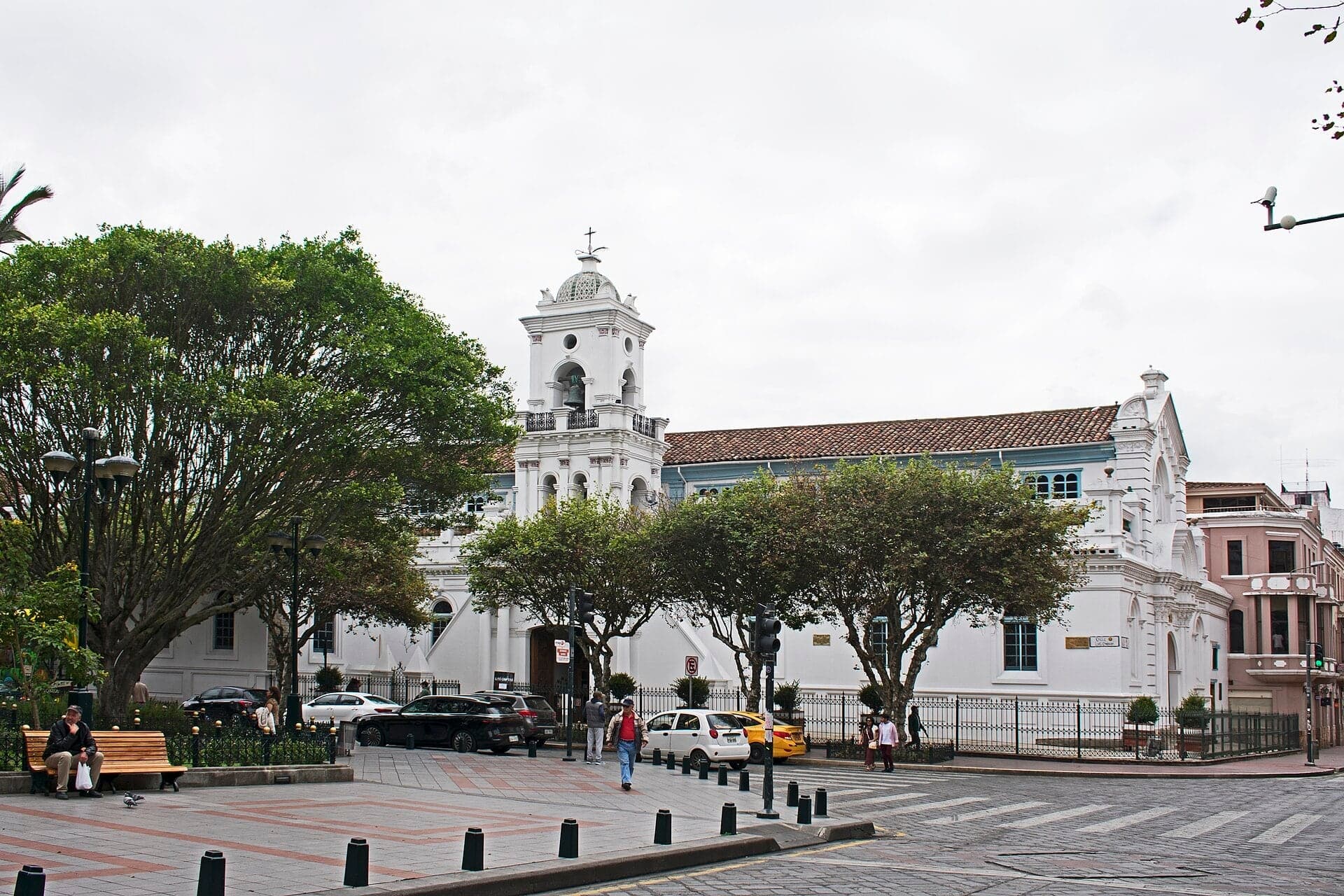
- Iglesia de San Sebastián, Cuenca Ecuador — Ceancata, CC BY-SA 4.0 · source
- Plaza de San Sebastián, Cuenca Ecuador — Ceancata, CC BY-SA 4.0 · source
- Calle Simón Bolívar 12-55 seen from the northeast, Cuenca, Azuay, Ecuador — Ymblanter, CC BY-SA 4.0 · source
- Calle Simón Bolívar 12-54, Cuenca, Azuay, Ecuador — Ymblanter, CC BY-SA 4.0 · source
- Calle Simón Bolívar 11-79, Cuenca, Azuay, Ecuador — Ymblanter, CC BY-SA 4.0 · source
- Calle General Torres 8-60, Cuenca, Azuay, Ecuador — Ymblanter, CC BY-SA 4.0 · source
- Santo Domingo Church, Cuenca, Ecuador — Bernard Gagnon, CC BY-SA 3.0 · source
- Calle Gran Colombia seen from Calle Padre Aguirre to the west, Cuenca, Azuay, Ecuador — Ymblanter, CC BY-SA 4.0 · source
- Cvetlični trg pred samostanom v Cuenci — Ljuba brank at Slovenian Wikipedia, GFDL · source
- Iglesia de San Francisco, Cuenca, Ecuador — Bernard Gagnon, CC BY-SA 3.0 · source
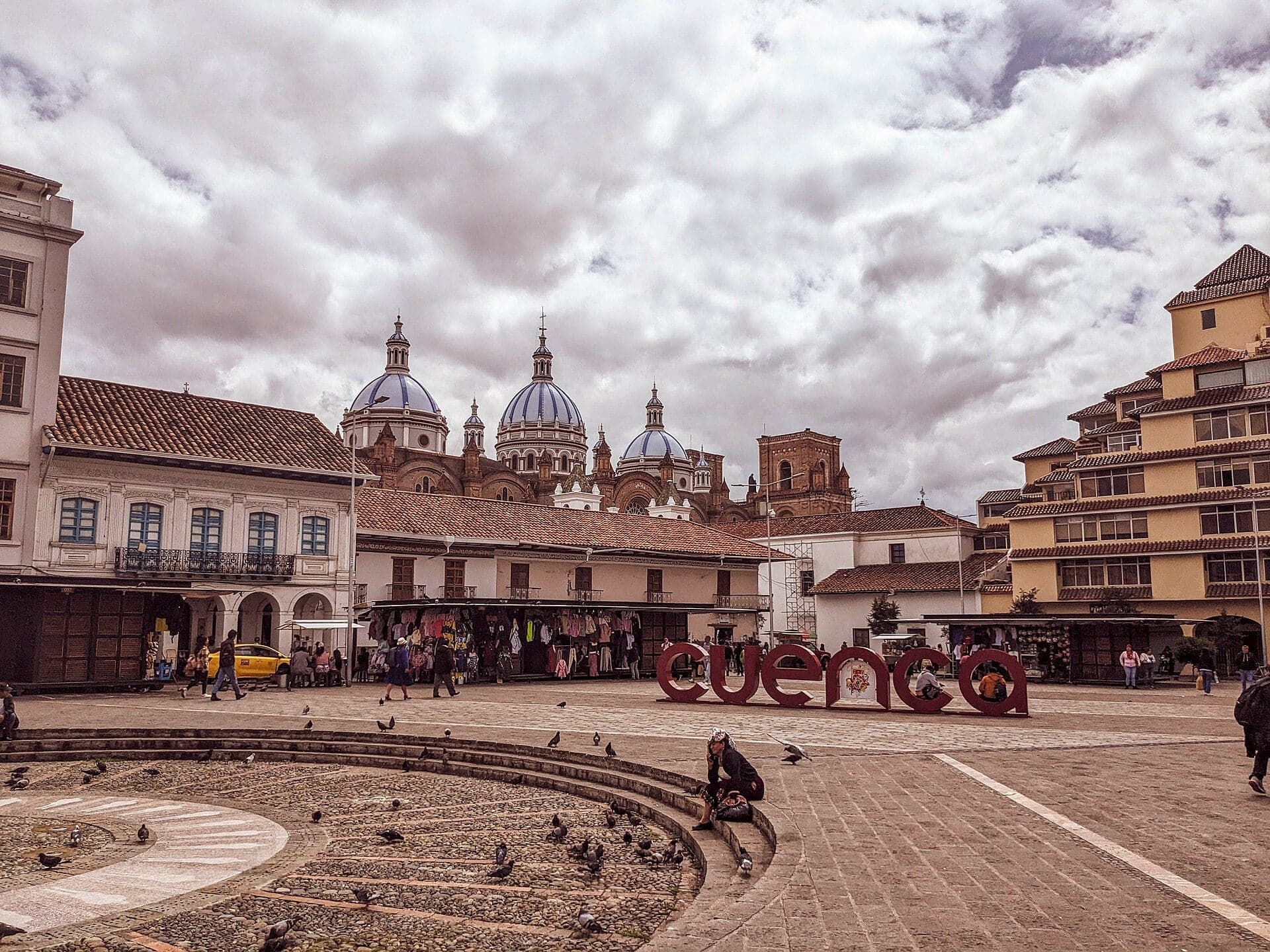
- Una foto tomada un mediodía nublado de la Plaza San Francisco con las cúpulas de la catedral de fondo y las letras de "Cuenca" en medio de l — Eduarda Abad Mendieta, CC BY 4.0 · source
- Cuenca, Ecuador, Parque Calderón — Johannes Wagenknecht, CC BY-SA 4.0 · source
- Iglesia del Sagrario (Old Cathedral), Cuenca, Ecuador — Bernard Gagnon, CC BY-SA 3.0 · source
- Old Cathedral seen from the west, Cuenca, Azuay, Ecuador — Ymblanter, CC BY-SA 4.0 · source
- Main facade of Monasterio de la Inmaculada Concepción, Cuenca, Azuay, Ecuador — Ymblanter, CC BY-SA 4.0 · source
- Iglesia del Monasterio de la Inmaculada Concepción seen from the southwest, Cuenca, Azuay, Ecuador — Ymblanter, CC BY-SA 4.0 · source
- Iglesia de San Alfonso, Cuenca, Ecuador — Bernard Gagnon, CC BY-SA 3.0 · source
- El edificio de la Alcaldía de Cuenca (Ecuador), de estilo antiguo, en el Centro Histórico de la ciudad. Mayo, 2025. — SantosJD, CC BY-SA 4.0 · source
Images may be cropped or resized. Other photos via Unsplash and Pexels.