Historic Center: French Faces on Colonial Houses
85 min · 2 km · easy
The Other Colonial City
Quito gets the headlines. Guayaquil gets the business travelers. But ask Ecuadorians which city they'd most like to live in, and a surprising number say Cuenca.
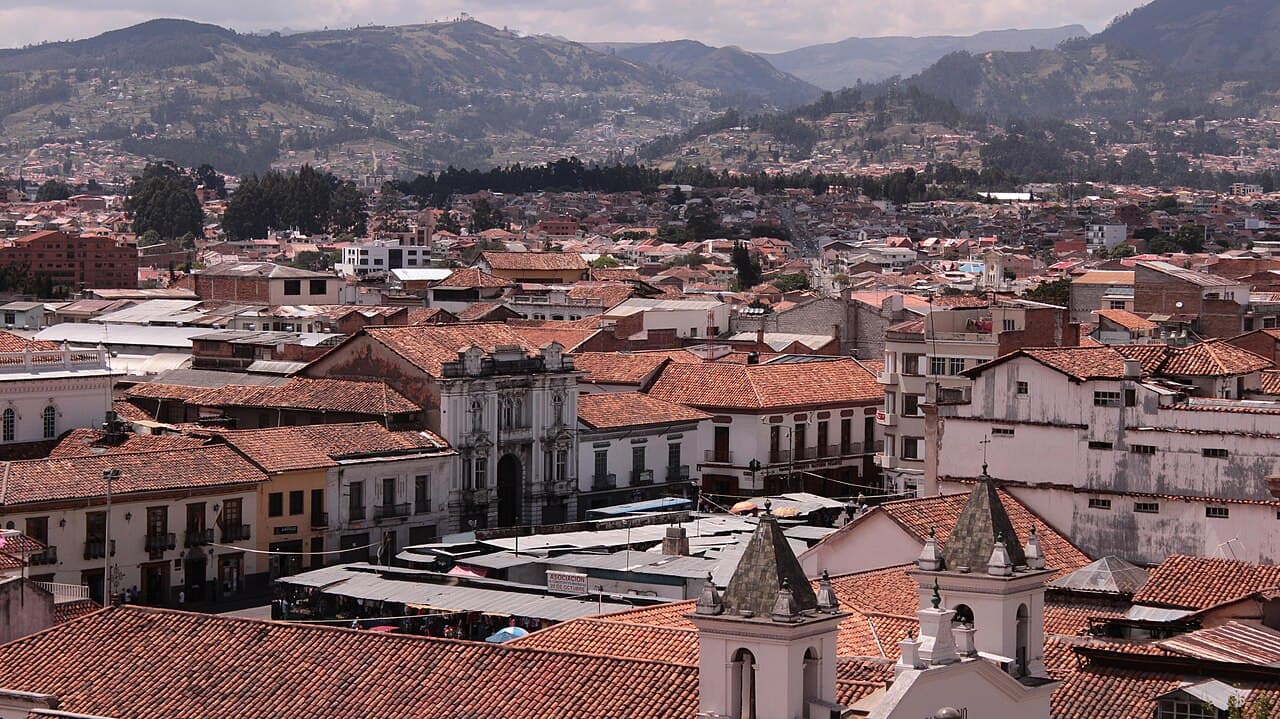
Tucked into a highland valley at 2,530 meters (lower and warmer than Quito), Cuenca (officially Santa Ana de los Ríos de Cuenca) is a city of 600,000 that moves at a pace most Latin American capitals abandoned decades ago. It earned its own UNESCO World Heritage designation in 1999, and the comparison with Quito is instructive: where Quito's colonial center overwhelms with scale, Cuenca charms with intimacy.
What You'll Find
Hear a stop from this walk
San Alfonso and the Banco del Azuay: Hats Into a Bank
Cuenca's historic center is built on a human scale. Cobblestone streets are narrow enough that balconies on opposite sides nearly touch. Most colonial buildings are two or three stories, with no towering monasteries or fortress-churches dominating the skyline. The effect is a city that feels like a large village, walkable and unhurried.
The Rivers
Four rivers run through Cuenca, and the city has built its identity around them. The Tomebamba, the largest, separates the colonial center from the modern southern neighborhoods. Its banks are lined with eucalyptus trees and walking paths, and the traditional houses along its edge, with their whitewashed walls and wooden balconies hanging over the water, form one of the most photographed scenes in Ecuador.
The New Cathedral
Cuenca's Catedral de la Inmaculada Concepcion, known as the New Cathedral, dominates the skyline with its massive blue-and-white tiled domes. Construction began in 1885 and took nearly a century to complete. The towers were never raised to their planned height: the building was judged unable to carry their weight, and it was consecrated without them in 1967 and declared finished in 1975. The result is a building with an oddly perfect, stout grandeur.
The Market Culture
Cuenca's markets are legendary. The Mercado 10 de Agosto is one of the best food markets in South America, a two-story building where ground-floor stalls sell produce, meat, and flowers, and upstairs vendors serve bowls of caldo de pata (cow foot soup), hornado (roasted pork), and fresh fruit juices for a dollar or two.
The Flower Market on Plaza de las Flores operates daily, a riot of color in front of the Carmen de la Asuncion church. Flower sellers fill the little square with roses, lilies, and tropical blooms, under the blue domes of the New Cathedral across the street.
Art and Craft
Cuenca is Ecuador's craft capital. The surrounding Azuay province produces the country's finest Panama hats (toquilla straw hats), ceramics, and metalwork. Workshops in the historic center and nearby towns like Chordeleg and Gualaceo welcome visitors, and watching a master weaver shape a superfino hat (a process that can take months) is one of those experiences that recalibrates your understanding of handcraft.
The city also has a growing contemporary art scene. Small galleries dot the historic center, and the Bienal Internacional de Cuenca, held every two years, is one of the most important art events in South America.
Why Expats Love It
Cuenca has become one of the most popular expat destinations in Latin America, consistently ranked among the world's best places to retire. The appeal is straightforward: low cost of living, excellent healthcare, spring-like weather, walkable neighborhoods, and a cultural life that includes theaters, universities, and year-round festivals.
The expat presence has added international restaurants and English-language services to Cuenca's mix, but the city hasn't lost its Ecuadorian character. It still feels like a place that belongs to itself.
Getting There
Cuenca's airport receives flights from Quito and Guayaquil. The overland route from Quito takes about eight hours by bus through spectacular Andean scenery, including a stretch along the Avenue of the Volcanoes and past the eerie, windswept páramo of Cañar province. The journey itself is half the reason to go.
Frequently asked questions
- When did Cuenca become a UNESCO World Heritage Site?
- Cuenca earned its UNESCO World Heritage designation in 1999. Where Quito's colonial center overwhelms with scale, Cuenca charms with intimacy.
- What is special about Cuenca's New Cathedral?
- The Catedral de la Inmaculada Concepcion, known as the New Cathedral, dominates the skyline with its massive blue-and-white tiled domes.
- Why do expats love living in Cuenca?
- Cuenca has become one of the most popular expat destinations in Latin America. The appeal includes low cost of living, excellent healthcare, spring-like weather, walkable neighborhoods, and a rich cultural life.
Ready to experience it?
Historic Center: French Faces on Colonial Houses
85 min · 2 km · easy
More from Cuenca
Explore more at your own pace.
Best Self-Guided Walking Tours in Cuenca (2026)
Cuenca Travel Guide: How Many Days, Altitude, Getting Around, Safety (2026)
One Day in Cuenca: A Walkable UNESCO Itinerary (2026)
Why Cuenca Calls Itself the Athens of Ecuador
What to Eat in Cuenca: A Food Guide (2026)