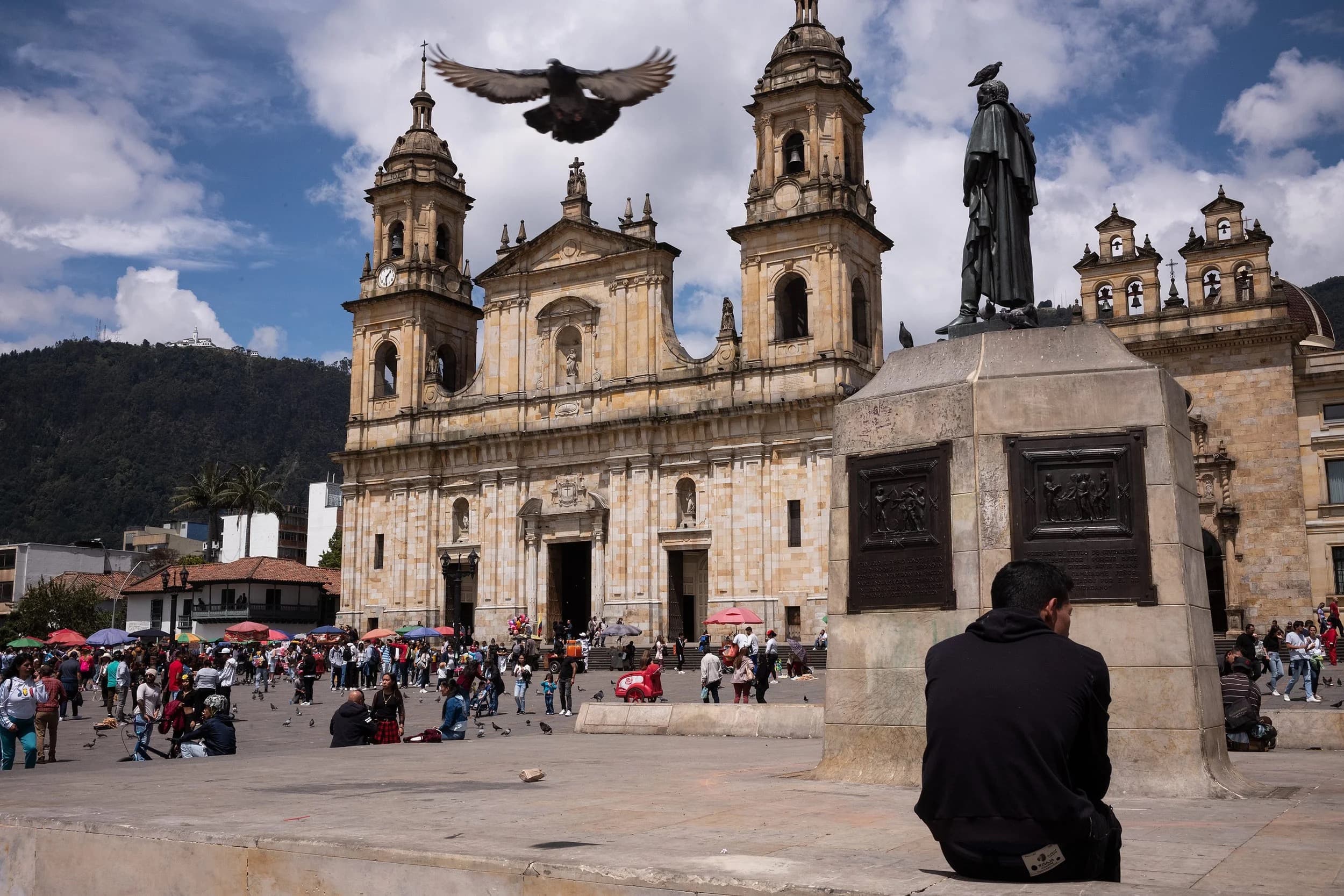
The Plaza de Bolívar sits at two thousand six hundred and forty meters of altitude. Around its four sides are the cathedral, the Capitolio Nacional that houses the legislature, the Palacio de Justicia that holds the courts, and the Liévano Palace that runs the city. Four hundred meters away is the Casa de Nariño, where the president lives and works. This is the most concentrated political and religious real estate in Colombia. It is the seat of every institution the country has.
And it is not what most visitors come to see.
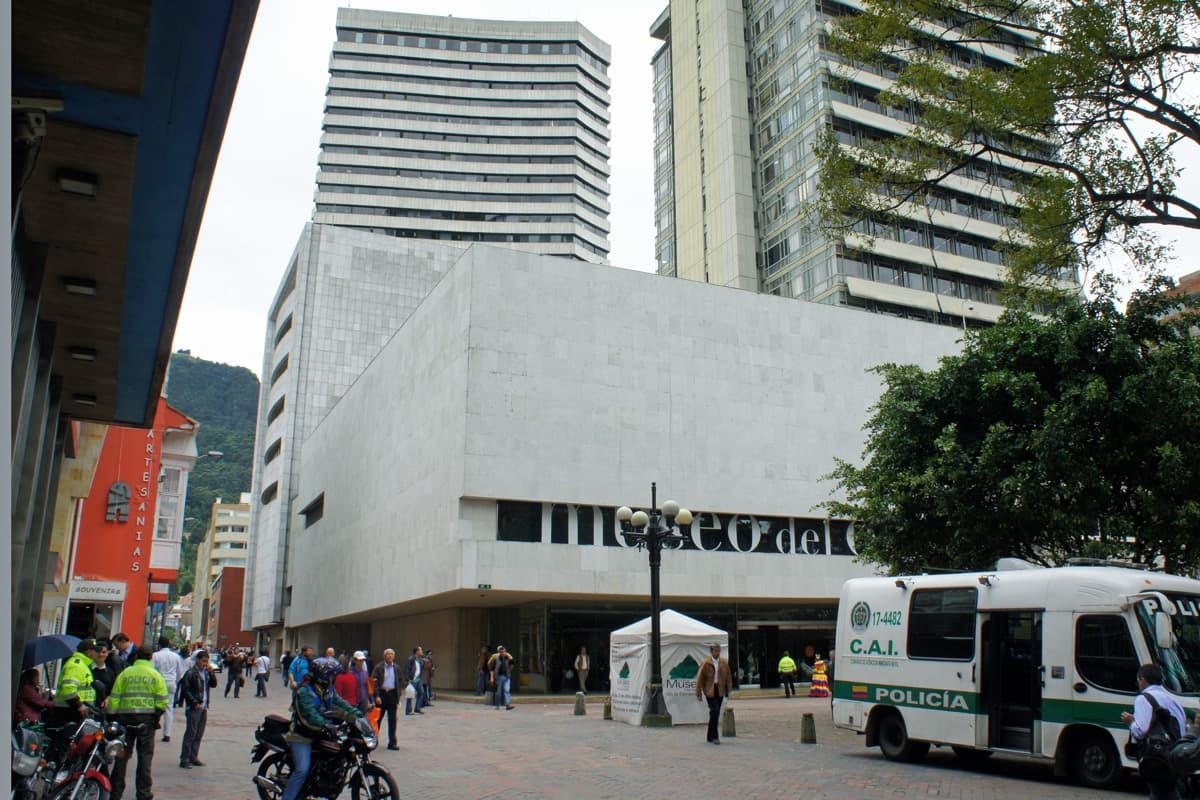
Across La Candelaria, the colonial neighborhood that fans out east and south from the plaza, the lines form in front of three other buildings. The Museo del Oro, which holds fifty-five thousand pieces of pre-Columbian gold. The Museo Botero, where Fernando Botero gave away two hundred and eight pieces of art on the condition they remain free forever. The Plazoleta del Chorro de Quevedo, a small bohemian square at the end of a cobblestone alley where students drink chicha under archways. The Bogotá that the capital projects is the four buildings on the Plaza de Bolívar. The Bogotá visitors actually walk is the three buildings on the rest of the neighborhood.
That gap is the city.
The altitude is not a detail
Bogotá sits higher than Lhasa. The air at two thousand six hundred and forty meters has roughly seventy-five percent of the oxygen at sea level. Visitors arriving from Cartagena or Miami feel it within an hour. Stairs that should take twenty seconds take forty. Wine hits twice as hard. The cathedral is the fourth church to stand on its site because earthquakes keep knocking down the previous three and because building a stone cathedral at this altitude on seismically active ground is mostly an act of stubbornness.
The altitude is also why this is the capital. When Gonzalo Jiménez de Quesada led nine hundred Spanish soldiers up from the Caribbean coast in 1536, he was looking for the gold he had heard about in Santa Marta. What he found, two years and seven hundred dead men later, was a high-altitude savanna at the heart of the Muisca confederacy. The Muisca had been working gold and emeralds in this valley for centuries. The temperature was twelve to twenty degrees Celsius year-round, no malaria, no yellow fever, defensible from below. Quesada founded the city on August sixth of 1538, with one hundred and sixty-six surviving men. He named it Santa Fe.
Almost every reason Spain wanted Bogotá then is the reason Colombia keeps it as a capital now. It is the seat because of its geography. The geography is what makes the air thin and the visitors slow.
Five centuries in nine blocks
Hear a stop from this walk
Plazoleta del Chorro de Quevedo
The colonial heart of the city, La Candelaria, is small. From the Plaza de Bolívar to the Plazoleta del Chorro de Quevedo is about eight hundred meters of walking. Inside that square kilometer the city accumulates roughly five hundred years of itself, layered in a way no other South American capital quite manages.
At one corner is the Iglesia de San Francisco, started in 1557 and finished in 1621. It is the oldest church still standing in Bogotá. Older than the Taj Mahal. Its ceiling is built in the Mudéjar style, a geometric wooden coffer that crossed the Atlantic in the heads of craftsmen trained in the Moorish tradition of Christian Spain. You can stand under it and look at a direct line from medieval Islamic geometry to colonial South America.
A block from San Francisco is the Casa del Florero. In July of 1810, a small group of Creole conspirators borrowed a flower vase from a Spanish merchant named José González Llorente, expected him to refuse, used the refusal as a pretext to gather a crowd, and triggered the public confrontation that began the independence of Colombia. The vase is in a museum case inside the building. It is plain. The whole story is plain. Independence began here, in this house, with a borrowed object and a calculated insult.
A block from the Casa del Florero is the Museo del Oro, which is where five centuries collapse back on themselves. The collection is dominated by the Muisca Raft, a small gold sculpture maybe the size of a hand, depicting a coronation ceremony on Lake Guatavita. Spanish conquistadors heard about that ceremony and chased the legend of El Dorado across the continent for two hundred years. The actual object that started the legend has been in this museum since 1969, when farmers found it in a cave near Pasca.
Walk five hundred meters east and you are in the Plazoleta del Chorro de Quevedo, where Quesada is said to have raised the first cross in 1538. Students drink chicha there now, a fermented corn drink the Muisca made long before the Spanish arrived, banned by the Colombian government from 1948 until 1991 to protect the Bavaria beer monopoly, restored by the 1991 constitution. Five centuries, eight hundred meters.
The street art is law, not graffiti
The other thing visitors notice within an hour of walking La Candelaria is that every available surface is painted. Not tagged. Painted. Large, finished, signed works of art on the side of any building whose owner does not actively object.
That is also institutional, in a way most visitors do not realize. On August nineteenth of 2011, a sixteen-year-old graffiti writer named Diego Felipe Becerra was shot in the back by a police officer while painting a Felix the Cat under a highway underpass in north Bogotá. The death triggered marches, a parliamentary inquiry, and ultimately Decreto 075 of 2013, which decriminalized street art on private surfaces with the owner's consent. The city went from criminalizing graffiti to formally protecting it inside two years. Today there are over five thousand catalogued murals in Bogotá, painted by named artists, sometimes commissioned, often political. The density on Calle Trece in La Candelaria is among the highest in the Americas.
The mural is now the most legible thing about contemporary Bogotá. The artists work in styles that pull from Muisca textile geometry, from Wayúu weaving patterns, from indigenous and Afro-Colombian portraiture. The state of the walls is the state of the country. Read them slowly.
How to walk the city
Two routes, walked back to back, cover most of what makes Bogotá Bogotá.
The first is the Historic Heart route through La Candelaria: Plaza de Bolívar, Casa del Florero, the cathedral and San Francisco, the Museo del Oro, the Museo Botero, ending at Chorro de Quevedo. Two hours at altitude, mostly downhill from the plaza, finishing in the bohemian square at the bottom. This is the visible city.
The second is the street art route, which overlaps La Candelaria but pushes north into La Macarena: Parque de los Periodistas where Diego Felipe Becerra is memorialized, Calle Trece for the dense work of Toxicómano and DJ Lu and Stinkfish, the Callejón del Embudo for chicha, the Centro Cultural Gabriel García Márquez and the Torres del Parque for Rogelio Salmona's brick architecture, ending in La Macarena where the next generation of artists actually lives. About eighty minutes at altitude. This is the present-tense city.
Walk slowly. The air is thin. The afternoon rain arrives between two and four most days from March through November. Bogotá is rewarding to people who treat it as a thinking city, not a postcard. The cathedral and the gold museum are not in the same building because Bogotá does not see them as the same thing. The contradiction is what the city is for.
Frequently asked questions
- How many self-guided walking tours are there in Bogotá?
- Roamer currently has 2 self-guided audio walking tours in Bogotá. Every tour is free to start: the introduction and first stop play in full, and every later stop plays a short preview before you decide to buy.
- How much does a self-guided walking tour in Bogotá cost?
- Each tour is free to preview and $4.99 for lifetime access. If you want more than one, a 7-day pass is $12.99 and a 30-day pass covering every tour is $19.99, which works out to well under a dollar a day.
- Can I do the Bogotá tours offline?
- Yes. Tours can be downloaded in advance in the Roamer app and played with no signal, which is useful when you are travelling without mobile data.
- How long are the Bogotá walking tours?
- They run about 90 to 100 minutes, covering 3.0 to 3.5 km on foot, with up to 7 stops on the longest route. You set the pace and can pause any time.
Colombia eSIM· 10% off with ROAMER10
Ready to experience it?
Historic Heart
100 min · 3 km · moderate
More from Bogota
Explore more at your own pace.
Best Self-Guided Walking Tours in Bogotá (2026)
Bogotá Travel Guide: How Many Days, Altitude, Getting Around, Safety (2026)
One Day in Bogotá: A Walkable La Candelaria Itinerary (2026)

What to Eat in Bogotá: A Colombian Food Guide (2026)
The Paradox of La Candelaria: Power, Gold, and Everything Visitors Came For