On the top floor of the Museo del Oro in Bogotá there is a glass case in a darkened room. Inside the case sits a gold object roughly nineteen and a half centimeters long. It depicts a small raft on which a central figure stands surrounded by ten smaller attendants. The figures wear ceremonial headdresses. They face outward. The casting is intricate enough that you can read individual ornaments on each one. The whole sculpture is small enough to hold in one hand.
This is the Muisca Raft. It was made between roughly 600 and 1600 CE, somewhere in the highlands north of present-day Bogotá. It is the single physical object that explains every Spanish expedition into the interior of South America for two centuries.
The ceremony it depicts
The Muisca were the dominant pre-Columbian civilization of the Bogotá savanna and the highlands surrounding it. Their political organization was a confederation of chiefdoms, the largest of which were centered at Hunza (now Tunja) and Bacatá (which became Bogotá). They were master metallurgists. They worked gold, copper, and tumbaga, an alloy of the two. Their goldworking techniques included lost-wax casting, depletion gilding, and the production of detailed figurative sculptures at very small scale. Lake Guatavita, roughly fifty kilometers northeast of Bogotá, was sacred to them.
The Muisca held a coronation ceremony at the lake when a new zipa, one of the two principal chiefs of the confederation, took office. The ceremony, reconstructed from oral histories the Spanish recorded in the sixteenth century, ran roughly like this. The new ruler was covered in gold dust. He was floated to the center of the lake on a ceremonial raft, surrounded by priests and attendants. There he made offerings to the goddess of the lake, throwing gold figurines and emeralds into the water. Then he washed the gold dust from his body. He returned to shore as the new ruler.
The Muisca Raft is a representation of this ceremony, cast in gold, intended as a votive offering. The central figure is the new ruler. The smaller figures are his priests and attendants. The whole sculpture would itself have been thrown into Lake Guatavita as part of the offering, or used in a related ceremony elsewhere. It was not a portrait. It was a participant in the ritual it depicts.
How the Spanish heard about it
Hear a stop from this walk
Plazoleta del Chorro de Quevedo
Spanish soldiers reached the Muisca highlands in 1537 and 1538, with the expedition led by Gonzalo Jiménez de Quesada that became the founding of Bogotá. Within a few years they had heard the story of the gilded ruler at the sacred lake. Versions of the story spread quickly: there was a king of gold, somewhere in the interior, who covered his body in gold dust every morning and washed it off every night. The word that attached to him was El Dorado, the Gilded One.
The story was true in its specifics and badly understood in its meaning. There was a gilded figure. There was a sacred lake. There was an enormous quantity of gold being placed into the water as offerings. None of this implied a city of gold. It implied a ceremony performed once per ruler at a specific location for religious reasons.
The Spanish did not hear it that way. They heard a city. For the next two centuries, Spanish, German, and English expeditions searched the entire northern half of South America for the city of El Dorado. They crossed the Andes, descended into the Amazon, wandered the Llanos, marched up the Orinoco. Most of these expeditions failed catastrophically. Most of the men on them died. The search killed thousands of European soldiers and many times more indigenous laborers and porters. The conquest of present-day Colombia, Venezuela, and parts of Brazil and Guyana proceeded under its momentum.
Lake Guatavita, the actual site, was identified and partially drained at least three times. The first attempt, by Antonio de Sepúlveda in the 1580s, used a small army of laborers to cut a notch in the rim of the crater lake and lower the water level. They recovered a number of gold pieces, including some ceremonial figures, before the notch collapsed and killed several workers. Further drainage attempts continued into the early twentieth century. A British company, Contractors Limited, attempted to drain the lake in 1909 and partially succeeded; the recovered objects, mostly small gold figurines, were sold at auction. Lake Guatavita is now a protected site. Diving and dredging are illegal.
The raft was found in a cave
The Muisca Raft itself never went into Lake Guatavita, or if it did, it did not stay there. It was found in 1969 by farmers in a cave near the small town of Pasca, about fifty kilometers south of Bogotá. The cave appears to have been used as a votive hiding place. Several gold offerings were found in the same chamber, possibly placed there by Muisca priests during the early years of the Spanish conquest to protect them from being looted and melted down.
The Banco de la República, which had been building the Museo del Oro since 1939 specifically to preserve pre-Columbian Colombian gold work, acquired the raft within months of its discovery. It has been on display in Bogotá since the early 1970s.
The piece is conserved carefully. Gold of the purity the Muisca used does not corrode, but the casting is detailed enough that handling damages it. The display case keeps temperature and humidity steady. The lighting is calibrated to bring out the casting detail without raising the surface temperature of the object. The Banco de la República has not allowed it to leave Colombia for any international exhibition. It is one of the few objects in the museum's collection treated as effectively unloanable.
What the museum actually holds
The Muisca Raft sits inside a collection of fifty-five thousand pieces of pre-Columbian gold. The collection is the largest of its kind in the world. It covers most of the metallurgical traditions of present-day Colombia: Muisca, Quimbaya, Calima, Tairona, Tolima, Tumaco, Nariño, and Zenú. The Quimbaya produced anthropomorphic vessels of striking realism. The Tairona made detailed figurines of priests and animals. The Zenú on the Caribbean coast worked gold filigree at a scale even contemporary jewelers find difficult to reproduce.
What was lost when the Spanish arrived is impossible to count. The Muisca and other gold-working peoples held tens of thousands of ceremonial objects in active use. Almost all of these were melted down. The conquistadors did not collect indigenous gold; they smelted it. The bulk of the surviving pre-Columbian gold from Colombia survived because it was buried, hidden in caves, or dropped in lakes before the Spanish reached it. The museum's collection is essentially the percentage the Spanish did not get to in time.
How to look at the raft
The display chamber for the Muisca Raft is the last room of the regular exhibition path. The museum walks you through the broader gold collection first, then the goldworking-technology rooms, then the ceremonial-context rooms. By the time you reach the raft you have seen a few thousand other pieces.
Stand close to the glass. Look at the central figure first. The headdress is large. The body posture is deliberate. The face is rendered with enough detail to read as ceremonial. Then look at the ten attendants. They are smaller. They face outward, as if guarding. The raft itself is rendered with horizontal bands suggesting woven reeds. The whole composition implies motion across water that the gold cannot show. Then leave the case and find the smaller Muisca votive figurines elsewhere in the collection. Each was made to be offered, the way the raft was made to be offered.
The closed loop
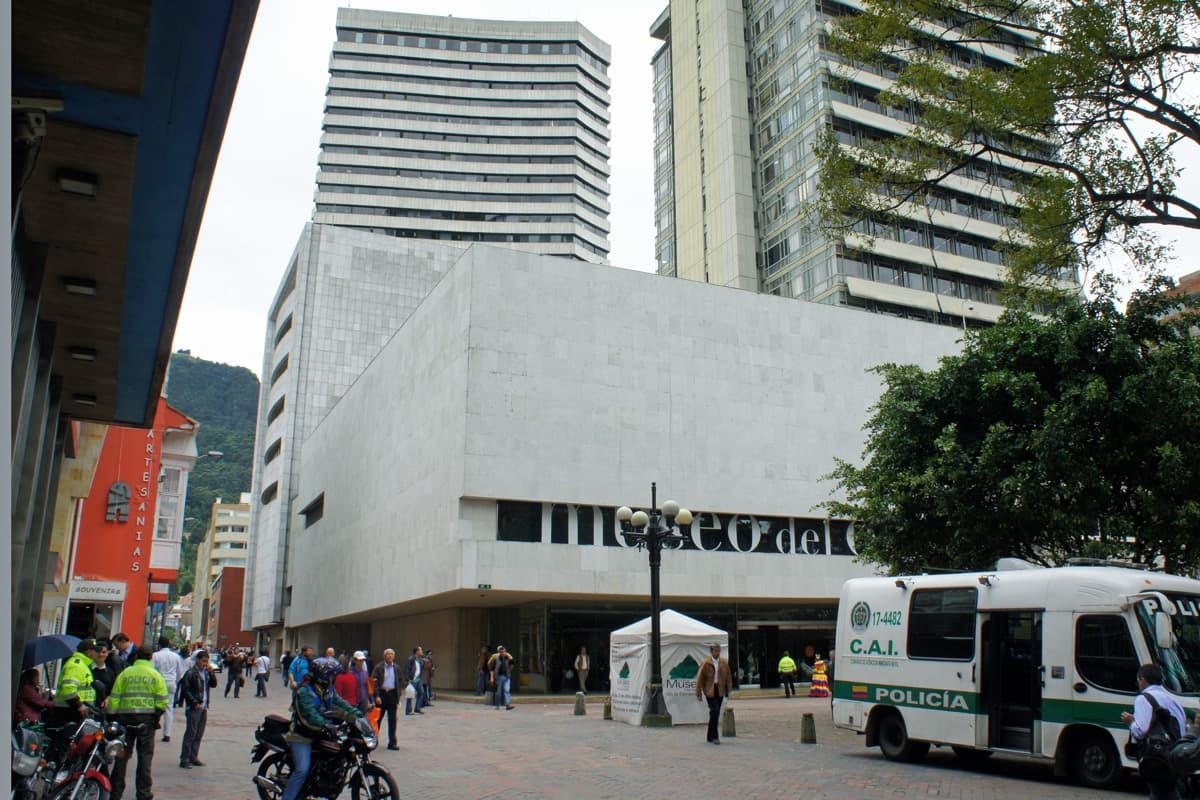
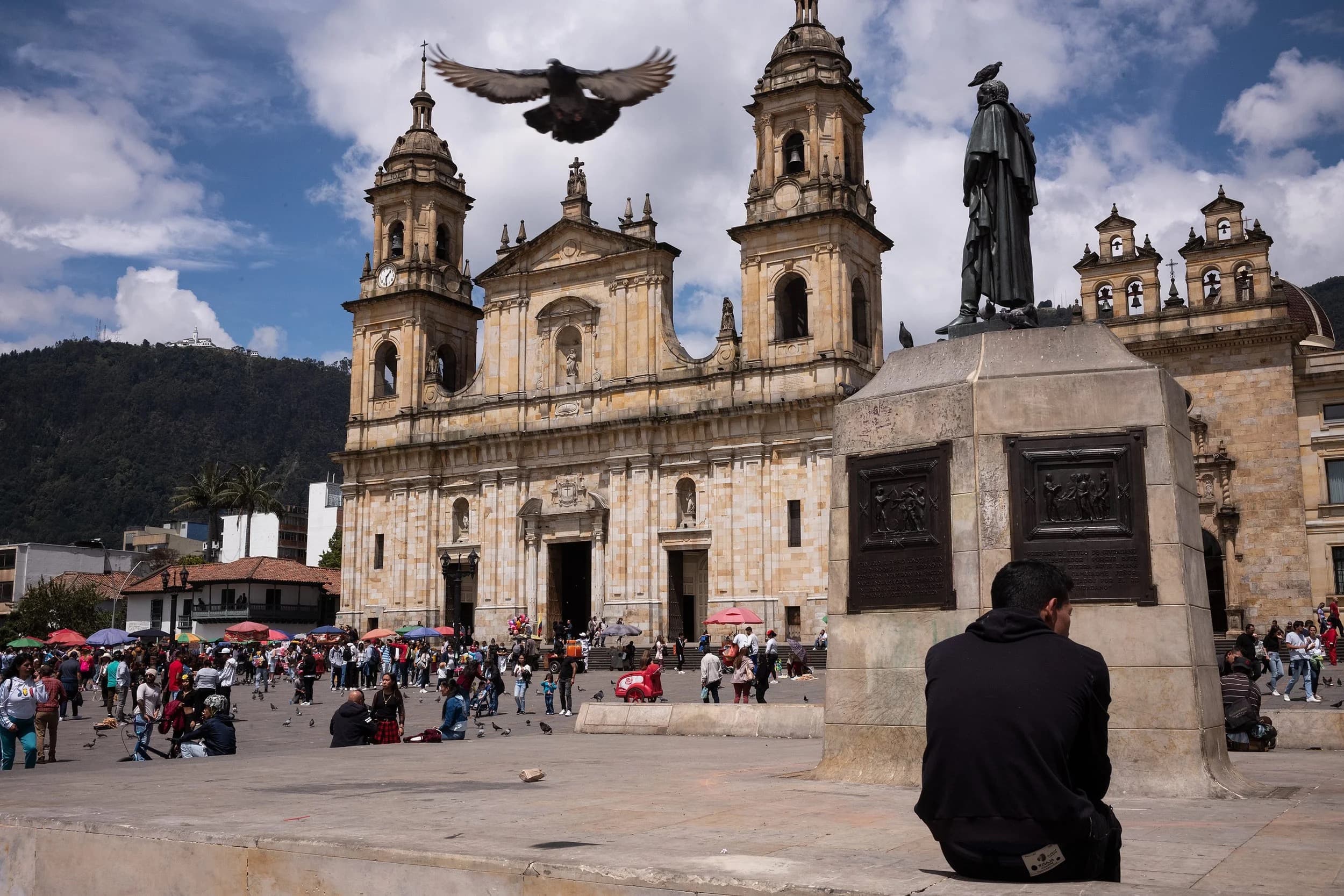
The Museo del Oro is a free or low-cost public museum, run by the central bank of Colombia, in the same neighborhood as the cathedral and the Plaza de Bolívar. Every day, thousands of visitors line up to see the object that, through misunderstanding, drove the Spanish conquest that made the Plaza de Bolívar possible in the first place. The contradiction is on display in glass cases. The Muisca Raft is the smallest object in the building. It is the one most of the visitors came for. It is the one Spain came for, in a sense, for two centuries.
It is nineteen and a half centimeters long.
Colombia eSIM· 10% off with ROAMER10
Ready to experience it?
Historic Heart
100 min · 3 km · moderate
More from Bogota
Explore more at your own pace.
Best Self-Guided Walking Tours in Bogotá (2026)
Bogotá Travel Guide: How Many Days, Altitude, Getting Around, Safety (2026)
One Day in Bogotá: A Walkable La Candelaria Itinerary (2026)

What to Eat in Bogotá: A Colombian Food Guide (2026)
The Paradox of La Candelaria: Power, Gold, and Everything Visitors Came For