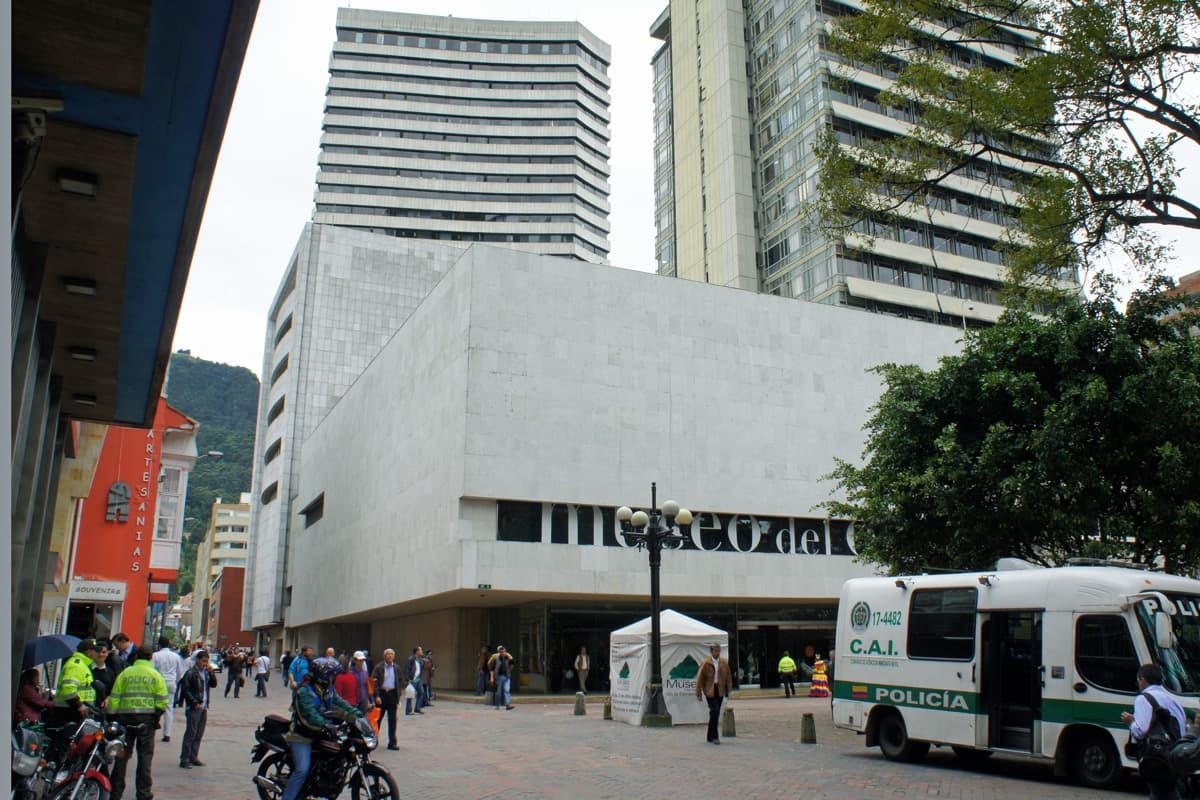
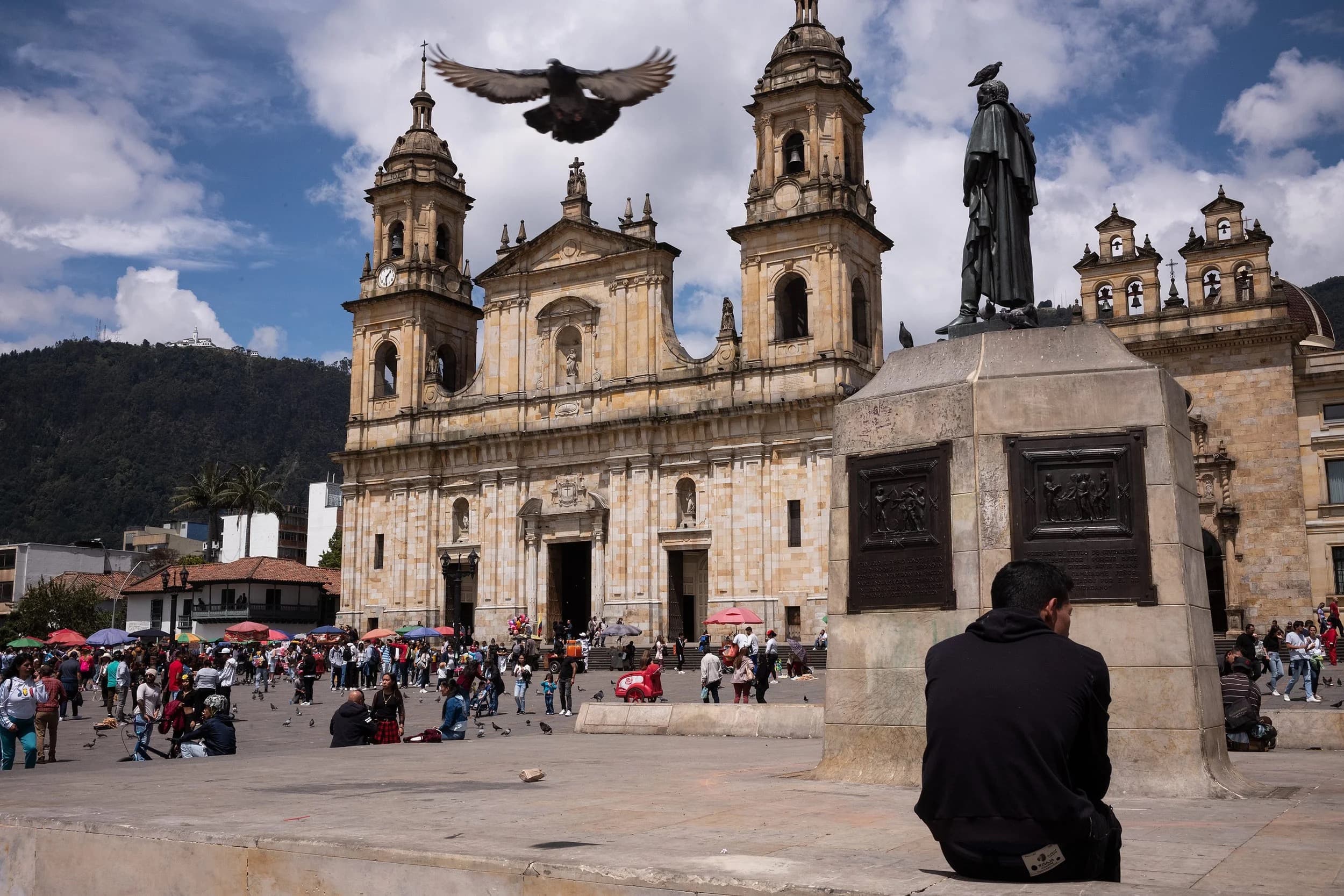
Stand on the Plaza de Bolívar and turn slowly. The four buildings around you are the cathedral on the south, the Capitolio Nacional that houses the legislature on the east, the Palacio de Justicia that holds the Supreme Court on the north, and the Liévano Palace where the mayor sits on the west. Four hundred meters away is the Casa de Nariño, the president's residence and office. By any reasonable measure of state power, this is the most concentrated political real estate in the country. It is where Colombia decides what Colombia is.
Now consider what the Historic Heart tour spends most of its time on. The flower vase that started independence. The Muisca gold that started the El Dorado myth. The colonial church with the Moorish ceiling. The Botero collection that one painter donated. The bohemian square where students drink banned beer. None of these are seats of power. Most of them are deliberately not.
The tour's thesis is that this contradiction is the city. The Plaza de Bolívar runs Colombia. La Candelaria is what Colombians and travelers come to see.
How an institutional center accumulates
The Plaza de Bolívar has been Bogotá's main square since 1538. It functioned as a marketplace, a bullring, and an execution ground before becoming the political center. The Bolívar statue at its center was cast in 1846 by the Italian sculptor Pietro Tenerani. It was the first public statue of Simón Bolívar anywhere in the Americas.
The buildings around the plaza accumulated slowly. The cathedral is the fourth church on its site. The first three were destroyed by earthquakes; the current one was finished in 1823, during the independence wars. The Palacio de Justicia on the north side was rebuilt after November sixth of 1985, when M-19 guerrillas stormed the original building and took the Supreme Court hostage. The military response was a tank assault directly into the plaza. Over a hundred people died, including eleven of the twenty-five justices. The current Palacio is a reconstruction. The plaza contains the entire spine of Colombia, but its visible surface is mostly the result of trying to recover from the things that broke that spine.
The vase, the man, and the conquest in reverse
Hear a stop from this walk
Plazoleta del Chorro de Quevedo
A block from the plaza is the Casa del Florero. On July twentieth of 1810, a group of Creole conspirators staged a public confrontation by asking a Spanish merchant named José González Llorente to lend them a flower vase for a banquet. They chose Llorente because his bad temper was a known quantity in the neighborhood. He refused, more or less rudely. They turned the refusal into a crowd. The crowd turned into a demand for a local junta. The junta was the first step toward independence.
The vase is in a glass case inside the museum. It is unornamented. It is, deliberately, an ordinary household object. That is the point of the story. Colombian independence does not begin with a battle or a manifesto. It begins with a borrowed pot.
The conquest it eventually unwound began differently. Gonzalo Jiménez de Quesada was a Spanish lawyer who, in 1536, led an expedition of nine hundred men up the Magdalena River from Santa Marta, looking for the gold he had heard rumors of in the highlands. The journey took two years. Disease, the jungle, and the Andes killed seven hundred and thirty-four of them. The one hundred and sixty-six survivors reached the Muisca savanna in August of 1538 and founded a city Quesada named Santa Fe. His tomb is in the Capilla del Sagrario beside the cathedral. He was a lawyer who led a conquest. The conspirators in the Casa del Florero were colonists who undid one. The two acts are exactly two hundred and seventy-two years apart, in buildings a block from each other.
Why the gold museum is the museum that matters
The Museo del Oro holds fifty-five thousand pieces of pre-Columbian gold. It is the largest such collection in the world. The piece that explains the rest is the Muisca Raft, a sculpture roughly nineteen and a half centimeters long, depicting a coronation ceremony at Lake Guatavita. A new Muisca chief was covered in gold dust, floated out on a raft, and made offerings of gold and emeralds to the gods.
Spanish conquistadors heard about this ceremony in the 1530s. They turned it into the legend of El Dorado: a city of gold somewhere in the interior. There was no city. There was a ceremony. But the legend drove Spanish, German, and English expeditions across the continent for two centuries. People drained Lake Guatavita three times trying to find it. The fact that visitors line up for the museum that explains the legend, in the country whose conquest was funded by the legend, is one of the closed loops of Bogotá. The thing that started everything is also one of the last things you see.
The Muisca Raft itself was found by farmers in a cave near Pasca in 1969. It had been hidden there sometime between 600 and 1600 CE. The museum acquired it almost immediately. Take the elevator to the top floor and look at it. It is small enough to hold in one hand. It is the physical object behind every Spanish boot that ever crossed the Andes.
Botero gave it away
The Museo Botero, six blocks south of the gold museum, exists because Fernando Botero donated two hundred and eight works of art to the Banco de la República in 2000 with one legal condition: admission free forever. One hundred and twenty-three were his own pieces. The rest were Picasso drawings, Renoir pastels, Dalí canvases, Giacometti bronzes, a Monet, a Calder, collected by Botero over decades. The valuation at the time was over two hundred million dollars. He refused offers from international museums. He grew up poor in Medellín. The collection opened in a restored colonial house in November of 2000. Admission has been free every day since. It is one of the most generous private-to-public art transfers in Latin American history, and it is two blocks from the gold museum.
The bohemian end
The Plazoleta del Chorro de Quevedo is at the eastern end of the tour, at the top of a narrow cobblestone alley called the Callejón del Embudo. Local tradition holds that this is where Quesada raised the first cross on August sixth of 1538. Historians dispute the precise spot. The legend persists because the plazoleta is small enough and stubborn enough to absorb a founding myth.
Today it is a working bohemian square. Students from the universities a few blocks away drink chicha under the archways and argue politics. The chicha vendors sell it in plastic cups topped with cinnamon. The drink itself is a fermented corn beer the Muisca brewed before Spanish contact. The Colombian government banned it in 1948 under pressure from the Bavaria brewery, which controlled over sixty percent of the national beer market and did not want competition. The official reason was hygiene. The ban lasted forty-three years. The 1991 constitution, one of the most progressive in Latin America, restored indigenous cultural rights, and chicha came back.
You can stand in the plazoleta and see, simultaneously, the founding site of Spanish colonial Bogotá, the cultural product of pre-Columbian Muisca life, and the constitutional restoration of indigenous practice. All in one cup of corn beer in one square at the end of one alley.
Why the contradiction holds
The tour does not try to reconcile the seat of power with the things visitors line up for. It treats them as the same fact. The institutional spine is on the Plaza de Bolívar. Colombia's cultural memory is everywhere else in La Candelaria. The two are eight hundred meters apart and they explain each other. The colonial center was built to hold a Spanish viceroyalty, became the seat of an independent republic, absorbed earthquakes and a Supreme Court siege and an indigenous gold collection and a painter's donation. La Candelaria is small enough to walk in two hours and old enough that nothing in it surprises it. Walk slowly. The altitude makes you slow anyway.
Colombia eSIM· 10% off with ROAMER10
Ready to experience it?
Historic Heart
100 min · 3 km · moderate
More from Bogota
Explore more at your own pace.
Best Self-Guided Walking Tours in Bogotá (2026)
Bogotá Travel Guide: How Many Days, Altitude, Getting Around, Safety (2026)
One Day in Bogotá: A Walkable La Candelaria Itinerary (2026)
What to Eat in Bogotá: A Colombian Food Guide (2026)
Parque de los Periodistas: The Park That Started a Law