Most cities that have a famous street-art scene developed it the slow way. Tolerance built up over decades, neighborhoods turned over, a few legal walls became many. Berlin's Kreuzberg, São Paulo's Vila Madalena, the East End of London. The protection accumulated.
Bogotá did not work that way. Bogotá legalized the entire practice inside two years, in direct response to a single death.
On August nineteenth of 2011, a sixteen-year-old graffiti writer named Diego Felipe Becerra was painting his signature Felix the Cat under a highway underpass in the north of the city, near Calle 116 and Carrera 70. A police officer named Wilmer Antonio Alarcón shot him in the back. The officers on the scene initially claimed Diego had been robbing a bus. The story collapsed within days. Security footage from a nearby gas station showed him painting. There was no bus. There was no robbery. There was a kid with a spray can and a cartoon cat.
The outrage was enormous and immediate. Vigils filled the Parque de los Periodistas in central Bogotá. Marches moved through La Candelaria. A criminal investigation opened. Wilmer Alarcón was eventually convicted of homicide. In 2013, the Distrito Capital passed Decree 075, which created a legal framework for street art on private surfaces with the owner's consent and on designated public surfaces with municipal permission. The decree did not just decriminalize a practice. It built a system. It told artists where they could paint, how to register a wall, how to apply for commissioned work, and what protections they had against police interference.
That is the chain of cause. One death in 2011. One decree in 2013. Twelve years later, Bogotá has over five thousand catalogued murals in a city of eight million people. Most of them are signed.
The names you will see
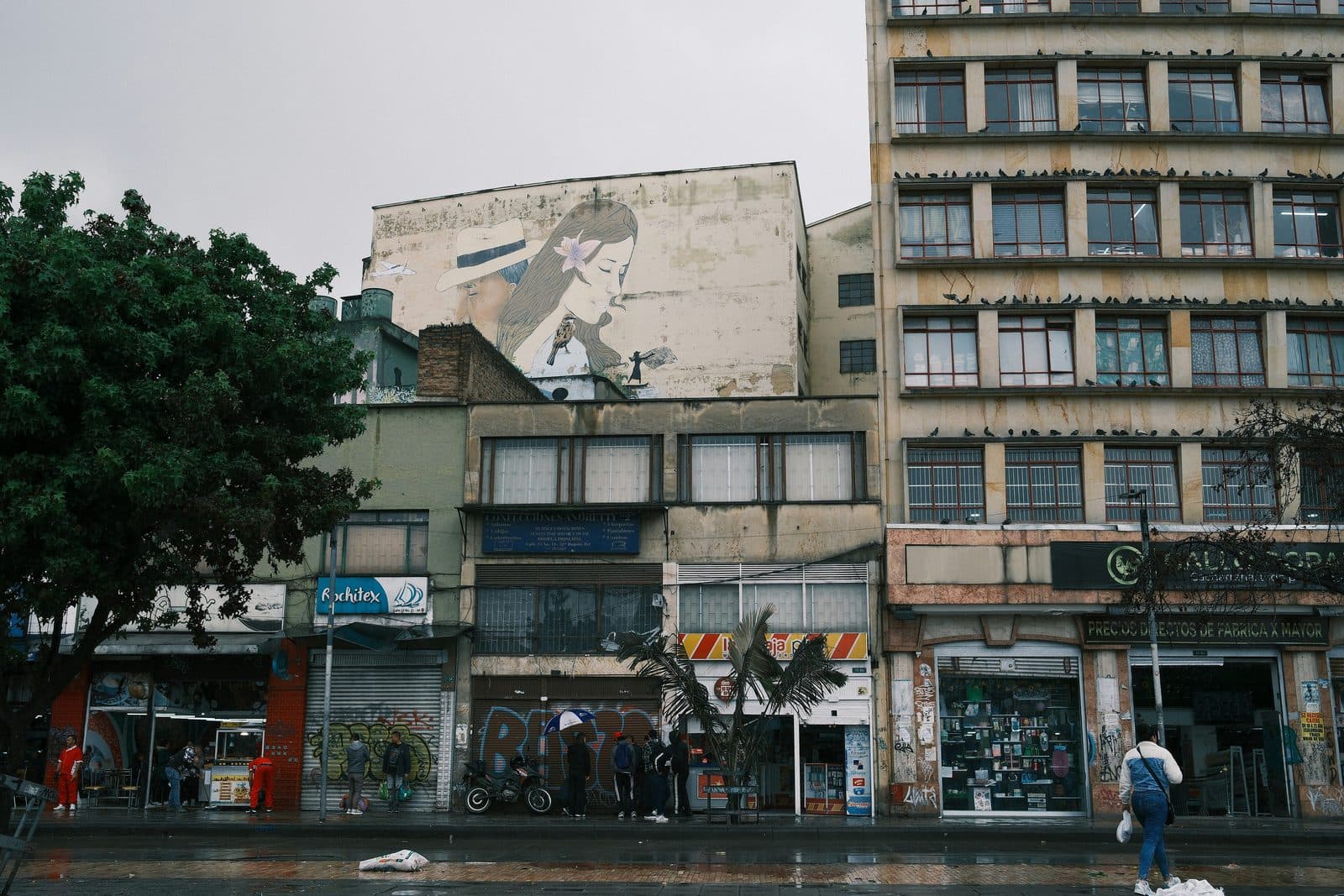
Walking the corridor on Calle Trece, in the densest concentration of work, you will see a small number of names repeated. Knowing the names changes what you are looking at.
Toxicómano Callejero. Translates roughly to Street Junkie. He has been active in Bogotá since the early 2000s, when the work was still illegal and getting caught meant a beating at minimum. His medium is the political stencil: razor-sharp graphic images of soldiers, politicians, riot police, and indigenous leaders, layered in flat black and red. The stencils are reproducible. He paints the same image dozens of times across the city. Bogotanos read his work the way they would read an editorial cartoon. He has never publicly revealed his identity. He still works.
DJ Lu. Real name Juan Carlos Sánchez Alarcón. His signature is dotwork: portraits and figures built out of thousands of small circles, almost the look of a halftoned newspaper image blown up to the side of a building. He pulls the technique from indigenous Wayúu weaving patterns from La Guajira. His subjects are people Colombia's mainstream culture often skips: indigenous elders, Afro-Colombian women, campesinos, the displaced. A DJ Lu portrait takes days to lay down. He works alone, without preliminary sketches, the dots tracking through the figure as he paints.
Stinkfish. One of the most internationally recognized Colombian street artists. He photographs strangers on the street, often children, and paints their faces three stories tall in explosions of color. The photography is the point. The blowup is the gesture. Every face deserves to be monumental, is the argument. He has worked in over fifty countries. He has said in interviews that Bogotá's walls remain his favorite because people in this city actually stop and argue about the work.
Bastardilla. Anonymous female artist. Ethereal female figures, often dissolving into birds or roots, painted in soft palettes that contrast with the harder graphic work around them. She works mostly in La Macarena and the northern neighborhoods. She has never confirmed her identity.
Guache. Indigenous cosmology rendered in geometric patterns that echo pre-Columbian gold work. Jaguars, condors, serpents in stepped Andean geometry. The work is the strongest contemporary visual link between modern Bogotá and the Muisca and Tairona civilizations that lived on this savanna before contact.
Five names will not exhaust what you see on a single block of Calle Trece, but knowing those five lets you recognize roughly half of it.
Why the Embudo smells like fermented corn
Hear a stop from this walk
La Macarena
The Callejón del Embudo, Funnel Alley, drops downhill toward the Plazoleta del Chorro de Quevedo at the southern end of the route. It is one of the oldest pedestrian passages in Bogotá. Its walls hold some of the most photographed murals in La Candelaria. And at any time of day, it smells of corn fermentation.
That smell is chicha. The drink is older than Bogotá. The Muisca brewed fermented corn beer for at least a thousand years before Spanish contact. It was central to their political, ceremonial, and daily life. The Spanish tolerated it for most of the colonial period. The Colombian government banned it in 1948, under sustained lobbying from the Bavaria brewery, which had been founded by German immigrants in 1889 and which controlled the national beer market. The official reason was public hygiene. The actual reason was monopoly protection.
The ban lasted forty-three years. It coincided with the broader Bogotazo period of 1948 and the government's wider suppression of indigenous practice that ran through the second half of the twentieth century. Chicha came back legally only with the 1991 Colombian Constitution, which formally recognized the country's multicultural identity and restored indigenous cultural rights.
The chicha bars in the Embudo are not nostalgic. They are political. The murals along the alley walls are full of corn imagery, Muisca geometry, Bavaria-mocking commentary. Drinking a cup of chicha here is a deliberate cultural reclamation that runs forty-three years deep. The cinnamon they put on top is traditional. The plastic cup is practical. Pace yourself: it is roughly three to five percent alcohol and the altitude amplifies everything.
Salmona, the architect on the route
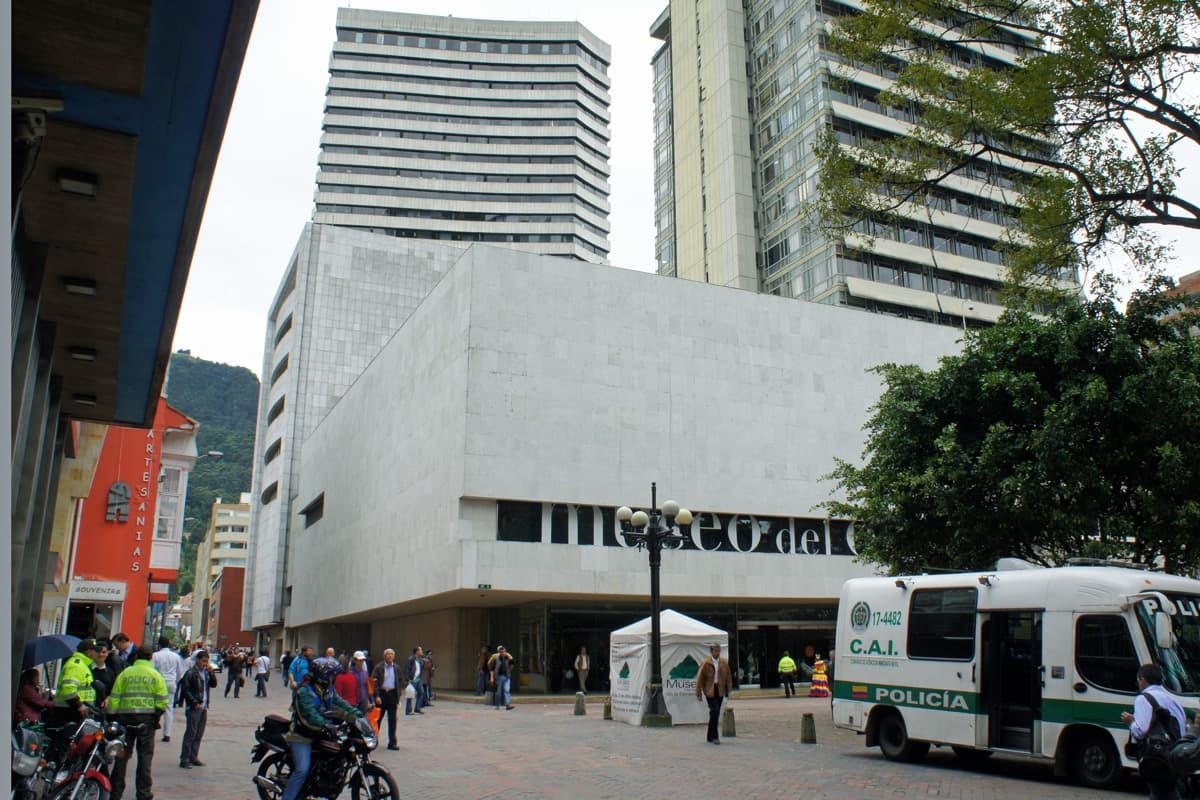
The walk steps out of the painted neighborhoods twice to look at brick. Both buildings are by Rogelio Salmona, who studied under Le Corbusier in Paris from 1948 to 1958, then came home to Bogotá and rejected most of what he had learned. He picked brick instead of concrete. He pulled his geometry from Muisca and Tairona textiles instead of European modernism. He built water into every project.
The Torres del Parque, three curved residential towers built between 1965 and 1970 next to the old Plaza de Toros bullring, are widely considered his masterpiece. The towers curve along the contour of the hill. No two apartments share a floor plan. Rain channels are built into the facades so storm water cascades down the buildings visibly. They contain two hundred and ninety-four apartments.
The Centro Cultural Gabriel García Márquez was finished in 2008, the year after Salmona's death. The brick is laid in shifting geometric patterns drawn from indigenous textiles. A rooftop terrace offers one of the cleanest views in La Candelaria.
Both buildings exist on this tour because Salmona's work is the architectural equivalent of what the muralists do. He pulls indigenous geometry into a contemporary material and lets it speak.
La Macarena, where the kids grew up
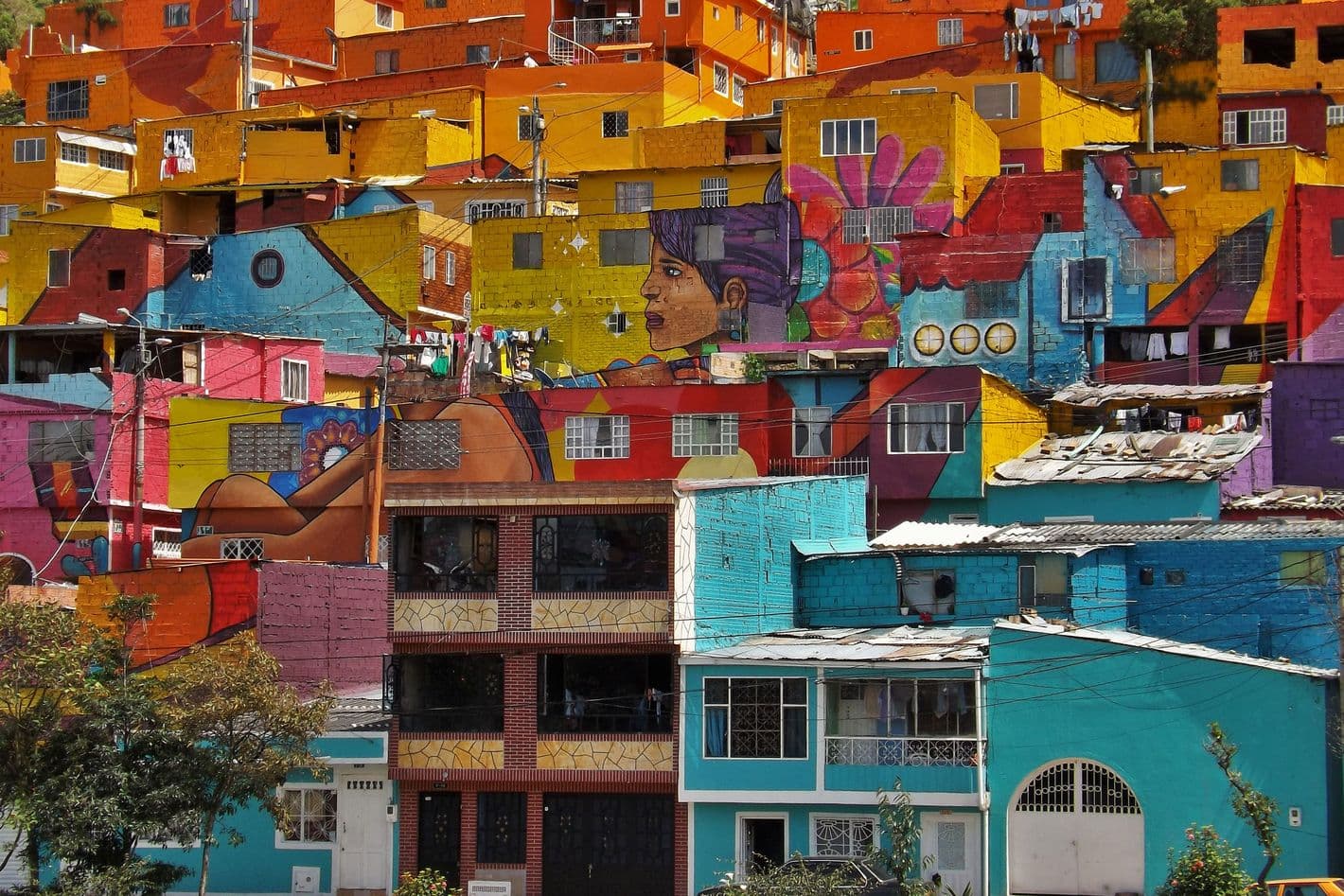
The tour ends in La Macarena, a small bohemian neighborhood pressed against the Cerros Orientales. In the 1990s it was unsafe and run-down. Artists and chefs priced out of the northern districts moved in through the early 2000s. The galleries followed. The graffiti kids from La Candelaria grew up and got their gallery shows here. Many of them live in the walkup apartments above the cafés.
The work on the walls of La Macarena is more curated than the work on Calle Trece. The murals are commissioned. The artists are paid. Some of this is gentrification, and the muralists are explicit about it: there are murals in La Macarena whose subject is the cost of living in La Macarena.
This is where the chain that started with Diego Felipe Becerra's death in 2011 arrives at the present tense. Walk slowly. The altitude makes the route into a long, slow read. The walls are arguing with each other. Most of them are signed.
Colombia eSIM· 10% off with ROAMER10
Ready to experience it?
Street Art & Bohemia
90 min · 3.5 km · moderate
More from Bogota
Explore more at your own pace.
Best Self-Guided Walking Tours in Bogotá (2026)
Bogotá Travel Guide: How Many Days, Altitude, Getting Around, Safety (2026)
One Day in Bogotá: A Walkable La Candelaria Itinerary (2026)
What to Eat in Bogotá: A Colombian Food Guide (2026)
The Paradox of La Candelaria: Power, Gold, and Everything Visitors Came For