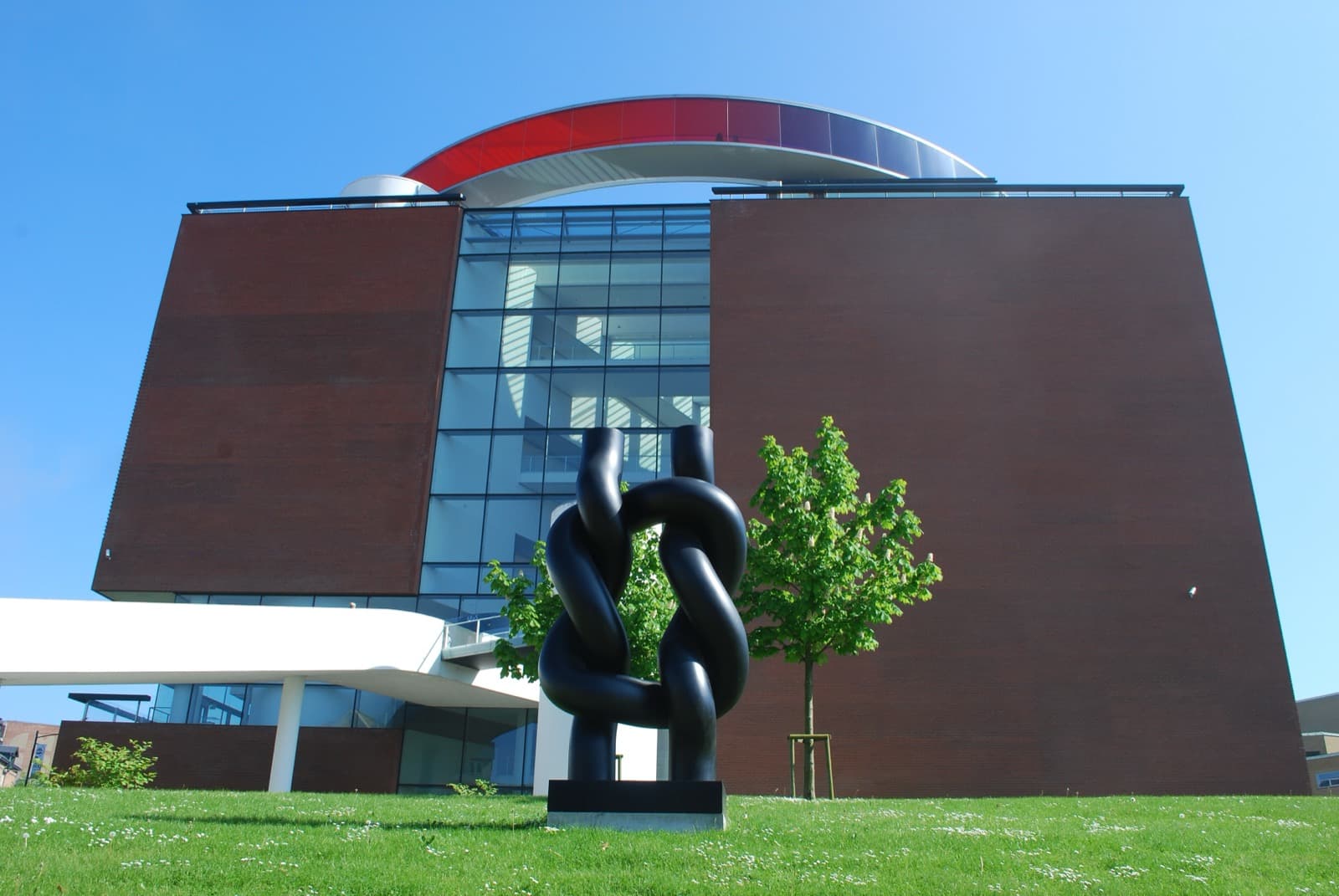
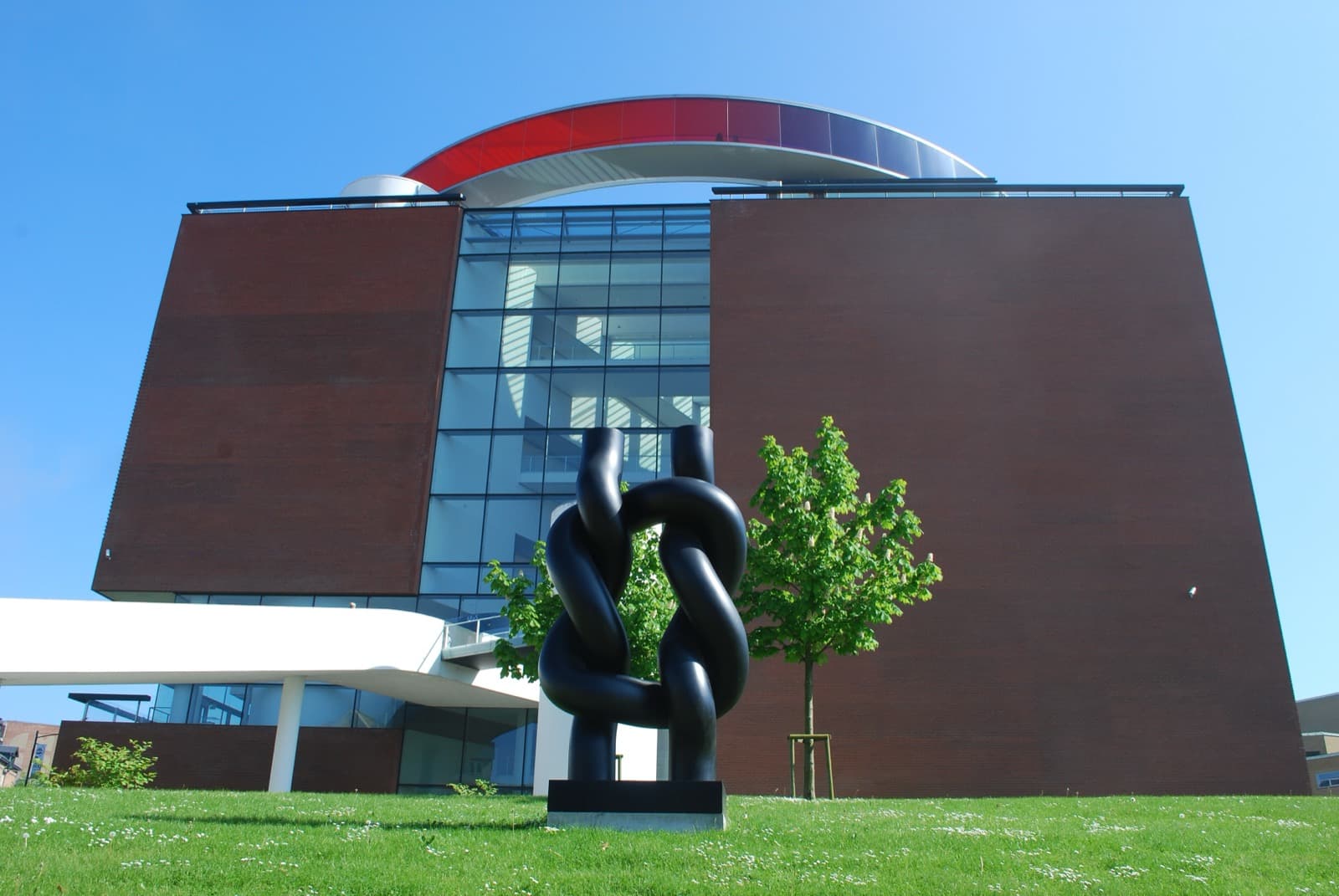
Walk up to the great red-brick cube of ARoS Aarhus Kunstmuseum and look at the roof. A ring of coloured glass floats there on slender columns, and once you notice it, you have already read the argument of this whole city. Aarhus spent most of the nineteenth century as a working harbour town, running on shipping, timber and factories. Over the last half-century it rebuilt its identity around art, learning and design. That coloured crown over an industrial material, brick below and rainbow above, is the reinvention made visible. It is the reason a self-guided walk across Aarhus can begin here and, from the museum steps, already see where it is going.
The ring that became the city's image
ARoS opened on the seventh of April, two thousand and four, designed by the Danish firm Schmidt Hammer Lassen. From the street it reads as one severe cube. Inside it climbs through ten storeys, with a floor area of about twenty thousand seven hundred square metres, which puts it, by the museum's own record, among the largest art museums in Northern Europe. In twenty twenty-three it drew around six hundred and twenty-four thousand visitors. Those numbers alone announce the arrival of a culture city.
But the thing that turned ARoS into a shorthand for Aarhus arrived seven years after the building did. Your Rainbow Panorama, by the Danish-Icelandic artist Olafur Eliasson, was inaugurated on the twenty-eighth of May, twenty eleven. It is a circular walkway glazed in every colour of the spectrum, about one hundred and fifty metres around and roughly fifty-two metres across, three metres wide, mounted some three and a half metres above the roof. You enter it and walk, and the whole city outside shifts hue as you go: red, then orange, then yellow, then every colour in turn. It is a work of art you look through rather than at, and the subject it frames is Aarhus itself.
The ring sits inside the ticketed museum, so the walkway asks for admission in Danish kroner. From the street below, though, you do not need a ticket to grasp the idea. A city that made its money loading freight decided, deliberately, to place a ring of coloured light at the summit of its art museum. Everything else on this walk is a variation on that single decision.
Seven landmarks, one continuous argument
Hear a stop from this walk
Dokk1: The Glass Library Over the Water
What makes the ARoS ring worth reading closely is that the rest of the route keeps rhyming with it. A few steps away stands Musikhuset Aarhus, the Music Hall, which opened in nineteen eighty-two and was expanded between two thousand and five and two thousand and eight. It is now one of the largest concert halls in Scandinavia, seating more than three thousand six hundred across its halls, and its signature is a glass foyer of about two thousand square metres with palm and olive trees growing inside. You can step in and sit among the trees without a ticket. On weekends there are free performances under the glass. If the ARoS ring is the image of the culture city, the Music Hall is the civic decision underneath it: what a place builds when it decides that music belongs at its centre.
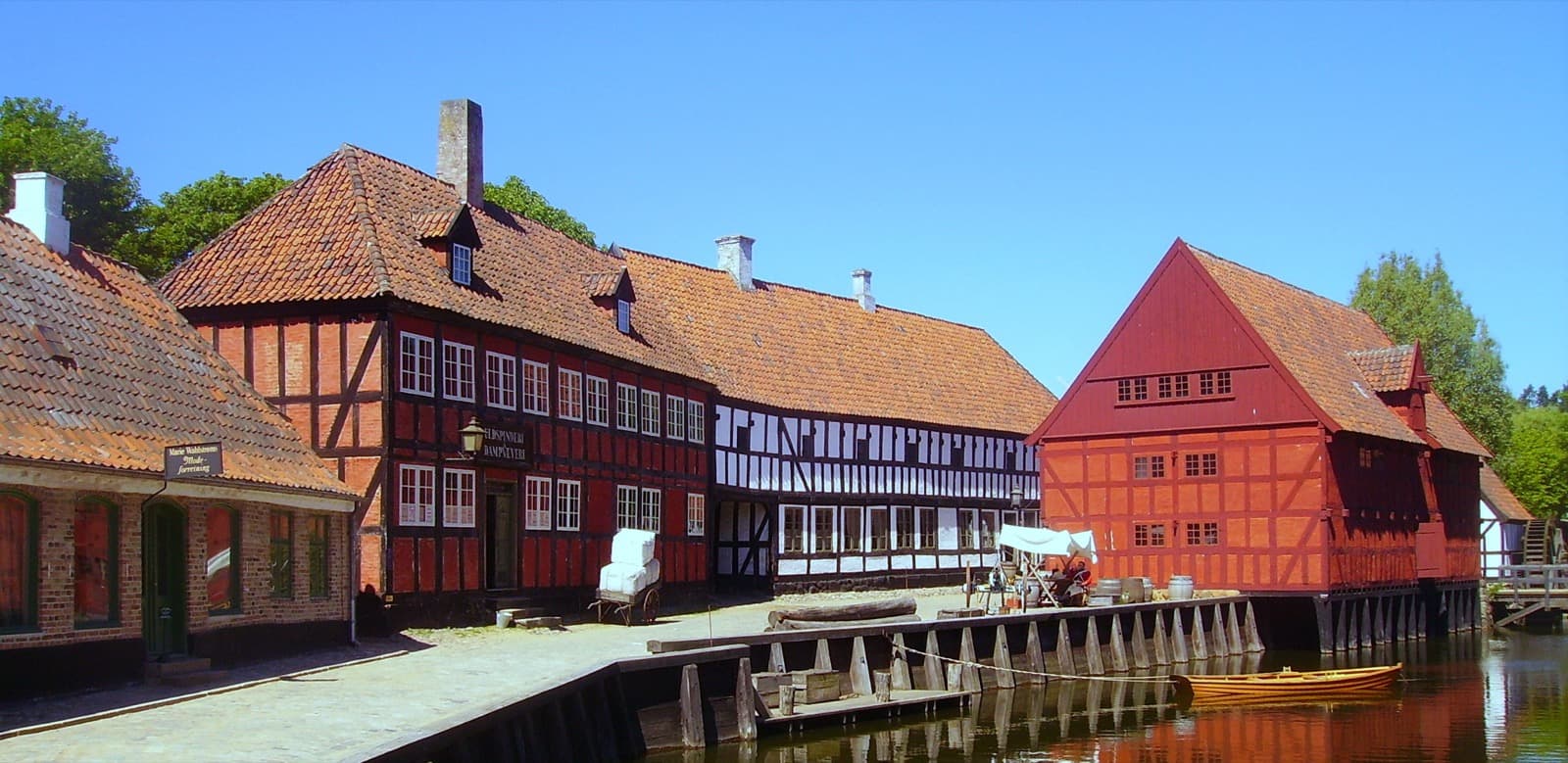
Then the walk turns its own theme inside out at Den Gamle By, the Old Town. It is a modern museum, founded in nineteen fourteen by the schoolteacher Peter Holm, that painstakingly reassembled an old town from scratch. Some seventy-five timber-framed houses were carried here from about twenty Danish towns and rebuilt plank by plank, buildings first raised between roughly fifteen fifty and the late nineteenth century. It was Denmark's first open-air museum devoted to town life rather than farms, and it now serves well over four hundred thousand visitors a year. A city that spent the nineteenth century as a working port later chose to gather up, house by house, the old Denmark that industry had swept past.
Above it climb the Botanical Gardens, founded in eighteen seventy-three across about twenty-one and a half hectares of terraced hillside. Do not mistake the shining tropical dome for a Victorian relic. The greenhouses were rebuilt between twenty eleven and late twenty fourteen at a cost of around sixty-five million Danish kroner, with C.F. Moeller Architects, part of the same glass-and-steel impulse that gave the city its music hall and, later, its library. Inside, the houses run from rainforest to desert across several climate zones. Entry to the gardens and the greenhouses is free.
The rise continues to Aarhus University, founded on the eleventh of September, nineteen twenty-eight, Denmark's second oldest. The campus is a work of architecture in its own right: yellow-brick functionalist pavilions with matching yellow roof tiles, laid across a rolling park among oak trees. Kay Fisker, C.F. Moeller and Povl Stegmann won the design competition in nineteen thirty-one, the first buildings opened in nineteen thirty-three, and the main building now sits in Denmark's official canon of architecture. The whole park has been protected by law since nineteen ninety-three, and it is open public ground you can wander freely.
Two moments of glass, in the sky and over the water
The walk descends to the water for its climax at Aarhus Oe, the former container port. From the two thousands, the old harbour was rebuilt into a district for roughly ten to twelve thousand residents, among the largest harbourfront developments in Europe. Where cranes once loaded timber, the skyline now carries The Iceberg, its jagged white towers cut into peaks so more homes catch the light, and the Lighthouse tower, one hundred and forty-two metres tall, completed in twenty twenty-three and Denmark's tallest building. At Basin seven, harbour baths opened in the summer of twenty eighteen, so people swim where ships once berthed.
The route closes at Dokk1, the great cantilevered glass library at the mouth of the Aarhus river, inaugurated on the twentieth of June, twenty fifteen. It was designed by Schmidt Hammer Lassen, the same firm behind ARoS, so the tour opens and closes on the work of one architect: coloured glass in the sky at the start, clear glass over the water at the end. It is the largest public library in Scandinavia, it holds the city's citizens' services, and it was named Public Library of the Year in twenty sixteen. Stepping inside is free.
That is the shape of it. A coloured ring crowning a brick museum, a music hall behind glass, an old town reassembled, terraced gardens, a yellow-brick campus, a container port remade, and a glass library reaching over the water. The whole route runs about eight kilometres, roughly two and a half to three relaxed hours, and every stop stands alone, so you set the pace and skip what does not call to you. Start at the ARoS ring, and read the rest of the Aarhus walking tours as one continuous argument. When you are ready to walk it, the full route begins in Aarhus.
Sources
- ARoS Aarhus Kunstmuseum, Wikipedia: opening date, architects, scale and visitor figures for the museum.
- Olafur Eliasson, Your Rainbow Panorama (2011), ARoS official page: inauguration date and the dimensions of the walkway.
- Den Gamle By, Wikipedia: founding by Peter Holm and the relocation of timber-framed houses.
- Dokk1, Wikipedia and Dezeen: opening, architect and its standing as Scandinavia's largest public library.
- Light House / Aarhus Docklands, Wikipedia: the redevelopment of the harbour and the Lighthouse tower height.
Ready to experience it?
ARoS: The Rainbow Panorama and the Reinvented City
140 min · 8.4 km · moderate
More from Aarhus
Explore more at your own pace.
Aarhus Travel Guide: Days, Transport, Safety, and Costs
One Day in Aarhus: A Walkable Itinerary From Cathedral to Harbour
Aarhus: From the Viking River Mouth to the Rainbow in the Sky
Aarhus Cathedral and the Old Streets: Reading a City's Whole Story in a Few Hundred Metres
Aarhus City Hall: How a Plain Modernist Box Grew a Marble Tower