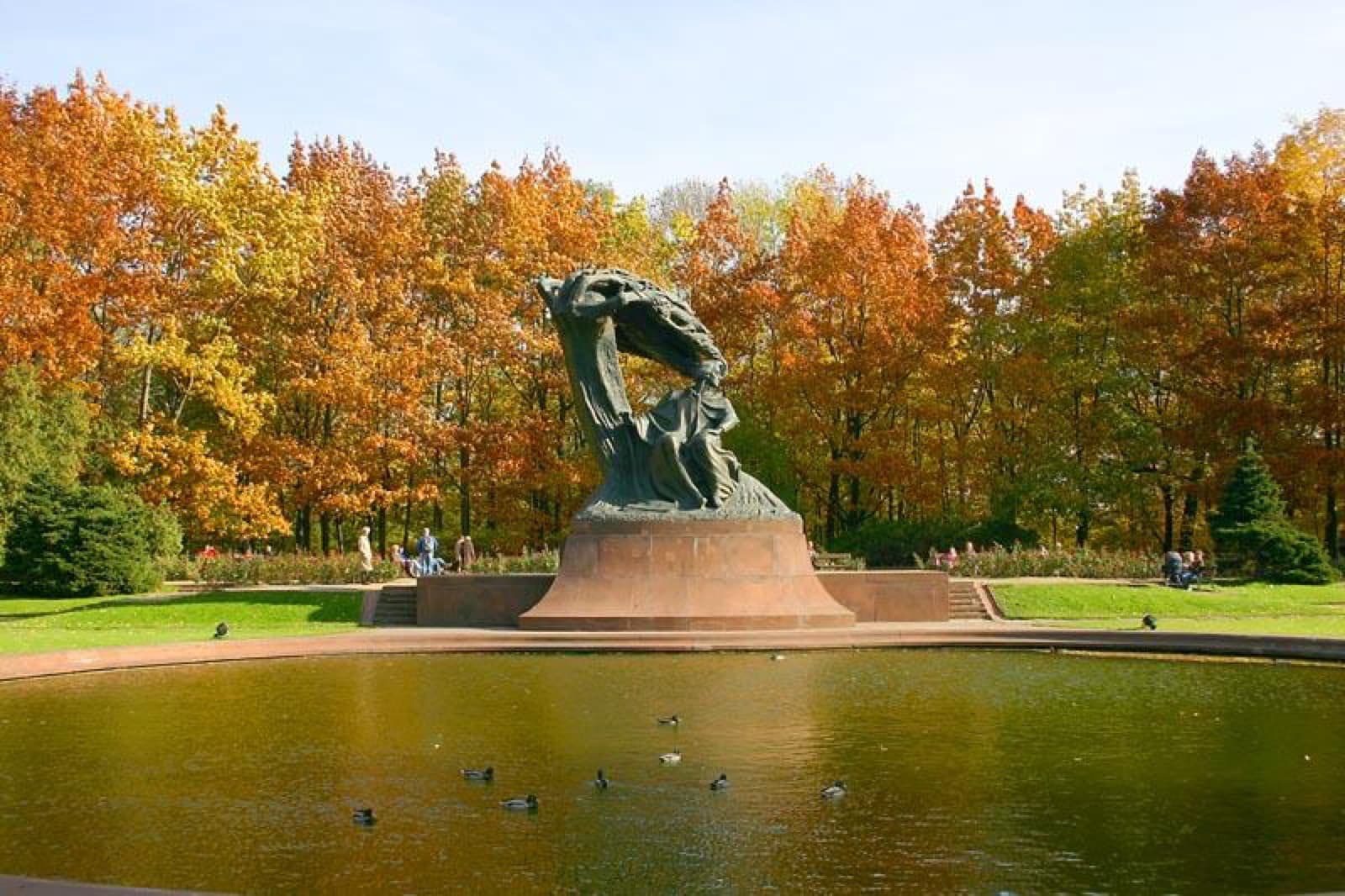
The Chopin Monument in Lazienki Park is the endpoint of Warsaw's Royal Route, the single ceremonial road the kings once travelled south from their city castle to their summer garden. The Art Nouveau bronze of the seated composer marks where a four and a half kilometre walk stops, and it also compresses the whole route's account into one object: royal power, the deliberate destruction of the city in 1944, and the patient reconstruction that followed. Reach this monument on foot, in the kings' own direction, and you have read the last century of the Polish capital in a single line.
The Monument That Was Destroyed First
The Chopin Monument sits near the avenue edge of Lazienki Park, seated beneath a stylised willow whose branches echo the shape of a pianist's hand. It is the work of the sculptor Waclaw Szymanowski, whose design was completed in 1907. The bronze was not unveiled until the fourteenth of November 1926, a long gap between conception and casting.
What the monument carries under its calm is a specific piece of history. When the Germans occupied Warsaw, this was the first Warsaw monument they destroyed, on the thirty-first of May 1940. It was recast only in 1958, from the surviving mould, and returned to the park. Since 1959, free Chopin piano recitals have been held at its base on summer Sunday afternoons, so the site now holds both an act of erasure and the music it tried to silence.
The pairing of a composer and a garden is not accidental. The park itself belonged to Poland's last king, and the two stories were joined the moment the Royal Route was planned to end here.
The Last King's Water Garden
Hear a stop from this walk
Lazienki Park: The Last King's Water Palace
Lazienki Park, the Royal Baths Park, is the largest park in Warsaw at seventy-six hectares of lakes, lawns and wooded walks. It was the creation of Stanislaw August Poniatowski, Poland's last reigning king, who acquired the estate in 1764 and remodelled the gardens from about 1772. It became a public park in 1918.
At its centre, set on a lake, stands the Palace on the Isle. It began as a small baroque bath-house around 1680, and the king transformed it into an elegant classicist palace, finished by 1793, with a columned portico reflected in the water. Like almost everything on this route, it was ravaged in 1944 and rebuilt across the years that followed, reopening from 1960. Walk in from the avenue and you may find peafowl crossing the paths. They roam freely among the more than nine thousand trees of a garden that once belonged to a king.
The park's meaning depends on how you arrive at it. The point of the Royal Route is that this endpoint is earned by walking the whole ceremonial spine, not driven to as a standalone attraction. That is why the anchor stop opens the argument for the entire tour.
Reading the Whole Road From Its End
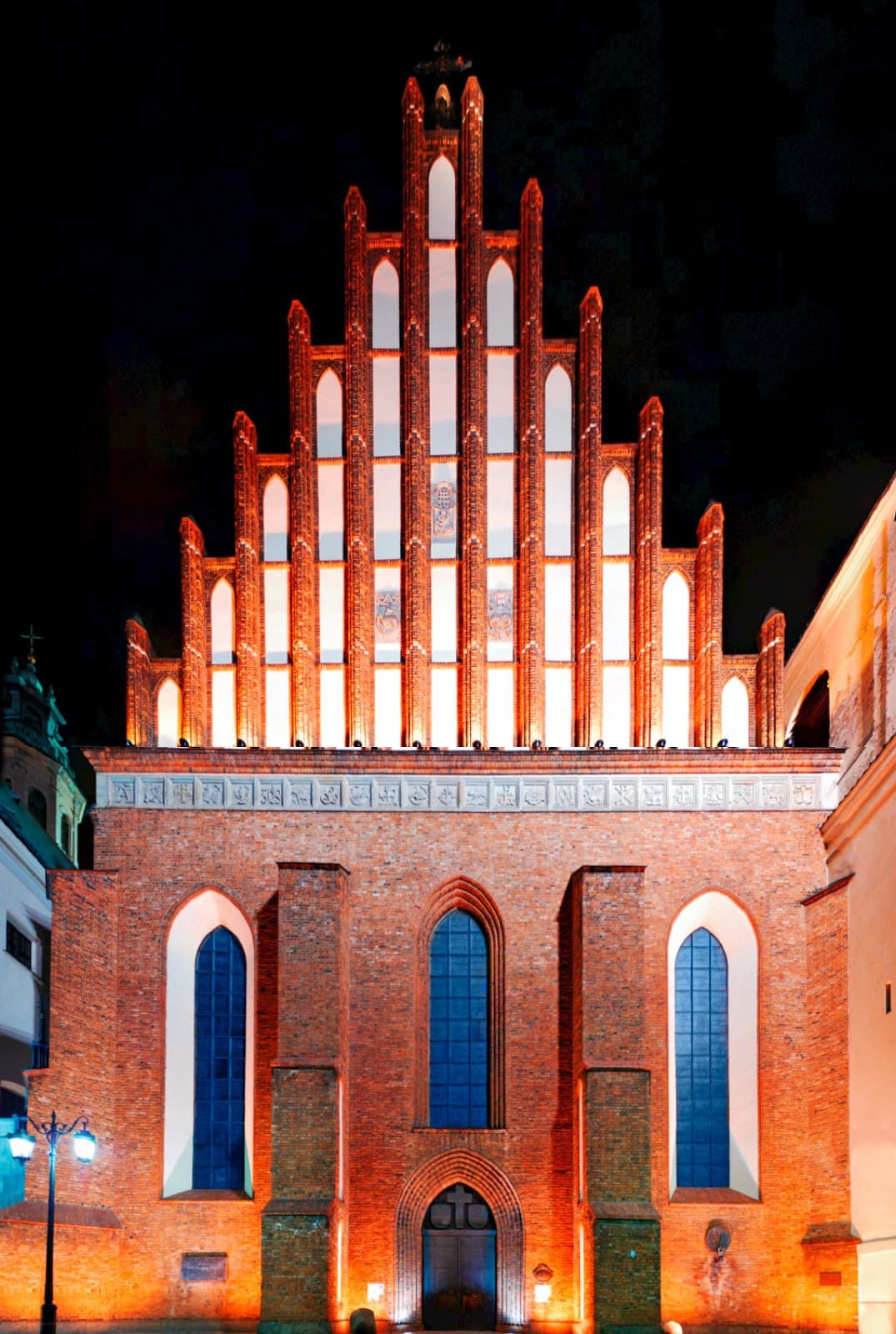
Start at the top of the road, at Krakowskie Przedmiescie just below Castle Square, and the tour unrolls as one continuous chronicle. The first stretch is about one kilometre of palaces and churches, anchored by St Anne's Church, founded in 1454 with a neoclassical facade added between 1786 and 1788 by the architect Chrystian Piotr Aigner. His name recurs down the whole walk, a quiet thread tying the buildings together.
A short walk south stands the Presidential Palace, rebuilt in neoclassical form by the same Aigner and completed in 1818. This one facade carries some of the century's heaviest weight: the Warsaw Pact was signed inside it on the fourteenth of May 1955, and in 1989 it hosted the Round Table talks between the communist government and the Solidarity-led opposition that helped bring an end to communism across the region. One building holds both the pact and the negotiations that helped dismantle it.
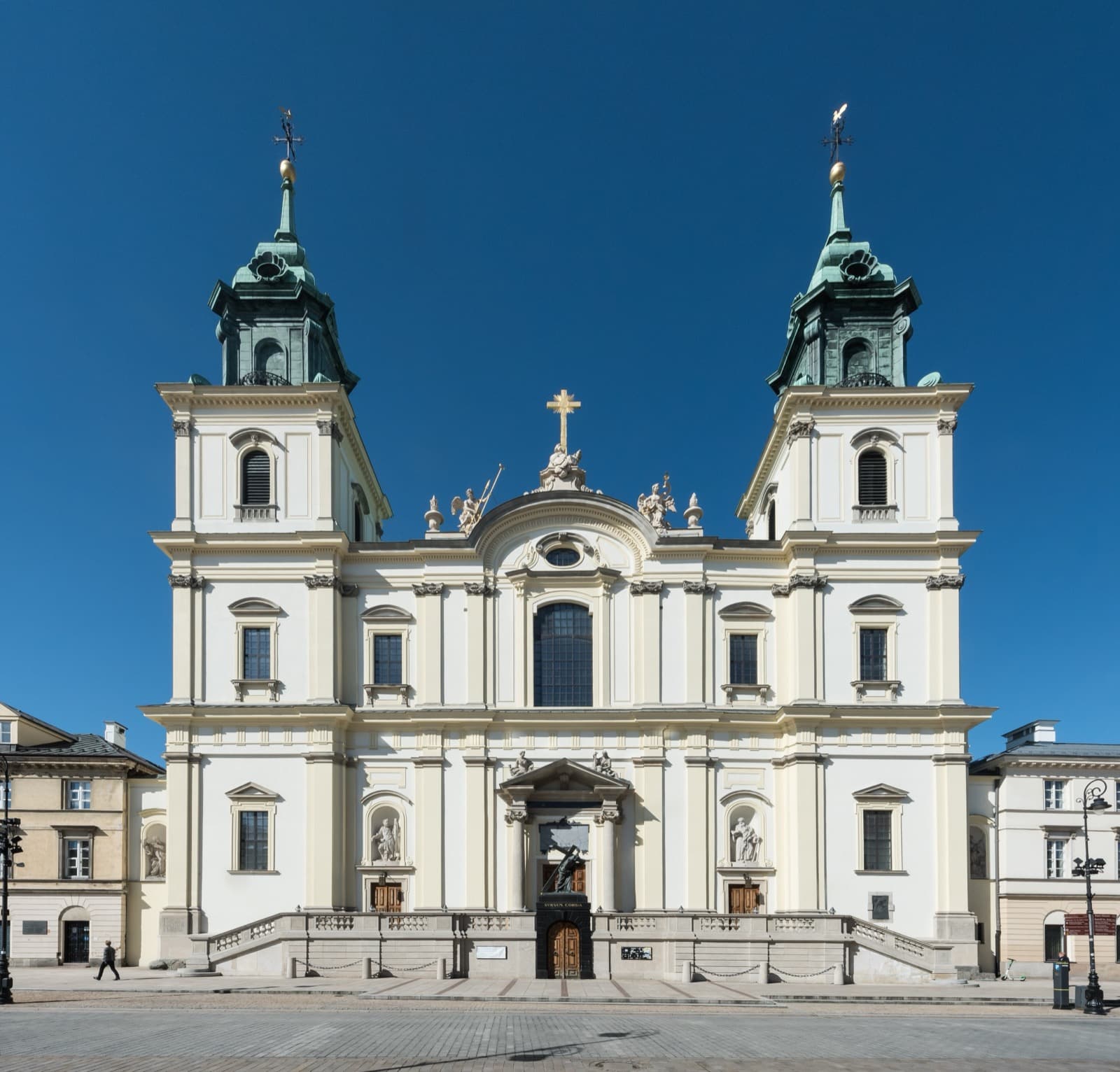
Continue and the street gathers the intellect of the city. The University of Warsaw, founded on the nineteenth of November 1816 during the years of Russian rule, grew into the largest institution of higher learning in Poland. Beside it stands Holy Cross Church, where an urn holding the heart of Frederic Chopin was immured in a pillar, set in place in 1882. Chopin died in Paris in 1849, but his heart returned to the city at his own wish. The connection to Lazienki is direct: the composer whose heart rests here, in the middle of the route, is the same composer whose monument closes it.
Where the boulevard becomes Nowy Swiat you meet the Copernicus Monument, by the Danish sculptor Bertel Thorvaldsen, unveiled in 1830, the same sculptor who made the Poniatowski statue at the Presidential Palace. Nowy Swiat, New World Street, was almost completely destroyed in the 1944 Warsaw Uprising and rebuilt in a uniform early-nineteenth-century neoclassical style under the architect Zygmunt Stepinski. What looks like an elegant old street is a chosen reconstruction, its facades pared back to one period.
The road then passes Three Crosses Square, with St Alexander's Church, another Aigner rotunda modelled loosely on the Pantheon in Rome, rebuilt after 1944 to its simpler original design. From there the walk opens into Ujazdow Avenue, the stately tree-lined leg of about one and a half kilometres, lined with nineteenth-century villas and the embassies of Switzerland, the United States and the United Kingdom, among others. It began as a devotional Calvary road under Augustus the Second in the 1720s and was drawn into the Royal Route in 1766. In 1944 it was the site of Operation Kutschera, the assassination of a senior SS officer by the Polish underground.
Why Walk It Yourself
The single thread that binds the route is the one you already noticed at the monument: almost nothing you see is truly old. The whole convincingly historic boulevard was reduced to rubble in 1944, when the Germans systematically destroyed the city after the Warsaw Uprising, then rebuilt street by street. Reading the route as a reconstruction, not an untouched old street, deepens everything on it.
This road is heavily group-toured, but it needs no group and no schedule. Ujazdow Avenue is the longest single leg, and the point of the walk is to take it slowly, as a deliberate transect past the embassies rather than a dash to the park. You set your own pace, linger where you like at the Chopin pillar or the palace gates, and move on when you are ready, with no one steering you and no tip expected. Late spring through early autumn is the best window, when the avenue trees are in leaf and the summer Sunday recitals play at the monument.
If you want to plan the full day, browse other Warsaw walking tours or start from the Warsaw city page. The Royal Route hands you the capital as one legible line, and the Chopin Monument in Lazienki is the place it comes to rest.
Sources
- Statue of Frederic Chopin (Warsaw), Wikipedia. Details on Szymanowski's design, the 1926 unveiling, the 1940 destruction, and the 1958 recasting.
- Lazienki Park, Wikipedia. The park's size, its origin under Stanislaw August Poniatowski, and the Palace on the Isle.
- Presidential Palace, Warsaw, Wikipedia. The 1955 Warsaw Pact signing and the 1989 Round Table talks.
- Holy Cross Church, Warsaw, Wikipedia. The pillar holding Chopin's heart and the church's reconstruction.
- St. Anne's Church, Warsaw, Wikipedia. The 1454 founding and Aigner's neoclassical facade of 1786 to 1788.
Ready to experience it?
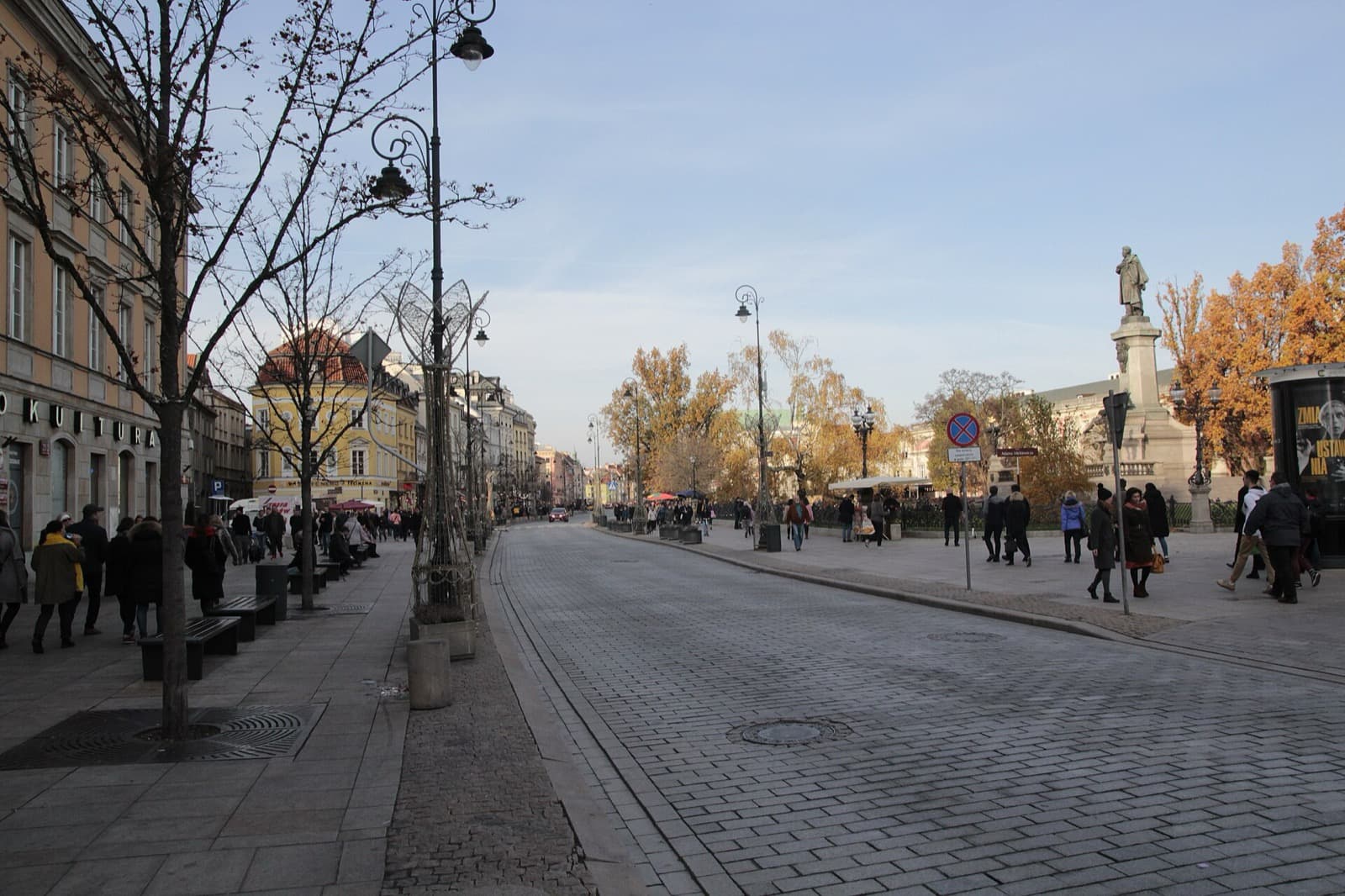
Royal Route: From the Castle to the King's Garden
120 min · 4.6 km · moderate
More from Warsaw
Explore more at your own pace.
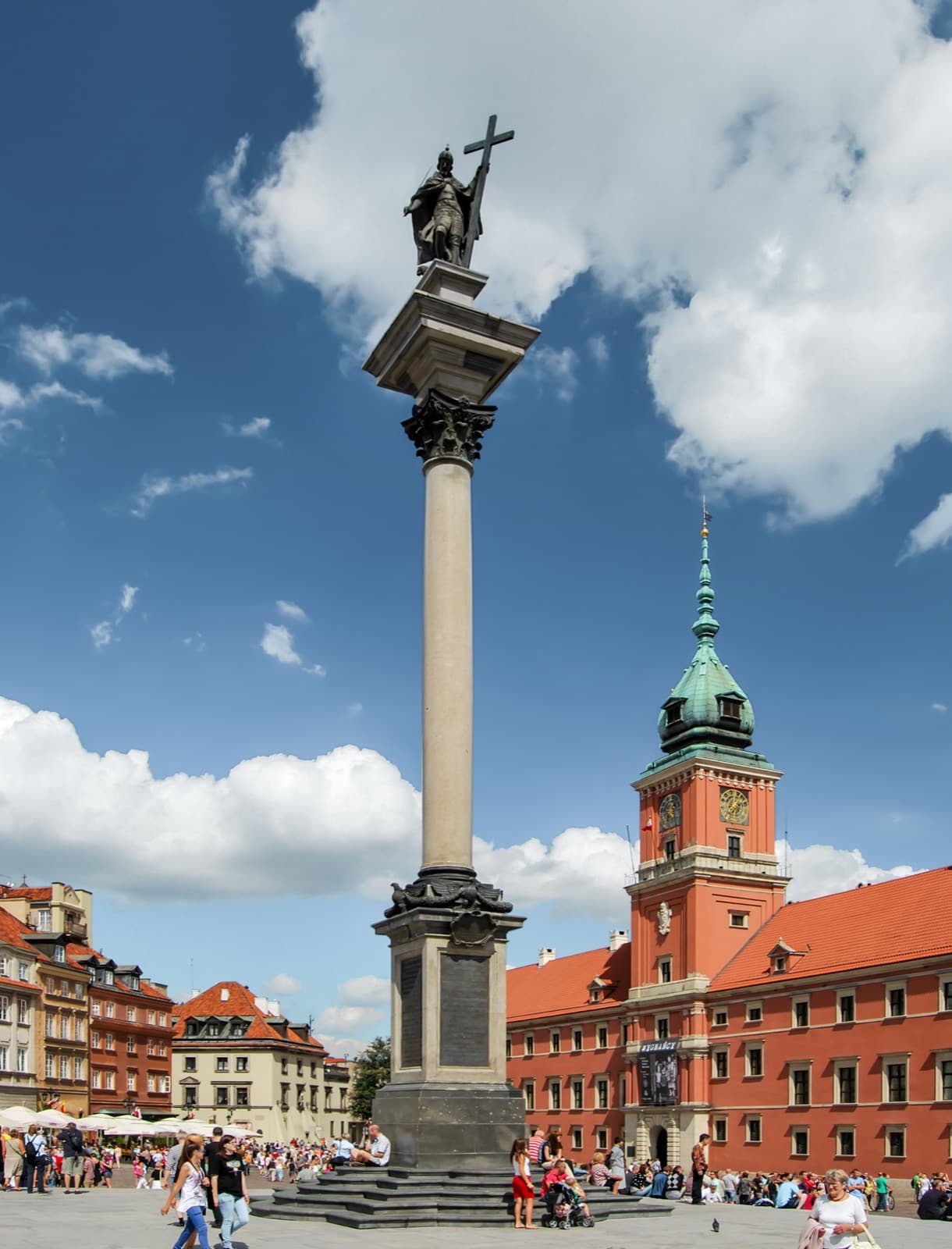
One Day in Warsaw: A Walkable Itinerary from the Old Town to Łazienki
Warsaw Travel Guide: Days, Transport, Cost, and Safety
Warsaw Rebuilt: Reading a Reconstructed Capital on Foot
The Royal Castle That Poland Rebuilt From Rubble
Holy Cross Church and Chopin's Heart on Warsaw's Royal Route