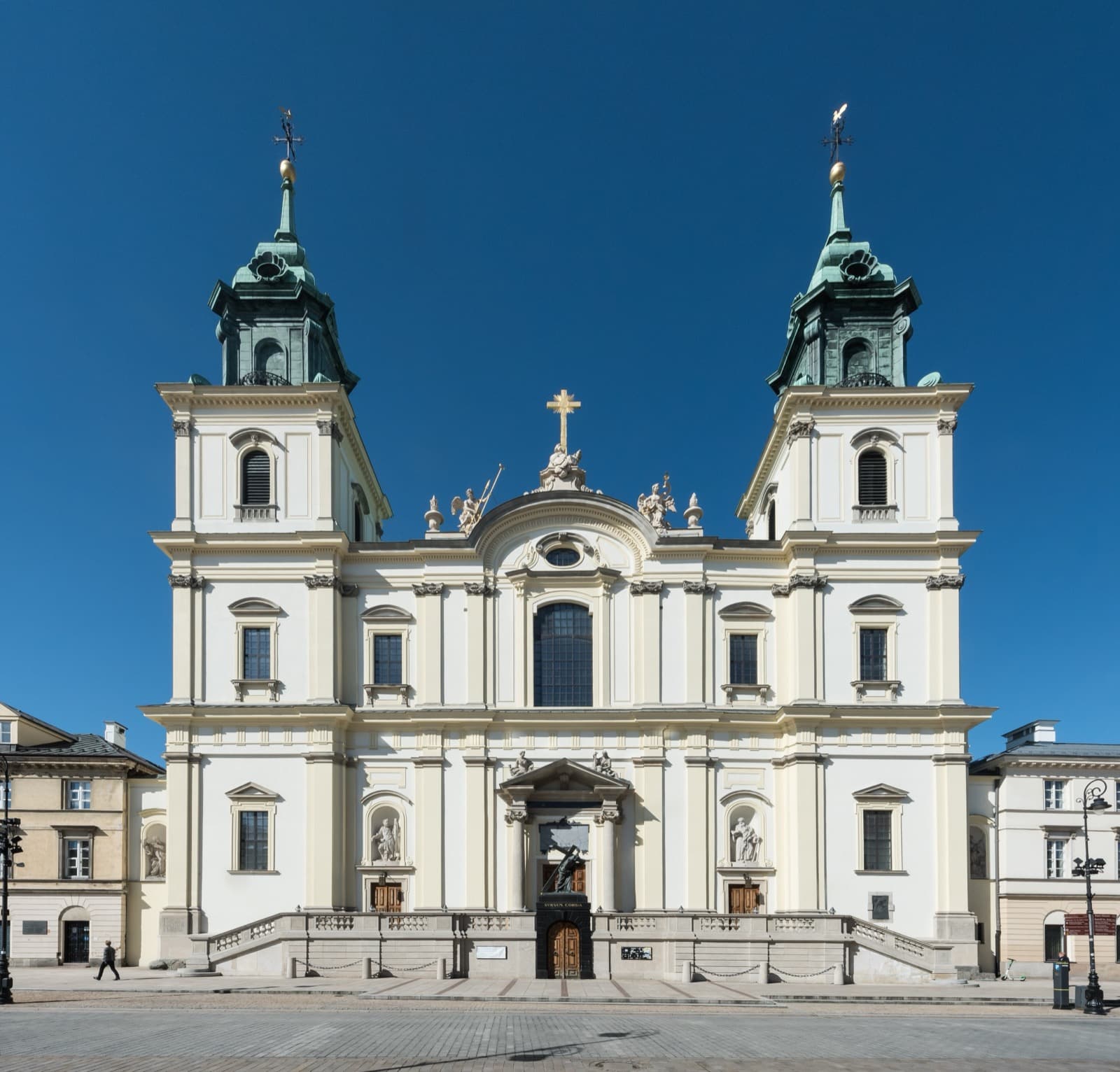
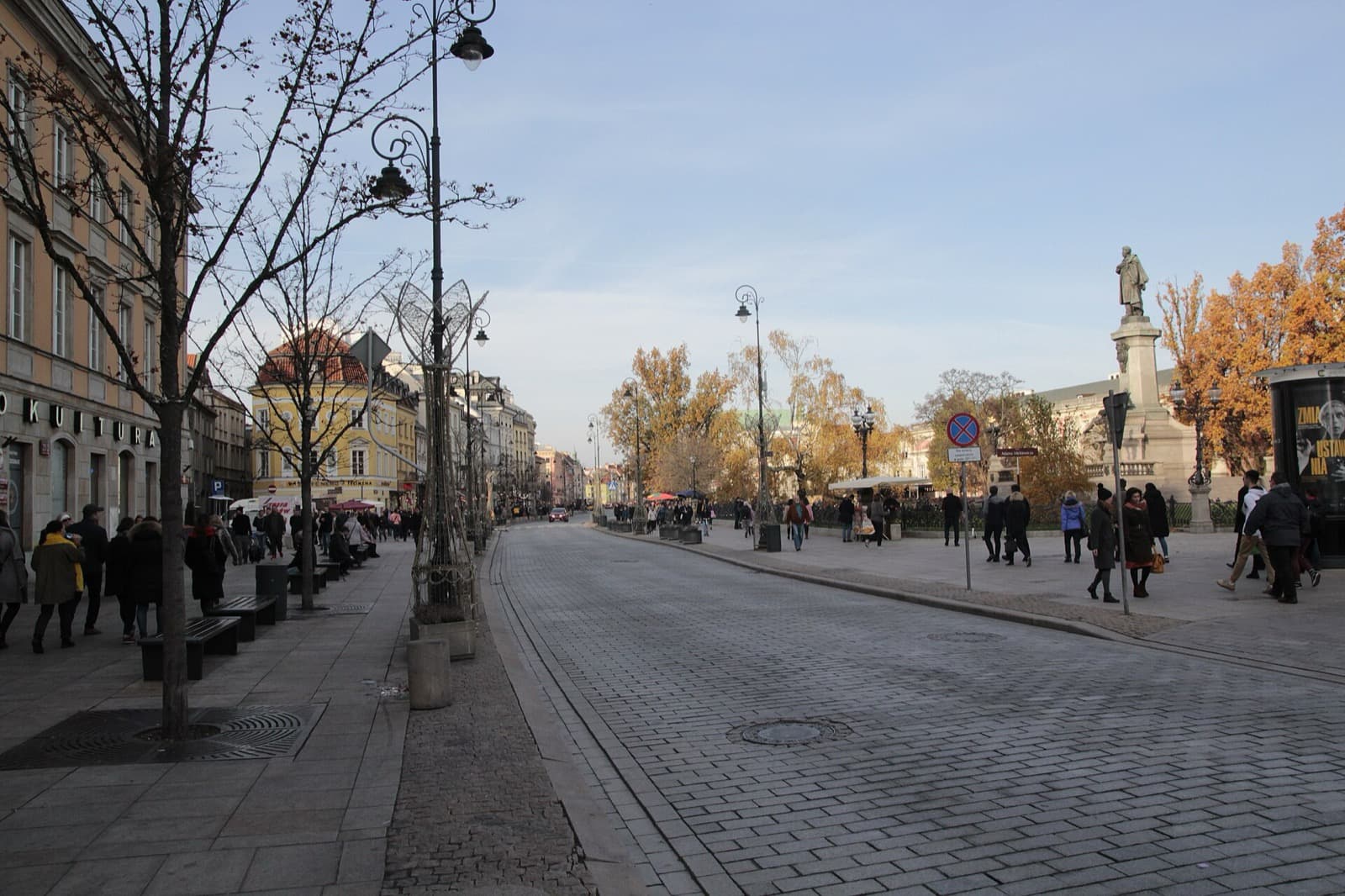
Holy Cross Church and the University of Warsaw gate mark the midpoint of Warsaw's Royal Route, and between them they explain the whole rebuilt capital: a pillar inside the church holds the rescued heart of Frederic Chopin, while the two-hundred-year-old university across the street holds the continuity of Polish learning. Both were nearly destroyed, and both were carried through and restored on purpose. The church sits at number three Krakowskie Przedmiescie, and directly opposite, the main gate of the University of Warsaw opens at numbers twenty-six to twenty-eight. Stand between them and you are standing where the boulevard's apparent permanence shows itself for what it is: a chosen reconstruction, not untouched history.
The church that holds a heart
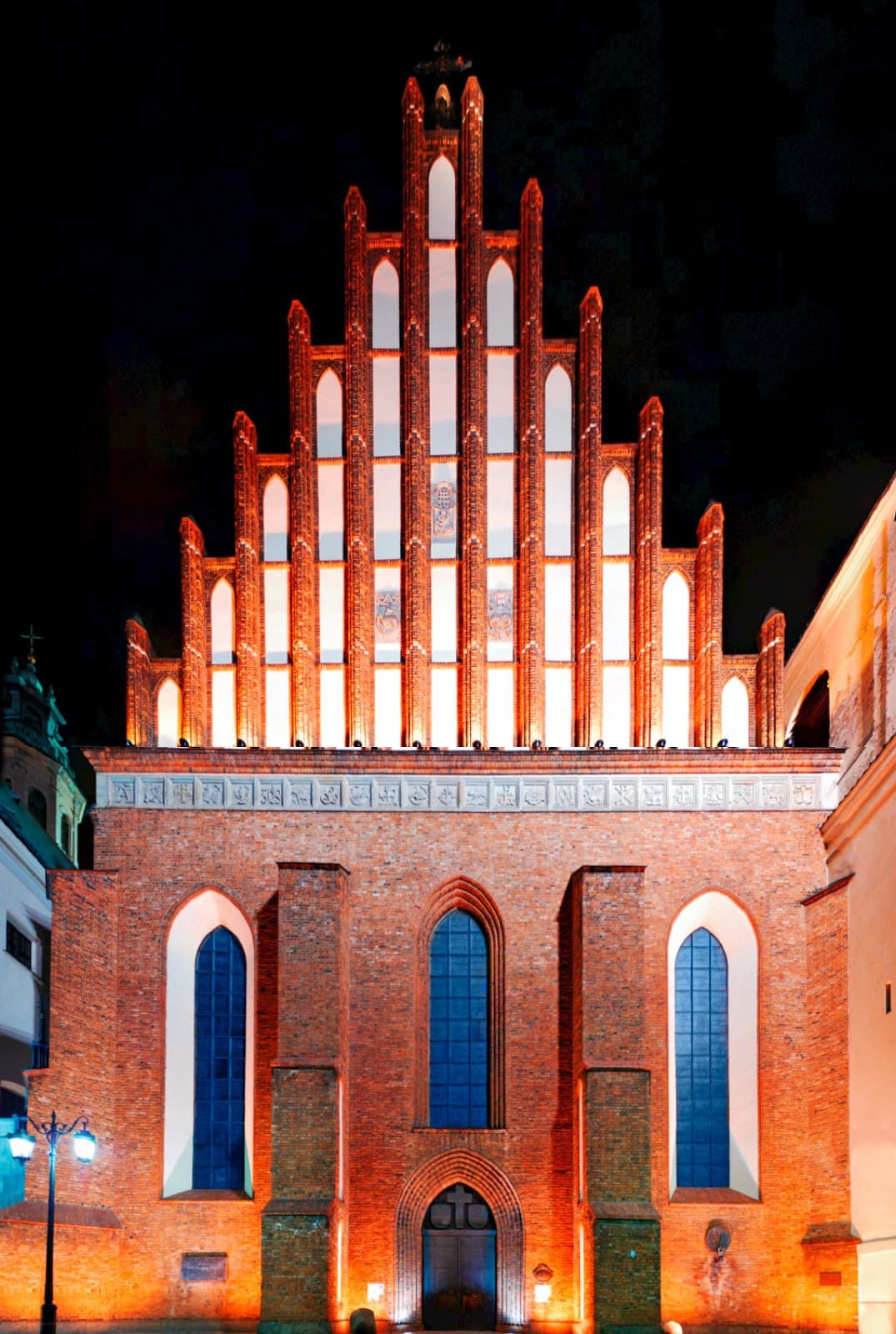
Holy Cross Church was built between sixteen seventy-nine and sixteen ninety-six by Jozef Szymon Bellotti, the royal architect, and it remains one of Warsaw's principal baroque churches. But its fame does not rest on its architecture. It rests on a single pillar in the nave.
Frederic Chopin was born near Warsaw in eighteen ten and died in Paris in eighteen forty-nine. He left the city of his birth as a young man and never returned, yet he asked that his heart come home. After his death, his sister carried the heart back to Warsaw, and in time it was immured in a pillar of Holy Cross Church. A plaque was set into the pillar carrying a line from the Gospel of Matthew: "For where your treasure is, there your heart will be also." It is one of the most quietly moving objects in the city, and most visitors walk past the door without knowing it is there. The heart of the novelist Wladyslaw Reymont was later placed nearby in a similar way.
The heart's story did not end in the nineteenth century. During the Warsaw Uprising of nineteen forty-four, the church became a target. On the sixth of September nineteen forty-four the Germans detonated two Goliath tracked mines inside it, destroying the facade, the vaulting, the high altar and much of the baroque interior. The church was blown up again in January nineteen forty-five and then rebuilt across the years that followed.
Chopin's heart survived the war because it had already been carried out of the church during the fighting and hidden for safekeeping. A widely repeated wartime tale credits the SS officer Heinz Reinefarth with taking the relic and passing it to the SS commander Erich von dem Bach-Zelewski, but the Museum of the Warsaw Uprising treats that account as postwar Nazi self-rehabilitation rather than fact. What is documented is the ending: the heart was kept safe outside the city and, on the seventeenth of October nineteen forty-five, the ninety-sixth anniversary of the composer's death, it was ceremoniously returned to Warsaw and restored to the rebuilt church.
That sequence tells you why this stop matters more than any single facade. The church you enter today is a reconstruction, blown up in the war and rebuilt over the following years. But the intention it holds, a composer's wish to lie in the city he loved, is genuine and old, and it was carried through the destruction intact. You are looking at a rebuilt shell around a surviving heart. That is Warsaw in one image.
The gate across the street
Hear a stop from this walk
Lazienki Park: The Last King's Water Palace
Turn from the church and you face the University of Warsaw. Its main gate opens onto the boulevard, and behind it the campus spreads back through more than a hundred buildings. The university was founded on the nineteenth of November eighteen sixteen, during the years of Russian rule over the city, and it grew into the largest institution of higher learning in Poland.
The date is worth holding. This was a Polish university established under a foreign empire, a deliberate assertion of intellectual life at a moment when Polish statehood had been erased from the map. Over the two centuries that followed, the institution was closed and reopened, suppressed and revived, in rhythm with the fortunes of the nation around it. That it stands and functions today, directly across a single street from Chopin's heart, concentrates the character of this stretch of the Royal Route. The church holds the memory of a composer; the gate holds the continuity of Polish learning. Both were nearly extinguished, and both endured.
The one thing to understand here
If you take a single idea from this stop, let it be this: what looks permanent on Krakowskie Przedmiescie is the product of will, not luck. Chopin's heart did not survive because the church was spared. The church was destroyed. The heart survived because people decided it must, carried it out, protected it through an occupation, and brought it back. The university did not persist because the times were kind. The times were often brutal. It persisted because generations of Poles insisted on it.
The baroque nave, the neoclassical grandeur of the boulevard, the calm of the university courtyard, all of it reads as continuous and untouched. Almost none of it is. This is the deeper argument the Royal Route makes at its midpoint. You are not walking through a preserved past. You are walking through a chosen one, restored on purpose by a city that refused to let its destruction be the final word.
Step inside the church if you wish and find the pillar in the nave, or simply stand a while at the door and look across at the gate. There is no group here to move you along and no schedule to keep. The pillar with Chopin's heart waits at whatever pace you choose to meet it, and the university gate has stood on that spot, in one form or another, for more than two hundred years.
Walk the whole route
Holy Cross Church and the university gate sit at the exact middle of Warsaw's ceremonial spine, the third of seven stops on a road the kings once travelled south from their castle toward their summer garden at Lazienki. To reach this point on foot is to have already passed the boulevard's grand opening and the Presidential Palace, where the Warsaw Pact was signed in nineteen fifty-five and the Round Table talks that helped end communism were later held. Ahead lie the Copernicus Monument, the fashionable Nowy Swiat, the avenue of embassies, and finally the last king's water palace on its lake.
Roamer's self-guided audio tour, "Royal Route: From the Castle to the King's Garden," lets you read this church and this gate at your own pace, then carries the same thread of destruction and rebuilding all the way to the park. For more of the city, browse the full set of Warsaw walking tours or start planning from the Warsaw city page. The heart in the pillar is only the middle of the story.
Sources
- Roamer tour "Royal Route: From the Castle to the King's Garden" (warsaw-royal-route), fact-audited stop transcript for Holy Cross Church and the University of Warsaw.
- Wikipedia, "Holy Cross Church, Warsaw": construction dates (1679 to 1696), architect Jozef Szymon Bellotti, and the destruction of the church by two Goliath tracked mines on 6 September 1944.
- Wikipedia, "Heart of Frederic Chopin": the immurement of the heart in a pillar, the Gospel of Matthew inscription, and the return of the heart to Warsaw on 17 October 1945, the 96th anniversary of Chopin's death.
- Museum of the Warsaw Uprising (1944.pl), "On a mission to save Chopin's Heart in 1944": the removal of the heart during the Uprising and its safekeeping, and the assessment that the Reinefarth account of taking the heart is postwar Nazi propaganda rather than fact.
- Wikipedia, "University of Warsaw": founding on 19 November 1816, its 126 buildings, and its standing as the largest institution of higher learning in Poland.
Ready to experience it?
Royal Route: From the Castle to the King's Garden
120 min · 4.6 km · moderate
More from Warsaw
Explore more at your own pace.
One Day in Warsaw: A Walkable Itinerary from the Old Town to Łazienki
Warsaw Travel Guide: Days, Transport, Cost, and Safety
Warsaw Rebuilt: Reading a Reconstructed Capital on Foot
The Chopin Monument in Lazienki Park: Where Warsaw's Royal Route Ends
The Royal Castle That Poland Rebuilt From Rubble