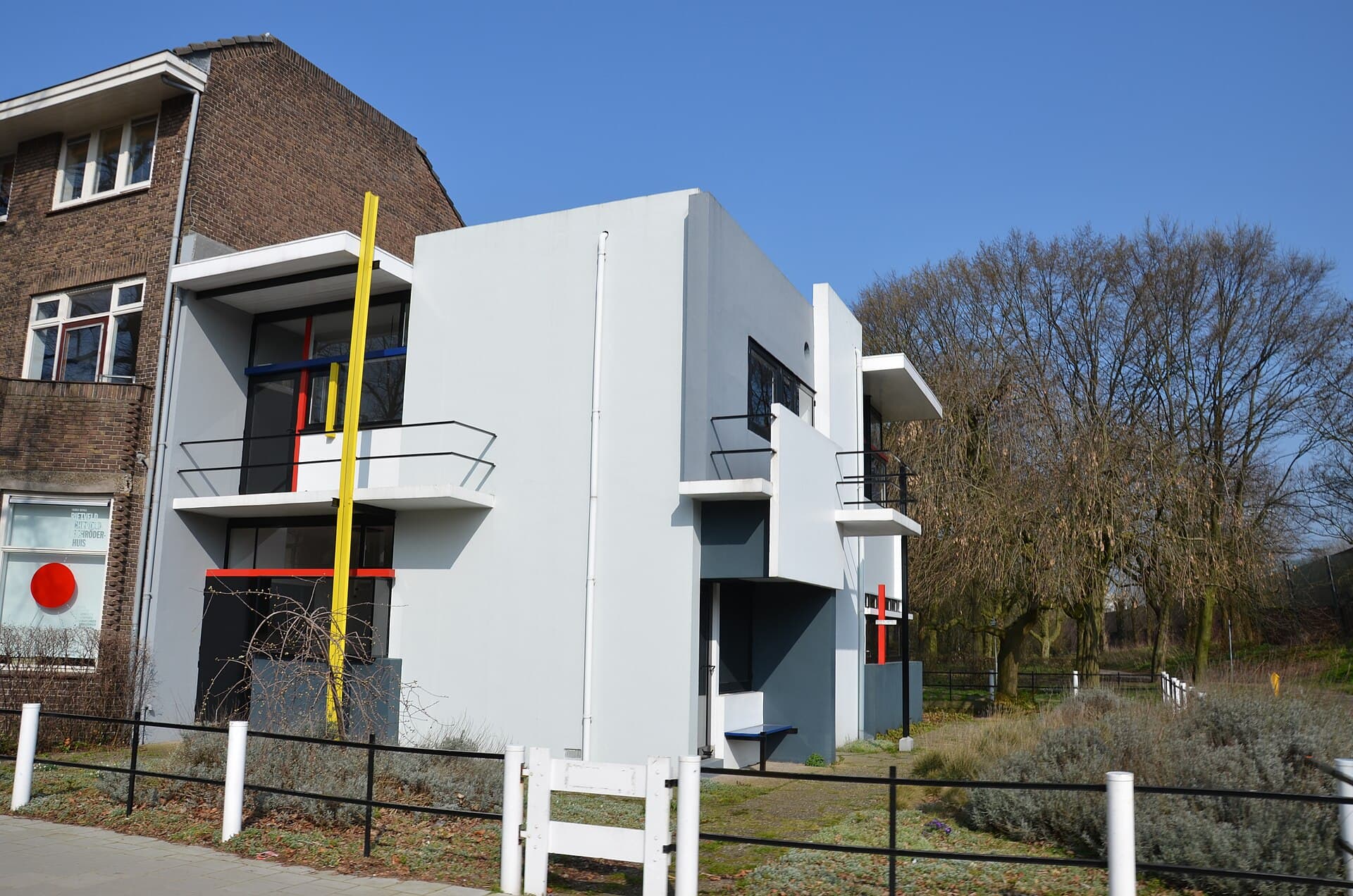
The Rietveld Schröder House is a small white house on the eastern edge of Utrecht that took the severe rules of a Dutch design movement called De Stijl and turned them into a building you can stand inside. Gerrit Rietveld designed it in 1924 with and for Truus Schröder-Schräder, and it is the point the whole design walk through Utrecht is quietly arguing toward. Understand this one house, and you understand why a city that looks medieval belongs in any conversation about modern design.
A house built from separate planes
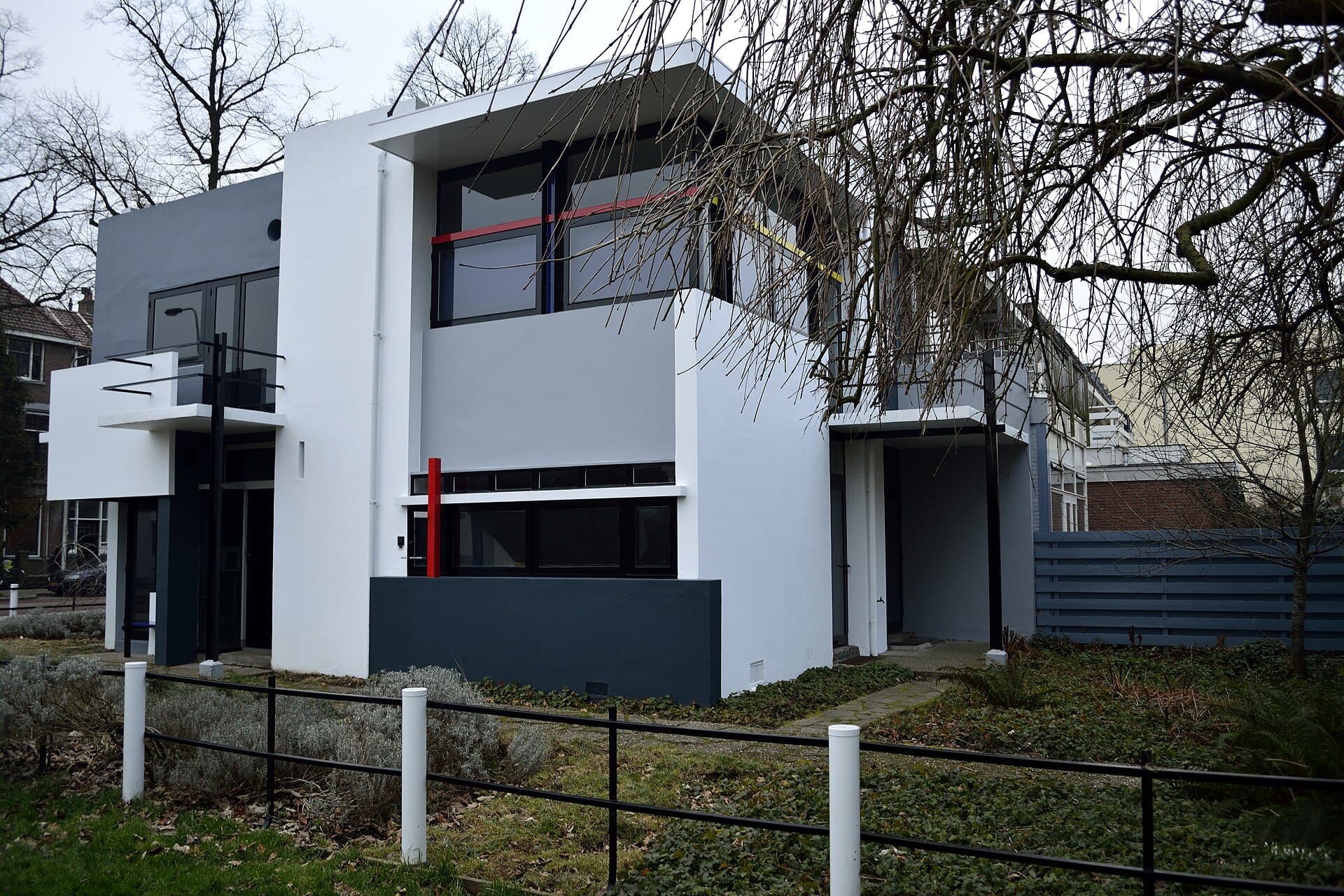
Look at the outside first, because the outside is the lesson. Most houses read as a box with windows cut into flat walls. This one refuses that. The facade is a composition of separate planes and lines, each element given its own form, its own position, and often its own colour, with accents in primary red, yellow, and blue. A beam floats past a window. A grey panel slides in front of a white one. Nothing pretends to be a single solid mass. It is one of the best-known examples of De Stijl architecture, and it is often called, arguably, the only true De Stijl building anywhere on earth.
The genius, though, is upstairs, and it is the part you cannot photograph from the street. The entire top floor, apart from the toilet and bathroom, is a single open space. A system of sliding and revolving panels lets that space transform: open it wide into one room, or divide it into three separate bedrooms as the day requires. Walls that come and go. Schröder asked Rietveld for a house preferably without walls, and this was his answer. She lived here until her death in 1985, more than sixty years in a house that keeps rearranging itself around whoever is inside. In the year 2000 it was inscribed as a UNESCO World Heritage Site, described as an icon of the Modern Movement in architecture. It has been a listed monument since 1976.
Why the walk starts far away from it
Hear a stop from this walk
Rietveld Schröderhuis: the manifesto you can stand inside
The Utrecht design walk does not drop you at the front door. It begins nearly five kilometres away, in the medieval centre, and that distance is the point. The first stop is the Centraal Museum, founded in 1838 and recognised as the oldest municipal museum in the Netherlands. Careful phrasing there: the oldest run by a city, not the oldest museum overall. Inside its former monastery walls sit around sixty thousand objects, and two of the collections are the reason for the whole day. One is the largest holding of Gerrit Rietveld anywhere in the world. The other is the work of Dick Bruna, the Utrecht illustrator who drew a small rabbit. The same institution that keeps the chair also runs the house at the far end of the walk.
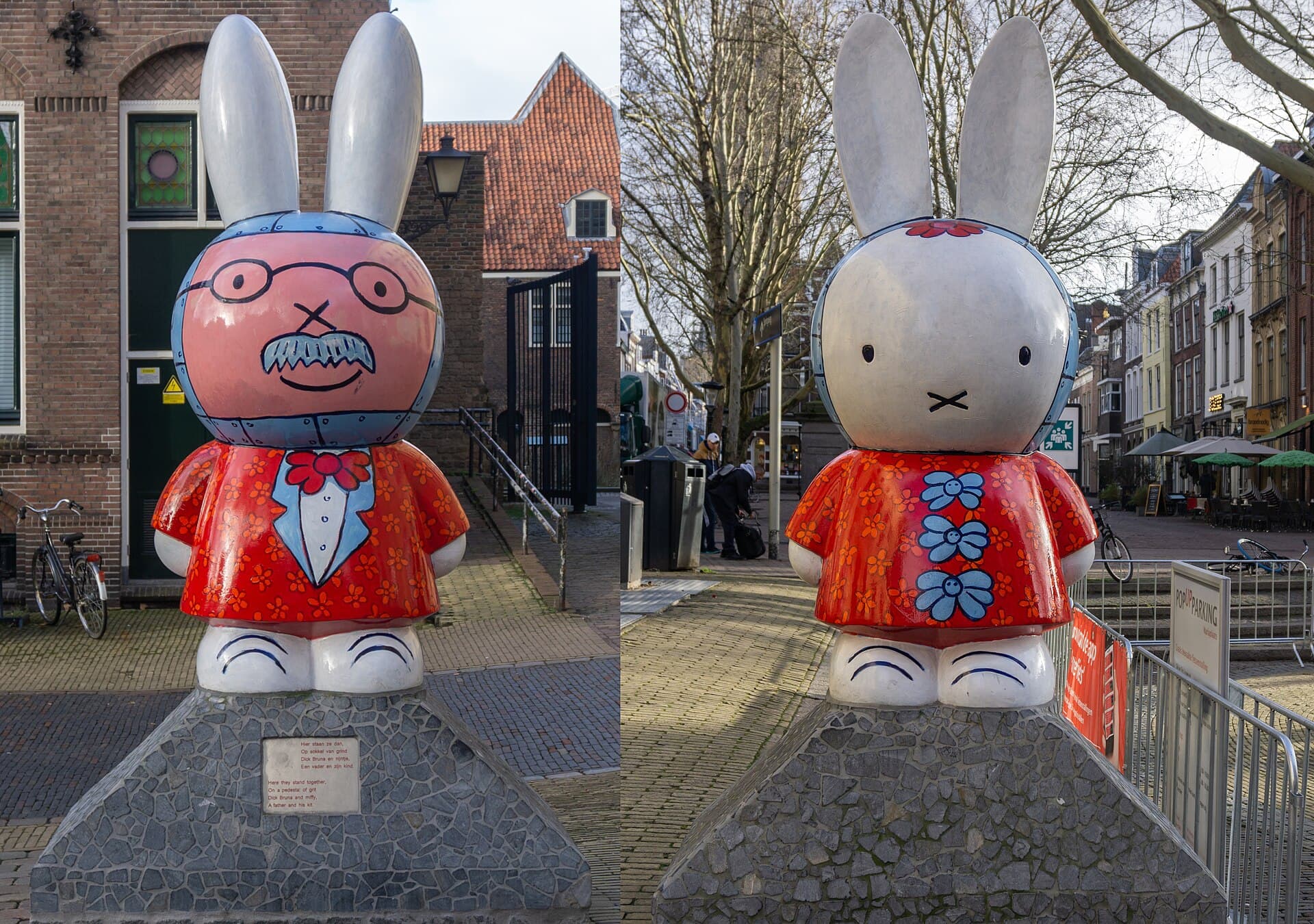
Then comes the little rabbit. On a square near the canal stands a dark bronze figure that children greet like a friend: the nijntje pleintje. Nijntje comes from clipping the front off the Dutch word konijntje, little rabbit, and most of the world knows her as Miffy. Bruna created her in 1955, out of bedtime stories he told his young son, and the statue on the square was sculpted by the illustrator's own son, Marc Bruna. She belongs on this particular route not because she is famous, but because of the method behind her. Bruna reduced a whole visual language to a few clean lines and a handful of flat, primary colours. No shading, no clutter, just the essential shape. That instinct, stripping a thing back to its purest form, is the graphic cousin of the idea the house makes solid.
The idea, held as a chair
Before the walk carries you east, it pauses in the old centre for the idea itself. In 1917 a group of Dutch artists and architects launched a movement they called De Stijl, which simply means the style. The rules were strict: only the primary colours red, yellow, and blue, plus black, white, and grey; only straight lines, horizontal and vertical, never a curve; only rectangles; pure abstraction, nothing that pictures the real world. Honesty matters here, and the tour is honest about it. De Stijl was not founded in Utrecht. Its figures worked in places such as Leiden, where the movement's journal was published. Utrecht's claim rests on one man, Gerrit Rietveld, the furniture-maker turned architect who gave the movement the clearest form you can actually hold.
That form is the Red and Blue Chair, which Rietveld designed around 1918. The surprise is that it began as plain, unstained beech wood. It was not painted red, blue, yellow, and black until around 1923, when the artist Bart van der Leck suggested the colours. It is called one of the first explorations of De Stijl in three dimensions, a whole philosophy of design compressed into a chair. Once you have held the theory in something that small, the house at the end stops being strange and starts being inevitable.
Walking the argument east
The long leg east, roughly three kilometres from the centre toward the Wilhelminapark and a street called Prins Hendriklaan, is the walk's whole argument put into your own footsteps. The tight medieval canals and lanes loosen. The buildings step back. The city opens toward its greener nineteenth-century edge. When Rietveld built the house in 1924 it stood on the very outskirts, at the end of a terrace, looking out over open polder, the flat reclaimed farmland. According to the house's own custodians, that view mattered so much to Truus Schröder that when the land opposite was released for building in the early 1930s, she bought it herself to protect what she saw from her window. The open polder is gone now. A motorway built in the 1960s runs where the outlook once was, and the house faces it today.
Do the museum first, then walk. Standing at the house after seeing Rietveld's chair and collection lets the whole idea click into place. Book the house ahead: a timed reservation is always required for the small interior, and the Dutch Museumkaart covers both the Centraal Museum and the house at no extra charge.
The walk closes by widening the portrait. In 2017 Utrecht was named a UNESCO City of Literature, the first Dutch city to hold that title, a creative honour separate from and complementary to the design heritage. A skyline that says the Middle Ages, an authorship of two landmarks of radically modern reduction, and a city of letters besides. To plan the full route, see Utrecht walking tours, and to place it in the wider city visit Utrecht.
Sources
- UNESCO World Heritage Centre, listing for the Rietveld Schröderhuis (inscription 2000): the primary record for the World Heritage designation and its description as an icon of the Modern Movement.
- Centraal Museum, official visitor pages: founding date, collection scope, and the museum's stewardship of both the Rietveld and Bruna collections and the house itself.
- Wikipedia, "Rietveld Schröder House" and "Red and Blue Chair": construction history, Truus Schröder's brief, the reconfigurable upper floor, and the chair's beech-to-colour timeline.
- Wikipedia, "De Stijl" and "Dick Bruna": the movement's 1917 founding and rules, and the 1955 creation of nijntje.
Ready to experience it?
Rietveld Schröderhuis and Miffy: From De Stijl to a Little White Rabbit
145 min · 5 km · moderate
More from Utrecht
Explore more at your own pace.
One Day in Utrecht: A Walkable Morning-to-Evening Itinerary
Utrecht: The City That Keeps Its Story Below the Surface
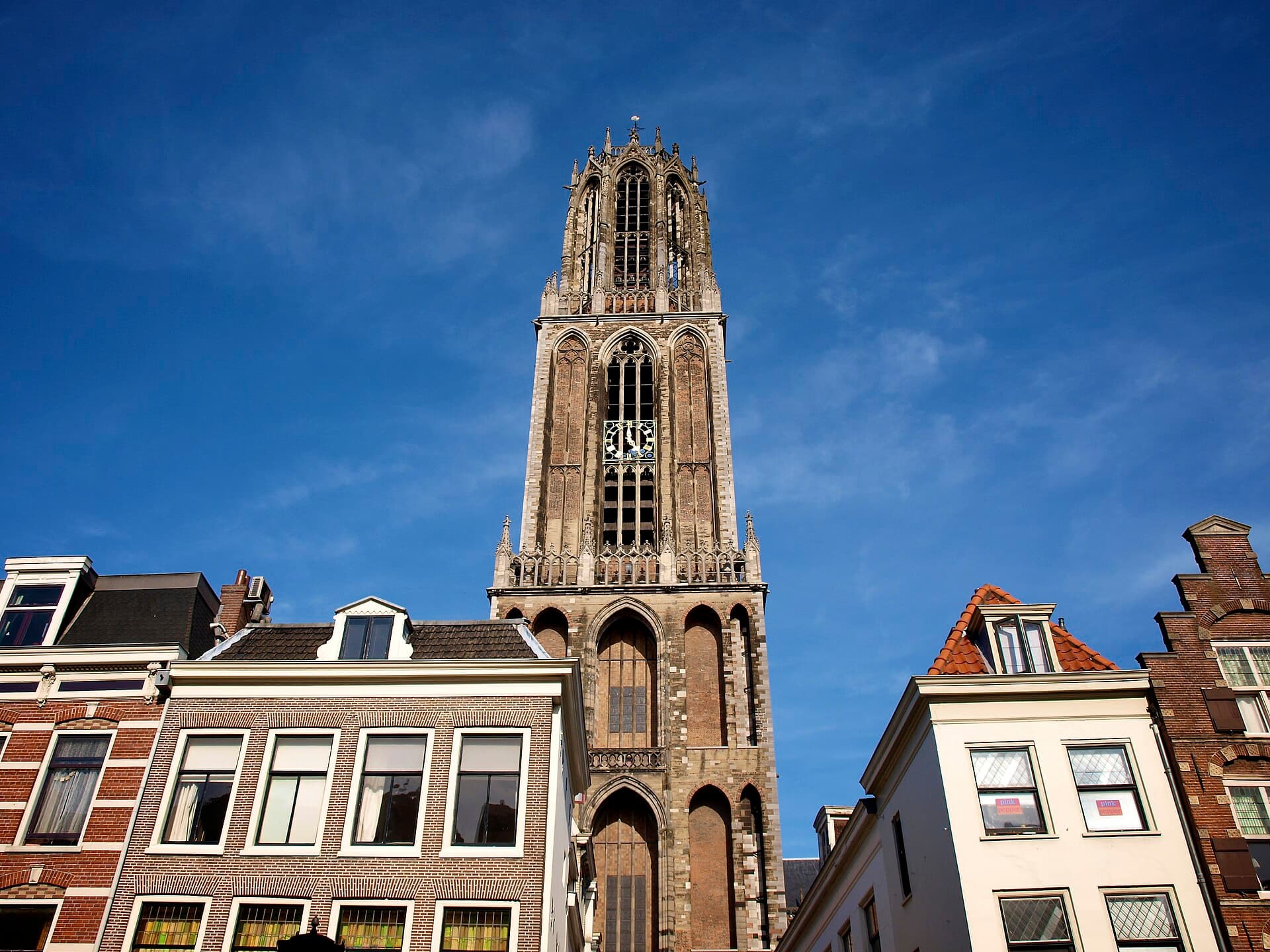
The Dom Church of Utrecht and the Storm That Split It From Its Tower
Nijntje Pleintje: Utrecht's Little Bronze Rabbit and the Man Who Drew Her
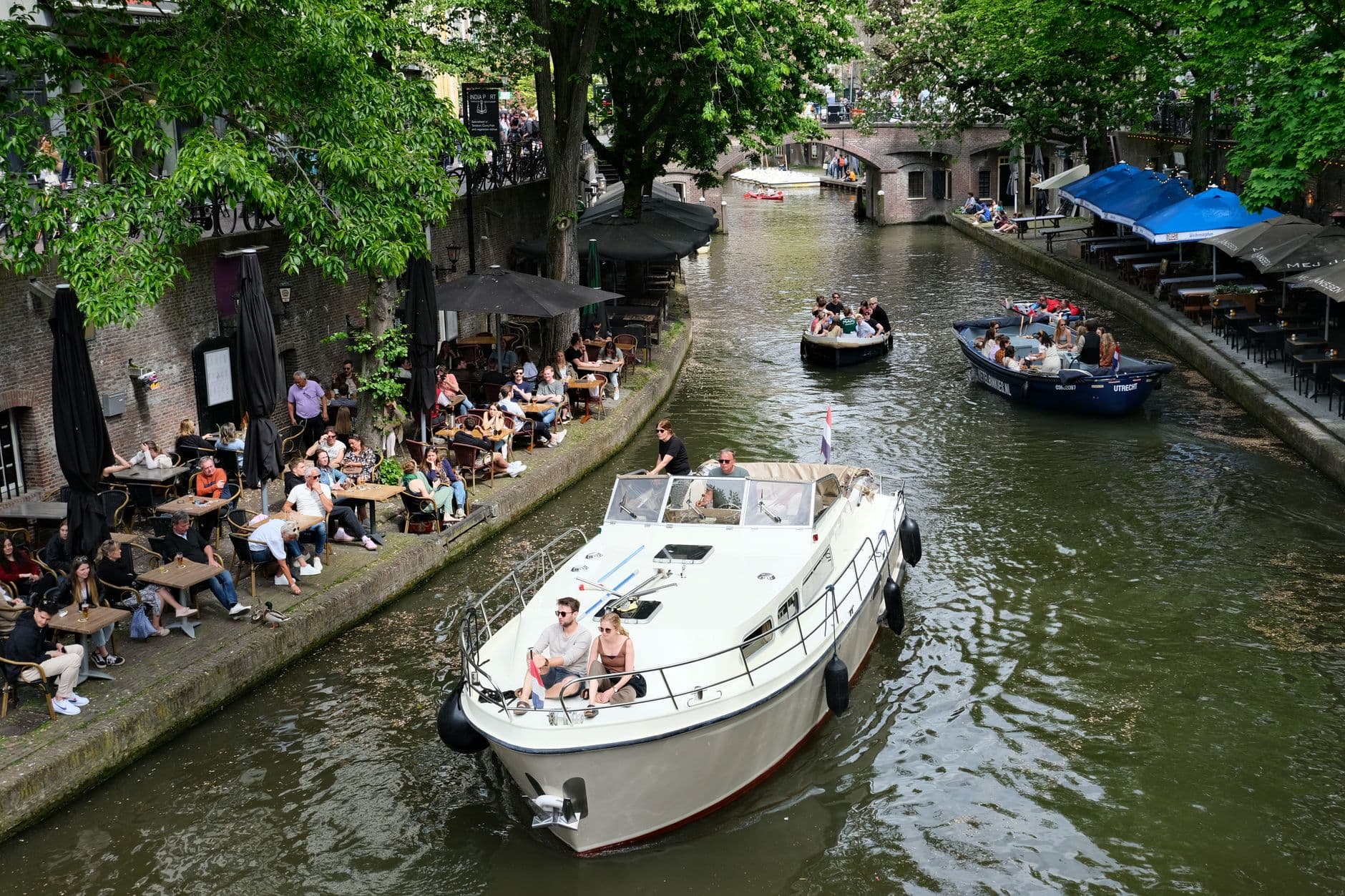
The Oudegracht: Why Utrecht's Canal Runs Below the Street