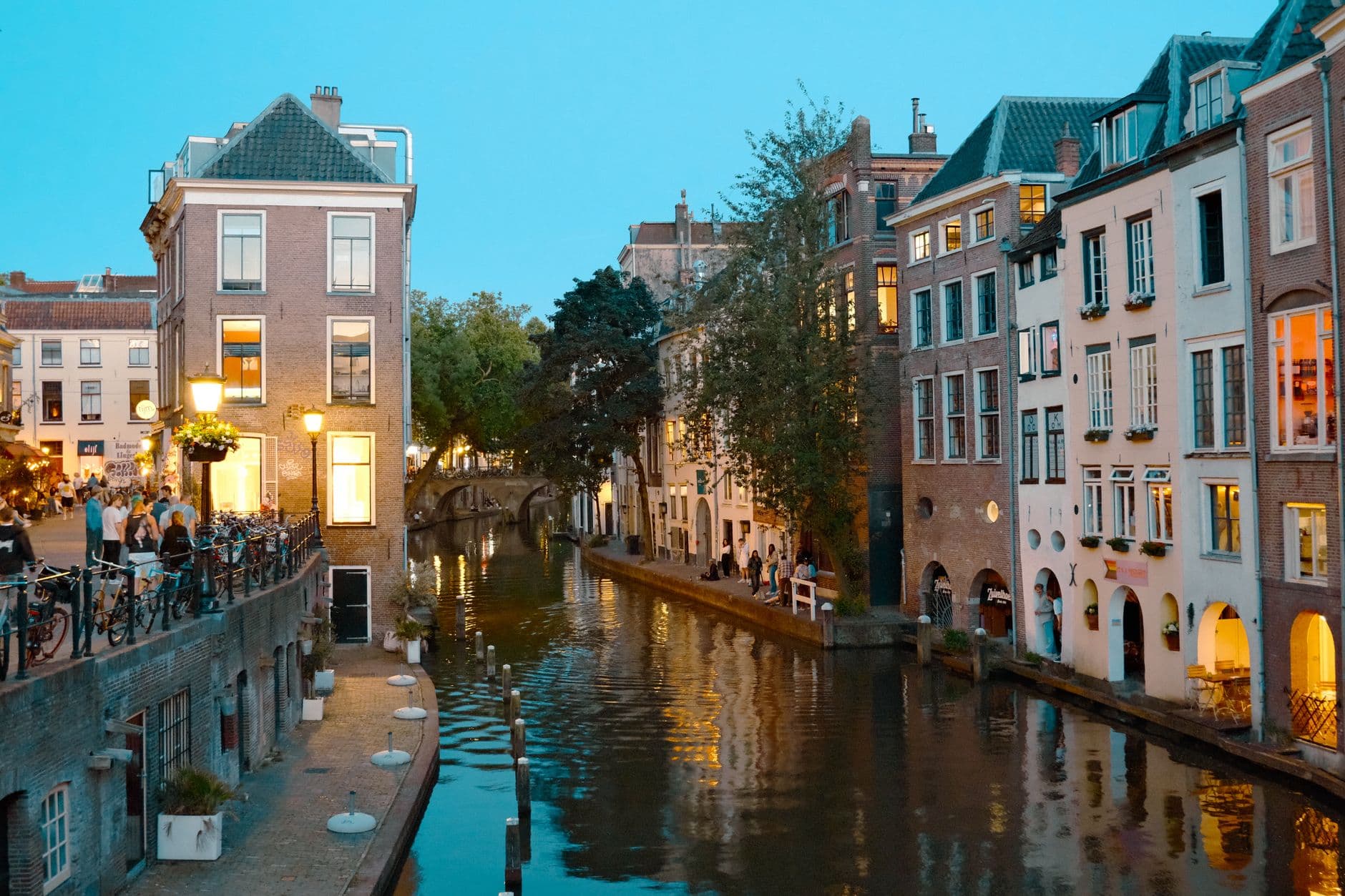
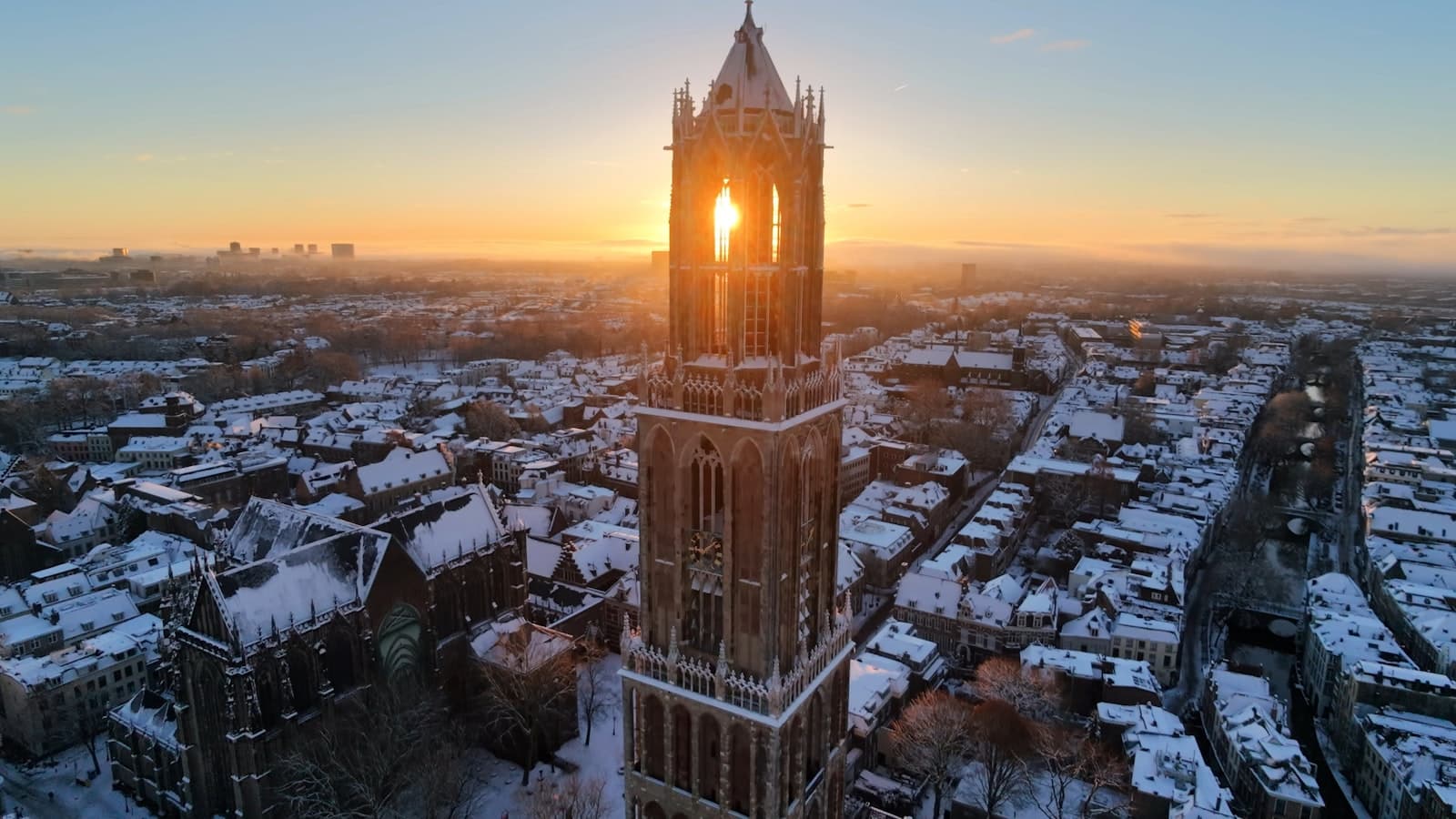
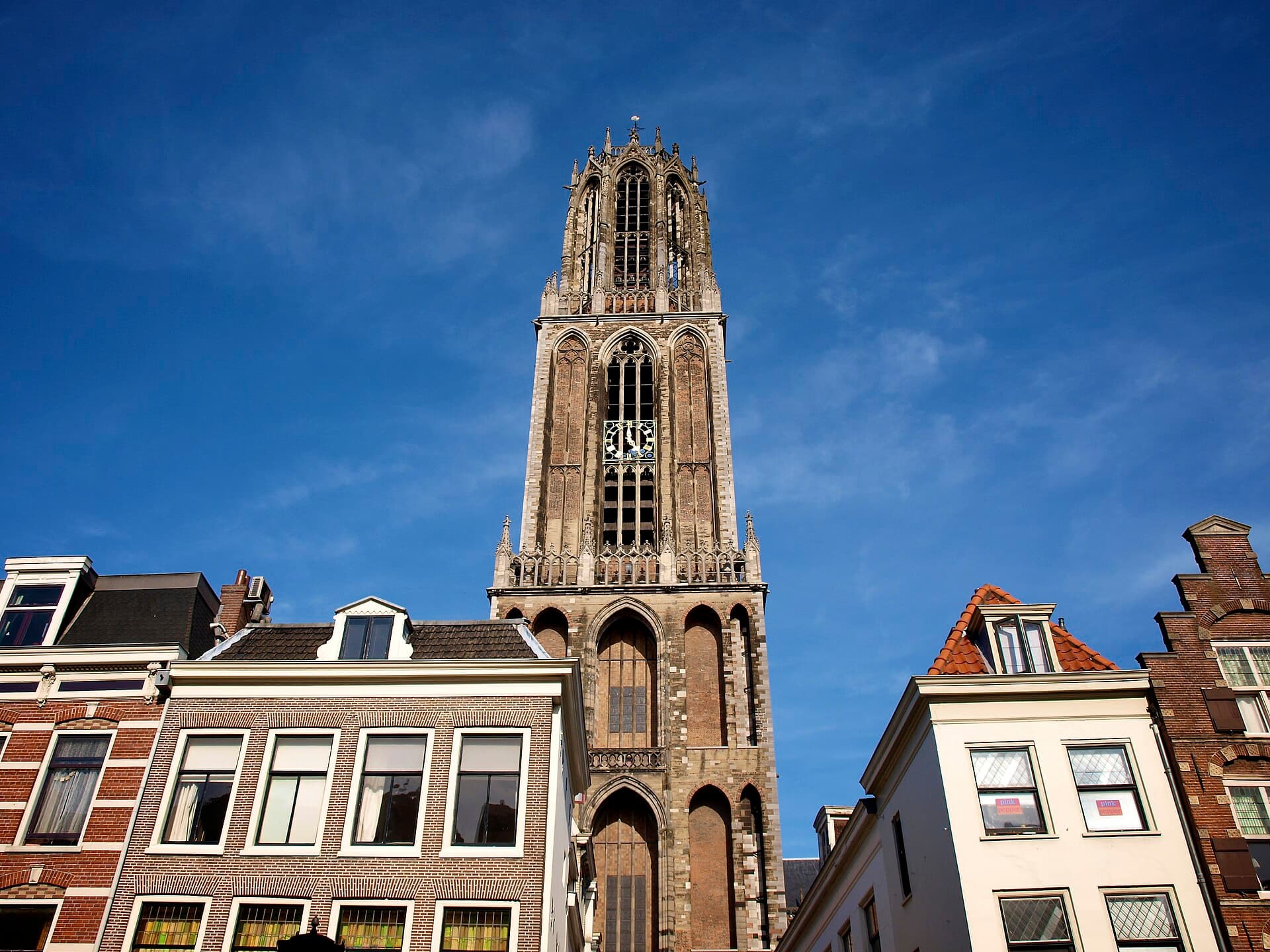
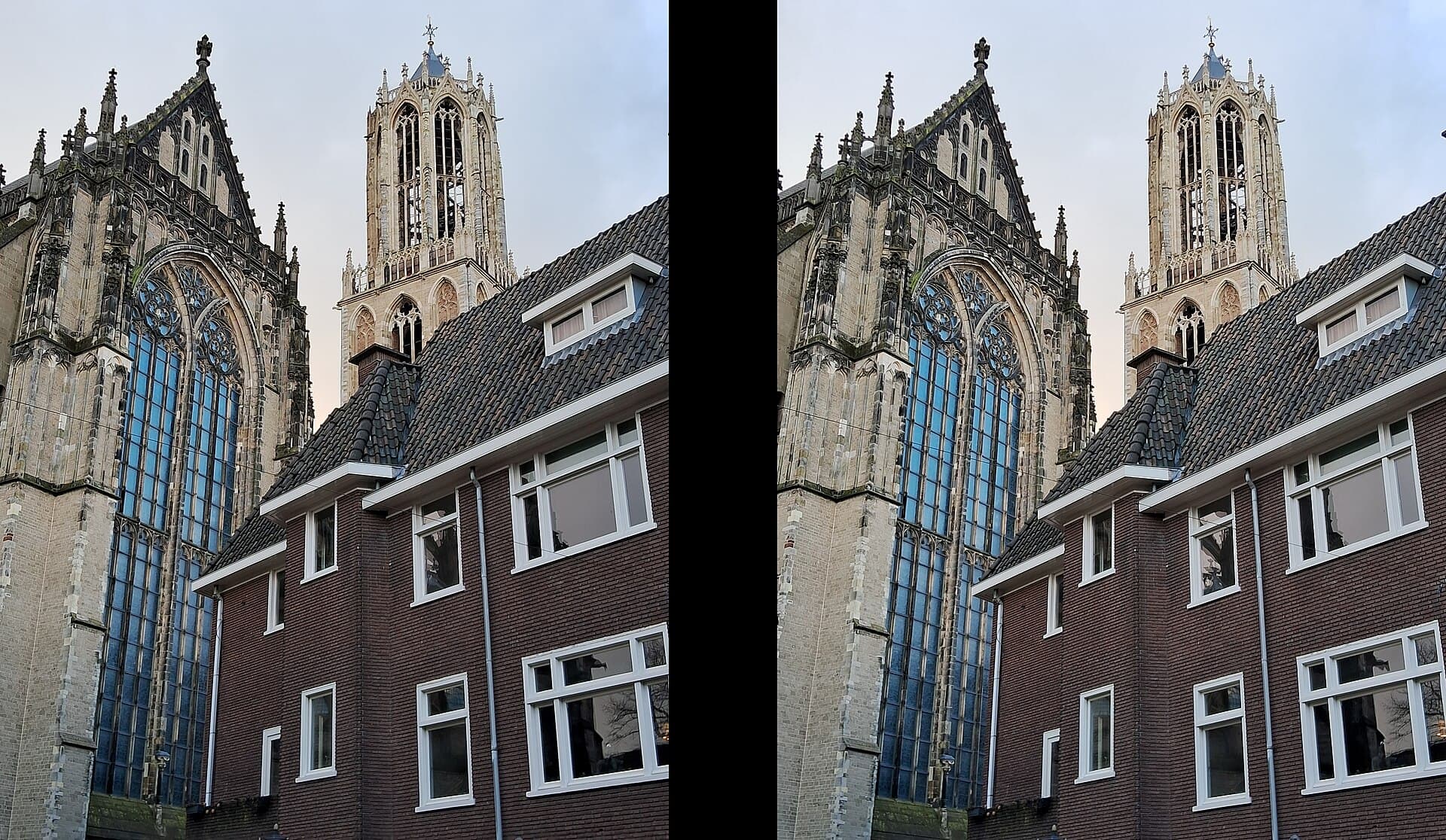
Utrecht's Dom Tower rises 112 metres of Gothic stone as the tallest church tower in the Netherlands, and it stands freestanding, joined to no church, because a violent storm on the first of August in the year sixteen seventy-four tore out the nave that once connected it to the cathedral behind. Almost every great medieval bell tower grows out of a building. This one grows out of open air. Understanding why the tower stands alone is the whole point of stopping in front of it, and it is a shorter, stranger story than the height alone suggests.
A tower built to crown a cathedral
The Domtoren was built over roughly six decades, from about the year thirteen twenty-one to thirteen eighty-two, to the design of an architect recorded as John of Hainaut. It was meant to crown the cathedral of Saint Martin, the seat of the medieval bishopric and the ecclesiastical center of the Low Countries. That intent is still legible in the stone. Everything about the tower's proportions, its buttressing, the way its lower stages are shaped, says it was designed to anchor a great church, to rise out of a nave and choir as the tallest element of a single connected silhouette.
For centuries the tower has served as the hallmark of the city. On the flat land of the central Netherlands, where the horizon is low and long, the tower is the shape travelers see from far out before Utrecht itself resolves into streets and roofs. It reaches 112 metres, and it has held its rank as the tallest church tower in the country. If you decide to climb it, the ascent is 465 steps, and on a clear day the reward at the top is a view that stretches as far as both Amsterdam and Rotterdam.
The gap where the church should be
Hear a stop from this walk
Pieterskerk and the church-cross
But the more revealing view is the one you already have from the ground, and it costs nothing. Stand on the Domplein, the open square, and look at how the tower meets the church across from it. It does not. There is air between them. The tower stands on one side of the square. The choir and transept of the Dom Church stand on the other. Where a long central hall, the nave, should join the two into one building, there is a public square instead.
A bell tower belongs to a church. It is part of the same structure, the same roofline. This tower rises out of nothing. That absence is not a design decision. It is the physical trace of a single day. On the first of August in the year sixteen seventy-four, a violent storm crossed the province of Utrecht. In Dutch it was remembered as Het Schrickelik Tempeest, the Terrible Tempest, and it killed more than a thousand people across the Netherlands. The cathedral's nave, still unfinished and poorly supported, collapsed. It was never rebuilt. Its footprint is the open Domplein you are standing in. The tower kept its footing. The middle did not.
What kind of storm, and why the nave was doomed
It is worth being precise about what happened, because historians are. Popular memory long called the storm a tornado, or a waterhoos, a waterspout. A modern reconstruction published in the Copernicus natural hazards journal argues instead that the damage most likely came from straight-line derecho winds, a violent, long-lived, wide-spreading windstorm, rather than from a single tornado. Scholars continue to debate tornado versus straight-line winds. What is not in dispute is that the nave was especially vulnerable. It lacked flying buttresses, and it carried its roof on a wooden structure rather than a stone vault. A great Gothic nave is normally held up by a system of stone thrust and counter-thrust. This one was not finished to that standard, and when the wind came, the unbraced middle of the cathedral was the part that gave way.
That is the paradox to hold in front of you. The most famous view in Utrecht, the tower framed across an empty square, exists only because the middle of the building is missing. The gap is not a plaza someone laid out for effect. It is a wound that was never healed, and the tower's isolation is the clearest evidence of it. The Dom Church that survives, the choir and transept, is the only pre-Reformation cathedral in the Netherlands, and it was once the largest church in the country. What you see across the square is the far end of a building whose long body no longer exists.
Standing in front of it
If there is one thing to understand while looking up at the Domtoren, it is this. You are not looking at a tower that was simply built tall and alone. You are looking at half of an intention. The tower was completed to join a cathedral, the cathedral was never finished to the strength it needed, and the storm of sixteen seventy-four settled the matter by removing the connection forever. The height is the headline. The empty air beside it is the actual history.
The tower's early weight in this place ran deep. The cathedral it was meant to crown drew the medieval bishops and even the Holy Roman emperors into its orbit. Conrad the Second died in Utrecht in the year one thousand thirty-nine, and Henry the Fifth in eleven twenty-five, and the heart and bowels of each were interred in the cathedral. This was a church of continental importance, and its tower was raised to say so. Then a single afternoon of wind rewrote the whole composition, and left the tallest church tower in the country standing on its own.
The Dom Tower is the second stop on Roamer's self-guided walk through Utrecht's cathedral hill, a level route of about seven stops just over one kilometre long. The tour drops first to the Roman fort beneath the square, then rises to the tower, crosses to the surviving church, and moves out through the quiet church quarter that closes back around the gap. To walk it at your own pace, browse the Utrecht walking tours or start from the Utrecht city page. Standing on the Domplein, with the tower on one side and the church on the other, the emptiness between them tells you more than any climb.
Sources
- Dom Tower of Utrecht, Wikipedia. Construction dates, height of 112 metres, architect John of Hainaut, 465 steps, freestanding condition.
- St. Martin's Cathedral, Utrecht, Wikipedia. The cathedral of Saint Martin, the lost nave, the only pre-Reformation cathedral in the Netherlands, and the imperial burials of Conrad the Second and Henry the Fifth.
- 1674 derecho, Wikipedia. The storm of the first of August sixteen seventy-four and the collapse of the cathedral's nave.
- Copernicus Natural Hazards and Earth System Sciences reconstruction of the 1674 Utrecht storm. The derecho versus tornado debate and the structural vulnerability of the unbuttressed, wood-roofed nave.
Ready to experience it?
Domtoren and Domplein: The Tower and the Church a Storm Took
85 min · 1.2 km · easy
More from Utrecht
Explore more at your own pace.
One Day in Utrecht: A Walkable Morning-to-Evening Itinerary
Utrecht: The City That Keeps Its Story Below the Surface
The Dom Church of Utrecht and the Storm That Split It From Its Tower
The Rietveld Schröder House: Utrecht's Manifesto You Can Stand Inside
Nijntje Pleintje: Utrecht's Little Bronze Rabbit and the Man Who Drew Her